Page 197 of 678

What To Do
Properly close the door(s).
Hood Open Warning Light
•What Does It Mean
The light will illuminate when the engine
hood is not completely closed. With the
hood open and the vehicle in motion, a
chime will sound.
•What To Do
Properly close the hood.
Liftgate Open Warning Light
•What Does It Mean
This light will illuminate when the liftgate
is open. With the tailgate open and the
vehicle in motion, a chime will sound.
•What To Do
Properly close the liftgate.
Electronic Throttle Control (ETC)
•What Does It Mean
The light will illuminate when the ignition is
first placed in the MAR/RUN or AVV/
START position and remain on briefly as a
bulb check. If the light does not come on during starting,
have the system checked by an authorized dealer.
If a problem is detected, the light will come on while
the engine is running. Bring the vehicle to a complete
stop and place it into PARK. Cycle the ignition to the
STOP/OFF position; the light should turn off.
If the light remains lit with the engine running, your
vehicle will usually be drivable. However, see an
authorized dealer for service as soon as possible.
If the light is flashing when the engine is running,
immediate service is required. You may experience
reduced performance, an elevated/rough idle or en-
gine stall, and your vehicle may require towing.
5
GETTING TO KNOW YOUR INSTRUMENT PANEL 195
Page 202 of 678
Transmission Over Temperature
•What Does It Mean
This light indicates that the automatic
transmission fluid temperature is running
hot. This may occur with heavy usage, such
as trailer towing.
•What To Do
Safely pull over and stop the vehicle. Shift the trans-
mission to PARK. Keep the engine off or at idle speed
until the light turns off.
Towing Hook Breakdown
•What Does It Mean
The light illuminates to indicate the failure
of the tow hook.
•What To Do
Please contact an authorized dealer.
Power Steering System Warning
•What Does It Mean
This light will illuminate to indicate a fail-
ure in the Electronic Power Steering System
(EPS). Although it will still be possible to
steer the car, additional effort may be needed to
operate the steering wheel.
•What To Do
Please contact an authorized dealer as soon as pos-
sible.
200 GETTING TO KNOW YOUR INSTRUMENT PANEL
Page 242 of 678

NOTE:TSC cannot stop all trailers from swaying. Al-
ways use caution when towing a trailer and follow the
trailer tongue weight recommendations. Refer to “Trailer
Towing” in this section for further information. When
TSC is functioning, the “ESC Activation/Malfunction
Indicator Light” will flash, the engine power may be
reduced and you may feel the brakes being applied to
individual wheels to attempt to stop the trailer from
swaying. TSC is disabled when the ESC system is in the
“Partial Off” mode.
WARNING!
If TSC activates while driving, slow the vehicle
down, stop at the nearest safe location, and adjust the
trailer load to eliminate trailer sway.
Ready Alert Braking (RAB)
Ready Alert Braking may reduce the time required to
reach full braking during emergency braking situations.
It anticipates when an emergency braking situation may
occur by monitoring how fast the throttle is released by
the driver. When the throttle is released very quickly,
Ready Alert Braking applies a small amount of brake
pressure. This brake pressure will not be noticed by the
driver. The brake system uses this brake pressure to allow
a fast brake response if the driver applies the brakes.
Dynamic Steering Torque (DST)
The DST function uses the integration of the ESC system
with the electric power steering to increase the safety
level of the whole car. In critical situations (understeer-
ing, oversteering, braking with different grip conditions),
through the DST function the ESC system controls the
steering to implement an additional torque contribution
240 SAFETY
Page 257 of 678
respective seat belts are buckled. The driver should
instruct all other occupants to buckle their seat belts. If an
outboard front seat belt is unbuckled while traveling at
speeds greater than 5 MPH (8 km/h), BeltAlert will
provide both audio and visual notification. The sequence
is interrupted when the reverse gear is selected or speed
is under 5 mph (8 km/h). In case of interruption, the
sequence will restart when speed is again over 5 mph
(8 km/h).
The outboard front passenger seat BeltAlert is not active
when the outboard front passenger seat is unoccupied.
BeltAlert may be triggered when an animal or heavy
object is on the outboard front passenger seat or when the
seat is folded flat (if equipped). It is recommended that
pets be restrained in the rear seat (if equipped) in pet
harnesses or pet carriers that are secured by seat belts,
and cargo is properly stowed.
In addition to the BeltAlert warning sequence that begins
when the vehicle speed is over 5MPH (8km/h), when the
ignition switch is turned to ON/RUN from OFF position
with the vehicle stopped, only for the driver (if unbelted),
an audible chime will sound for a few seconds.
BeltAlert can be activated or deactivated by your autho-
rized dealer. Chrysler Group LLC does not recommend
deactivating BeltAlert.
NOTE:If BeltAlert has been deactivated, the Seat Belt
Reminder Light will continue to illuminate while the
driver ’s or outboard front passenger ’s (if equipped with
BeltAlert) seat belt remains unbuckled. Even though
BeltAlert is deactivated, the initial warning cycle (both
the chime and the light) could be executed for few
seconds.
6
SAFETY 255
Page 263 of 678
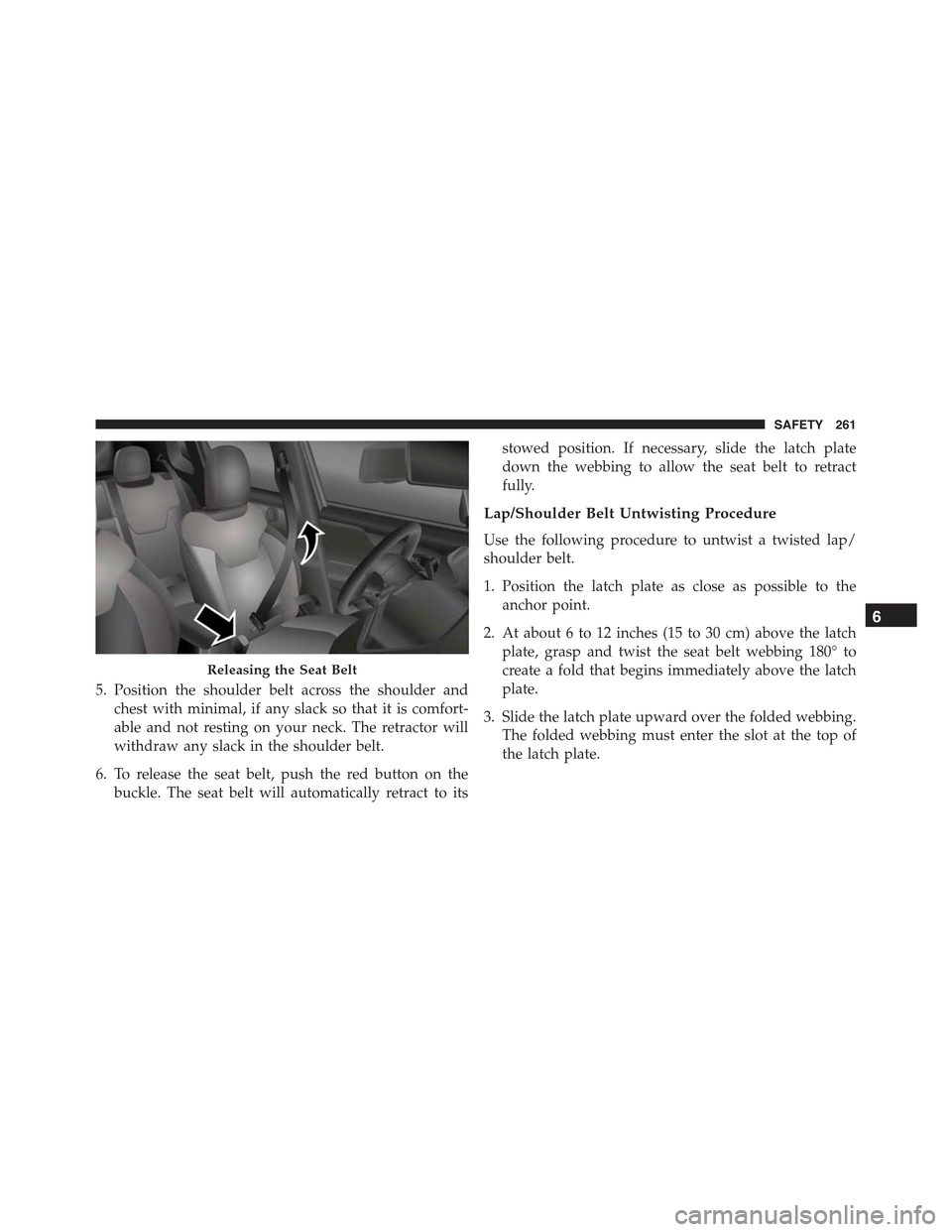
5. Position the shoulder belt across the shoulder and
chest with minimal, if any slack so that it is comfort-
able and not resting on your neck. The retractor will
withdraw any slack in the shoulder belt.
6. To release the seat belt, push the red button on the
buckle. The seat belt will automatically retract to its
stowed position. If necessary, slide the latch plate
down the webbing to allow the seat belt to retract
fully.
Lap/Shoulder Belt Untwisting Procedure
Use the following procedure to untwist a twisted lap/
shoulder belt.
1. Position the latch plate as close as possible to the
anchor point.
2. At about 6 to 12 inches (15 to 30 cm) above the latch
plate, grasp and twist the seat belt webbing 180° to
create a fold that begins immediately above the latch
plate.
3. Slide the latch plate upward over the folded webbing.
The folded webbing must enter the slot at the top of
the latch plate.
Releasing the Seat Belt
6
SAFETY 261
Page 264 of 678
4. Continue to slide the latch plate up until it clears the
folded webbing and the seat belt is no longer twisted.
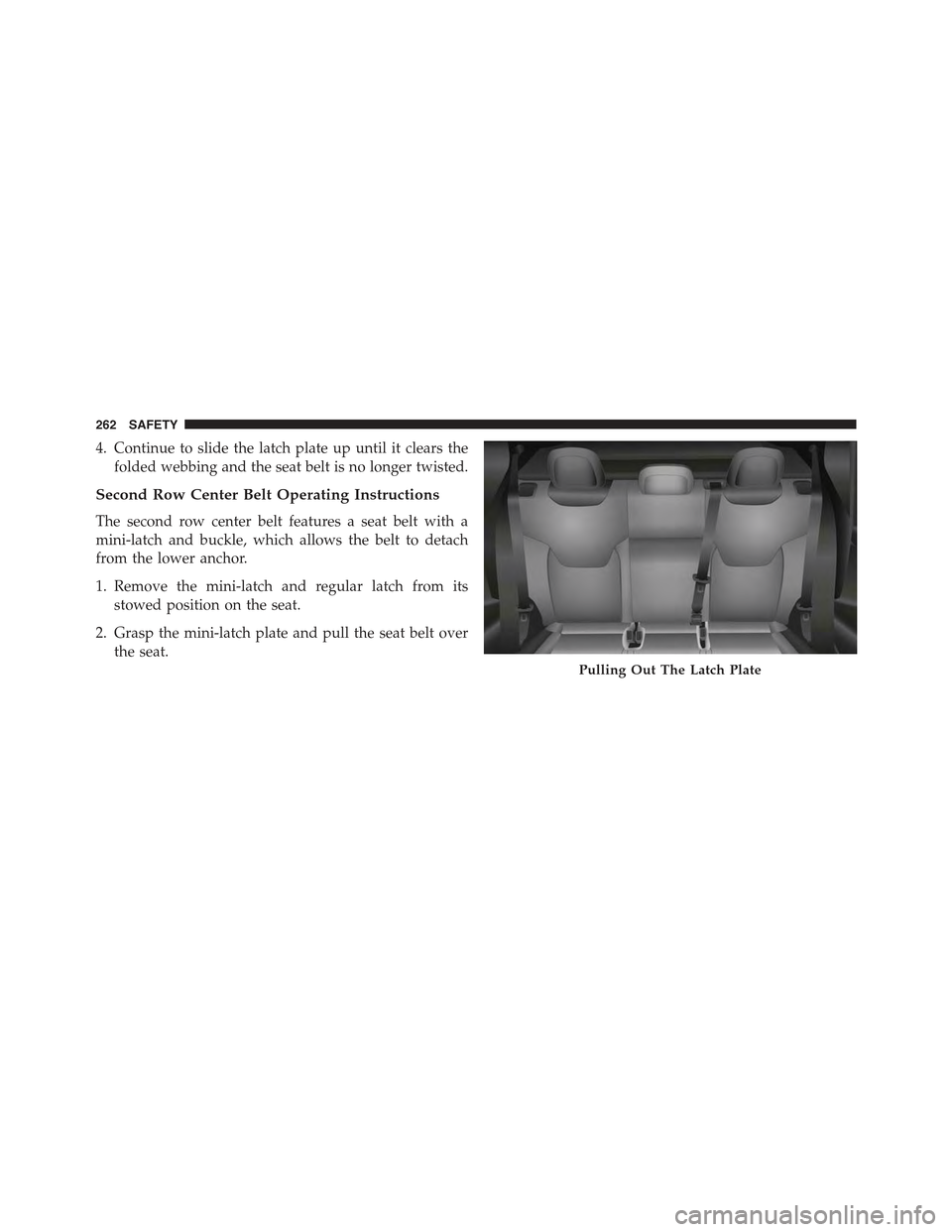
Second Row Center Belt Operating Instructions
The second row center belt features a seat belt with a
mini-latch and buckle, which allows the belt to detach
from the lower anchor.
1. Remove the mini-latch and regular latch from its
stowed position on the seat.
2. Grasp the mini-latch plate and pull the seat belt over
the seat.
Pulling Out The Latch Plate
262 SAFETY
Page 266 of 678
10. To disengage the mini-latch from the mini-buckle for
storage, insert the regular latch plate into the center
red slot on the mini-buckle. The seat belt will auto-
matically retract to its stowed position. If necessary,
slide the latch plate down the webbing to allow the
seat belt to retract fully. Insert the mini-latch plate
and regular latch plate into its stowed position.
WARNING!
•If the mini-latch and mini-buckle are not properly
connected when the seat belt is used by an occu-
pant, the seat belt will not be able to provide
proper restraint and will increase the risk of injury
in a collision.
(Continued)
WARNING!(Continued)
•When reattaching the mini-latch and mini-buckle,
ensure the seat belt webbing is not twisted. If the
webbing is twisted, follow the preceding proce-
dure to detach the mini-latch and mini-buckle,
untwist the webbing, and reattach the mini-latch
and mini-buckle.
Adjustable Upper Shoulder Belt Anchorage
In the driver and front passenger seats, the top of the
shoulder belt can be adjusted upward or downward to
position the seat belt away from your neck. Push or
squeeze the anchorage button to release the anchorage,
and move it up or down to the position that serves you
best.
264 SAFETY
Page 303 of 678
Center Seat LATCH:
WARNING!
•Do not install a child restraint in the center posi-
tion using the LATCH system. This position is not
approved for installing child seats using the
LATCH attachments. You must use the seat belt
and tether anchor to install a child seat in the center
seating position.
•Never use the same lower anchorage to attach more
than one child restraint. Please refer to “Installing
The LATCH-Compatible Child Restraint System”
for typical installation instructions.
Always follow the directions of the child restraint manu-
facturer when installing your child restraint. Not all child
restraint systems will be installed as described here.
To Install A LATCH-Compatible Child Restraint
If the selected seating position has a Switchable Auto-
matic Locking Retractor (ALR) seat belt, stow the seat
belt, following the instructions below. See the section
“Installing Child Restraints Using the Vehicle Seat Belt”
to check what type of seat belt each seating position has.
1. Loosen the adjusters on the lower straps and on the
tether strap of the child seat so that you can more
easily attach the hooks or connectors to the vehicle
anchorages.
2. Place the child seat between the lower anchorages for
that seating position. For some second row seats, you
may need to recline the seat and/or raise the head
restraint to get a better fit. If the rear seat can be moved
forward and rearward in the vehicle, you may wish to
move it to its rear-most position to make room for the
child seat. You may also move the front seat forward
to allow more room for the child seat.
6
SAFETY 301