Page 232 of 678

The following conditions must be met in order for HSA to
activate:
•The vehicle must be stopped.
•The vehicle must be on a 5% (approximate) grade or
greater hill.
•The gear selection must match vehicle uphill direction
(i.e., vehicle facing uphill is in forward gear; vehicle
backing uphill is in REVERSE gear).
•For vehicles equipped with an automatic transmission,
the HSA will work in REVERSE gear and all forward
gears. The system will not activate if the transmission
is in PARK.
WARNING!
There may be situations where the Hill Start Assist
(HSA) will not activate and slight rolling may occur,
such as on minor hills or with a loaded vehicle, or
while pulling a trailer. HSA is not a substitute for
active driving involvement. It is always the driver ’s
responsibility to be attentive to distance to other
vehicles, people, and objects, and most importantly
brake operation to ensure safe operation of the ve-
hicle under all road conditions. Your complete atten-
tion is always required while driving to maintain
safe control of your vehicle. Failure to follow these
warnings can result in a collision or serious personal
injury.
230 SAFETY
Page 247 of 678

If the driver does not take action based upon these
progressive warnings, then the system will provide a
limited level of active braking to help slow the vehicle
and mitigate the potential forward collision. If the driver
reacts to the warnings by braking and the system deter-
mines that the driver intends to avoid the collision by
braking but has not applied sufficient brake force, the
system will compensate and provide additional brake
force as required.
Vehicles With A Manual Transmission: After the end of
the intervention of automatic braking, the engine could
stall, unless the driver can depress the clutch pedal.
Vehicles With Automatic Transmission: After the end of
the intervention of automatic braking, the transmission
may remain in last gear stored: therefore the car could
lurch forward, once the brakes release a few seconds
later.
If a Forward Collision Warning with Mitigation event
begins at a speed below 20 mph (32 km/h), the system
may provide the maximum braking possible to mitigate
the potential forward collision. If the Forward Collision
Warning with Mitigation event stops the vehicle com-
pletely, the system will hold the vehicle at standstill for
two seconds and then release the brakes.
6
SAFETY 245
Page 317 of 678
STARTING AND OPERATING
CONTENTS
!STARTING THE ENGINE................319
▫Tip Start Feature......................320
▫Failure Of The Engine To Start............320
▫Extreme Cold Weather
(Below –20°F or−29°C).................321
▫Extended Park Starting..................322
▫Warming Up The Engine................322
▫Shutting The Engine Off.................323
▫Turbocharger “Cool Down” — If Equipped . . .323
!ENGINE BREAK-IN RECOMMENDATIONS . . .324
!ELECTRIC PARK BRAKE (EPB)............325
▫Auto Park Brake......................329
▫Safehold...........................329
▫Brake Service Mode....................330
!MANUAL TRANSMISSION...............332
▫Shifting.............................333
▫Downshifting........................334
!AUTOMATIC TRANSMISSION............336
▫Shift Lever..........................339
▫Gear Ranges.........................340
7
Page 322 of 678

•Cycle the ignition to the AVV/START position and
release it as soon as the engine is started.
•If the engine does not start, place the ignition in the
STOP/OFF position and wait 10-15 seconds before
attempting to restart the engine.
Automatic Transmission
Proceed as follows:
•Set the Electric Park Brake (EPB) and put the shift lever
in the PARK or NEUTRAL position.
•Press on the brake pedal, without pressing the accel-
erator.
•Cycle the ignition to the AVV/START position and
release it as soon as the engine is started.
•If the engine does not start, place the ignition in the
STOP/OFF position and wait 10-15 seconds before
attempting to restart the engine.
Tip Start Feature
Do notpress the accelerator. Cycle the ignition switch
briefly to the AVV/START position and release it. The
starter motor will continue to run but will automatically
disengage when the engine is running.
Failure Of The Engine To Start
WARNING!
Never pour fuel or other flammable liquid into the
throttle body air inlet opening in an attempt to start
the vehicle. This could result in flash fire causing
serious personal injury.
If the engine fails to start after you have followed the
#Normal Starting#or#Extreme Cold Weather#procedure,
and has not experienced an extended park condition as
identified in#Extended Park Starting#procedure it may
be flooded. Push the accelerator pedal all the way to the
320 STARTING AND OPERATING
Page 325 of 678
Shutting The Engine Off
To turn off the engine, proceed as follows:
•Park the car in a position that does not cause a traffic
hazard.
•Place the transmission in gear (models with a manual
transmission) or place the transmission in PARK (P)
(models with automatic transmission).
•With the engine idling, place the ignition in the STOP/
OFF position.
Remove the key from the ignition when the engine is shut
off.
Vehicles Equipped With Electronic Key (Keyless Enter-
N-Go™):
To shut off the engine with vehicle speed greater than
5 mph (8 km/h) you must push and hold the ignition or
push the START/STOP button three times consecutively
within a few seconds. The engine will shut down and the
ignition will be placed in the RUN position.
Turning Off the car (turning the ignition from RUN to the
STOP position), the power supply to the accessories are
maintained for a period of three minutes.
Opening the driver side door with the ignition RUN will
sound a short chime, to remind the driver to turn the
ignition to STOP.
When the ignition is in the STOP/OFF position, the
window switches remains active for three minutes.
Opening a front door will cancel this function.
After severe driving, idle the engine to allow the tem-
perature inside the engine compartment to cool before
shutting off the engine.
Turbocharger “Cool Down” — If Equipped
This vehicle is equipped with an after-run pump to cool
the turbocharger after the engine is shut off. Depending
7
STARTING AND OPERATING 323
Page 327 of 678
ELECTRIC PARK BRAKE (EPB)
Your vehicle is equipped with an Electric Park Brake
System (EPB) that offers simple operation, and some
additional features that make the parking brake more
convenient and useful.
The parking brake is primarily intended to prevent the
vehicle from rolling while parked. Before leaving the
vehicle, make sure that the parking brake is applied.
Also, be certain to leave the transmission in PARK.
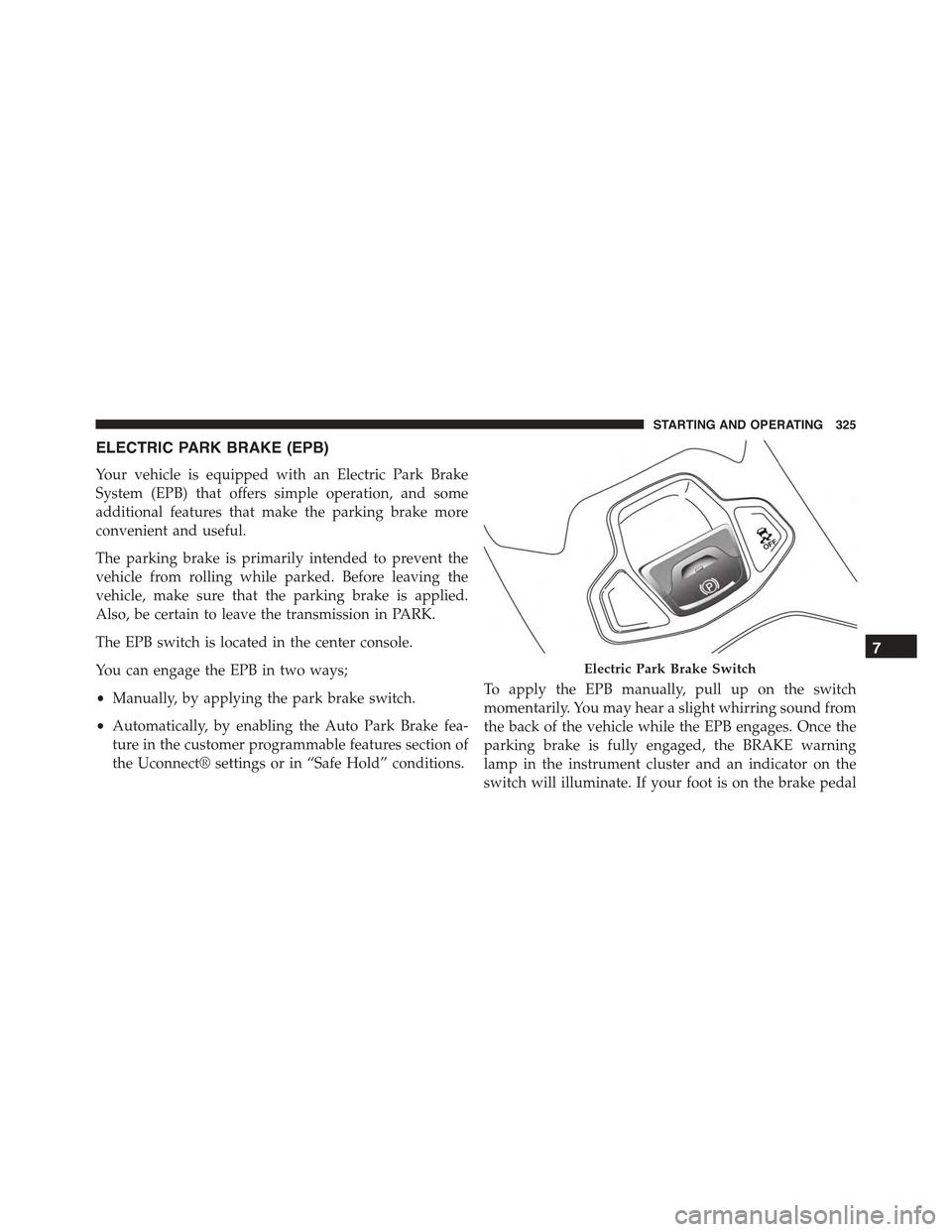
The EPB switch is located in the center console.
You can engage the EPB in two ways;
•Manually, by applying the park brake switch.
•Automatically, by enabling the Auto Park Brake fea-
ture in the customer programmable features section of
the Uconnect® settings or in “Safe Hold” conditions.
To apply the EPB manually, pull up on the switch
momentarily. You may hear a slight whirring sound from
the back of the vehicle while the EPB engages. Once the
parking brake is fully engaged, the BRAKE warning
lamp in the instrument cluster and an indicator on the
switch will illuminate. If your foot is on the brake pedal
Electric Park Brake Switch
7
STARTING AND OPERATING 325
Page 328 of 678

while you apply the EPB, you may notice a small amount
of brake pedal movement. The EPB can be applied even
when the ignition switch is in the STOP/OFF position
but the BRAKE warning lamp will not illuminate, how-
ever, it can only be released when the ignition switch is in
the MAR/RUN position.
NOTE:The EPB fault lamp will illuminate if the EPB
switch is held for longer than 20 seconds in either the
released or applied position. The light will extinguish
upon releasing the switch.
If the Auto Park Brake feature is enabled, the EPB will
automatically engage whenever the transmission is
placed into PARK, or with a manual transmission, when
the ignition switch is in the STOP/OFF position. If your
foot is on the brake pedal, you may notice a small amount
of brake pedal movement while the EPB is engaging.
The electric park brake will be automatically released if
the driver ’s seat belt is buckled and driver’s intention to
start (in forward or reverse direction) is recognized by the
system
To release the EPB manually, the ignition switch must be
in the MAR/RUN position. Put your foot on the brake
pedal, then push the EPB switch down momentarily. You
may hear a slight whirring sound from the back of the car
while the parking brake disengages. You may also notice
a small amount of movement in the brake pedal. Once
the EPB is fully disengaged, The BRAKE warning lamp
in the instrument cluster and the LED indicator on the
switch will extinguish.
326 STARTING AND OPERATING
Page 329 of 678

NOTE:
•When parking on a hill, it is important to turn the front
wheels toward the curb on a downhill grade and away
from the curb on an uphill grade. Apply the EPB
before placing the shift lever in PARK, otherwise the
load on the transmission locking mechanism may
make it difficult to move the shift lever out of PARK.
The EPB should always be applied whenever the
driver is not in the vehicle.
•If the clutch pedal is released at the same time the gas
pedal is pressed, the EPB will be automatically re-
leased (manual transmissions only).
WARNING!
•Never use the PARK position as a substitute for the
parking brake. Always apply the parking brake
fully when parked to guard against vehicle move-
ment and possible injury or damage.
•When leaving the vehicle, always remove the Key
Fob from the ignition and lock your vehicle.
•Never leave children alone in a vehicle, or with
access to an unlocked vehicle. Allowing children to
be in a vehicle unattended is dangerous for a
number of reasons. A child or others could be
seriously or fatally injured. Children should be
warned not to touch the parking brake, brake pedal
or the shift lever.
(Continued)
7
STARTING AND OPERATING 327
