Page 481 of 678

WARNING!
Do not attempt to change a tire on the side of the
vehicle close to moving traffic, pull far enough off
the road to avoid being hit when operating the jack
or changing the wheel.
2. Turn on the Hazard Warning flasher.
3. Set the Electric Park Brake.
4. Place the shift lever into PARK (automatic transmis-
sion) or REVERSE (manual transmission).
5. Turn the ignition off to the STOP/OFF position.
6. Chock both the front and rear of the wheel diagonally
opposite of the jacking position. For
example, if changing the right front
tire, chock the left rear wheel.
NOTE:Passengers should not remain in the vehicle
when the vehicle is being jacked.
Jacking Instructions
WARNING!
Carefully follow these tire changing warnings to
help prevent personal injury or damage to your
vehicle:
•Always park on a firm, level surface as far from the
edge of the roadway as possible before raising the
vehicle.
•Turn on the Hazard Warning flasher.
•Chock the wheel diagonally opposite the wheel to
be raised.
•Apply the parking brake and place an automatic
transmission in PARK.
(Continued)
8
IN CASE OF EMERGENCY 479
Page 495 of 678

WARNING!
•Take care to avoid the radiator cooling fan when-
ever the hood is raised. It can start anytime the
ignition switch is ON. You can be injured by
moving fan blades.
•Remove any metal jewelry such as rings, watch
bands and bracelets that could make an inadvertent
electrical contact. You could be seriously injured.
•Batteries contain sulfuric acid that can burn your
skin or eyes and generate hydrogen gas which is
flammable and explosive. Keep open flames or
sparks away from the battery.
Proceed as follows:
1. Set the Electric Park Brake, shift the automatic trans-
mission into PARK (manual transmission in NEU-
TRAL) and turn the ignition to STOP/OFF.
2. Turn off the heater, radio, and all unnecessary electri-
cal accessories.
3. If using another vehicle to jump-start the battery, park
the vehicle within the jumper cables reach, set the
parking brake and make sure the ignition is STOP/
OFF.
WARNING!
Do not allow vehicles to touch each other as this
could establish a ground connection and personal
injury could result.
8
IN CASE OF EMERGENCY 493
Page 498 of 678
ENHANCED ACCIDENT RESPONSE SYSTEM
In the event of an impact, if the communication network
remains intact, and the power remains intact, depending
on the nature of the event, the ORC will determine
whether to have the Enhanced Accident Response Sys-
tem perform the following functions:
•Cut off fuel to the engine.
•Flash hazard lights as long as the battery has power or
until the ignition switch is turned to the STOP/OFF
position.
•Turn on the interior lights, which remain on as long as
the battery has power or until the ignition switch is
turned to the STOP/OFF position.
•Unlock the doors automatically.
System Reset Procedure
Depending on the nature of the event the left and right
turn signal lights, located in the instrument panel, may
both be blinking and will continue to blink until the
ignition switch is turned to the STOP/OFF position. In
order to move your vehicle to the side of the road, you
must follow the system reset procedure.
Customer Action Customer Will See
1. Turn ignition OFF.
(Turn Signal Switch Must
be placed in Neutral
State).
—
2. Turn ignition ON. Left Turn Light is OFF.
Right Turn Light
BLINKS.
496 IN CASE OF EMERGENCY
Page 499 of 678

Customer Action Customer Will See
3. Turn Right Turn Signal
Switch ON.
Right Turn Light is ON
SOLID. Left Turn Light
BLINKS.
4. Turn Left Turn Signal
Switch ON.
Left Turn Light is ON
SOLID. Right Turn Light
BLINKS.
5. Turn Right Turn Signal
Switch ON.
Right Turn Light is ON
SOLID. Left Turn Light
BLINKS.
6. Turn Left Turn Signal
Switch ON.
Left Turn Light is ON
SOLID. Right Turn Light
is ON SOLID.
7. Turn Left Turn Signal
Switch OFF. (Turn Signal
Switch Must be placed in
Neutral State).
Left Turn Light is OFF.
Right Turn Light is OFF.
Customer Action Customer Will See
8. Turn ignition OFF.—
9. Turn Hazard Flashers
OFF (Manually).
System is now reset and
the engine may be
started.
If a reset procedure step is not completed within 45
seconds, then the turn signal lights will turn off and the
reset procedure must be performed again in order to be
successful.
SUPPLY OF EMERGENCY
The filling procedure fuel in case of emergency is de-
scribed in the paragraph#Fill of the car#, chapter#Starting
and driving#.
8
IN CASE OF EMERGENCY 497
Page 503 of 678
IGNITION KEY REMOVAL OVERRIDE
This vehicle is equipped with a Key Ignition Park Inter-
lock which requires the transmission to be in PARK
before the ignition switch can be turned to the STOP/
OFF (key removal) position. To remove the key manually,
proceed as follows:
1. Make sure the vehicle is in a safe location and set the
Electric Park Brake.
2. Unlock the steering column, and pull the tilt/
telescoping control handle down.
3. Pull the steering wheel outward until it is in the end of
the travel position, then lock the steering column in
position and push the control handle up until fully
engaged.
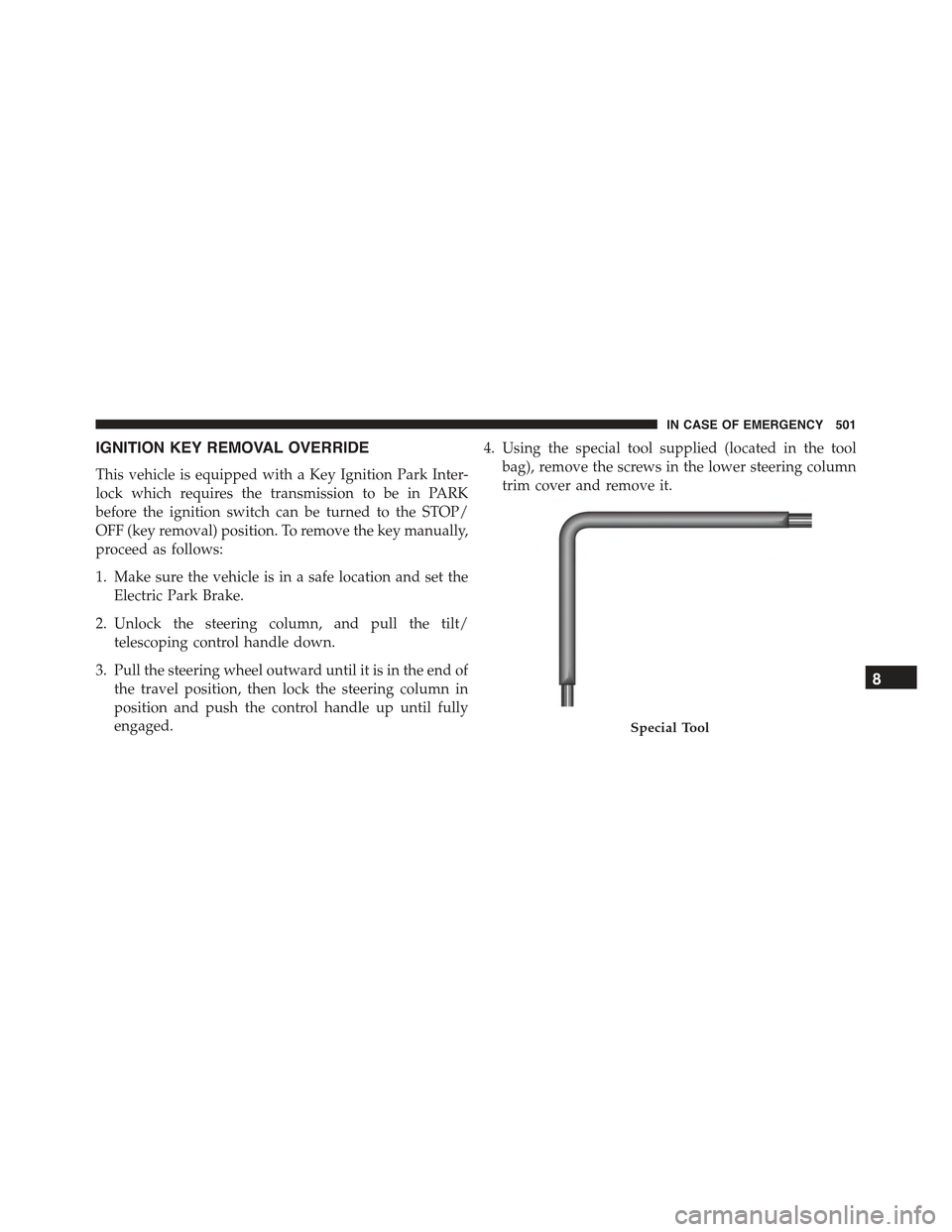
4. Using the special tool supplied (located in the tool
bag), remove the screws in the lower steering column
trim cover and remove it.
Special Tool
8
IN CASE OF EMERGENCY 501
Page 504 of 678
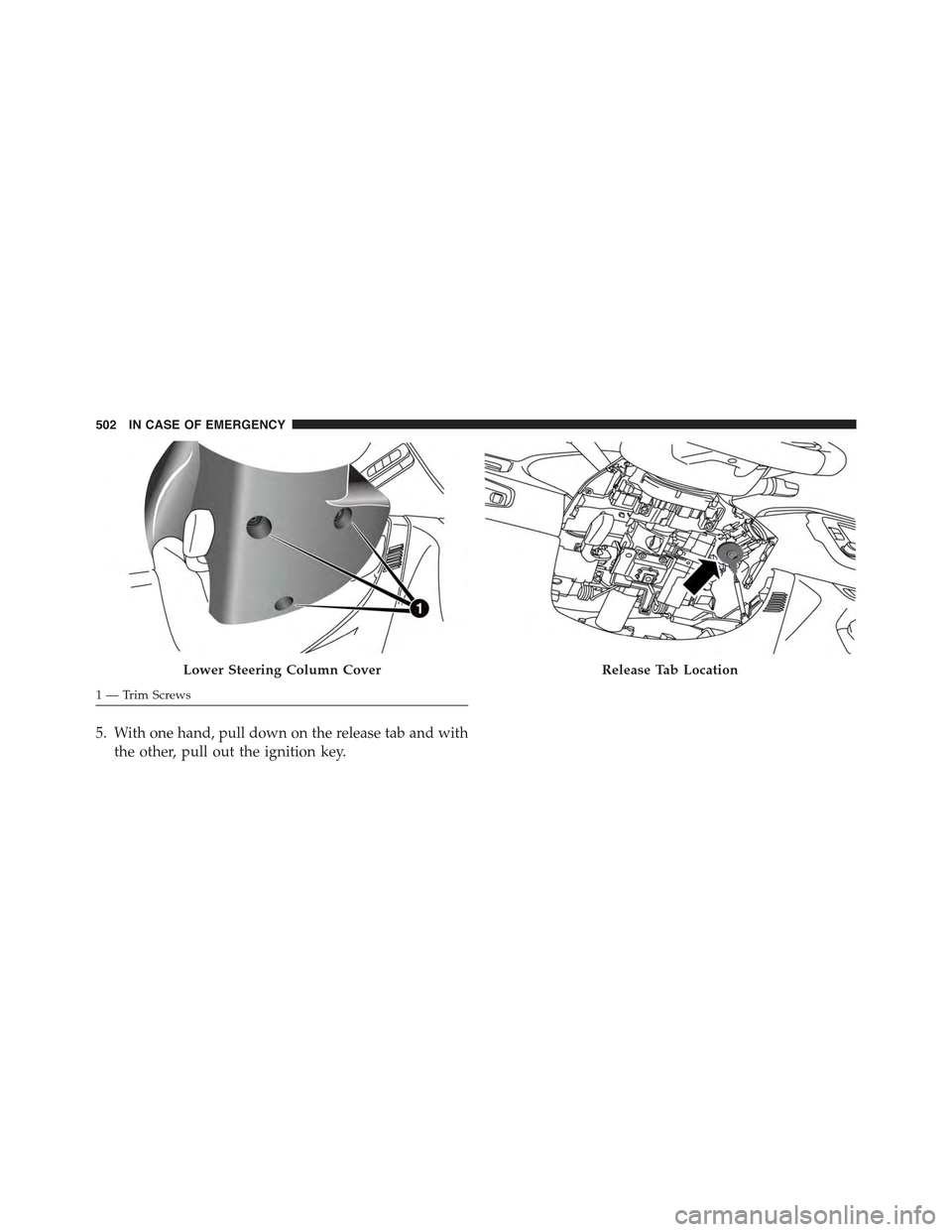
5. With one hand, pull down on the release tab and with
the other, pull out the ignition key.
Lower Steering Column Cover
1 — Trim Screws
Release Tab Location
502 IN CASE OF EMERGENCY
Page 508 of 678

NOTE:Vehicles with a discharged battery or total elec-
trical failure when the Electric Park Brake (EPB) is
engaged, will need a wheel dolly or jack to raise the rear
wheels off the ground when moving the vehicle onto a
flatbed.
If you must use the accessories (wipers, defrosters, etc.)
while being towed, the ignition must be in the MAR/
RUN position. If the key fob is unavailable, or the
vehicle’s battery is discharged, refer to “Shift Lever
Override” in this section for instructions on shifting the
transmission out of PARK so that the vehicle can be
moved.
CAUTION!
•Do not use sling type equipment when towing.
Vehicle damage may occur.
•When securing the vehicle to a flat bed truck, do
not attach to front or rear suspension components.
Damage to your vehicle may result from improper
towing.
Front Wheel Drive (FWD)
The manufacturer recommends towing your vehicle with
all four wheels OFF the ground on a flatbed.
If flatbed equipment is not available, this vehicle must
towed with the front wheels OFF the ground (using a
towing dolly, or wheel lift equipment with the front
wheels raised).
506 IN CASE OF EMERGENCY
Page 510 of 678
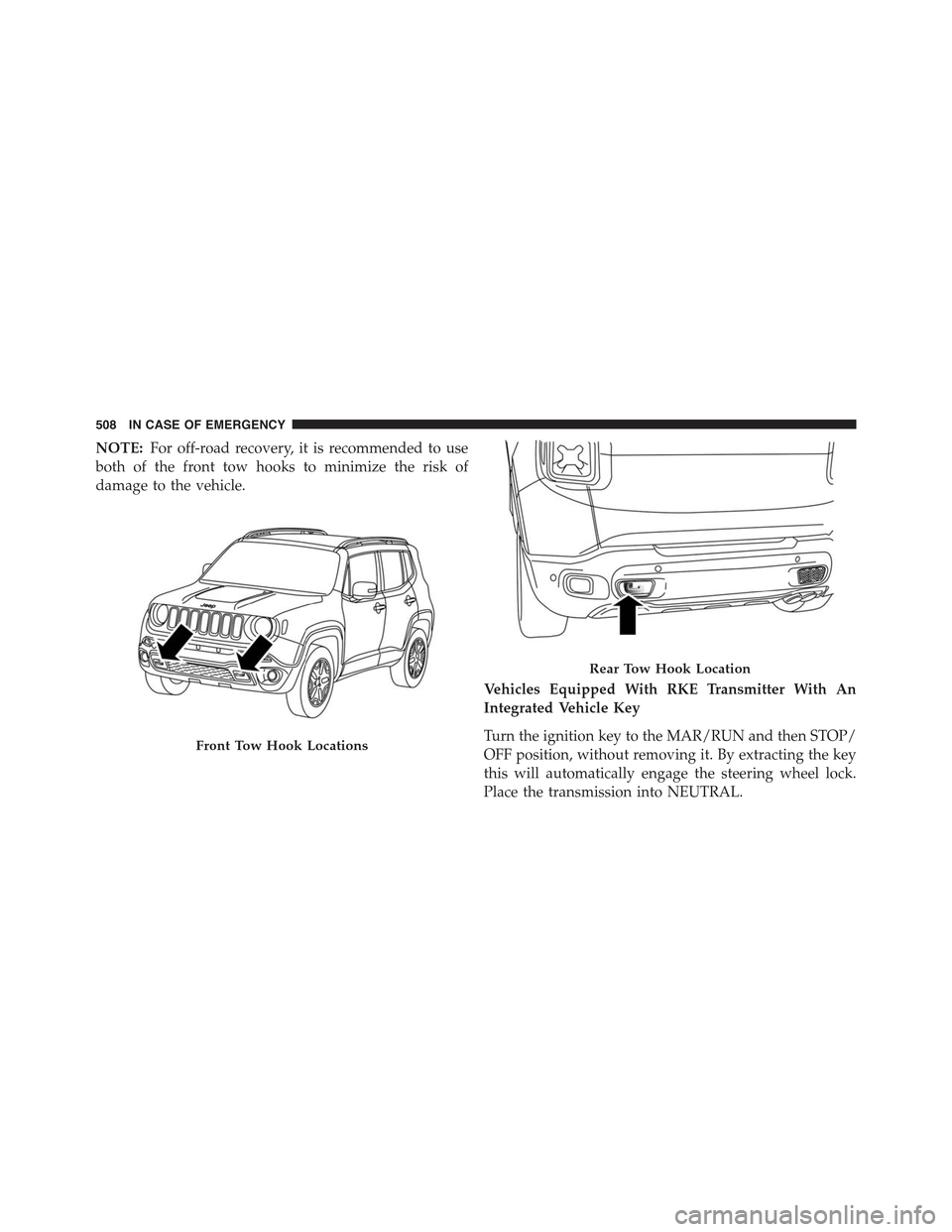
NOTE:For off-road recovery, it is recommended to use
both of the front tow hooks to minimize the risk of
damage to the vehicle.
Vehicles Equipped With RKE Transmitter With An
Integrated Vehicle Key
Turn the ignition key to the MAR/RUN and then STOP/
OFF position, without removing it. By extracting the key
this will automatically engage the steering wheel lock.
Place the transmission into NEUTRAL.
Front Tow Hook Locations
Rear Tow Hook Location
508 IN CASE OF EMERGENCY