Page 650 of 717
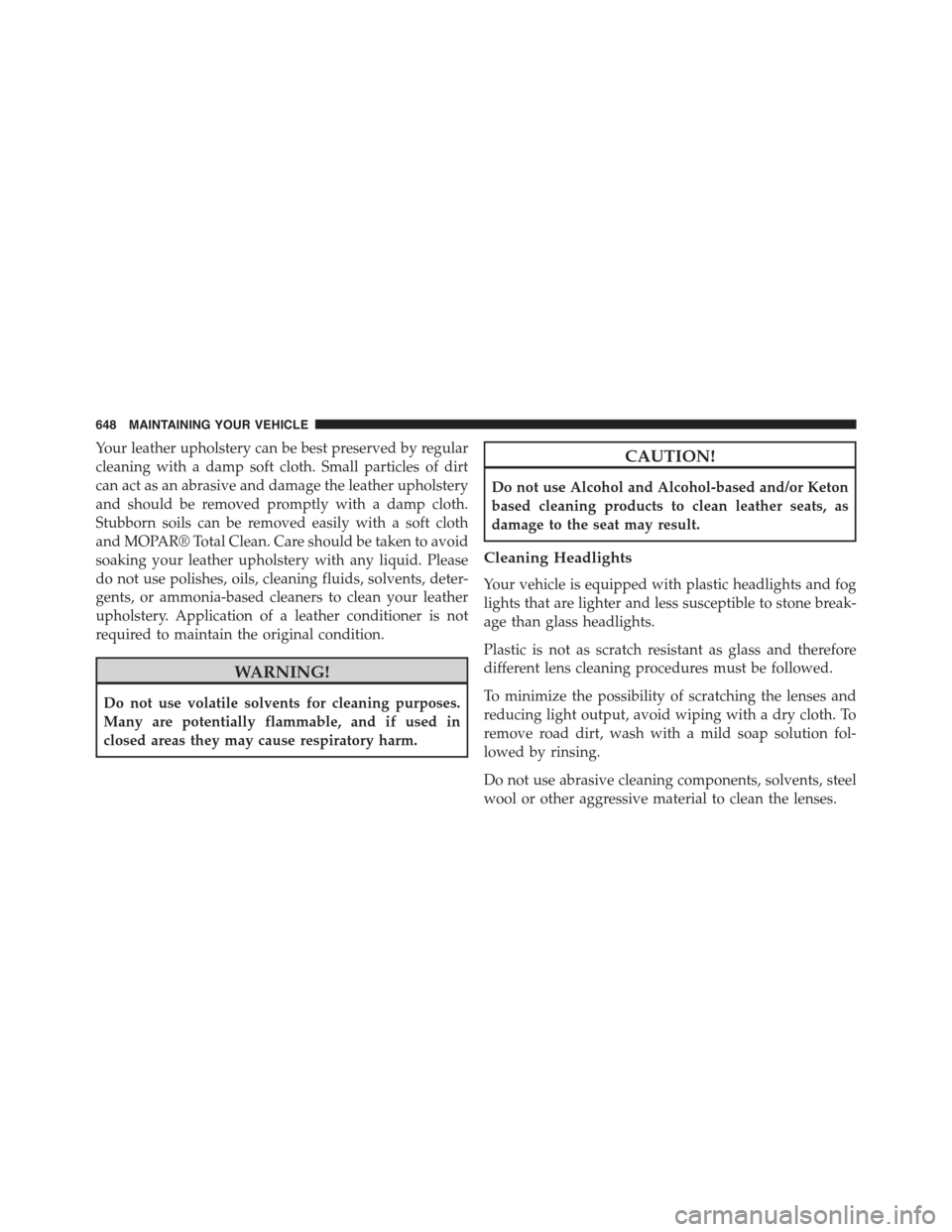
Your leather upholstery can be best preserved by regular
cleaning with a damp soft cloth. Small particles of dirt
can act as an abrasive and damage the leather upholstery
and should be removed promptly with a damp cloth.
Stubborn soils can be removed easily with a soft cloth
and MOPAR® Total Clean. Care should be taken to avoid
soaking your leather upholstery with any liquid. Please
do not use polishes, oils, cleaning fluids, solvents, deter-
gents, or ammonia-based cleaners to clean your leather
upholstery. Application of a leather conditioner is not
required to maintain the original condition.
WARNING!
Do not use volatile solvents for cleaning purposes.
Many are potentially flammable, and if used in
closed areas they may cause respiratory harm.
CAUTION!
Do not use Alcohol and Alcohol-based and/or Keton
based cleaning products to clean leather seats, as
damage to the seat may result.
Cleaning Headlights
Your vehicle is equipped with plastic headlights and fog
lights that are lighter and less susceptible to stone break-
age than glass headlights.
Plastic is not as scratch resistant as glass and therefore
different lens cleaning procedures must be followed.
To minimize the possibility of scratching the lenses and
reducing light output, avoid wiping with a dry cloth. To
remove road dirt, wash with a mild soap solution fol-
lowed by rinsing.
Do not use abrasive cleaning components, solvents, steel
wool or other aggressive material to clean the lenses.
648 MAINTAINING YOUR VEHICLE
Page 657 of 717
CavityCartridge Fuse Micro FuseDescription
F56–15 Amp Blue Additional Content (Diesel engine only)
F57–15 Amp Blue HID Headlamps LH - If Equipped
F59–10 Amp Red Purging Pump (Diesel engine only)
F60–15 Amp BlueTransmission Control Module
F61–10 Amp Red Transmission Control Module/PM Sensor
(diesel engine only)
F62–10 Amp RedAir Conditioning Clutch
F63–20 Amp Yellow Ignition Coils (Gas), Urea Heater (Diesel)
F64–25 Amp ClearFuel Injectors / Powertrain
F66–10 Amp Red Sunroof / Passenger Window Switches /
Rain Sensor
F67–15 Amp Blue CD / DVD / Bluetooth Hands-free
Module - If Equipped
F68–20 Amp YellowRear Wiper Motor
F69–15 Amp BlueSpotlight Feed - If Equipped
7
MAINTAINING YOUR VEHICLE 655
Page 665 of 717

WARNING!
A transient high voltage occurs at the bulb sockets of
High Intensity Discharge (HID) headlamps when the
headlamp switch is turned ON. It may cause serious
electrical shock or electrocution if not serviced prop-
erly. See your authorized dealer for service.
NOTE:On vehicles equipped with High Intensity Dis-
charge (HID) headlamps, when the headlamps are
turned on, there is a blue hue to the lamps. This dimin-
ishes and becomes more white after approximately 10
seconds, as the system charges.
Halogen Headlamps — If Equipped
1. Open the hood.
2. Turn the low or high beam bulb one–quarter turn
counterclockwise to remove from housing.
3. Disconnect the electrical connector and replace the
bulb.
CAUTION!
Do not touch the new bulb with your fingers. Oil
contamination will severely shorten bulb life. If the
bulb comes in contact with any oily surface, clean the
bulb with rubbing alcohol.
Front Turn Signal
1. Open the hood.
2. Turn the turn signal bulb one–quarter turn counter-
clockwise to remove from housing.
3. Disconnect the electrical connector and replace the
bulb.
7
MAINTAINING YOUR VEHICLE 663
Page 666 of 717
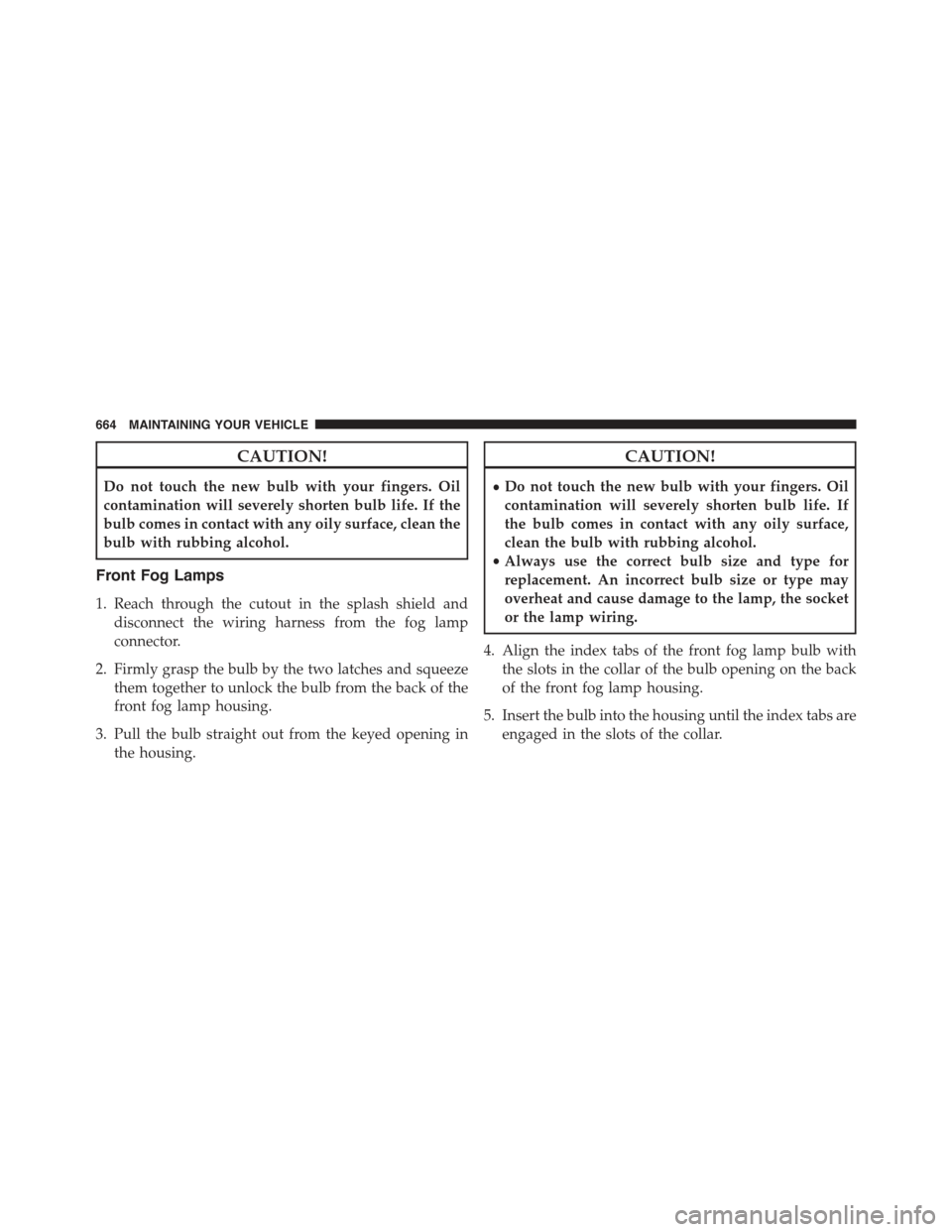
CAUTION!
Do not touch the new bulb with your fingers. Oil
contamination will severely shorten bulb life. If the
bulb comes in contact with any oily surface, clean the
bulb with rubbing alcohol.
Front Fog Lamps
1. Reach through the cutout in the splash shield and
disconnect the wiring harness from the fog lamp
connector.
2. Firmly grasp the bulb by the two latches and squeeze
them together to unlock the bulb from the back of the
front fog lamp housing.
3. Pull the bulb straight out from the keyed opening in
the housing.
CAUTION!
•Do not touch the new bulb with your fingers. Oil
contamination will severely shorten bulb life. If
the bulb comes in contact with any oily surface,
clean the bulb with rubbing alcohol.
•Always use the correct bulb size and type for
replacement. An incorrect bulb size or type may
overheat and cause damage to the lamp, the socket
or the lamp wiring.
4. Align the index tabs of the front fog lamp bulb with
the slots in the collar of the bulb opening on the back
of the front fog lamp housing.
5. Insert the bulb into the housing until the index tabs are
engaged in the slots of the collar.
664 MAINTAINING YOUR VEHICLE
Page 671 of 717
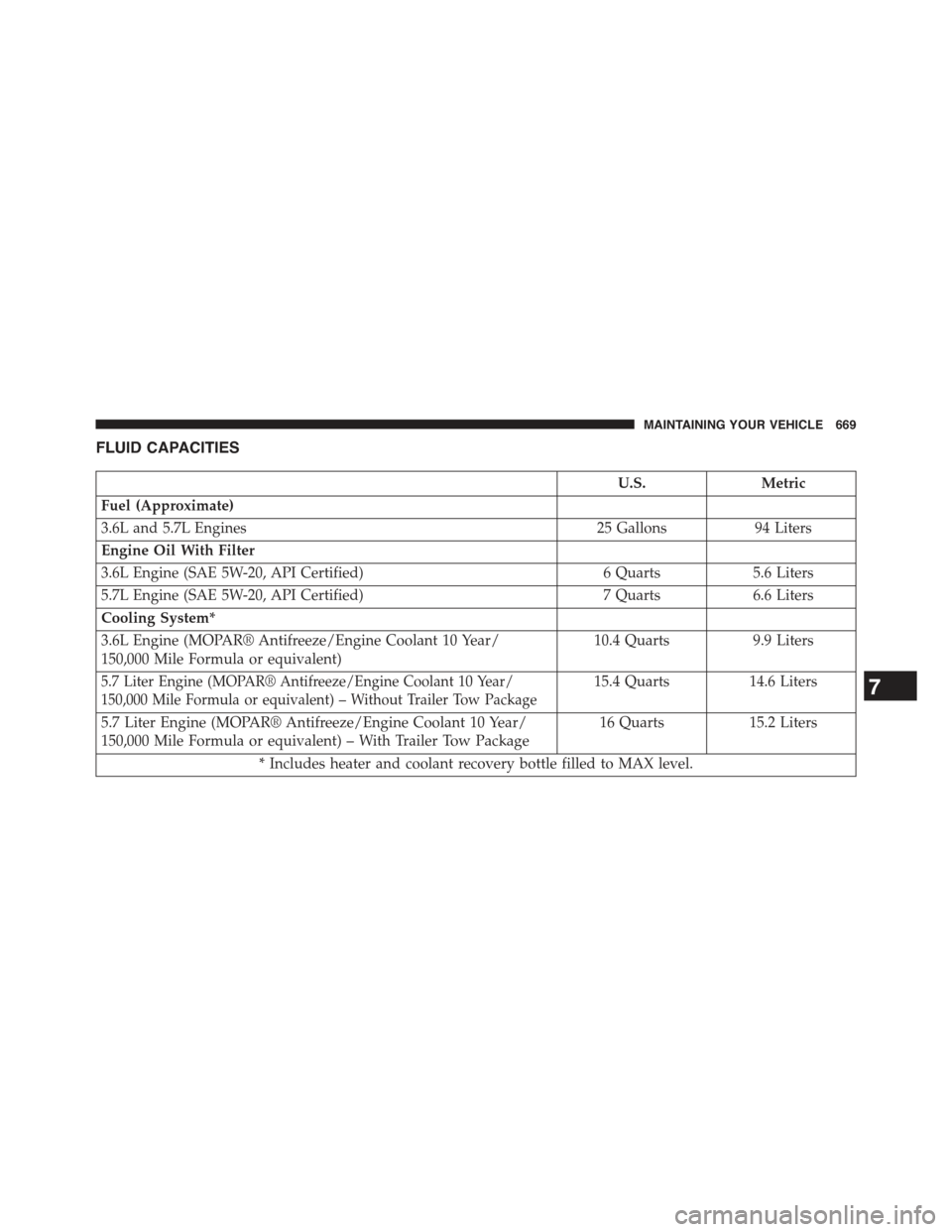
FLUID CAPACITIES
U.S.Metric
Fuel (Approximate)
3.6L and 5.7L Engines25 Gallons94 Liters
Engine Oil With Filter
3.6L Engine (SAE 5W-20, API Certified)6 Quarts5.6 Liters
5.7L Engine (SAE 5W-20, API Certified)7 Quarts6.6 Liters
Cooling System*
3.6L Engine (MOPAR® Antifreeze/Engine Coolant 10 Year/
150,000 Mile Formula or equivalent)
10.4 Quarts9.9 Liters
5.7 Liter Engine (MOPAR® Antifreeze/Engine Coolant 10 Year/
150,000 Mile Formula or equivalent) – Without Trailer Tow Package
15.4 Quarts14.6 Liters
5.7 Liter Engine (MOPAR® Antifreeze/Engine Coolant 10 Year/
150,000 Mile Formula or equivalent) – With Trailer Tow Package
16 Quarts15.2 Liters
* Includes heater and coolant recovery bottle filled to MAX level.
7
MAINTAINING YOUR VEHICLE 669
Page 672 of 717
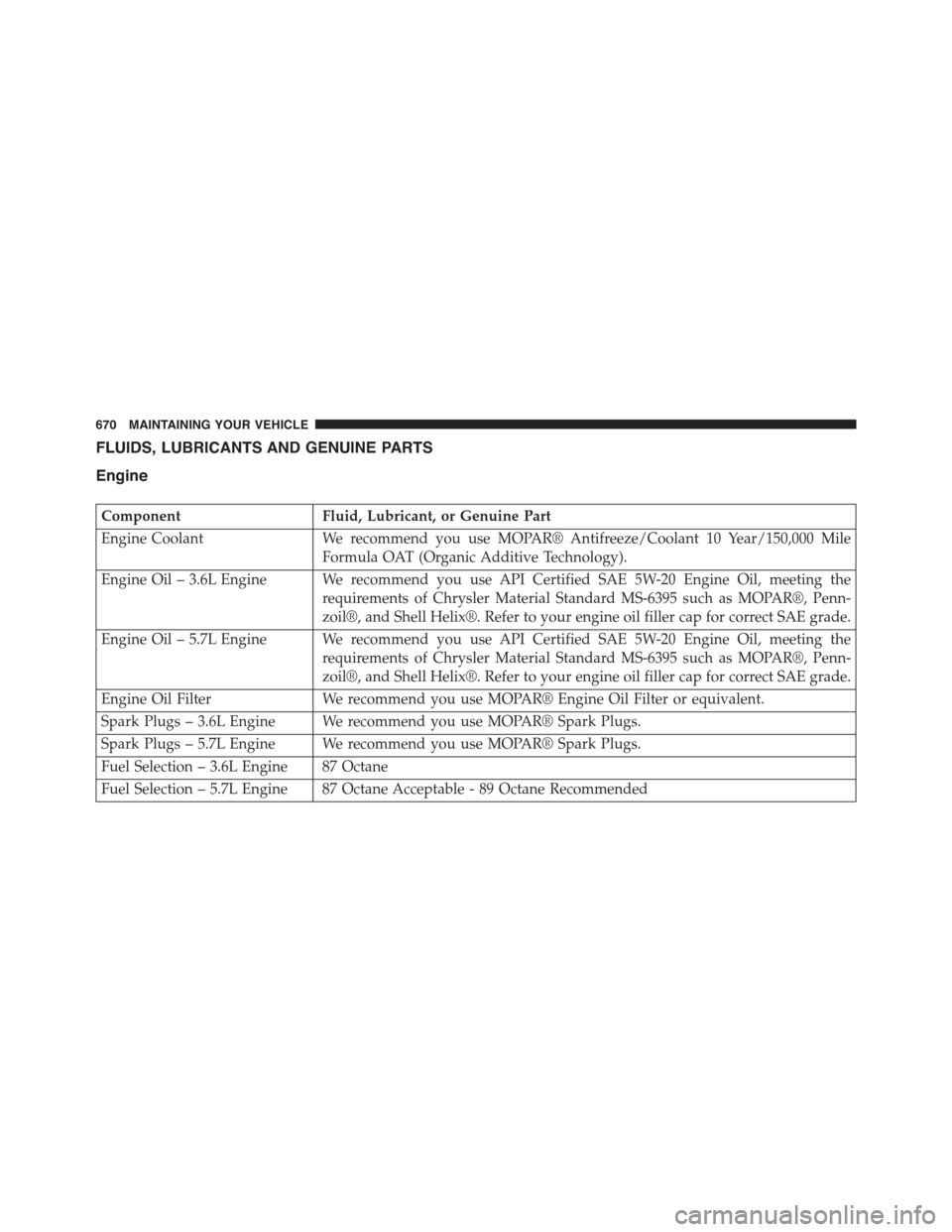
FLUIDS, LUBRICANTS AND GENUINE PARTS
Engine
ComponentFluid, Lubricant, or Genuine Part
Engine CoolantWe recommend you use MOPAR® Antifreeze/Coolant 10 Year/150,000 Mile
Formula OAT (Organic Additive Technology).
Engine Oil – 3.6L Engine We recommend you use API Certified SAE 5W-20 Engine Oil, meeting the
requirements of Chrysler Material Standard MS-6395 such as MOPAR®, Penn-
zoil®, and Shell Helix®. Refer to your engine oil filler cap for correct SAE grade.
Engine Oil – 5.7L Engine We recommend you use API Certified SAE 5W-20 Engine Oil, meeting the
requirements of Chrysler Material Standard MS-6395 such as MOPAR®, Penn-
zoil®, and Shell Helix®. Refer to your engine oil filler cap for correct SAE grade.
Engine Oil FilterWe recommend you use MOPAR® Engine Oil Filter or equivalent.
Spark Plugs – 3.6L Engine We recommend you use MOPAR® Spark Plugs.
Spark Plugs – 5.7L Engine We recommend you use MOPAR® Spark Plugs.
Fuel Selection – 3.6L Engine 87 Octane
Fuel Selection – 5.7L Engine 87 Octane Acceptable - 89 Octane Recommended
670 MAINTAINING YOUR VEHICLE
Page 678 of 717

MAINTENANCE SCHEDULE
Your vehicle is equipped with an automatic oil change
indicator system. The oil change indicator system will
remind you that it is time to take your vehicle in for
scheduled maintenance.
Based on engine operation conditions, the oil change
indicator message will illuminate. This means that ser-
vice is required for your vehicle. Operating conditions
such as frequent short-trips, trailer tow, extremely hot or
cold ambient temperatures, and E85 fuel usage will
influence when the “Oil Change Required” message is
displayed. Severe Operating Conditions can cause the
change oil message to illuminate as early as 3,500 miles
(5,600 km) since last reset. Have your vehicle serviced as
soon as possible, within the next 500 miles (805 km).
Your authorized dealer will reset the oil change indicator
message after completing the scheduled oil change.
NOTE:Under no circumstances should oil change inter-
vals exceed 10,000 miles (16,000 km) or twelve months,
whichever comes first.
Severe Duty All Models
Change Engine Oil at 4000 miles (6,500 km) if the vehicle
is operated in a dusty and off road environment. This
type of vehicle use is considered Severe Duty.
Once A Month Or Before A Long Trip:
•Check engine oil level
•Check windshield washer fluid level
•Check the tire inflation pressures and look for unusual
wear or damage
•Check the fluid levels of the coolant reservoir, brake
master cylinder and power steering, and fill as needed.
•Check function of all interior and exterior lights
8
MAINTENANCE
SCHEDULES
676 MAINTENANCE SCHEDULES
Page 679 of 717
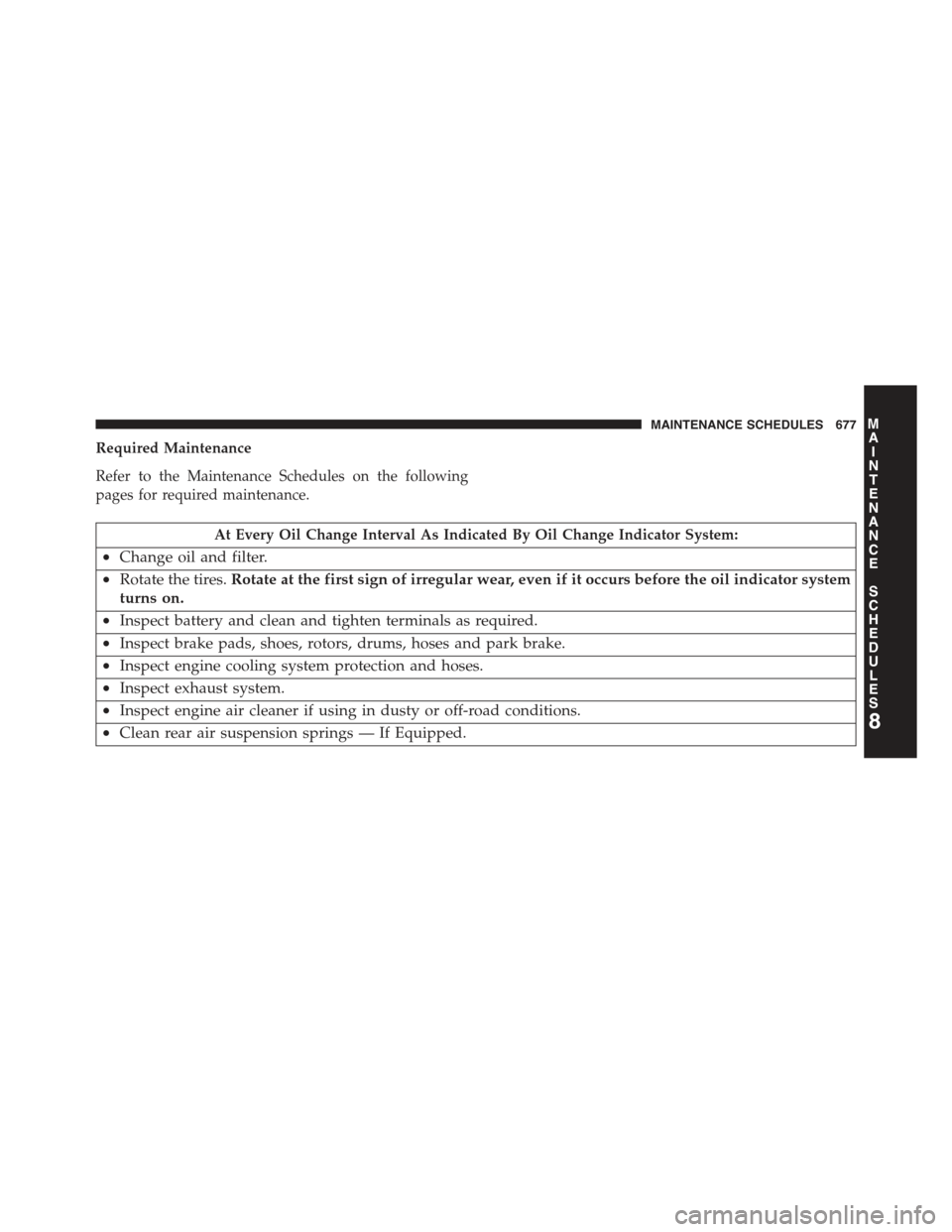
Required Maintenance
Refer to the Maintenance Schedules on the following
pages for required maintenance.
At Every Oil Change Interval As Indicated By Oil Change Indicator System:
•Change oil and filter.
•Rotate the tires.Rotate at the first sign of irregular wear, even if it occurs before the oil indicator system
turns on.
•Inspect battery and clean and tighten terminals as required.
•Inspect brake pads, shoes, rotors, drums, hoses and park brake.
•Inspect engine cooling system protection and hoses.
•Inspect exhaust system.
•Inspect engine air cleaner if using in dusty or off-road conditions.
•Clean rear air suspension springs — If Equipped.8
MAINTENANCE
SCHEDULES
MAINTENANCE SCHEDULES 677