2015 JEEP GRAND CHEROKEE acc
[x] Cancel search: accPage 687 of 717
SUGGESTIONS FOR OBTAINING SERVICE FOR
YOUR VEHICLE
Prepare For The Appointment
If you are having warranty work done, be sure to have
the right papers with you. Take your warranty folder. All
work to be performed may not be covered by the
warranty. Discuss additional charges with the service
manager. Keep a maintenance log of your vehicle’s
service history. This can often provide a clue to the
current problem.
Prepare A List
Make a written list of your vehicle’s problems or the
specific work you want done. If you’ve had an accident
or work done that is not on your maintenance log, let the
service advisor know.
Be Reasonable With Requests
If you list a number of items and you must have your
vehicle by the end of the day, discuss the situation with
the service advisor and list the items in order of priority.
At many authorized dealers, you may obtain a rental
vehicle at a minimal daily charge. If you need a rental, it
is advisable to make these arrangements when you call
for an appointment.
IF YOU NEED ASSISTANCE
The manufacturer and its authorized dealer are vitally
interested in your satisfaction. We want you to be happy
with our products and services.
Warranty service must be done by an authorized dealer.
We strongly recommend that you take the vehicle to an
authorized dealer. They know your vehicle the best, and
are most concerned that you get prompt and high quality
service. The manufacturer’s authorized dealer have the
9
IF YOU NEED CONSUMER ASSISTANCE 685
Page 689 of 717

In Mexico Contact:
Av. Prolongacion Paseo de la Reforma, 1240
Sante Fe C.P. 05109
Mexico, D. F.
In Mexico City: 5081-7568
Outside Mexico City: 1-800-505-1300
Customer Assistance For The Hearing Or Speech
Impaired (TDD/TTY)
To assist customers who have hearing difficulties, the
manufacturer has installed special TDD (Telecommuni-
cation Devices for the Deaf) equipment at its customer
center. Any hearing or speech impaired customer, who
has access to a TDD or a conventional teletypewriter
(TTY) in the United States, can communicate with the
manufacturer by dialing 1–800–380–CHRY.
Canadian residents with hearing difficulties that require
assistance can use the special needs relay service offered
by Bell Canada. For TTY teletypewriter users, dial 711
and for Voice callers, dial 1-800-855-0511 to connect with
a Bell Relay Service operator.
Service Contract
You may have purchased a service contract for a vehicle
to help protect you from the high cost of unexpected
repairs after the manufacturer’s New Vehicle Limited
Warranty expires. The manufacturer stands behind only
the manufacturer’s service contracts. If you purchased a
manufacturer’s service contract, you will receive Plan
Provisions and an Owner Identification Card in the mail
within three weeks of the vehicle delivery date. If you
have any questions about the service contract, call the
manufacturer’s Service Contract National Customer
Hotline at 1-800-521-9922 (Canadian residents, call (800)
465–2001 English / (800) 387–9983 French).
9
IF YOU NEED CONSUMER ASSISTANCE 687
Page 691 of 717
MOPAR® PARTS
MOPAR® fluids, lubricants, parts, and accessories are
available from an authorized dealer. They are recom-
mended for your vehicle in order to help keep the vehicle
operating at its best.
REPORTING SAFETY DEFECTS
In The 50 United States And Washington, D.C.
If you believe that your vehicle has a defect that could
cause a crash or cause injury or death, you should
immediately inform the National Highway Traffic Safety
Administration (NHTSA) in addition to notifying the
manufacturer.
If NHTSA receives similar complaints, it may open an
investigation, and if it finds that a safety defect exists in
a group of vehicles, it may order a recall and remedy
campaign. However, NHTSA cannot become involved in
individual problems between you, your authorized
dealer, and the manufacturer.
To contact NHTSA, you may either call the Auto Safety
Hotline toll free at 1–888–327–4236 (TTY: 1–800–424– 9153),
or go tohttp://www.safercar.gov; or write to: Admin-
istrator, NHTSA, 1200 New Jersey Avenue, SE., West
Building, Washington, D.C. 20590. You can also obtain
other information about motor vehicle safety from
http://www.safercar.gov.
In Canada
If you believe that your vehicle has a safety defect, you
should contact the Customer Service Department imme-
diately. Canadian customers who wish to report a safety
defect to the Canadian government should contact Trans-
port Canada, Motor Vehicle Defect Investigations and
Recalls at 1-800-333-0510 or go tohttp://www.tc.gc.ca/
roadsafety/
9
IF YOU NEED CONSUMER ASSISTANCE 689
Page 694 of 717
WARNING!
The traction grade assigned to this tire is based on
straight-ahead braking traction tests, and does not
include acceleration, cornering, hydroplaning, or
peak traction characteristics.
Temperature Grades
The temperature grades are A (the highest), B, and C,
representing the tire’s resistance to the generation of heat
and its ability to dissipate heat, when tested under
controlled conditions on a specified indoor laboratory
test wheel. Sustained high temperature can cause the
material of the tire to degenerate and reduce tire life, and
excessive temperature can lead to sudden tire failure. The
grade C corresponds to a level of performance, which all
passenger car tires must meet under the Federal Motor
Vehicle Safety Standard No. 109. Grades B and A repre-
sent higher levels of performance on the laboratory test
wheel, than the minimum required by law.
WARNING!
The temperature grade for this tire is established for
a tire that is properly inflated and not overloaded.
Excessive speed, under-inflation, or excessive load-
ing, either separately or in combination, can cause
heat buildup and possible tire failure.
692 IF YOU NEED CONSUMER ASSISTANCE
Page 696 of 717
About Your Brakes........................472
ABS (Anti-Lock Brake System)................473
Adaptive Cruise Control (ACC) (Cruise Control) . . .192
Adding Engine Coolant (Antifreeze)............634
Adding Fuel.............................536
Additives, Fuel...........................530
Air bag . . . . . . . . . . . . . . . . . . . . . . . . . . . . . . . . .67
Air Bag
Advance Front Air Bag....................68
Air Bag Components.....................67
Air bag Operation.......................70
Air Bag Warning Light....................79
Enhanced Accident Response................78
Event Data Recorder (EDR).................82
Front Air Bag . . . . . . . . . . . . . . . . . . . . . . . . . . .67
If A Deployment Occurs...................77
Knee Impact Bolsters.....................71
Maintaining Your Air Bag System............81
Side Air Bags...........................72
Transporting Pets.......................107
Air bag Deployment........................67
Air bag Light.............................79
Air bag Maintenance........................81
Air Cleaner, Engine (Engine Air Cleaner Filter) . . . .610
Air Conditioner Maintenance.................616
Air Conditioning Filter.....................395
Air Conditioning, Operating Tips..............394
Air Conditioning Refrigerant.................616
Air Conditioning System....................392
Air Pressure, Tires.........................506
Air Suspension...........................450
Alarm
Arm The System........................19
Tamper Alert...........................21
Alarm, Panic.............................24
Alarm (Security Alarm)......................19
Alterations/Modifications, Vehicle...............9
Antifreeze (Engine Coolant)..................633
694 INDEX
Page 701 of 717
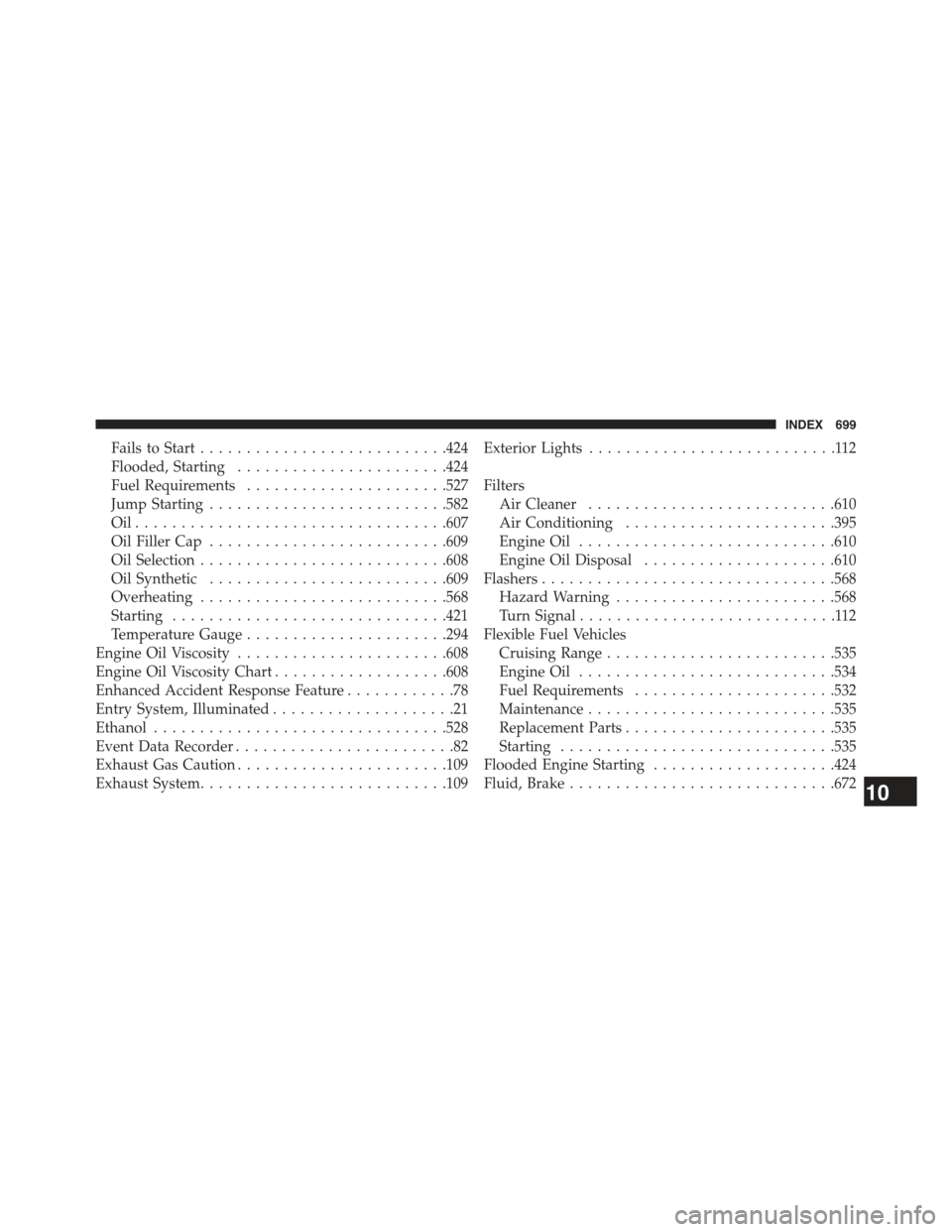
Fails to Start...........................424
Flooded, Starting.......................424
Fuel Requirements......................527
Jump Starting..........................582
Oil . . . . . . . . . . . . . . . . . . . . . . . . . . . . . . . . ..607
Oil Filler Cap..........................609
Oil Selection...........................608
Oil Synthetic..........................609
Overheating...........................568
Starting..............................421
Temperature Gauge......................294
Engine Oil Viscosity.......................608
Engine Oil Viscosity Chart...................608
Enhanced Accident Response Feature............78
Entry System, Illuminated....................21
Ethanol................................528
Event Data Recorder........................82
Exhaust Gas Caution.......................109
Exhaust System...........................109
Exterior Lights...........................112
Filters
Air Cleaner...........................610
Air Conditioning.......................395
Engine Oil............................610
Engine Oil Disposal.....................610
Flashers................................568
Hazard Warning........................568
Turn Signal............................112
Flexible Fuel Vehicles
Cruising Range.........................535
Engine Oil............................534
Fuel Requirements......................532
Maintenance...........................535
Replacement Parts.......................535
Starting..............................535
Flooded Engine Starting....................424
Fluid, Brake.............................67210
INDEX 699
Page 716 of 717
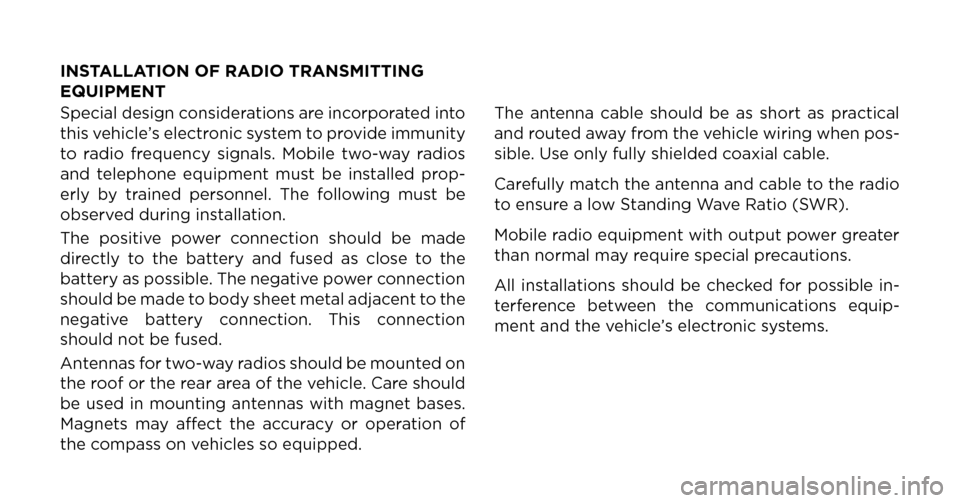
INSTALLATION OF RADIO TRANSMITTING
EQUIPMENT
Special design considerations are incorporated into
this vehicle’s electronic system to provide immunity
to radio frequency signals. Mobile two-way radios
and telephone equipment must be installed prop-
erly by trained personnel. The following must be
observed during installation.
The positive power connection should be made
directly to the battery and fused as close to the
battery as possible. The negative power connection
should be made to body sheet metal adjacent to the
negative battery connection. This connection
should not be fused.
Antennas for two-way radios should be mounted on
the roof or the rear area of the vehicle. Care should
be used in mounting antennas with magnet bases.
Magnets may affect the accuracy or operation of
the compass on vehicles so equipped.
The antenna cable should be as short as practical
and routed away from the vehicle wiring when pos-
sible. Use only fully shielded coaxial cable.
Carefully match the antenna and cable to the radio
to ensure a low Standing Wave Ratio (SWR).
Mobile radio equipment with output power greater
than normal may require special precautions.
All installations should be checked for possible in-
terference between the communications equip-
ment and the vehicle’s electronic systems.