Page 419 of 717
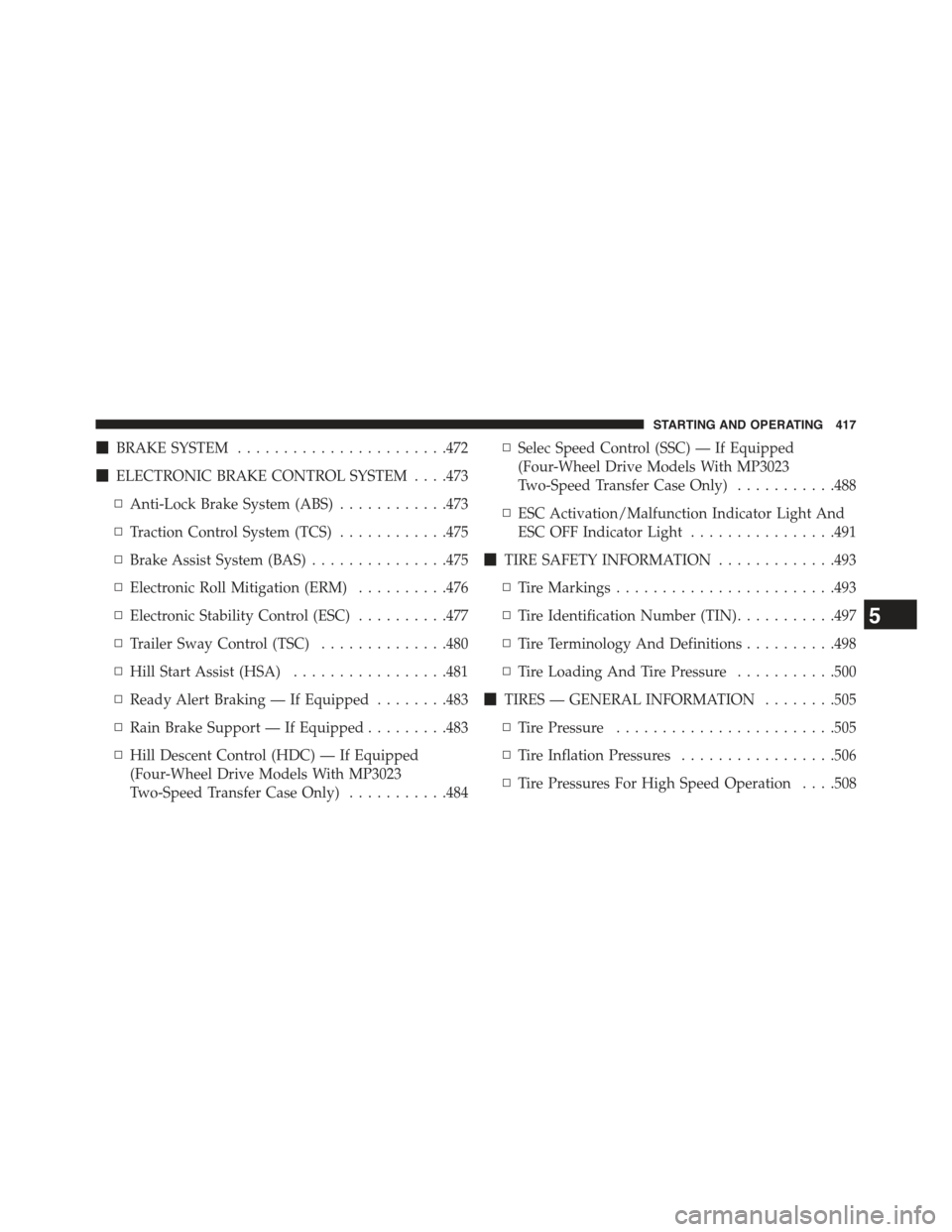
!BRAKE SYSTEM.......................472
!ELECTRONIC BRAKE CONTROL SYSTEM . . . .473
▫Anti-Lock Brake System (ABS)............473
▫Traction Control System (TCS)............475
▫Brake Assist System (BAS)...............475
▫Electronic Roll Mitigation (ERM)..........476
▫Electronic Stability Control (ESC)..........477
▫Trailer Sway Control (TSC)..............480
▫Hill Start Assist (HSA).................481
▫Ready Alert Braking — If Equipped........483
▫Rain Brake Support — If Equipped.........483
▫Hill Descent Control (HDC) — If Equipped
(Four-Wheel Drive Models With MP3023
Two-Speed Transfer Case Only)...........484
▫Selec Speed Control (SSC) — If Equipped
(Four-Wheel Drive Models With MP3023
Two-Speed Transfer Case Only)...........488
▫ESC Activation/Malfunction Indicator Light And
ESC OFF Indicator Light................491
!TIRE SAFETY INFORMATION.............493
▫Tire Markings........................493
▫Tire Identification Number (TIN)...........497
▫Tire Terminology And Definitions..........498
▫Tire Loading And Tire Pressure...........500
!TIRES — GENERAL INFORMATION........505
▫Tire Pressure........................505
▫Tire Inflation Pressures.................506
▫Tire Pressures For High Speed Operation . . . .508
5
STARTING AND OPERATING 417
Page 421 of 717
▫Carbon Monoxide Warnings.............531
!FLEXIBLE FUEL (3.6L ENGINE ONLY) — IF
EQUIPPED...........................532
▫E-85 General Information...............532
▫Ethanol Fuel (E-85)....................533
▫Fuel Requirements....................533
▫Selection Of Engine Oil For Flexible Fuel Vehicles
(E-85) And Gasoline Vehicles.............534
▫Starting............................535
▫Cruising Range.......................535
▫Replacement Parts....................535
▫Maintenance........................535
!ADDING FUEL........................536
▫Emergency Fuel Filler Door Release.........538
!VEHICLE LOADING....................539
▫Certification Label....................539
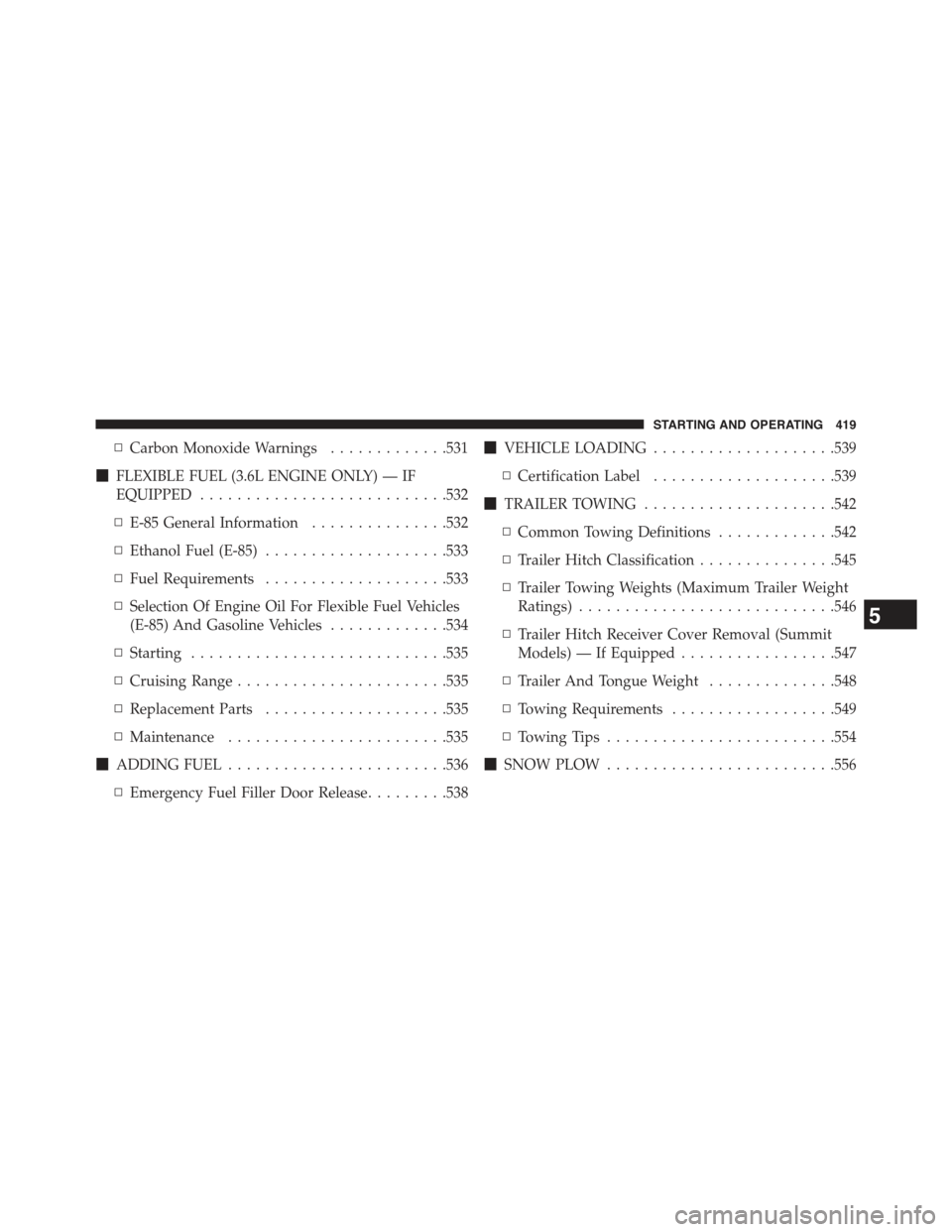
!TRAILER TOWING.....................542
▫Common Towing Definitions.............542
▫Trailer Hitch Classification...............545
▫Trailer Towing Weights (Maximum Trailer Weight
Ratings)............................546
▫Trailer Hitch Receiver Cover Removal (Summit
Models) — If Equipped.................547
▫Trailer And Tongue Weight..............548
▫Towing Requirements..................549
▫Towing Tips.........................554
!SNOW PLOW.........................556
5
STARTING AND OPERATING 419
Page 438 of 717
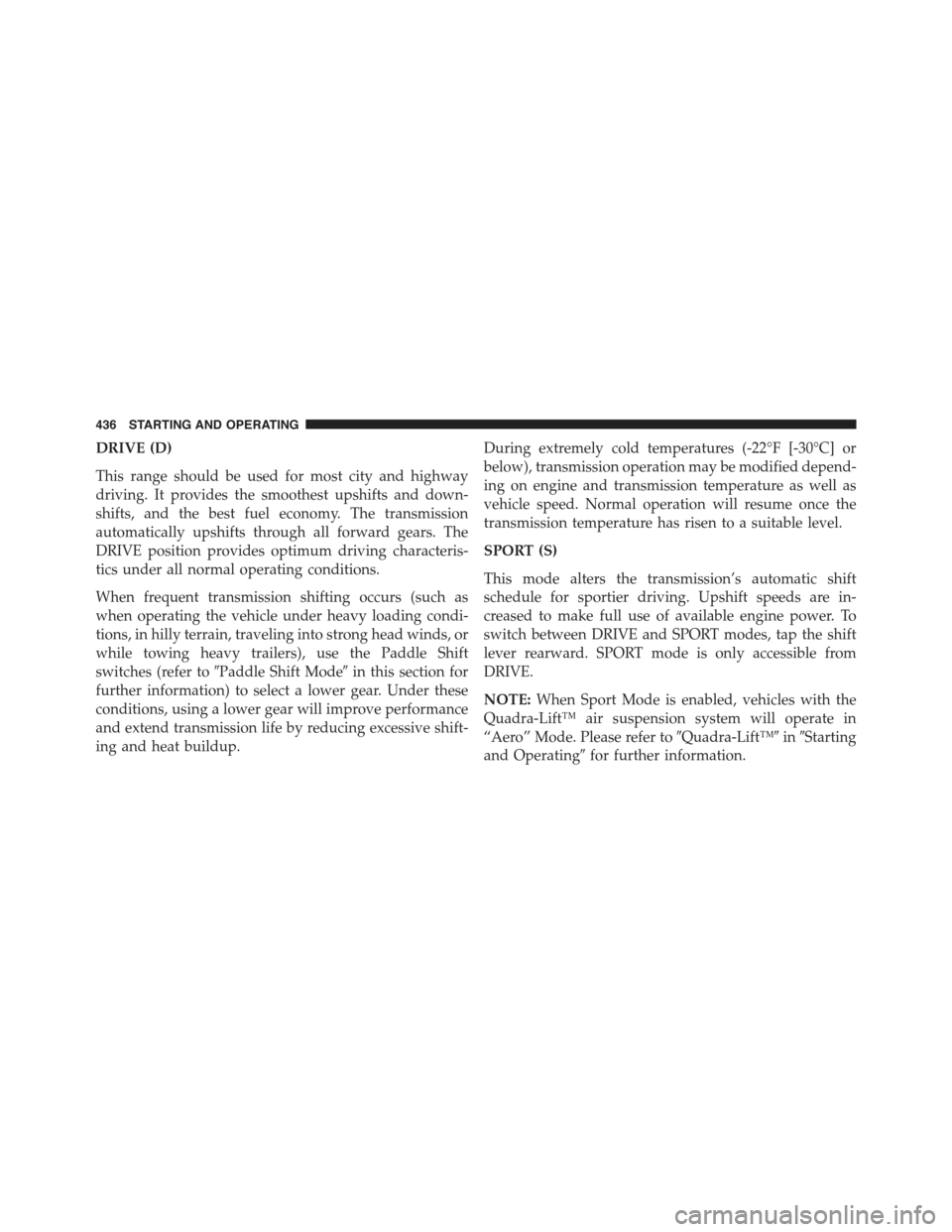
DRIVE (D)
This range should be used for most city and highway
driving. It provides the smoothest upshifts and down-
shifts, and the best fuel economy. The transmission
automatically upshifts through all forward gears. The
DRIVE position provides optimum driving characteris-
tics under all normal operating conditions.
When frequent transmission shifting occurs (such as
when operating the vehicle under heavy loading condi-
tions, in hilly terrain, traveling into strong head winds, or
while towing heavy trailers), use the Paddle Shift
switches (refer to#Paddle Shift Mode#in this section for
further information) to select a lower gear. Under these
conditions, using a lower gear will improve performance
and extend transmission life by reducing excessive shift-
ing and heat buildup.
During extremely cold temperatures (-22°F [-30°C] or
below), transmission operation may be modified depend-
ing on engine and transmission temperature as well as
vehicle speed. Normal operation will resume once the
transmission temperature has risen to a suitable level.
SPORT (S)
This mode alters the transmission’s automatic shift
schedule for sportier driving. Upshift speeds are in-
creased to make full use of available engine power. To
switch between DRIVE and SPORT modes, tap the shift
lever rearward. SPORT mode is only accessible from
DRIVE.
NOTE:When Sport Mode is enabled, vehicles with the
Quadra-Lift™ air suspension system will operate in
“Aero” Mode. Please refer to#Quadra-Lift™#in#Starting
and Operating#for further information.
436 STARTING AND OPERATING
Page 440 of 717
NOTE:Even if the transmission can be reset, we recom-
mend that you visit your authorized dealer at your
earliest possible convenience. Your authorized dealer has
diagnostic equipment to determine if the problem could
recur.
If the transmission cannot be reset, authorized dealer
service is required.
Paddle Shift Mode
Paddle Shift mode is a driver-interactive transmission
feature providing manual shift control, giving you more
control of the vehicle. Paddle Shift allows you to maxi-
mize engine braking, eliminate undesirable upshifts and
downshifts, and improve overall vehicle performance.
This system can also provide you with more control
during passing, city driving, cold slippery conditions,
mountain driving, trailer towing, and many other situa-
tions.
Operation
When the transmission is in DRIVE or SPORT mode, it
will operate automatically, shifting between the eight
available gears. To activate Paddle Shift mode, simply tap
one of the steering wheel-mounted shift paddles (+/-)
while in DRIVE or SPORT mode. Tapping (-) to enter
Paddle Shift mode will downshift the transmission to the
next lower gear, while using (+) to enter Paddle Shift
mode will retain the current gear. When Paddle Shift
mode is active, the current transmission gear is displayed
in the instrument cluster.
In Paddle Shift mode, the transmission will shift up or
down when (+/-) is manually selected by the driver,
unless an engine lugging or overspeed condition would
result. It will remain in the selected gear until another
upshift or downshift is chosen, except as described
below.
438 STARTING AND OPERATING
Page 475 of 717
In the event power assist is lost for any reason (i.e.,
repeated brake applications with the engine off) the
brakes will still function. However, the effort required to
brake the vehicle will be much greater than that required
with the power system operating.
ELECTRONIC BRAKE CONTROL SYSTEM
Your vehicle is equipped with an advanced electronic
brake control system that includes the Anti-Lock Brake
System (ABS), Traction Control System (TCS), Brake
Assist System (BAS), Electronic Roll Mitigation (ERM),
and Electronic Stability Control (ESC). All five of these
systems work together to enhance vehicle stability and
control in various driving conditions.
Also, your vehicle may be equipped with Trailer Sway
Control (TSC), Hill Start Assist (HSA), Ready Alert
Braking (RAB), Rain Brake Support (RBS) and, if it has
four-wheel drive with the MP 3023 two-speed transfer
case, Hill Descent Control (HDC), Selec Speed Control
(SSC).
Anti-Lock Brake System (ABS)
The Anti-Lock Brake System (ABS) is designed to aid the
driver in maintaining vehicle control under adverse
braking conditions. The system operates with a separate
computer to modulate hydraulic pressure to prevent
wheel lock-up and help avoid skidding on slippery
surfaces.
All vehicle wheels and tires must be the same size and
type, and tires must be properly inflated to produce
accurate signals for the computer.
5
STARTING AND OPERATING 473
Page 482 of 717

WARNING!
•When in “Partial Off” mode, the TCS functionality
of ESC, (except for the limited slip feature de-
scribed in the TCS section), has been disabled and
the “ESC Off Indicator Light” will be illuminated.
When in “Partial Off” mode, the engine power
reduction feature of TCS is disabled, and the
enhanced vehicle stability offered by the ESC sys-
tem is reduced.
•Trailer Sway Control (TSC) is disabled when the
ESC system is in the'Partial Off'mode.
4WD Low Range
Partial Off
This is the normal operating mode for ESC in 4WD LOW
range. Whenever the vehicle is started in 4WD LOW
range, or the transfer case (if equipped) is shifted from
4WD HIGH range or NEUTRAL to 4WD LOW range, the
ESC system will be in the “Partial Off” mode.
Trailer Sway Control (TSC)
TSC uses sensors in the vehicle to recognize an exces-
sively swaying trailer and will take the appropriate
actions to attempt to stop the sway. The system may
reduce engine power and apply the brake of the appro-
priate wheel(s) to counteract the sway of the trailer. TSC
will become active automatically once an excessively
swaying trailer is recognized. Note that TSC cannot stop
all trailers from swaying. Always use caution when
towing a trailer and follow the trailer tongue weight
recommendations. Refer to “Trailer Towing” in this sec-
tion for further information. When TSC is functioning,
the “ESC Activation/Malfunction Indicator Light” will
flash, the engine power may be reduced and you may
feel the brakes being applied to individual wheels to
480 STARTING AND OPERATING
Page 483 of 717
attempt to stop the trailer from swaying. TSC is disabled
when the ESC system is in the “Partial Off” mode.
WARNING!
If TSC activates while driving, slow the vehicle
down, stop at the nearest safe location, and adjust the
trailer load to eliminate trailer sway.
Hill Start Assist (HSA)
The HSA system is designed to assist the driver when
starting a vehicle from a stop on a hill. HSA will maintain
the level of brake pressure the driver applied for a short
period of time after the driver takes their foot off of the
brake pedal. If the driver does not apply the throttle
during this short period of time, the system will release
brake pressure and the vehicle will roll down the hill. The
system will release brake pressure in proportion to the
amount of throttle applied as the vehicle starts to move in
the intended direction of travel.
HSA Activation Criteria
The following criteria must be met in order for HSA to
activate:
•Vehicle must be stopped.
•Vehicle must be on a 6% (approximate) grade or
greater hill.
•Gear selection matches vehicle uphill direction (i.e.,
vehicle facing uphill is in forward gear; vehicle back-
ing uphill is in REVERSE gear).
HSA will work in REVERSE and all forward gears when
the activation criteria have been met. The system will not
activate if the vehicle is placed in NEUTRAL or PARK.
5
STARTING AND OPERATING 481
Page 484 of 717
WARNING!
There may be situations on minor hills with a loaded
vehicle, or while pulling a trailer, when the system
will not activate and slight rolling may occur. This
could cause a collision with another vehicle or object.
Always remember the driver is responsible for brak-
ing the vehicle.
Towing With HSA
HSA will provide assistance when starting on a grade
when pulling a trailer.
WARNING!
•If you use a trailer brake controller with your
trailer, your trailer brakes may be activated and
deactivated with the brake switch. If so, when the
brake pedal is released, there may not be enough
brake pressure to hold the vehicle and trailer on a
hill and this could cause a collision with another
vehicle or object behind you. In order to avoid
rolling down the hill while resuming acceleration,
manually activate the trailer brake prior to releas-
ing the brake pedal. Always remember the driver is
responsible for braking the vehicle.
(Continued)
482 STARTING AND OPERATING