Page 12 of 120
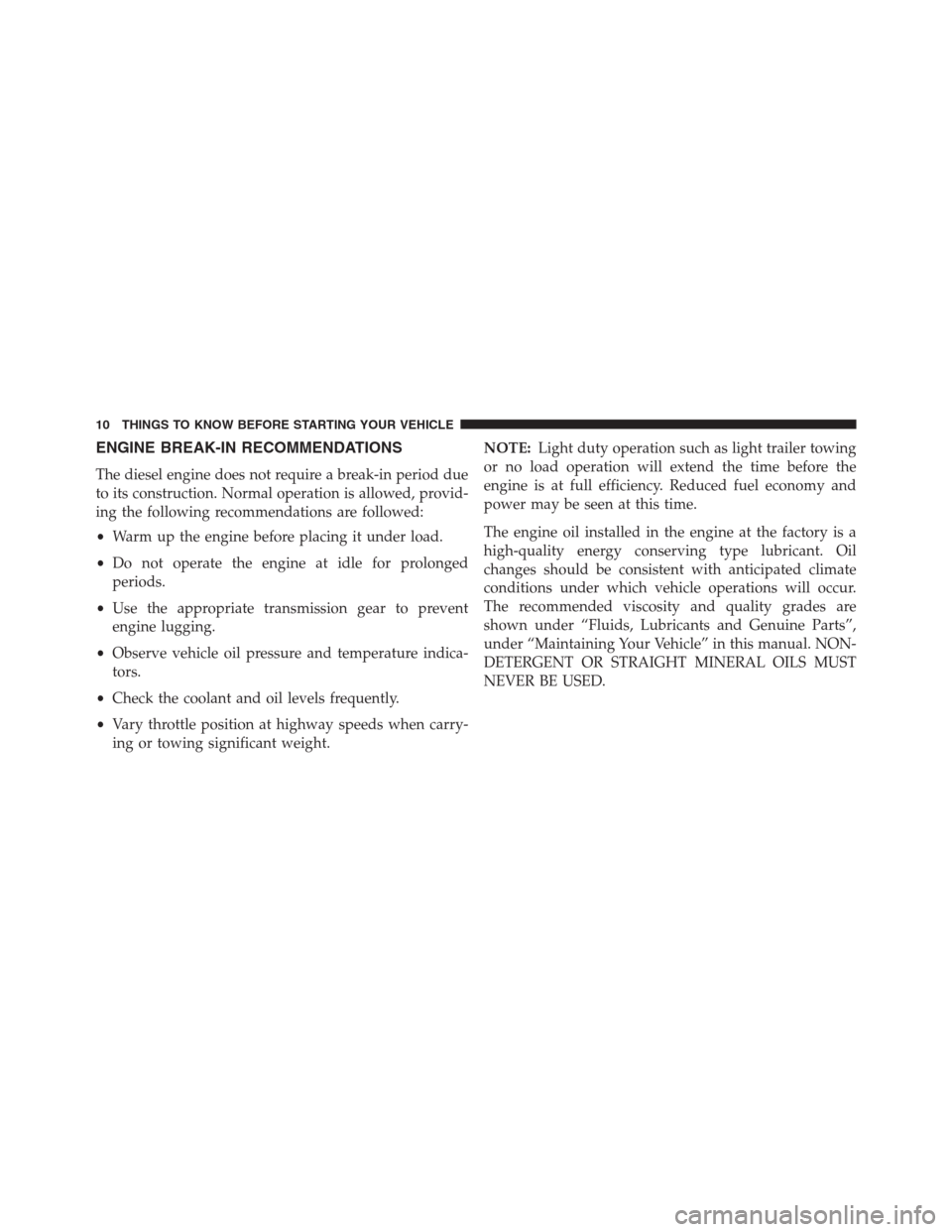
ENGINE BREAK-IN RECOMMENDATIONS
The diesel engine does not require a break-in period due
to its construction. Normal operation is allowed, provid-
ing the following recommendations are followed:
•Warm up the engine before placing it under load.
•Do not operate the engine at idle for prolonged
periods.
•Use the appropriate transmission gear to prevent
engine lugging.
•Observe vehicle oil pressure and temperature indica-
tors.
•Check the coolant and oil levels frequently.
•Vary throttle position at highway speeds when carry-
ing or towing significant weight.NOTE:Light duty operation such as light trailer towing
or no load operation will extend the time before the
engine is at full efficiency. Reduced fuel economy and
power may be seen at this time.
The engine oil installed in the engine at the factory is a
high-quality energy conserving type lubricant. Oil
changes should be consistent with anticipated climate
conditions under which vehicle operations will occur.
The recommended viscosity and quality grades are
shown under “Fluids, Lubricants and Genuine Parts”,
under “Maintaining Your Vehicle” in this manual. NON-
DETERGENT OR STRAIGHT MINERAL OILS MUST
NEVER BE USED.
10 THINGS TO KNOW BEFORE STARTING YOUR VEHICLE
Page 46 of 120

NOTE:Under certain conditions the engine fan will run
after the engine is turned off. These conditions are under
high load and high temperature conditions.
Cooling System Tips — Automatic Transmission
To reduce the potential for engine and transmission
overheating in high ambient temperature conditions,
take the following actions:
•City Driving — When stopped, shift the transmission
into NEUTRAL and increase engine idle speed.
•Highway Driving — Reduce your speed.
•Up Steep Hills — Select a lower transmission gear.
•Air Conditioning — Turn it off temporarily.
NOTE:If the coolant temperature is too high the A/C
will automatically turn off.
Do Not Operate The Engine With Low Oil
Pressure
If the low oil pressure warning light turns on while
driving, stop the vehicle and shut down the engine as
soon as possible. A chime will sound when the light turns
on.
NOTE:Do not operate the vehicle until the cause is
corrected. This light does not show how much oil is in the
engine. The engine oil level must be checked under the
hood.
CAUTION!
If oil pressure falls to less than normal readings, shut
the engine off immediately. Failure to do so could
result in immediate and severe engine damage.
44 STARTING AND OPERATING
Page 93 of 120

Please review these recommendations for using Organic
Additive Technology (OAT) engine coolant (antifreeze)
that meets the requirements of FCA Material Standard
MS.90032. When adding engine coolant (antifreeze):
•We recommend using MOPAR® Antifreeze/Coolant
10 Year/150,000 Mile Formula OAT (Organic Additive
Technology) that meets the requirements of FCA Ma-
terial Standard MS.90032.
•Mix a minimum solution of 50% OAT engine coolant
that meets the requirements of FCA Material Standard
MS.90032 and distilled water. Use higher concentra-
tions (not to exceed 70%) if temperatures below 34° F
(37° C) are anticipated.
•Use only high purity water such as distilled or deion-
ized water when mixing the water/engine coolant
(antifreeze) solution. The use of lower quality water
will reduce the amount of corrosion protection in the
engine cooling system.Please note that it is the owner’s responsibility to main-
tain the proper level of protection against freezing ac-
cording to the temperatures occurring in the area where
the vehicle is operated.
NOTE:
•Some vehicles require special tools to add coolant
properly. Failure to fill these systems properly could
lead to severe internal engine damage. If any coolant is
needed to be added to the system please contact your
local authorized dealer.
•Mixing engine coolant (antifreeze) types is not recom-
mended and can result in cooling system damage. If
HOAT and OAT coolant are mixed in an emergency,
have a authorized dealer drain, flush, and refill with
OAT coolant (conforming to MS.90032) as soon as
possible.
5
MAINTAINING YOUR VEHICLE 91
Page 105 of 120
Engine Oil Filter Replacement
Residual oil in the housing may spill from the housing
when the new filter is installed if the residual oil is not
either removed from the housing or enough time has not
elapsed to allow the oil to drain back into the engine.
When servicing the oil filter on this engine, carefully
remove the filter and use a suction gun to remove any
residual oil left in the housing or wait about 30 minutes
for the oil to drain back into the engine.
Once A Month Or Before A Long Trip:
•Check engine oil level
•Check windshield washer fluid level
•Check the tire inflation pressures and look for unusual
wear or damage•Check the fluid levels of the coolant reservoir, brake
master cylinder, power steering and transmission as
needed
•Check function of all interior and exterior lights
Required Maintenance
Refer to the Maintenance Schedules on the following
pages for required maintenance.
6
MAINTENANCE SCHEDULE 103
Page 114 of 120

Adding Engine Coolant (Antifreeze).............90
Adding Fuel..............................65
Air Bag Light.............................21
Air Cleaner, Engine (Engine Air Cleaner Filter).....78
Air Conditioning Filter......................79
Alarm (Security Alarm)......................21
Antifreeze (Engine Coolant)...................89
Capacities.............................96
Disposal..............................92
Anti-Lock Warning Light.....................13
Automatic Transmission
Fluid Type.............................99
Axle Fluid...............................99
Battery.................................87
Brake Fluid..............................99
Brake System.............................94
Fluid Check............................94
Master Cylinder.........................94Warning Light..........................17
Capacities, Antifreeze (Engine Coolant)...........96
Capacities, Fluid...........................96
Caps, Filler
Oil (Engine)............................77
Radiator (Coolant Pressure).................92
Charge Air Cooler.........................94
Coolant Pressure Cap (Radiator Cap)............92
Cooling System...........................88
Adding Coolant (Antifreeze)................90
Coolant Capacity........................96
Coolant Level...........................88
Disposal Of Used Coolant..................92
Drain, Flush, And Refill...................89
Points To Remember......................93
Pressure Cap...........................92
Radiator Cap...........................92
112 INDEX
Page 116 of 120
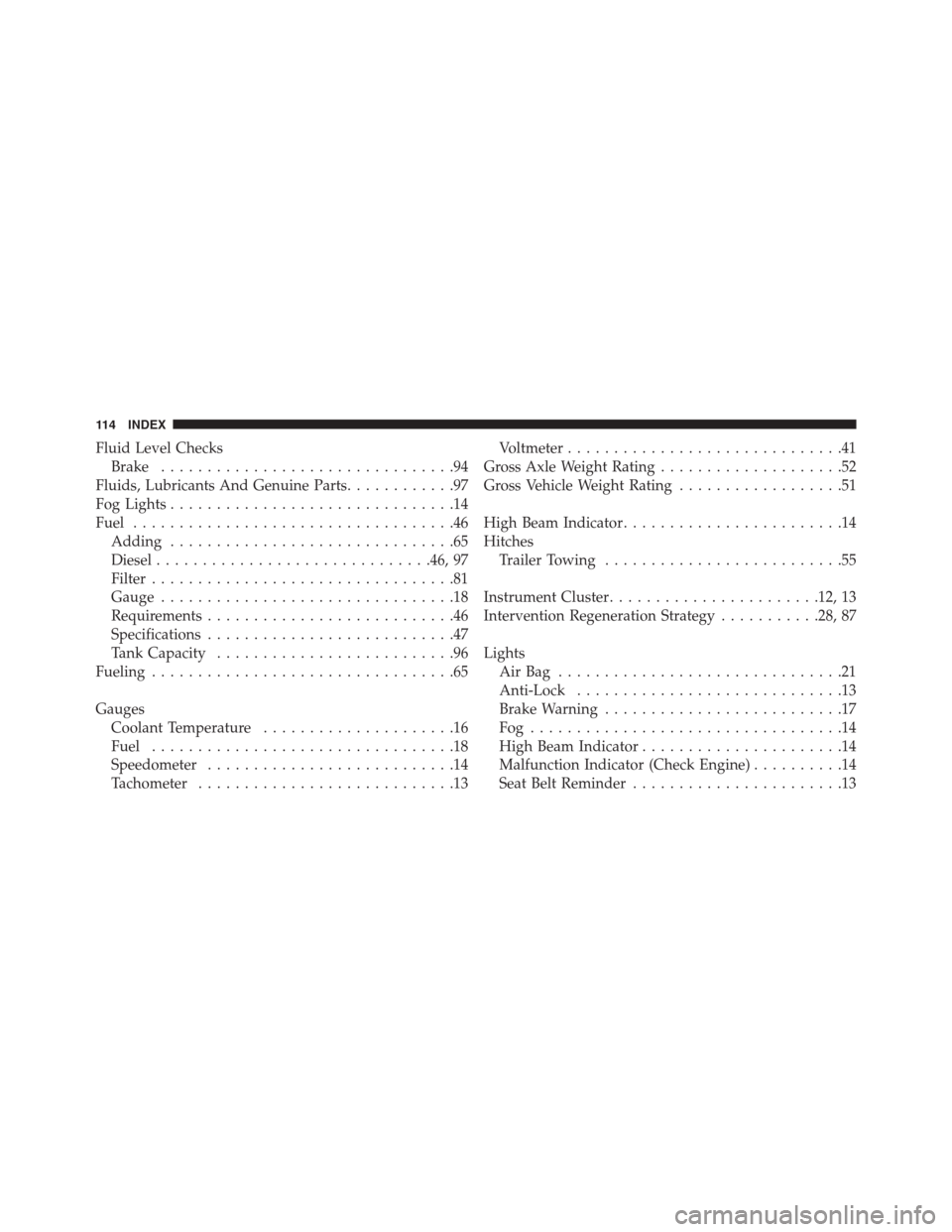
Fluid Level Checks
Brake................................94
Fluids, Lubricants And Genuine Parts............97
Fog Lights...............................14
Fuel...................................46
Adding...............................65
Diesel..............................46, 97
Filter.................................81
Gauge................................18
Requirements...........................46
Specifications...........................47
Tank Capacity..........................96
Fueling.................................65
Gauges
Coolant Temperature.....................16
Fuel.................................18
Speedometer...........................14
Tachometer............................13Voltmeter..............................41
Gross Axle Weight Rating....................52
Gross Vehicle Weight Rating..................51
High Beam Indicator........................14
Hitches
Trailer Towing..........................55
Instrument Cluster.......................12, 13
Intervention Regeneration Strategy...........28, 87
Lights
AirBag ...............................21
Anti-Lock.............................13
Brake Warning..........................17
Fog ..................................14
High Beam Indicator......................14
Malfunction Indicator (Check Engine)..........14
Seat Belt Reminder.......................13
114 INDEX
