Page 436 of 560
3. Set the parking brake.
4. Place the shift lever in PARK (automatic transmission)
or REVERSE (manual transmission).
5. Turn OFF the ignition.
6. Block both the front and rear of the wheel diagonally
opposite of the jacking position.
For example, if changing the right
front tire, block the left rear wheel.
NOTE:Passengers should not remain in the vehicle
while the vehicle is being jacked.
Jacking Instructions
WARNING!
Carefully follow these tire changing warnings to help
prevent personal injury or damage to your vehicle:
•Always park on a firm, level surface as far from the
edge of the roadway as possible before raising the
vehicle.
•Turn on the Hazard Warning flasher.
•Block the wheel diagonally opposite the wheel to
be raised.
•Set the parking brake firmly and set an automatic
transmission in PARK; a manual transmission in
REVERSE.
•Never start or run the engine with the vehicle on a
jack.
(Continued)
434 WHAT TO DO IN EMERGENCIES
Page 456 of 560

WARNING!
•Take care to avoid the radiator cooling fan when-
ever the hood is raised. It can start anytime the
ignition switch is ON. You can be injured by
moving fan blades.
•Remove any metal jewelry such as rings, watch
bands and bracelets that could make an inadvertent
electrical contact. You could be seriously injured.
•Batteries contain sulfuric acid that can burn your
skin or eyes and generate hydrogen gas which is
flammable and explosive. Keep open flames or
sparks away from the battery.
1. Set the parking brake, shift the automatic transmission
into PARK (manual transmission to NEUTRAL) and
turn the ignition to LOCK.
2. Turn off the heater, radio, and all unnecessary electri-
cal accessories.
3. If using another vehicle to jump-start the battery, park
the vehicle within the jumper cables reach, set the
parking brake and make sure the ignition is OFF.
WARNING!
Do not allow vehicles to touch each other as this
could establish a ground connection and personal
injury could result.
Jump-Starting Procedure
WARNING!
Failure to follow this jump-starting procedure could
result in personal injury or property damage due to
battery explosion.
454 WHAT TO DO IN EMERGENCIES
Page 459 of 560

FREEING A STUCK VEHICLE
If your vehicle becomes stuck in mud, sand or snow, it can
often be moved using a rocking motion. Turn the steering
wheel right and left to clear the area around the front
wheels. Then shift back and forth between DRIVE and
REVERSE (with automatic transmission) or 2nd gear and
REVERSE (with manual transmission), while gently press-
ing the accelerator. Use the least amount of accelerator
pedal pressure that will maintain the rocking motion,
without spinning the wheels, or racing the engine.
CAUTION!
Racing the engine or spinning the wheels may lead to
transmission overheating and failure. Allow the en-
gine to idle with the transmission in NEUTRAL for at
least one minute after every five rocking-motion
cycles. This will minimize overheating and reduce
(Continued)
CAUTION!(Continued)
the risk of clutch or transmission failure during
prolonged efforts to free a stuck vehicle.
NOTE:Press the#ESC Off#switch, to place the Electronic
Stability Control (ESC) system in#Partial Off#mode,
before rocking the vehicle. Refer to “Electronic Brake
Control” in “Starting And Operating” for further infor-
mation. Once the vehicle has been freed, press the#ESC
Off#switch again to restore#ESC On#mode.
CAUTION!
•When “rocking” a stuck vehicle by shifting be-
tween DRIVE/2nd gear and REVERSE, do not spin
the wheels faster than 15 mph (24 km/h), or drive-
train damage may result.
(Continued)
6
WHAT TO DO IN EMERGENCIES 457
Page 462 of 560
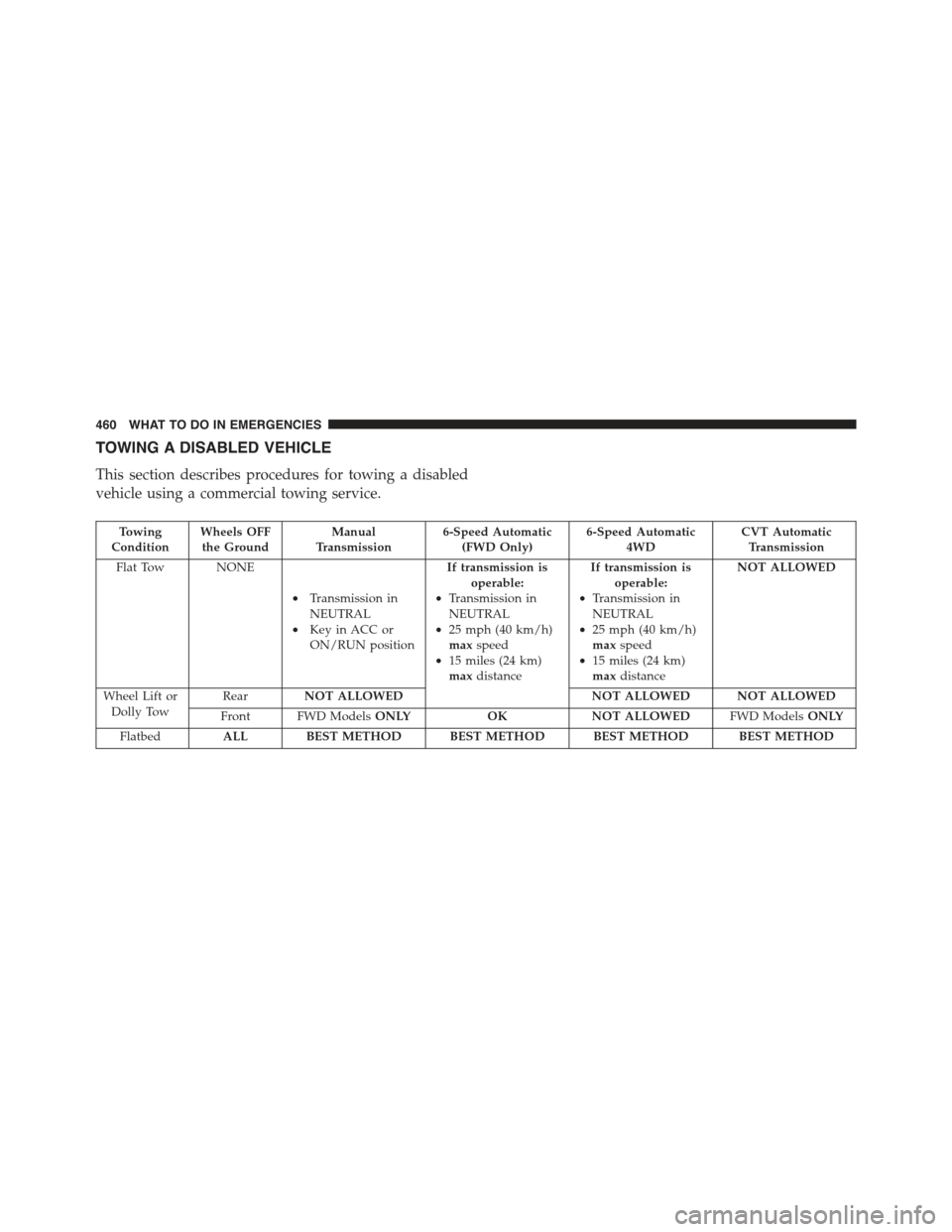
TOWING A DISABLED VEHICLE
This section describes procedures for towing a disabled
vehicle using a commercial towing service.
To w i n gConditionWheels OFFthe GroundManualTransmission6-Speed Automatic(FWD Only)6-Speed Automatic4WDCVT AutomaticTransmission
Flat Tow NONE
•Transmission inNEUTRAL•Key in ACC orON/RUN position
If transmission isoperable:•Transmission inNEUTRAL•25 mph (40 km/h)maxspeed•15 miles (24 km)maxdistance
If transmission isoperable:•Transmission inNEUTRAL•25 mph (40 km/h)maxspeed•15 miles (24 km)maxdistance
NOT ALLOWED
Wheel Lift orDolly TowRearNOT ALLOWEDNOT ALLOWED NOT ALLOWED
Front FWD ModelsONLYOKNOT ALLOWEDFWD ModelsONLY
FlatbedALL BEST METHOD BEST METHOD BEST METHOD BEST METHOD
460 WHAT TO DO IN EMERGENCIES
Page 463 of 560
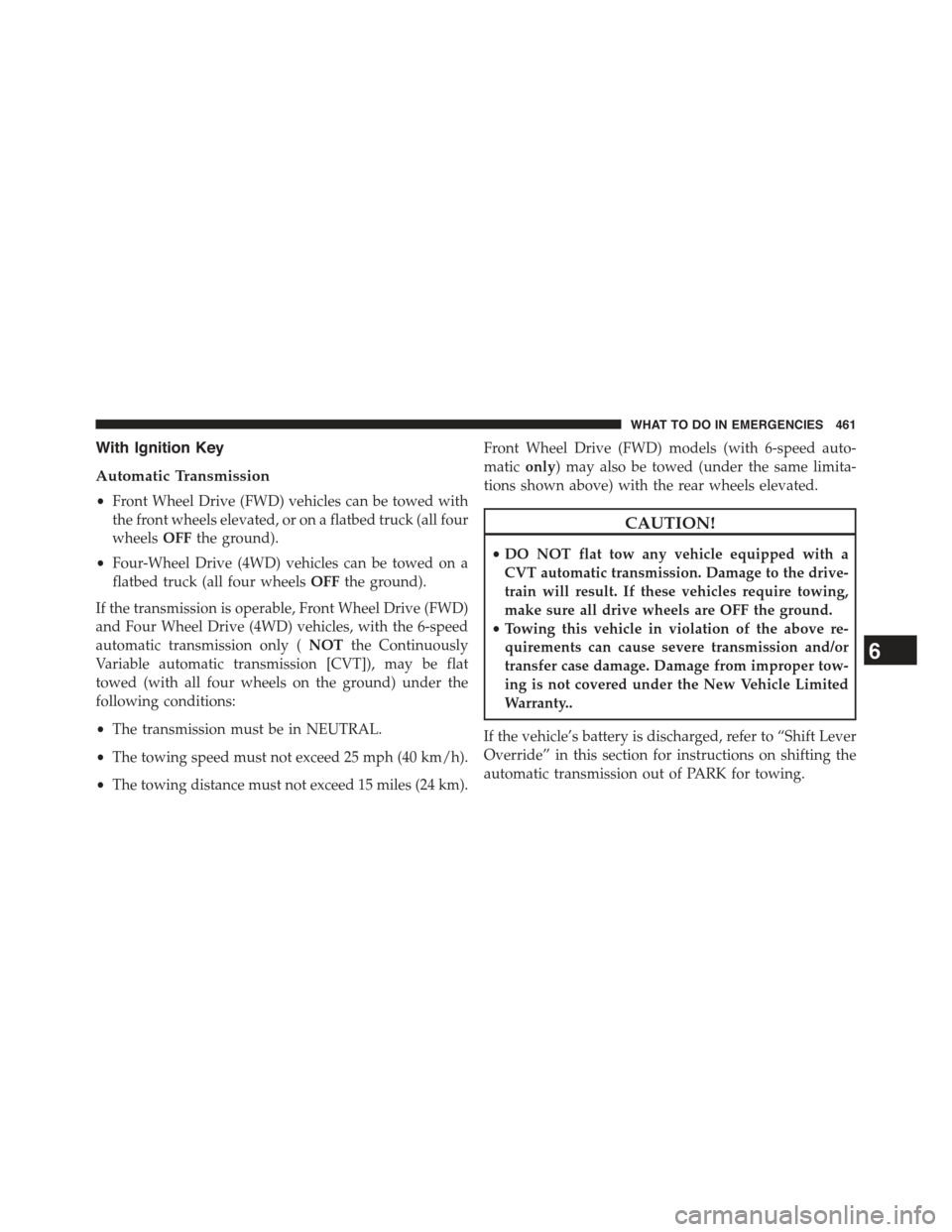
With Ignition Key
Automatic Transmission
•Front Wheel Drive (FWD) vehicles can be towed with
the front wheels elevated, or on a flatbed truck (all four
wheelsOFFthe ground).
•Four-Wheel Drive (4WD) vehicles can be towed on a
flatbed truck (all four wheelsOFFthe ground).
If the transmission is operable, Front Wheel Drive (FWD)
and Four Wheel Drive (4WD) vehicles, with the 6-speed
automatic transmission only (NOTthe Continuously
Variable automatic transmission [CVT]), may be flat
towed (with all four wheels on the ground) under the
following conditions:
•The transmission must be in NEUTRAL.
•The towing speed must not exceed 25 mph (40 km/h).
•The towing distance must not exceed 15 miles (24 km).
Front Wheel Drive (FWD) models (with 6-speed auto-
maticonly) may also be towed (under the same limita-
tions shown above) with the rear wheels elevated.
CAUTION!
•DO NOT flat tow any vehicle equipped with a
CVT automatic transmission. Damage to the drive-
train will result. If these vehicles require towing,
make sure all drive wheels are OFF the ground.
•Towing this vehicle in violation of the above re-
quirements can cause severe transmission and/or
transfer case damage. Damage from improper tow-
ing is not covered under the New Vehicle Limited
Warranty..
If the vehicle’s battery is discharged, refer to “Shift Lever
Override” in this section for instructions on shifting the
automatic transmission out of PARK for towing.
6
WHAT TO DO IN EMERGENCIES 461
Page 468 of 560

▫Automatic Transmission (Six-Speed) —
If Equipped.........................494
▫Automatic Transmission (CVT) —
If Equipped.........................496
▫Manual Transmission — If Equipped.......498
▫Rear Drive Assembly (RDA) — AWD/4WD
Models Only........................498
▫Power Transfer Unit (PTU) — AWD/4WD
Models Only........................499
▫Appearance Care And Protection From
Corrosion...........................499
!FUSES..............................506
▫Integrated Power Module...............507
!VEHICLE STORAGE....................511
!REPLACEMENT BULBS..................511
!BULB REPLACEMENT..................512
▫Headlamps.........................512
▫Fog Lamps..........................513
▫Rear Turn Signal And Backup Lamp........513
▫License Lamps.......................514
▫Center High-Mounted Stoplamp..........514
!FLUID CAPACITIES....................514
!FLUIDS, LUBRICANTS AND GENUINE
PA R T S . . . . . . . . . . . . . . . . . . . . . . . . . . . . ..515
▫Engine.............................515
▫Chassis............................517
466 MAINTAINING YOUR VEHICLE
Page 471 of 560

ONBOARD DIAGNOSTIC SYSTEM — OBD II
Your vehicle is equipped with a sophisticated onboard
diagnostic system called OBD II. This system monitors
the performance of the emissions, engine, and automatic
transmission control systems. When these systems are
operating properly, your vehicle will provide excellent
performance and fuel economy, as well as engine emis-
sions well within current government regulations.
If any of these systems require service, the OBD II system
will turn on the “Malfunction Indicator Light” (MIL). It
will also store diagnostic codes and other information to
assist your service technician in making repairs. Al-
though your vehicle will usually be drivable and not
need towing, see your authorized dealer for service as
soon as possible.
CAUTION!
•Prolonged driving with the MIL on could cause
further damage to the emission control system. It
could also affect fuel economy and driveability.
The vehicle must be serviced before any emissions
tests can be performed.
•If the MIL is flashing while the engine is running,
severe catalytic converter damage and power loss
will soon occur. Immediate service is required.
Loose Fuel Filler Cap Message
After fuel is added, the vehicle diagnostic system can
determine if the fuel filler cap is possibly loose or
improperly installed. A “gASCAP” message will be dis-
played in the instrument cluster. Tighten the gas cap until
a#clicking#sound is heard. This is an indication that the
gas cap is properly tightened. Press the trip odometer
7
MAINTAINING YOUR VEHICLE 469
Page 496 of 560

Automatic Transmission (Six-Speed) —
If Equipped
Selection Of Lubricant (Six-Speed Transmission)
It is important to use the proper transmission fluid to
ensure optimum transmission performance and life. Use
only the manufacturer ’s specified transmission fluid.
Refer to “Fluids, Lubricants, and Genuine Parts” in this
section for fluid specifications. It is important to maintain
the transmission fluid at the correct level using the
recommended fluid.
No chemical flushes should be used in any transmission;
only the approved lubricant should be used.
CAUTION!
Using a transmission fluid other than the manufac-
turer ’s recommended fluid may cause deterioration
(Continued)
CAUTION!(Continued)
in transmission shift quality and/or torque converter
shudder. Refer to “Fluids, Lubricants, and Genuine
Parts” in this section for fluid specifications.
Special Additives
The manufacturer strongly recommends against using
any special additives in the transmission.
Automatic Transmission Fluid (ATF) is an engineered
product and its performance may be impaired by supple-
mental additives. Therefore, do not add any fluid addi-
tives to the transmission. The only exception to this
policy is the use of special dyes for diagnosing fluid
leaks. Avoid using transmission sealers as they may
adversely affect seals.
494 MAINTAINING YOUR VEHICLE