Page 574 of 653
7-33
7
Maintenance
✽✽NOTICE
Use only the specified brake fluid
(refer to “Recommended Lubricants
and Capacities” in chapter 8).
Do not allow brake fluid to
contact the vehicle’s body
paint, as paint damage willresult.
Brake fluid, which has been
exposed to open air for an
extended time should NEVERbe used as its quality cannot
be guaranteed. It should be
disposed of properly.
Do not use the wrong kind of
brake fluid. A few drops of
mineral based oil, such as
engine oil, in your brake sys-
tem can damage brake sys-
tem parts.
CAUTION
Page 575 of 653
7-34
Maintenance
WWAASSHH EERR FF LLUU IIDD
Checking the washer fluid
level
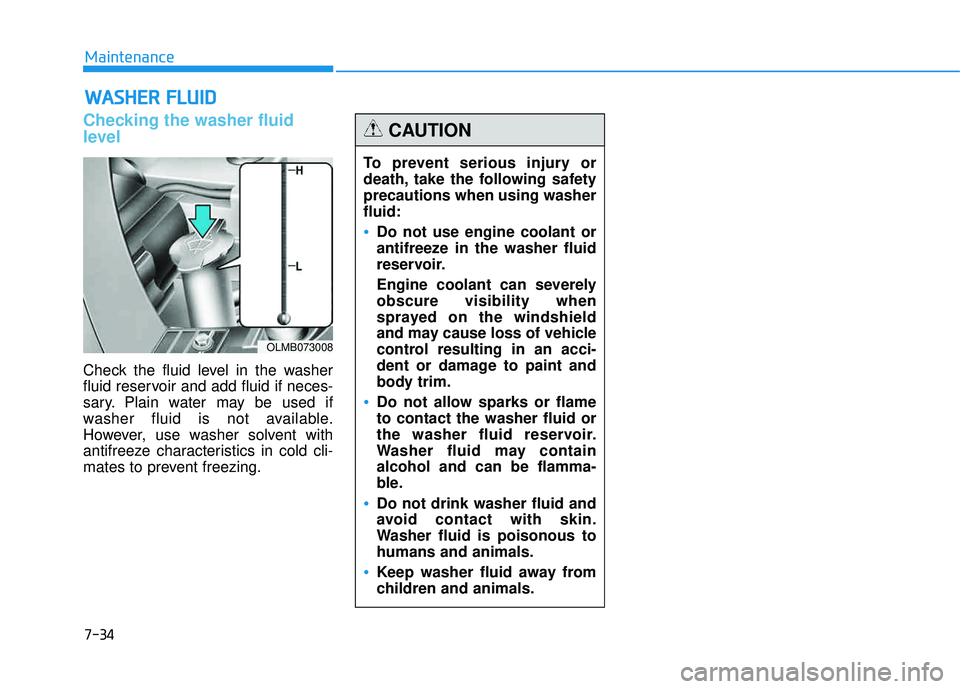
Check the fluid level in the washer
fluid reservoir and add fluid if neces-
sary. Plain water may be used if
washer fluid is not available.
However, use washer solvent with
antifreeze characteristics in cold cli-
mates to prevent freezing.
OLMB073008
To prevent serious injury or
death, take the following safetyprecautions when using washerfluid:
Do not use engine coolant or
antifreeze in the washer fluid
reservoir.
Engine coolant can severely obscure visibility when
sprayed on the windshield
and may cause loss of vehicle
control resulting in an acci-
dent or damage to paint and
body trim.
Do not allow sparks or flame to contact the washer fluid or
the washer fluid reservoir.
Washer fluid may containalcohol and can be flamma-
ble.
Do not drink washer fluid and
avoid contact with skin.
Washer fluid is poisonous tohumans and animals.
Keep washer fluid away from
children and animals.
CAUTION
Page 578 of 653
7-37
7
Maintenance
Replace the filter according to the Maintenance Schedule
✽✽NOTICE
If the vehicle is operated in extreme-
ly dusty or sandy areas, replace the
element more often than the usual
recommended intervals (refer to
“Maintenance Under Severe Usage
Conditions” in this chapter).Do not drive with the air clean-
er filter removed. This will
result in excessive engine
wear.
When removing the air clean-
er filter, be careful that dust or
dirt does not enter the air
intake, or damage may result.
Use HYUNDAI genuine parts,
use of non-genuine parts
could damage the air flow
sensor.
CAUTION
Page 585 of 653
7-44
Maintenance
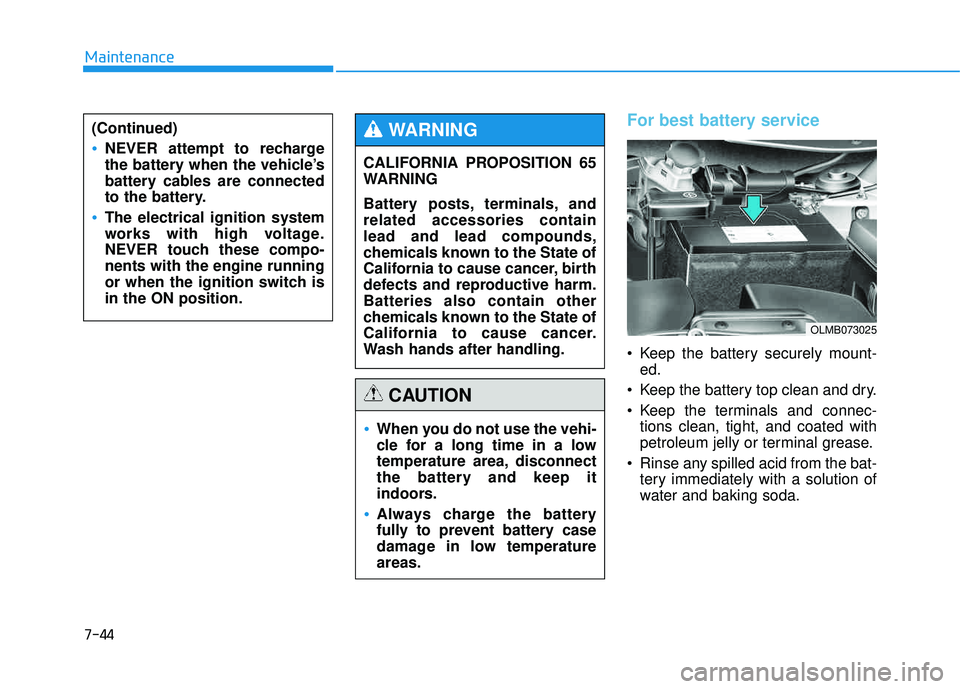
For best battery service
Keep the battery securely mount-ed.
Keep the battery top clean and dry.
Keep the terminals and connec- tions clean, tight, and coated with
petroleum jelly or terminal grease.
Rinse any spilled acid from the bat- tery immediately with a solution of
water and baking soda.
When you do not use the vehi-
cle for a long time in a low
temperature area, disconnect
the battery and keep it
indoors.
Always charge the battery
fully to prevent battery case
damage in low temperatureareas.
CAUTION
CALIFORNIA PROPOSITION 65
WARNING
Battery posts, terminals, and related accessories containlead and lead compounds,
chemicals known to the State of
California to cause cancer, birth
defects and reproductive harm.Batteries also contain other
chemicals known to the State of
California to cause cancer.
Wash hands after handling.
WARNING
OLMB073025
(Continued)
NEVER attempt to recharge
the battery when the vehicle’s
battery cables are connected
to the battery.
The electrical ignition system
works with high voltage.
NEVER touch these compo-nents with the engine running
or when the ignition switch isin the ON position.
Page 604 of 653
7-63
7
Maintenance
FFUU SSEE SS
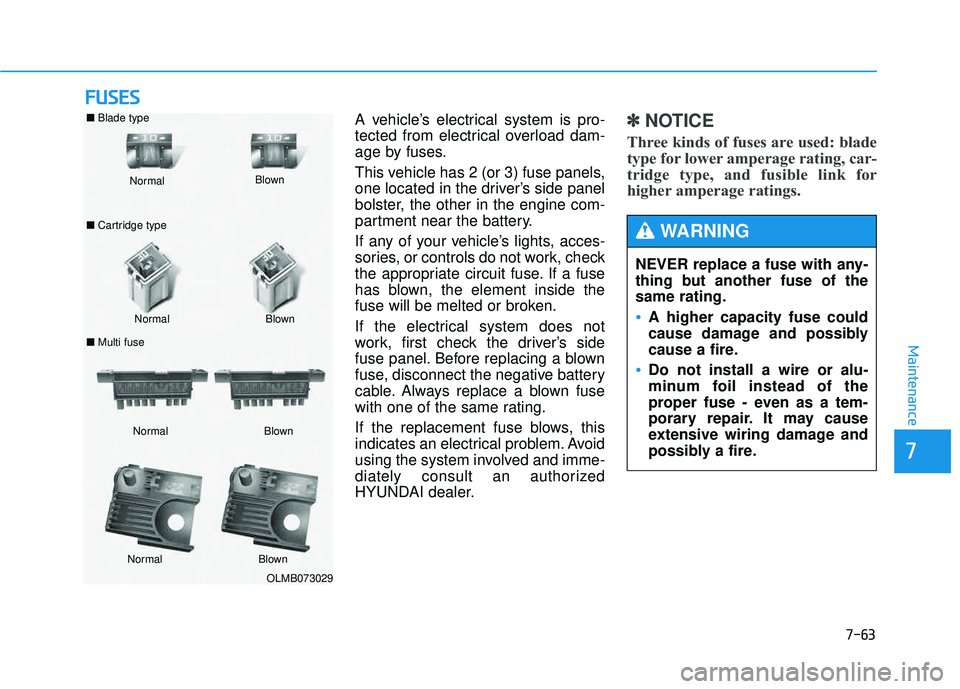
A vehicle’s electrical system is pro-
tected from electrical overload dam-
age by fuses.
This vehicle has 2 (or 3) fuse panels,
one located in the driver’s side panel
bolster, the other in the engine com-
partment near the battery.
If any of your vehicle’s lights, acces-
sories, or controls do not work, check
the appropriate circuit fuse. If a fuse
has blown, the element inside the
fuse will be melted or broken.
If the electrical system does not
work, first check the driver’s side
fuse panel. Before replacing a blown
fuse, disconnect the negative battery
cable. Always replace a blown fuse
with one of the same rating.
If the replacement fuse blows, this
indicates an electrical problem. Avoid
using the system involved and imme-
diately consult an authorized
HYUNDAI dealer.✽✽
NOTICE
Three kinds of fuses are used: blade
type for lower amperage rating, car-
tridge type, and fusible link for
higher amperage ratings.
NEVER replace a fuse with any-
thing but another fuse of thesame rating.
A higher capacity fuse could
cause damage and possibly
cause a fire.
Do not install a wire or alu-
minum foil instead of the
proper fuse - even as a tem-
porary repair. It may cause
extensive wiring damage and
possibly a fire.
WARNING
OLMB073029
Normal
Normal
■
Blade type
■ Cartridge type
■ Multi fuse Blown
Blown
Normal Blown
Normal Blown
Page 605 of 653
7-64
Maintenance
Instrument panel fuse replace- ment
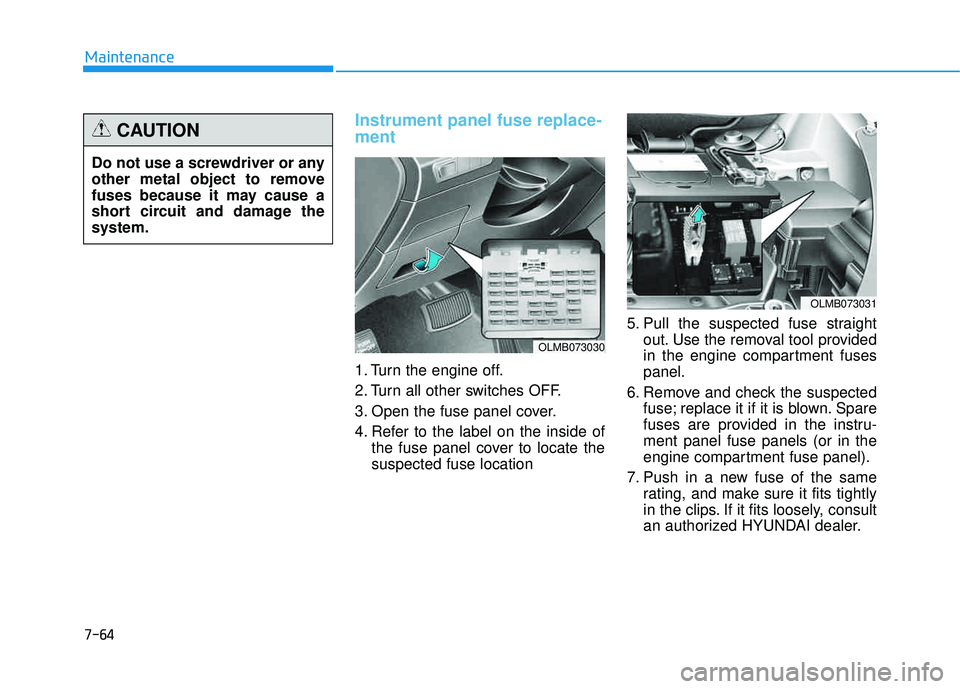
1. Turn the engine off.
2. Turn all other switches OFF.
3. Open the fuse panel cover.
4. Refer to the label on the inside ofthe fuse panel cover to locate the suspected fuse location 5. Pull the suspected fuse straight
out. Use the removal tool provided
in the engine compartment fusespanel.
6. Remove and check the suspected fuse; replace it if it is blown. Spare
fuses are provided in the instru-ment panel fuse panels (or in the
engine compartment fuse panel).
7. Push in a new fuse of the same rating, and make sure it fits tightly
in the clips. If it fits loosely, consult
an authorized HYUNDAI dealer.
Do not use a screwdriver or any
other metal object to remove
fuses because it may cause a
short circuit and damage thesystem.
CAUTION
OLMB073031
OLMB073030
Page 606 of 653
7-65
7
Maintenance
In an emergency, if you do not have
a spare fuse, use a fuse of the same
rating from a circuit you may not
need for operating the vehicle, such
as the cigarette lighter fuse.
If the headlights or other electrical
components do not work and the
fuses are OK, check the fuse panel
in the engine compartment. If a fuse
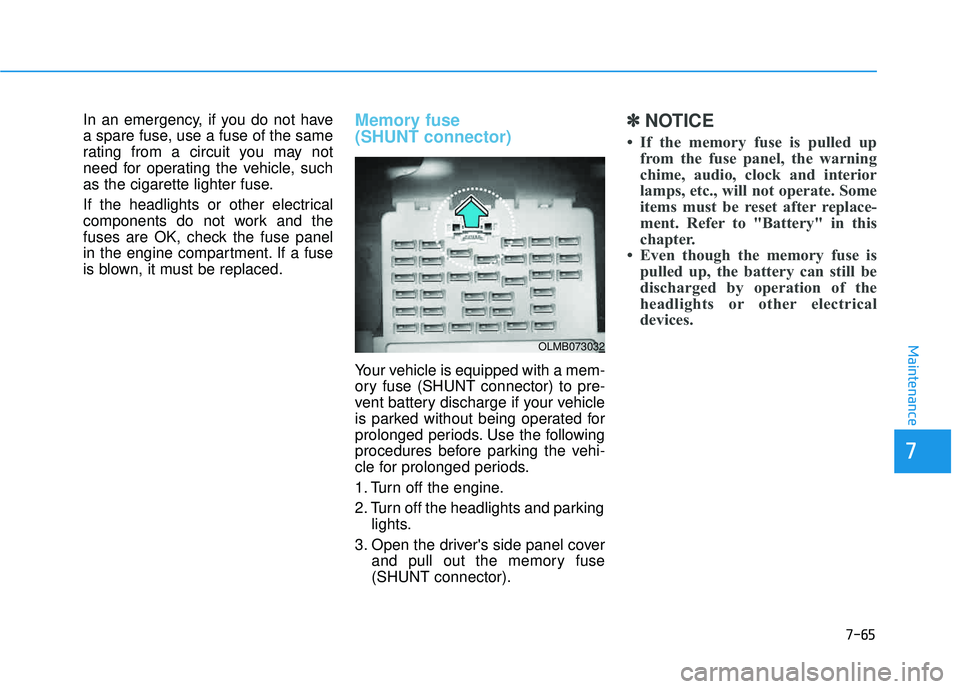
is blown, it must be replaced.Memory fuse (SHUNT connector)
Your vehicle is equipped with a mem-
ory fuse (SHUNT connector) to pre-
vent battery discharge if your vehicle
is parked without being operated for
prolonged periods. Use the following
procedures before parking the vehi-
cle for prolonged periods.
1. Turn off the engine.
2. Turn off the headlights and parkinglights.
3. Open the driver's side panel cover and pull out the memory fuse (SHUNT connector).
✽✽ NOTICE
If the memory fuse is pulled up from the fuse panel, the warning
chime, audio, clock and interior
lamps, etc., will not operate. Some
items must be reset after replace-
ment. Refer to "Battery" in this
chapter.
Even though the memory fuse is pulled up, the battery can still be
discharged by operation of the
headlights or other electrical
devices.
OLMB073032
Page 607 of 653
7-66
Maintenance
Engine compartment panel fuse replacement
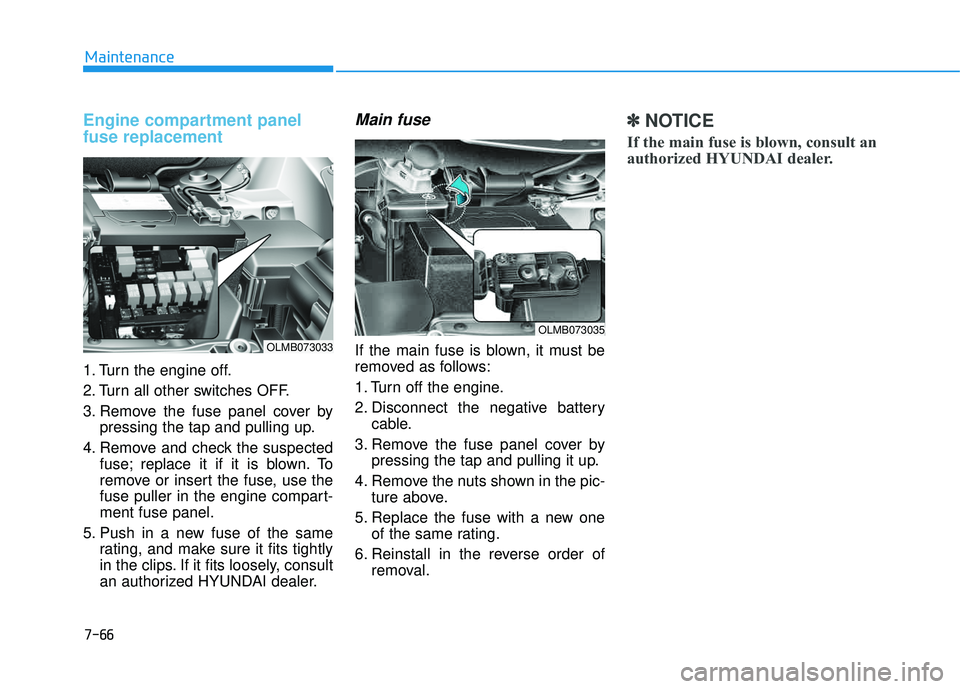
1. Turn the engine off.
2. Turn all other switches OFF.
3. Remove the fuse panel cover bypressing the tap and pulling up.
4. Remove and check the suspected fuse; replace it if it is blown. To
remove or insert the fuse, use the
fuse puller in the engine compart-ment fuse panel.
5. Push in a new fuse of the same rating, and make sure it fits tightly
in the clips. If it fits loosely, consult
an authorized HYUNDAI dealer.
Main fuse
If the main fuse is blown, it must be
removed as follows:
1. Turn off the engine.
2. Disconnect the negative batterycable.
3. Remove the fuse panel cover by pressing the tap and pulling it up.
4. Remove the nuts shown in the pic- ture above.
5. Replace the fuse with a new one of the same rating.
6. Reinstall in the reverse order of removal.
✽✽ NOTICE
If the main fuse is blown, consult an
authorized HYUNDAI dealer.
OLMB073035
OLMB073033