Page 519 of 653
6-3
What to do in an emergency
If the engine stalls while driving
Reduce your speed gradually,keeping a straight line. Move cau-
tiously off the road to a safe place.
Turn on your hazard warning flash- er.
Try to start the engine again. If your vehicle will not start, contact an
authorized HYUNDAI dealer or
seek other qualified assistance.
If the engine stalls at a cross-
road or crossing
If the engine stalls at a crossroad or
crossing, if safe to do so, move the
shift lever to the N (Neutral) position
and then push the vehicle to a safelocation.
If you have a flat tire while driving
If a tire goes flat while you are driv- ing:
Take your foot off the acceleratorpedal and let the vehicle slow
down while driving straight ahead.
Do not apply the brakes immedi-ately or attempt to pull off the road
as this may cause loss of vehiclecontrol resulting in an accident.
When the vehicle has slowed to
such a speed that it is safe to do
so, brake carefully and pull off the
road. Drive off the road as far as
possible and park on firm, level
ground. If you are on a divided
highway, do not park in the median
area between the two traffic lanes. When the vehicle is stopped, press
the hazard warning flasher button,
move the shift lever into P (Park),
apply the parking brake, and place
the ignition switch in theLOCK/OFF position.
Have all passengers get out of the vehicle. Be sure they all get out on
the side of the vehicle that is away
from traffic.
When changing a flat tire, follow the instructions provided later in
this chapter.
IINN CC AA SSEE OO FF AA NN EE MM EERR GG EENN CCYY WW HHIILL EE DD RRIIVV IINN GG
6
Page 522 of 653
6-6
What to do in an emergency
✽✽NOTICE
An inappropriately disposedbattery can be harmful to
the environment and human
health. Dispose the battery
according to your local
law(s) or regulation.Jump starting procedure
1.Position the vehicles close enough that the jumper cables will reach,
but do not allow the vehicles totouch.
2.Avoid fans or any moving parts in the engine compartment at all
times, even when the vehicles are
turned off.
3.Turn off all electrical devices such as radios, lights, air conditioning,
etc. Put the vehicles in P (Park)
and set the parking brakes. Turn
both vehicles OFF.(Continued)
NEVER attempt to recharge
the battery when the vehicle’s
battery cables are connected
to the battery.
The electrical ignition system
works with high voltage.
NEVER touch these compo-nents with the engine running
or when the ignition switch isin the ON position.
To prevent damage to your vehi-
cle:
Only use a 12-volt power sup-
ply (battery or jumper system)
to jump start your vehicle.
Do not attempt to jump start
your vehicle by push-starting.
CAUTION
Pb
Page 527 of 653
6-11
What to do in an emergency
TPMS malfunctions may occur for a
variety of reasons, including theinstallation of replacement or alter-
nate tires or wheels on the vehicle
that prevent the TPMS from function-
ing properly. Always check the TPMSmalfunction telltale after replacing
one or more tires or wheels on your
vehicle to ensure that the replace-
ment or alternate tires and wheels
allow the TPMS to continue to func-
tion properly.
✽✽NOTICE
If the TPMS Low Tire Pressure
Telltale does not illuminate for three
seconds when the ignition switch is
in the ON position or when the
engine starts, or if it remains illumi-
nated after coming on for approxi-
mately three seconds, take your
vehicle to your nearest authorized
HYUNDAI dealer and have the sys-
tem checked.
Low Tire Pressure
Telltale
The TPMS is not a substitute for
manually checking tire pressure with
a tire pressure gauge. Changes in
temperature affect tire pressure. See
“Tires and Wheels” in chapter 7 forproper tire inflating and tire pressure
measurement procedures.
Immediately reduce your speed,
avoid hard cornering and anticipate
increased stopping distances. You
should stop and check your tires as
soon as possible. Inflate the tires tothe proper pressure as indicated on
the vehicle’s placard or tire inflation
pressure label located on the driver’s
side door jamb. If you cannot reach a
service station or if the tire cannot
hold the newly added air, replace the
low pressure tire with the compact
spare tire. The Low Tire Pressure Telltale will
remain on and the TPMS Malfunction
Indicator may blink for one minuteand then remain illuminated if the
vehicle is driven approximately 20
minutes at speed above 15.5 mph(25 km/h).
✽✽
NOTICE
The compact spare tire is not
equipped with a tire pressure sensor.
6
Page 532 of 653
6-16
What to do in an emergency
Changing tires Follow these steps to change your
vehicle’s tire:
1.Park on a level, firm surface.
2.Move the shift lever into P (Park),apply the parking brake, and place
the ignition switch in theLOCK/OFF position.
3.Press the hazard warning flasher button.
4.Remove the wheel lug nut wrench, jack, jack handle, and spare tire
from the vehicle.
5.Block both the front and rear of the tire diagonally opposite of the tire
you are changing.
A vehicle can slip or roll off of a
jack causing serious injury or
death to you or those nearby.
Take the following safety pre-cautions:
NEVER place any portion of
your body under a vehicle that
is supported by a jack.
NEVER attempt to change a tire in the lane of traffic.
ALWAYS move the vehicle
completely off the road on
level, firm ground away from
traffic before trying to change
a tire. If you cannot find a
level, firm place off the road,
call a towing service for assis-
tance.
Be sure to use the jack pro-
vided with the vehicle.
(Continued)
WARNING
(Continued)
ALWAYS place the jack on the
designated jacking positions
on the vehicle and NEVER on
the bumpers or any other part
of the vehicle.
Do not start or run the engine
while the vehicle is on the
jack.
Do not allow anyone to remain
in the vehicle while it is on the
jack.
Keep children away from the
road and the vehicle.
Page 539 of 653
6-23
What to do in an emergency
6
When towing your vehicle in an emergency without wheel dollies:
1.Place the ignition switch in theACC position.
2.Place the shift lever in N (Neutral).
3.Release the parking brake.
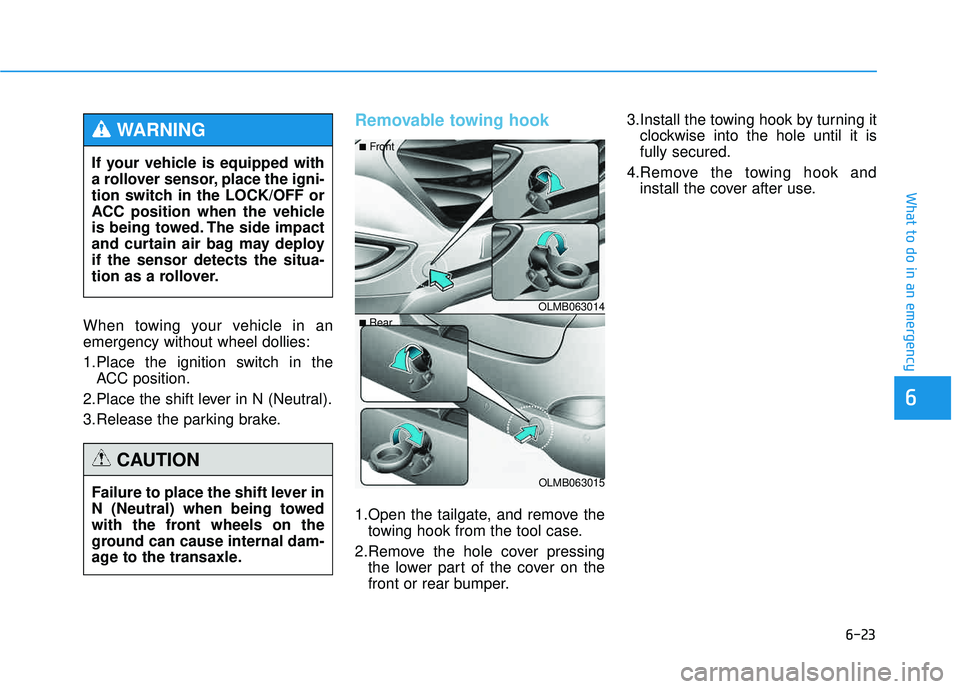
Removable towing hook
1.Open the tailgate, and remove the towing hook from the tool case.
2.Remove the hole cover pressing the lower part of the cover on the
front or rear bumper. 3.Install the towing hook by turning it
clockwise into the hole until it isfully secured.
4.Remove the towing hook and install the cover after use.
Failure to place the shift lever in
N (Neutral) when being towed
with the front wheels on the
ground can cause internal dam-
age to the transaxle.
CAUTION
OLMB063014
OLMB063015
■
Front
■ Rear
If your vehicle is equipped with
a rollover sensor, place the igni-
tion switch in the LOCK/OFF or
ACC position when the vehicle
is being towed. The side impact
and curtain air bag may deployif the sensor detects the situa-
tion as a rollover.
WARNING
Page 540 of 653
6-24
What to do in an emergency
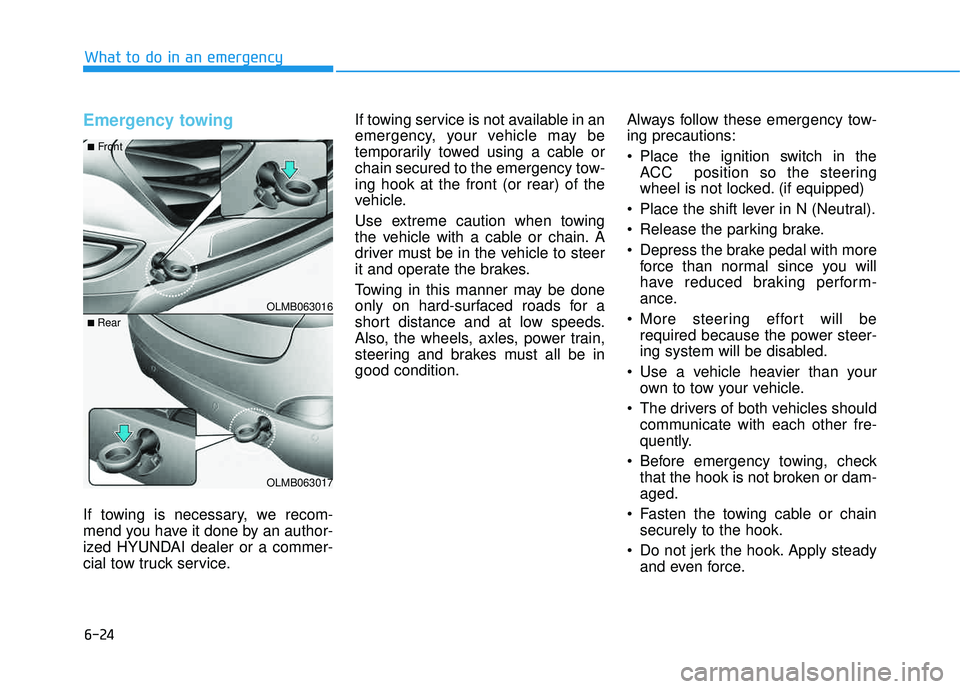
Emergency towing
If towing is necessary, we recom-
mend you have it done by an author-
ized HYUNDAI dealer or a commer-
cial tow truck service.If towing service is not available in an
emergency, your vehicle may be
temporarily towed using a cable or
chain secured to the emergency tow-ing hook at the front (or rear) of the
vehicle.
Use extreme caution when towing
the vehicle with a cable or chain. A
driver must be in the vehicle to steer
it and operate the brakes.
Towing in this manner may be done
only on hard-surfaced roads for a
short distance and at low speeds.
Also, the wheels, axles, power train,
steering and brakes must all be ingood condition.
Always follow these emergency tow-ing precautions:
Place the ignition switch in the
ACC position so the steering
wheel is not locked. (if equipped)
Place the shift lever in N (Neutral).
Release the parking brake.
Depress the brake pedal with more force than normal since you will
have reduced braking perform-
ance.
More steering effort will be required because the power steer-
ing system will be disabled.
Use a vehicle heavier than your own to tow your vehicle.
The drivers of both vehicles should communicate with each other fre-
quently.
Before emergency towing, check that the hook is not broken or dam-aged.
Fasten the towing cable or chain securely to the hook.
Do not jerk the hook. Apply steady and even force.
OLMB063016
OLMB063017
■
Front
■ Rear
Page 547 of 653
7-6
Maintenance
OOWW NNEERR MM AAIINN TTEENN AANN CCEE
The following lists are vehicle checks and inspections that should be per-
formed by the owner or an author-
ized HYUNDAI dealer at the frequen-
cies indicated to help ensure safe,
dependable operation of your vehi-
cle.
Any adverse conditions should be
brought to the attention of your deal-
er as soon as possible.
These Owner Maintenance vehicle
checks are generally not covered by
warranties and you may be charged
for labor, parts and lubricants used.
Performing maintenance work
on a vehicle can be dangerous.
If you lack sufficient knowledge
and experience or the propertools and equipment to do the
work, have it done by an author-
ized HYUNDAI dealer. ALWAYS
follow these precautions for
performing maintenance work:
Park your vehicle on level
ground, move the shift lever
into the P (Park, for automatic
transaxle vehicle) position or
neutral (for manual transaxle
vehicle, apply the parking
brake, place the ignition
switch in the OFF position.
Block the tires (front and
back) to prevent the vehicle
from moving.
Remove loose clothing or jew-
elry that can become entan-
gled in moving parts.
(Continued)
WARNING (Continued)
If you must run the engine
during maintenance, do so
out doors or in an area withplenty of ventilation.
Keep flames, sparks, or smok-
ing materials away from the
battery and fuel-related parts.
Page 585 of 653
7-44
Maintenance
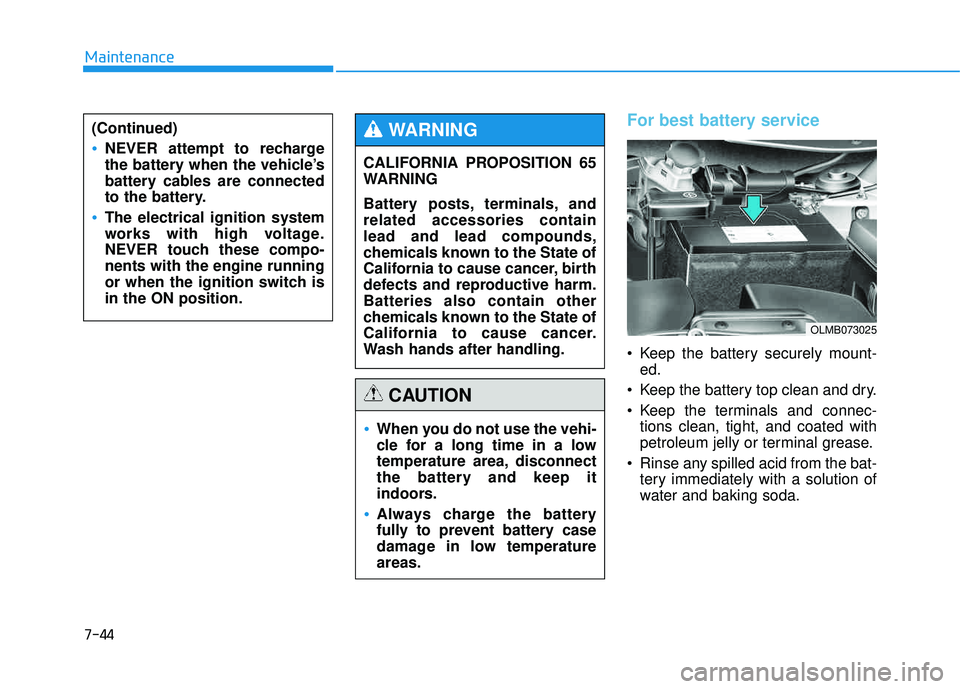
For best battery service
Keep the battery securely mount-ed.
Keep the battery top clean and dry.
Keep the terminals and connec- tions clean, tight, and coated with
petroleum jelly or terminal grease.
Rinse any spilled acid from the bat- tery immediately with a solution of
water and baking soda.
When you do not use the vehi-
cle for a long time in a low
temperature area, disconnect
the battery and keep it
indoors.
Always charge the battery
fully to prevent battery case
damage in low temperatureareas.
CAUTION
CALIFORNIA PROPOSITION 65
WARNING
Battery posts, terminals, and related accessories containlead and lead compounds,
chemicals known to the State of
California to cause cancer, birth
defects and reproductive harm.Batteries also contain other
chemicals known to the State of
California to cause cancer.
Wash hands after handling.
WARNING
OLMB073025
(Continued)
NEVER attempt to recharge
the battery when the vehicle’s
battery cables are connected
to the battery.
The electrical ignition system
works with high voltage.
NEVER touch these compo-nents with the engine running
or when the ignition switch isin the ON position.