Page 477 of 653
5-31
Driving your vehicle
5
If the Parking Brake Warning Light
remains on after the parking brake is
released while engine is running,
there may be a malfunction in the
brake system. Immediate attention is
necessary.
If at all possible, cease driving the
vehicle immediately. If that is not pos-
sible, use extreme caution while
operating the vehicle and only con-
tinue to drive the vehicle until you
can reach a safe location.Anti-lock Brake System (ABS)
An Anti-Lock Braking System
(ABS) or an Electronic Stability
Control (ESC) system will not
prevent accidents due to
improper or dangerous driving
maneuvers. Even though vehi-
cle control is improved during
emergency braking, always
maintain a safe distance
between you and objects ahead
of you. Vehicle speeds should
always be reduced during
extreme road conditions. The
braking distance for cars
equipped with ABS or ESC may
be longer than for those without
these systems in the road con-
ditions described below.(Continued)
(Continued)
Drive your vehicle at reduced
speeds during the followingconditions:
Rough, gravel or snow-cov-
ered roads.
On roads where the road sur-
face is pitted or has differentsurface height.
Tire chains are installed on
your vehicle.
The safety features of an ABS
or ESC equipped vehicle should
not be tested by high speed
driving or cornering. This could
endanger the safety of yourself
or others.
WARNING
Page 479 of 653
5-33
Driving your vehicle
5
✽✽NOTICE
When you jump start your vehicle
because of a drained battery, the
ABS warning light ( ) may turn
on at the same time. This happens
because of the low battery voltage. It
does not mean your ABS is malfunc-
tioning. Have the battery recharged
before driving the vehicle.
If the ABS warning light ( ) is
on and stays on, you may have
a problem with the ABS. Your
power brakes will work normal-
ly. To reduce the risk of serious
injury or death, contact your
HYUNDAI dealer as soon as
possible.
WARNING
When you drive on a road hav-
ing poor traction, such as an icy
road, and apply your brakes
continuously, the ABS will be
active continuously and the
ABS warning light ( ) may
illuminate. Pull your car over to
a safe place and turn the engine
off.
Restart the engine. If the ABS
warning light is off, then yourABS system is normal.
Otherwise, you may have a
problem with your ABS system.
Contact an authorized
HYUNDAI dealer as soon as
possible.
CAUTION
Page 480 of 653
5-34
Driving your vehicle
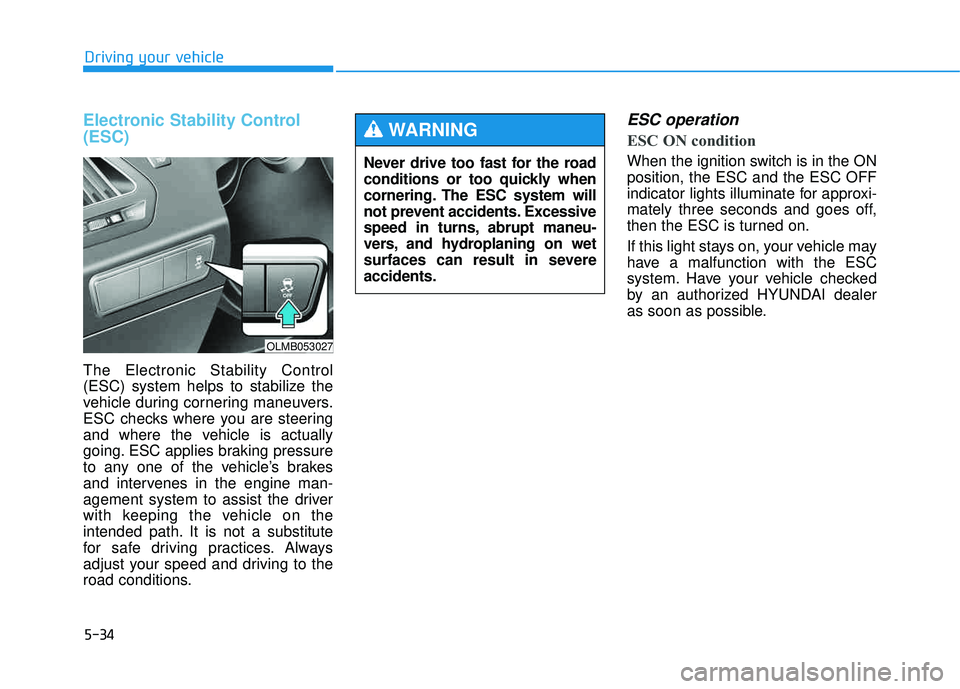
Electronic Stability Control (ESC)
The Electronic Stability Control
(ESC) system helps to stabilize the
vehicle during cornering maneuvers.
ESC checks where you are steering
and where the vehicle is actually
going. ESC applies braking pressure
to any one of the vehicle’s brakes
and intervenes in the engine man-
agement system to assist the driver
with keeping the vehicle on the
intended path. It is not a substitute
for safe driving practices. Always
adjust your speed and driving to the
road conditions.
ESC operation
ESC ON condition
When the ignition switch is in the ON position, the ESC and the ESC OFF
indicator lights illuminate for approxi-
mately three seconds and goes off,
then the ESC is turned on.
If this light stays on, your vehicle may
have a malfunction with the ESC
system. Have your vehicle checked
by an authorized HYUNDAI dealer
as soon as possible.
Never drive too fast for the road
conditions or too quickly when
cornering. The ESC system will
not prevent accidents. Excessive
speed in turns, abrupt maneu-
vers, and hydroplaning on wet
surfaces can result in severeaccidents.
WARNING
OLMB053027
Page 481 of 653
5-35
Driving your vehicle
5
When operating
When the ESC is in opera- tion, the ESC indicator light
blinks:
When you apply your brakes under conditions which may lock the
wheels, you may hear sounds from
the brakes, or feel a corresponding
sensation in the brake pedal. This
is normal and it means your ESC is
active.
When the ESC activates, the engine may not respond to the
accelerator as it does under rou-
tine conditions.
If the Cruise Control was in use when the ESC activates, the cruise
control automatically disengages.
The Cruise Control can be reen-gaged when the road conditions
allow. See “Cruise Control System”
later in this chapter.
When moving out of the mud or driving on a slippery road, the
engine rpm (revolutions per
minute) may not increase even if
you press the accelerator pedal
deeply. This is to maintain the sta-
bility and traction of the vehicle and
does not indicate a problem.
ESC OFF condition
To cancel ESC operation :
State 1
Press the ESC OFF button shortly (ESC OFF indicator light illumi-
nates). At this state, the engine con-
trol function does not operate. In
other words, the traction control
function does not operate but only
the brake control function operates. State 2
Press the ESC OFF button for more
than 3 seconds. ESC OFF indicator
light illuminates and ESC OFF warn-
ing chime will sound. At this state,
the engine control function and brake
control function does not operate. In
other words, the vehicle stability con-
trol function does not operate any
more. If the ignition switch is placed to the
LOCK/OFF position when ESC is off,
ESC remains off. Upon restarting the
engine, the ESC will automatically
turn on again.
Page 483 of 653
5-37
Driving your vehicle
5
✽✽NOTICE
Turning the ESC OFF does not
affect ABS or standard brake sys-
tem operation.Vehicle Stability Management (VSM)
Vehicle Stability Management (VSM)
helps ensure the vehicle stays stable
when accelerating or braking sud-
denly on wet, slippery and rough
roads where traction over the four
tires can suddenly become uneven.
To prevent damage to thetransaxle:
Do not allow wheel(s) of one
axle to spin excessively while
the ESC, ABS, and brake
warning lights are displayed.
The repairs would not be cov-
ered by the vehicle warranty.
Reduce engine power and do
not spin the wheel(s) exces-
sively while these lights are
displayed.
When operating the vehicle
on a dynamometer, ensure theESC is turned off (ESC OFFlight illuminated).
CAUTION
Take the following precautions
when using the Vehicle Stability
Management (VSM):
ALWAYS check the speed and
the distance to the vehicle
ahead. The VSM is not a sub-
stitute for safe driving prac-tices.
Never drive too fast for the
road conditions. The VSM sys-
tem will not prevent acci-
dents. Excessive speed in bad
weather, slippery and uneven
roads can result in severeaccidents.
WARNING
Page 489 of 653
5-43
Driving your vehicle
5
DDRRIIVV IINN GG AA SSSS IISS TT SS YY SSTT EEMM
Active ECO system
Active ECO operation
Active ECO helps improve fuel effi-
ciency by controlling the engine and
transaxle. Fuel-efficiency is deter-
mined by the driver's driving habits
and road conditions.
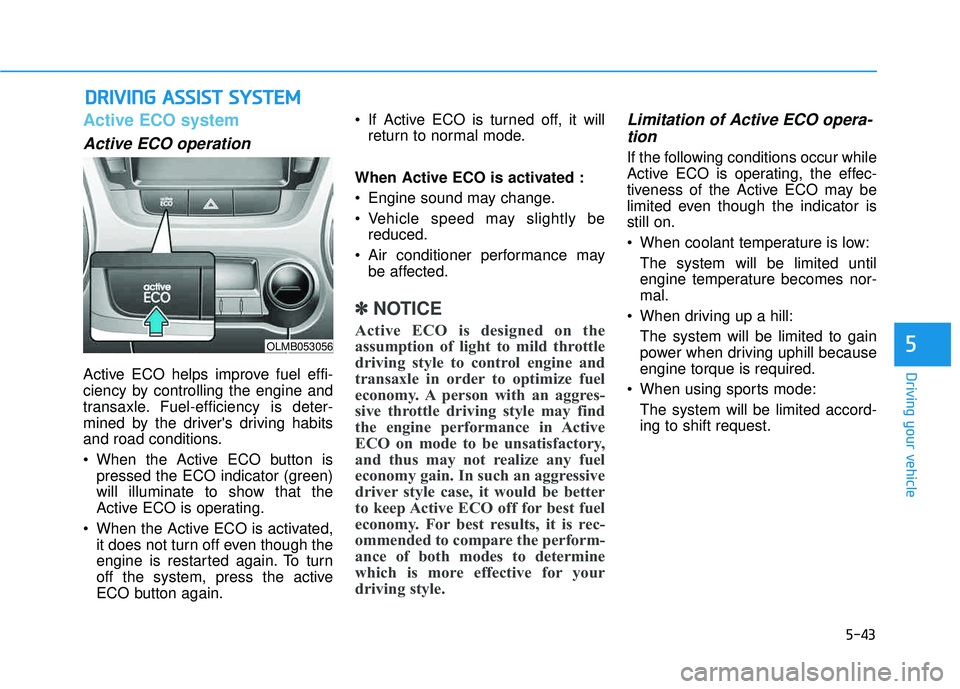
When the Active ECO button is
pressed the ECO indicator (green)
will illuminate to show that the
Active ECO is operating.
When the Active ECO is activated, it does not turn off even though the
engine is restarted again. To turn
off the system, press the active
ECO button again. If Active ECO is turned off, it will
return to normal mode.
When Active ECO is activated :
Engine sound may change.
Vehicle speed may slightly be reduced.
Air conditioner performance may be affected.
✽✽ NOTICE
Active ECO is designed on the
assumption of light to mild throttle
driving style to control engine and
transaxle in order to optimize fuel
economy. A person with an aggres-
sive throttle driving style may find
the engine performance in Active
ECO on mode to be unsatisfactory,
and thus may not realize any fuel
economy gain. In such an aggressive
driver style case, it would be better
to keep Active ECO off for best fuel
economy. For best results, it is rec-
ommended to compare the perform-
ance of both modes to determine
which is more effective for your
driving style.
Limitation of Active ECO opera- tion
If the following conditions occur while
Active ECO is operating, the effec-
tiveness of the Active ECO may be
limited even though the indicator isstill on.
When coolant temperature is low:
The system will be limited until
engine temperature becomes nor-mal.
When driving up a hill: The system will be limited to gain
power when driving uphill becauseengine torque is required.
When using sports mode:
The system will be limited accord-ing to shift request.
OLMB053056
Page 490 of 653
5-44
Driving your vehicle
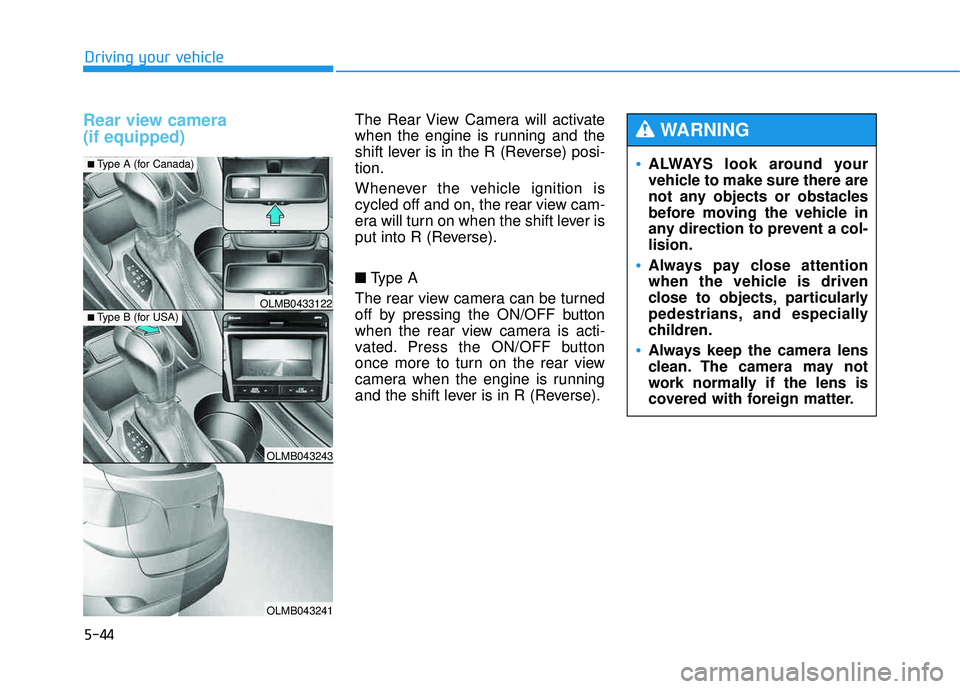
Rear view camera (if equipped) The Rear View Camera will activate
when the engine is running and the
shift lever is in the R (Reverse) posi-tion.
Whenever the vehicle ignition is
cycled off and on, the rear view cam-
era will turn on when the shift lever is
put into R (Reverse). ■Type A
The rear view camera can be turned
off by pressing the ON/OFF button
when the rear view camera is acti-
vated. Press the ON/OFF button
once more to turn on the rear view
camera when the engine is running
and the shift lever is in R (Reverse).
OLMB043243
OLMB043241
OLMB0433122
■ Type A (for Canada)
■Type B (for USA)
ALWAYS look around your
vehicle to make sure there are
not any objects or obstacles
before moving the vehicle in
any direction to prevent a col-lision.
Always pay close attention
when the vehicle is driven
close to objects, particularly
pedestrians, and especially
children.
Always keep the camera lens
clean. The camera may not
work normally if the lens is
covered with foreign matter.
WARNING
Page 494 of 653
5-48
Driving your vehicle
✽✽NOTICE
Each of the above actions will cancel
cruise control operation (the SET
indicator light in the instrument
cluster will go off), but only pressing
the cruise ON/OFF button will turn
the system off. If you wish to resume
cruise control operation, push the
lever up (to RES+) located on your
steering wheel. You will return to
your previously preset speed, unless
the system was turned off using the
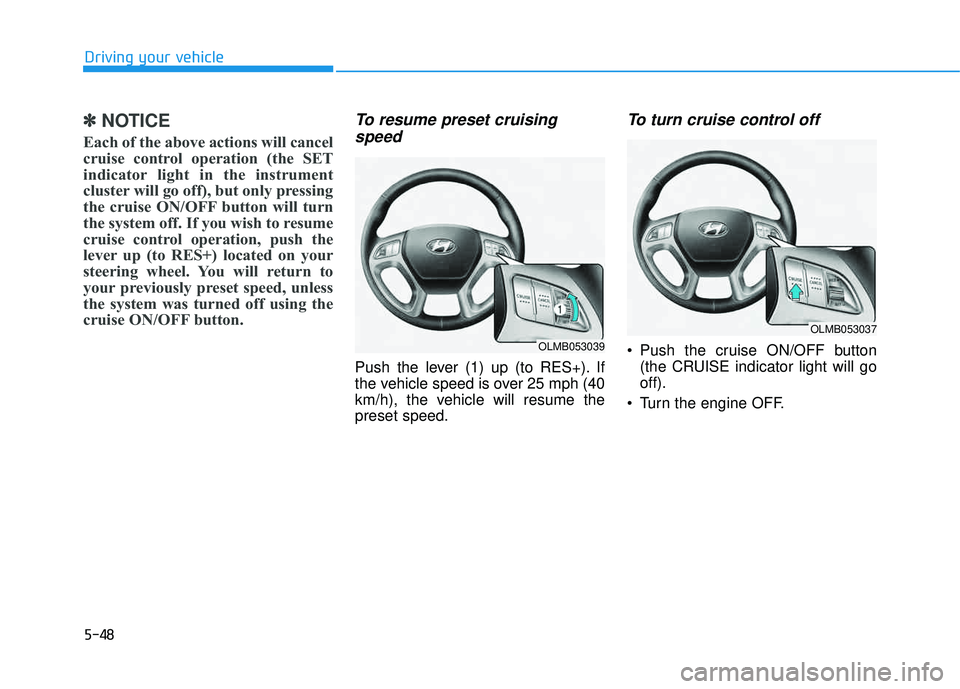
cruise ON/OFF button.To resume preset cruising speed
Push the lever (1) up (to RES+). If
the vehicle speed is over 25 mph (40
km/h), the vehicle will resume thepreset speed.
To turn cruise control off
Push the cruise ON/OFF button (the CRUISE indicator light will gooff).
Turn the engine OFF.OLMB053039
OLMB053037