Page 203 of 504
3-119
Convenient features of your vehicle
3
Mode selection
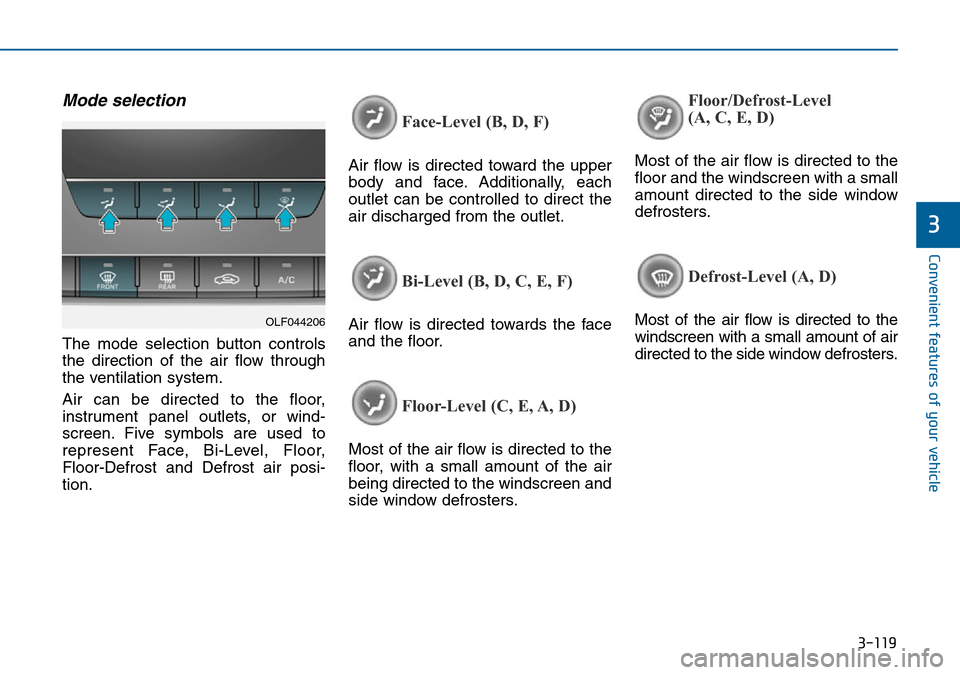
The mode selection button controls
the direction of the air flow through
the ventilation system.
Air can be directed to the floor,
instrument panel outlets, or wind-
screen. Five symbols are used to
represent Face, Bi-Level, Floor,
Floor-Defrost and Defrost air posi-
tion.
Face-Level (B, D, F)
Air flow is directed toward the upper
body and face. Additionally, each
outlet can be controlled to direct the
air discharged from the outlet.
Bi-Level (B, D, C, E, F)
Air flow is directed towards the face
and the floor.
Floor-Level (C, E, A, D)
Most of the air flow is directed to the
floor, with a small amount of the air
being directed to the windscreen and
side window defrosters.
Floor/Defrost-Level
(A, C, E, D)
Most of the air flow is directed to the
floor and the windscreen with a small
amount directed to the side window
defrosters.
Defrost-Level (A, D)
Most of the air flow is directed to the
windscreen with a small amount of air
directed to the side window defrosters.OLF044206
Page 204 of 504
3-120
Convenient features of your vehicle
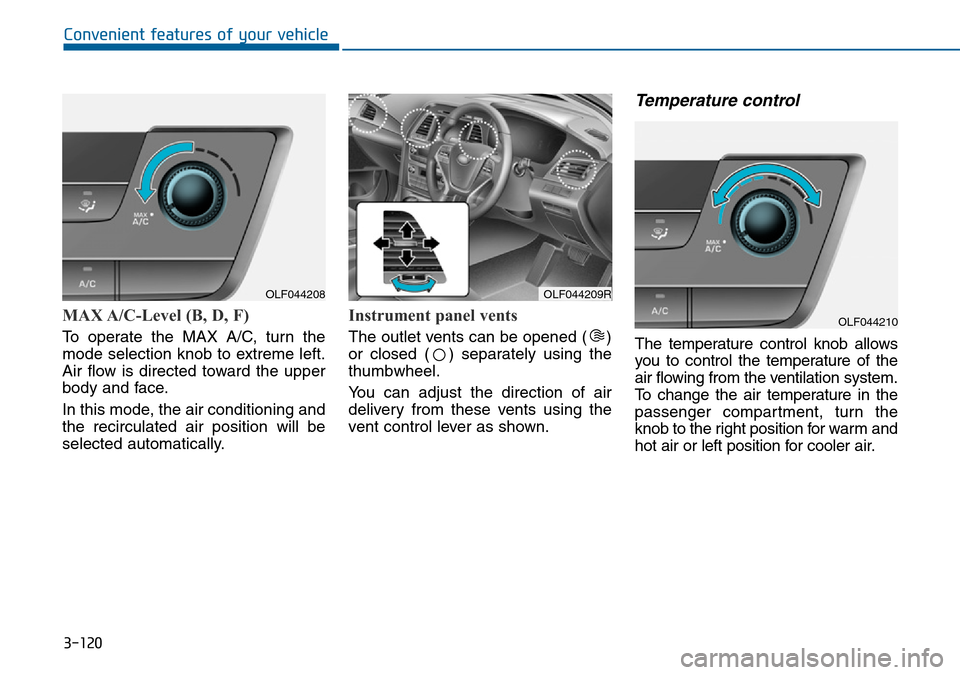
MAX A/C-Level (B, D, F)
To operate the MAX A/C, turn the
mode selection knob to extreme left.
Air flow is directed toward the upper
body and face.
In this mode, the air conditioning and
the recirculated air position will be
selected automatically.
Instrument panel vents
The outlet vents can be opened ( )
or closed ( ) separately using the
thumbwheel.
You can adjust the direction of air
delivery from these vents using the
vent control lever as shown.
Temperature control
The temperature control knob allows
you to control the temperature of the
air flowing from the ventilation system.
To change the air temperature in the
passenger compartment, turn the
knob to the right position for warm and
hot air or left position for cooler air.
OLF044208OLF044209R
OLF044210
Page 215 of 504
3-131
Convenient features of your vehicle
3
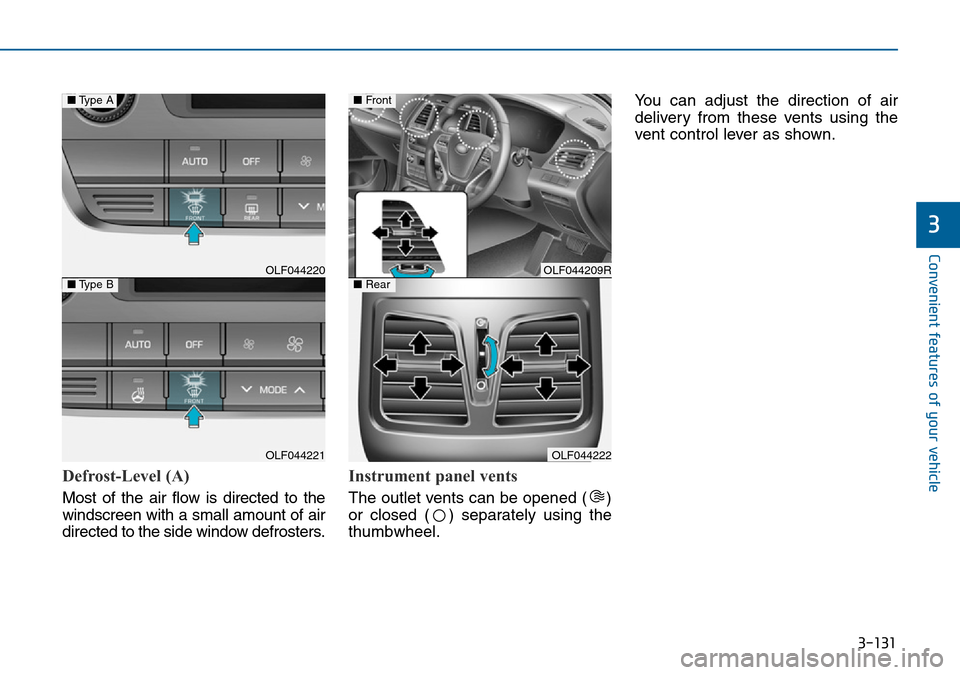
Defrost-Level (A)
Most of the air flow is directed to the
windscreen with a small amount of air
directed to the side window defrosters.
Instrument panel vents
The outlet vents can be opened ( )
or closed ( ) separately using the
thumbwheel.You can adjust the direction of air
delivery from these vents using the
vent control lever as shown.
OLF044220
OLF044221
■Type A
■Type BOLF044209R
OLF044222
■Front
■Rear
Page 315 of 504
5-2
Driving your vehicle
Carbon monoxide (CO) gas is toxic. Breathing CO can cause unconsciousness and death.
Engine exhaust contains carbon monoxide which cannot be seen or smelled.
Do not inhale engine exhaust.
If at any time you smell engine exhaust inside the vehicle, open the windows immediately. Exposure to CO can cause
unconsciousness and death by asphyxiation.
Ensure the exhaust system does not leak.
The exhaust system should be checked whenever the vehicle is raised to change the oil or for any other purpose. If
you hear a change in the sound of the exhaust or if you drive over something that strikes the underneath side of the
vehicle, we recommend that the exhaust system be checked as soon as possible by an authorised HYUNDAI dealer.
Do not run the engine in an enclosed area.
Letting the engine idle in your garage, even with the garage door open, is a hazardous practice. Run the engine only
long enough to start the engine and to move the vehicle out of the garage.
Avoid idling the engine for prolonged periods with people inside the vehicle.
If it is necessary to idle the engine for a prolonged period with people inside the vehicle, be sure to do so only in an
open area with the air intake set at "Fresh" and fan control set to high so fresh air is drawn into the interior.
Keep the air intakes clear.
To ensure proper operation of the ventilation system, keep the ventilation air intakes located in front of the windscreen
clear of snow, ice, leaves, or other obstructions.
If you must drive with the boot open:
Close all windows.
Open instrument panel air vents.
Set the air intake control at "Fresh", the air flow control at "Floor" or "Face", and the fan control set to high.
WARNING
Page 468 of 504
7-57
7
Maintenance
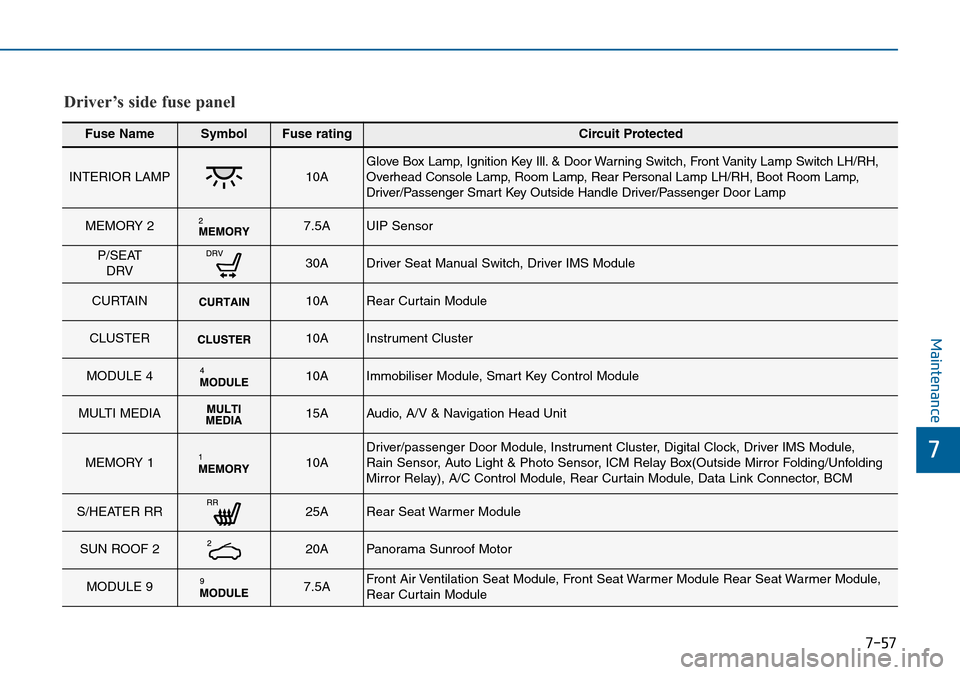
Fuse NameSymbolFuse ratingCircuit Protected
INTERIOR LAMP 10A Glove Box Lamp, Ignition Key Ill. & Door Warning Switch, Front Vanity Lamp Switch LH/RH,
Overhead Console Lamp, Room Lamp, Rear Personal Lamp LH/RH, Boot Room Lamp,
Driver/Passenger Smart Key Outside Handle Driver/Passenger Door Lamp
MEMORY 2 7.5A UIP Sensor
P/SEAT
DRV 30A Driver Seat Manual Switch, Driver IMS Module
CURTAIN 10A Rear Curtain Module
CLUSTER 10A Instrument Cluster
MODULE 4 10A Immobiliser Module, Smart Key Control Module
MULTI MEDIA 15A Audio, A/V & Navigation Head Unit
MEMORY 1 10A Driver/passenger Door Module, Instrument Cluster, Digital Clock, Driver IMS Module,
Rain Sensor, Auto Light & Photo Sensor, ICM Relay Box(Outside Mirror Folding/Unfolding
Mirror Relay), A/C Control Module, Rear Curtain Module, Data Link Connector, BCM
S/HEATER RR 25A Rear Seat Warmer Module
SUN ROOF 2 20A Panorama Sunroof Motor
MODULE 9 7.5A Front Air Ventilation Seat Module, Front Seat Warmer Module Rear Seat Warmer Module,
Rear Curtain Module
Driver’s side fuse panel
Page 469 of 504
7-58
Maintenance
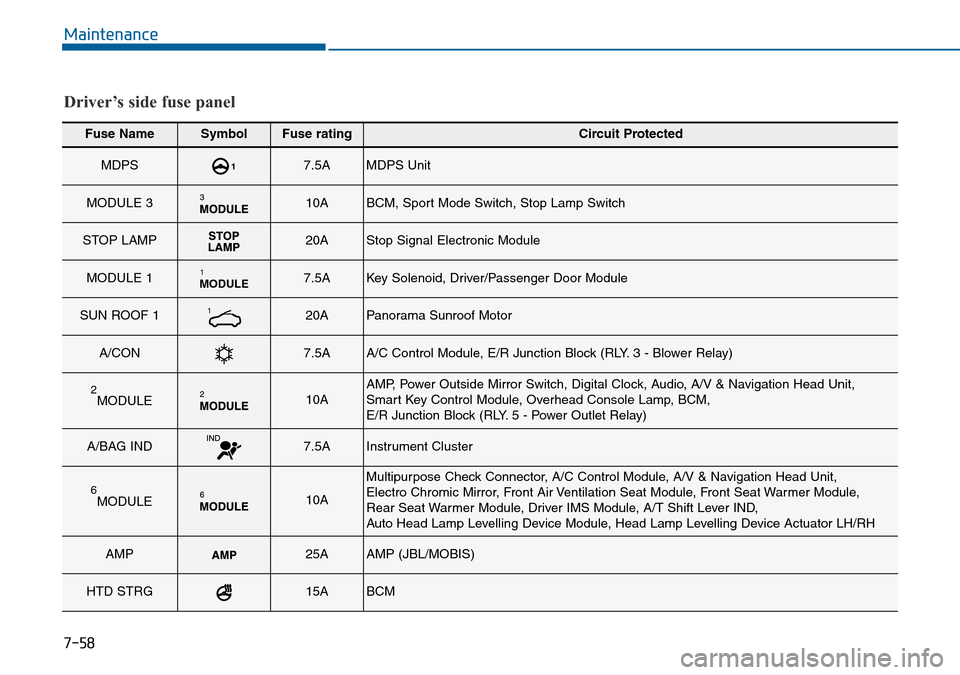
Fuse NameSymbolFuse ratingCircuit Protected
MDPS 17.5A MDPS Unit
MODULE 3 10A BCM, Sport Mode Switch, Stop Lamp Switch
STOP LAMP 20A Stop Signal Electronic Module
MODULE 1 MODULE17.5A Key Solenoid, Driver/Passenger Door Module
SUN ROOF 1 120A Panorama Sunroof Motor
A/CON 7.5A A/C Control Module, E/R Junction Block (RLY. 3 - Blower Relay)
2MODULE 10A AMP, Power Outside Mirror Switch, Digital Clock, Audio, A/V & Navigation Head Unit,
Smart Key Control Module, Overhead Console Lamp, BCM,
E/R Junction Block (RLY. 5 - Power Outlet Relay)
A/BAG IND 7.5A Instrument Cluster
6MODULE 10A
Multipurpose Check Connector, A/C Control Module, A/V & Navigation Head Unit,
Electro Chromic Mirror, Front Air Ventilation Seat Module, Front Seat Warmer Module,
Rear Seat Warmer Module, Driver IMS Module, A/T Shift Lever IND,
Auto Head Lamp Levelling Device Module, Head Lamp Levelling Device Actuator LH/RH
AMP 25A AMP (JBL/MOBIS)
HTD STRG 15A BCM
Driver’s side fuse panel
Page 503 of 504
8-8
Specifications & Consumer information
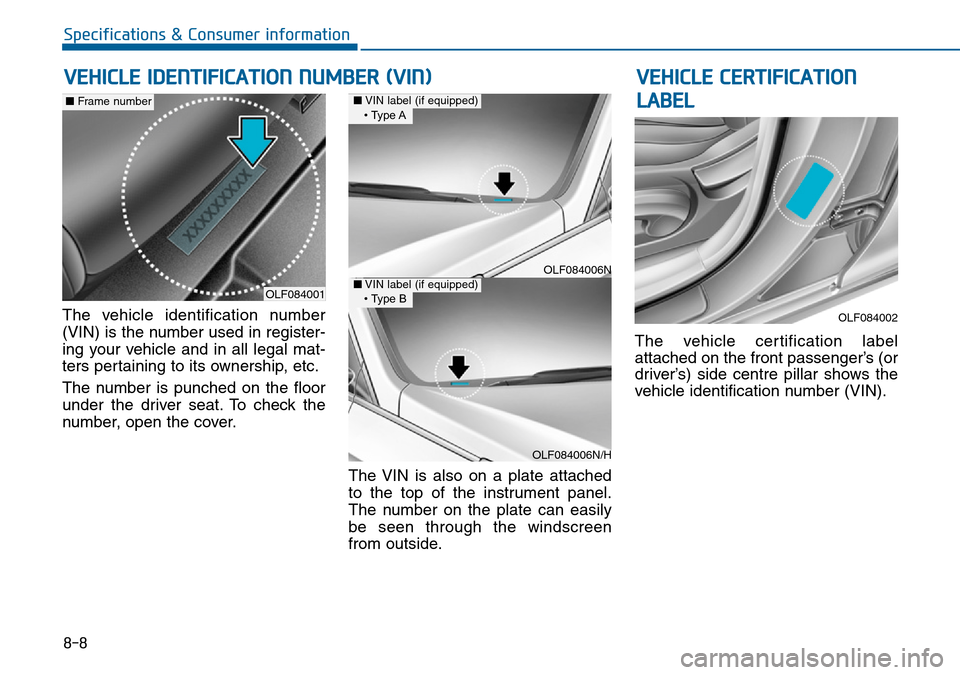
The vehicle identification number
(VIN) is the number used in register-
ing your vehicle and in all legal mat-
ters pertaining to its ownership, etc.
The number is punched on the floor
under the driver seat. To check the
number, open the cover.
The VIN is also on a plate attached
to the top of the instrument panel.
The number on the plate can easily
be seen through the windscreen
from outside.The vehicle certification label
attached on the front passenger’s (or
driver’s) side centre pillar shows the
vehicle identification number (VIN).
VEHICLE IDENTIFICATION NUMBER (VIN)VEHICLE CERTIFICATION
LABEL
OLF084001
■Frame number
OLF084002
OLF084006N
■VIN label (if equipped)
OLF084006N/H
• Type A
• Type B■VIN label (if equipped)
Page:
< prev 1-8 9-16 17-24