2015 HONDA CR-Z seats
[x] Cancel search: seatsPage 46 of 329

45
uuAirbags uFront Airbags (SRS)
Safe DrivingYour front airbags have advanced features to help reduce the likelihood of airbag
related injuries to smaller occupants.
The driver's advanced front airbag system
includes a seat position sensor.
If the seat is too far forward, the airbag
inflates with less force, regardless of the
severity of the impact.
The passenger's advanced front airbag system
has weight sensors.
Although we recommend against carrying an
infant or small child in the passenger seat, if
the sensors detect the weight of a child (up to
about 65 lbs or 29 kg), the system will
automatically turn off the passenger's front
airbag.
■Advanced Airbags1 Advanced Airbags
If there is a problem with the driver's seat position
sensor, the SRS indicator wi ll come on and the airbag
will inflate with full (normal) force, regardless of the
driver's seating position.
For both advanced front airbags to work properly:
•Do not spill any liquid on or under the seats.•Do not put any object under the passenger’s seat.
•Make sure any objects are positioned properly on
the floor. Improperly pos itioned objects can
interfere with the advanced airbag sensors.
•All occupants should sit upri ght and wear their seat
belts properly.
•Do not place any cover over the passenger side
dashboard.
Driver’s
Seat
Position
Sensor
Passenger’s
Seat
Weight
Sensors
15 CR-Z-31SZT6400.book 45 ページ 2014年8月1日 金曜日 午後1時59分
Page 57 of 329
56
uuChild Safety uSafety of Infants and Small Children
Safe Driving
Safety of Infants and Small Children
An infant must be properly restrained in a rear-facing, reclining child seat until the
infant reaches the seat maker's weight or he ight limit for the seat, and the infant is
at least one year old. Because rear-facing child seats should not be used in this
vehicle, you should never carry an infant in this vehicle.
■Protecting Infants1 Protecting Infants
Rear-facing child seats should never be installed in a
forward facing position.
3WARNING
Placing a rear-facing child seat in the
passenger’s seat can resu lt in serious injury
or death during a crash.
Never install a rear-facin g child seat in this
vehicle.
15 CR-Z-31SZT6400.book 56 ページ 2014年8月1日 金曜日 午後1時59分
Page 58 of 329
Continued57
uuChild Safety uSafety of Infants and Small Children
Safe DrivingSince this vehicle does not have a back seat, Honda recommends that you do not
carry a child, age 12 or under, as a passenger.
This is because placing a fo rward-facing child seat in the passenger’s seat can be
hazardous, even with advanced front airbags that automatically turn the
passenger’s front airbag off.
If you choose to ignore our warnings and transport a small child in this vehicle, be
sure to move the passenger seat as far to the rear as possible, and follow the
instructions and guidelines in the following pages.
■Important consideration when selecting a child seat
Make sure the child seat meets the following thr ee requirements:
• The child seat is the correct type and size for the child.
• The child seat is the correct type for the seating position.
• The child seat is compliant with Federa l Motor Vehicle Safety Standard 213 or
Canadian Motor Vehicle Safety Standard 213.
■Protecting Smaller Children
■Selecting a Forward-facing Child Seat
1 Protecting Smaller Children
Educate yourself about th e laws and regulations
regarding child seat use wh ere you are driving, and
follow the child seat manufacturer's instructions.
All child seats must be secured to the vehicle with the
lap part of a lap/shoulder be lt. A child whose seat is
not properly secured to the vehicle can be
endangered in a crash.
3WARNING
Placing a forward-facing child seat in the
passenger’s seat can resu lt in serious injury
or death if the front airbag inflates.
If you must place a forward-facing child
seat in the passenger’s seat, move the
vehicle seat as far back as possible, and
properly restrain the child.
15 CR-Z-31SZT6400.book 57 ページ 2014年8月1日 金曜日 午後1時59分
Page 59 of 329
uuChild Safety uSafety of Infants and Small Children
58
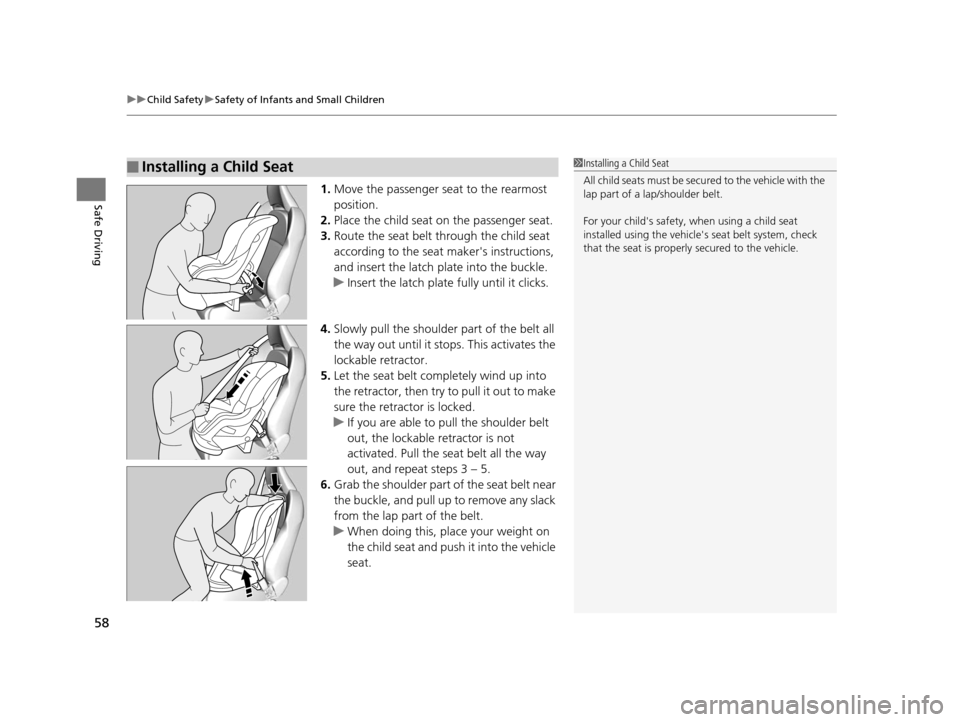
Safe Driving1. Move the passenger seat to the rearmost
position.
2. Place the child seat on the passenger seat.
3. Route the seat belt through the child seat
according to the seat maker's instructions,
and insert the latch plate into the buckle.
u Insert the latch plate fully until it clicks.
4. Slowly pull the shoulder part of the belt all
the way out until it stops. This activates the
lockable retractor.
5. Let the seat belt completely wind up into
the retractor, then try to pull it out to make
sure the retractor is locked.
u If you are able to pull the shoulder belt
out, the lockable retractor is not
activated. Pull the seat belt all the way
out, and repeat steps 3 – 5.
6. Grab the shoulder part of the seat belt near
the buckle, and pull up to remove any slack
from the lap part of the belt.
u When doing this, place your weight on
the child seat and push it into the vehicle
seat.
■Installing a Child Seat1Installing a Child Seat
All child seats must be secured to the vehicle with the
lap part of a la p/shoulder belt.
For your child's safety, when using a child seat
installed using the vehicle' s seat belt system, check
that the seat is properly secured to the vehicle.
15 CR-Z-31SZT6400.book 58 ページ 2014年8月1日 金曜日 午後1時59分
Page 62 of 329
61
uuChild Safety uSafety of Larger Children
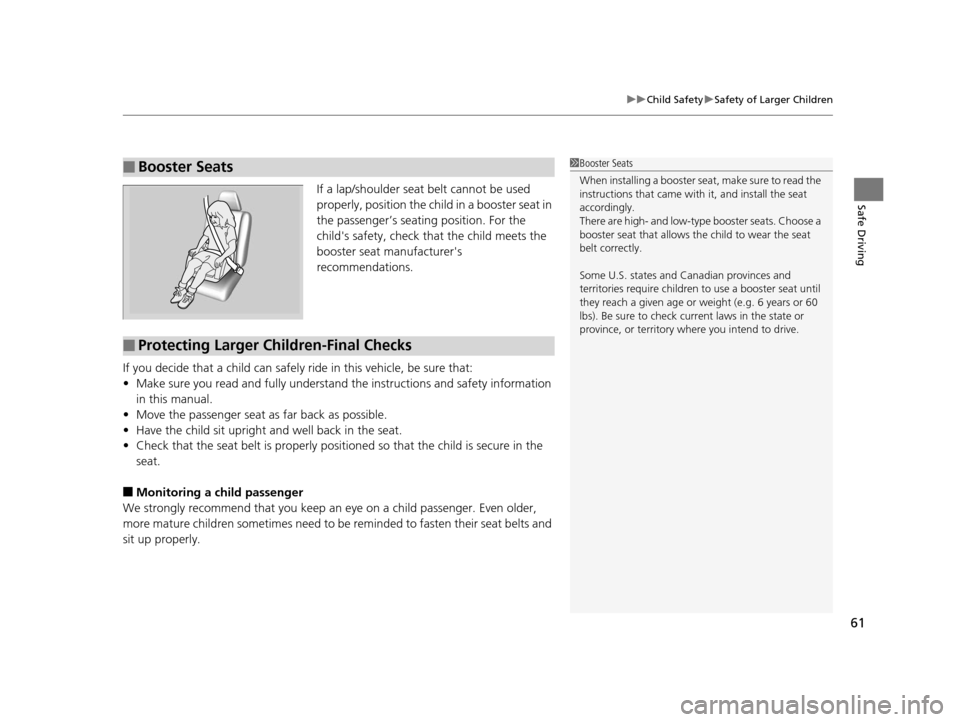
Safe DrivingIf a lap/shoulder seat belt cannot be used
properly, position the child in a booster seat in
the passenger’s seating position. For the
child's safety, check th at the child meets the
booster seat manufacturer's
recommendations.
If you decide that a child can safely ride in this vehicle, be sure that:
• Make sure you read and fully understand the instructions and safety information
in this manual.
• Move the passenger seat as far back as possible.
• Have the child sit upright and well back in the seat.
• Check that the seat belt is properly positi oned so that the child is secure in the
seat.
■Monitoring a child passenger
We strongly recommend that you keep an eye on a child passenger. Even older,
more mature children sometimes need to be reminded to fasten their seat belts and
sit up properly.
■Booster Seats1 Booster Seats
When installing a booster seat, make sure to read the
instructions that came with it, and install the seat
accordingly.
There are high- and low-type booster seats. Choose a
booster seat that allows the child to wear the seat
belt correctly.
Some U.S. states and Canadian provinces and
territories require children to use a booster seat until
they reach a given age or weight (e.g. 6 years or 60
lbs). Be sure to check current laws in the state or
province, or territory where you intend to drive.
■Protecting Larger Children-Final Checks
15 CR-Z-31SZT6400.book 61 ページ 2014年8月1日 金曜日 午後1時59分
Page 98 of 329

97
Controls
This chapter explains how to operate the various controls necessary for driving.
Clock.................................................... 98
Locking and Unlocking the Doors
Key Types and Functions .................... 99
Locking/Unlocking the Doors from the Outside .......................................... 100
Locking/Unlocking the Doors from the Inside ............................................. 102
Auto Door Locking/Unlocking .......... 104
Opening and Closing the Hatch....... 105
Security System Immobilizer System .......................... 107
Security System Alarm ...................... 107
Opening and Closing the Windows ..... 109
Operating the Switches Around the
Steering Wheel
Ignition Switch ................................. 111
Turn Signals ..................................... 112
Light Switches.................................. 112
Fog Lights
*...................................... 114
Daytime Running Lights ................... 114
Wipers and Washers ........................ 115
Brightness Control ........................... 117
Rear Defogger/Heat ed Door Mirror
*
Button ........................................... 118
Adjusting the Steering Wheel........... 119 Adjusting the Mirrors
Interior Rearview Mirror ................... 120
Power Door Mirrors ......................... 121
Adjusting the Seats Adjusting the Seat Positions ............. 122
Interior Lights/Interior Convenience ItemsInterior Lights .................................. 127
Interior Convenience Items .............. 128
Climate Control System Using Automatic Climate Control .... 136
Automatic Climate Control Sensors ...... 138
* Not available on all models
15 CR-Z-31SZT6400.book 97 ページ 2014年8月1日 金曜日 午後1時59分
Page 123 of 329

122
Controls
Adjusting the Seats
Adjusting the Seat Positions
Adjust the driver's seat as far back as possible
while allowing you to maintain full control of
the vehicle. You should be able to sit upright,
well back in the seat and be able to
adequately press the pedals without leaning
forward, and grip the steering wheel
comfortably. The passenger's seat should be
adjusted in a similar manner, so that it is as far
back from the front airbag in the dashboard
as possible.1Adjusting the Seats
The National Highway Traffic Safety Administration
and Transport Cana da recommend that drivers allow
at least 10 inches (25 cm) between the center of the
steering wheel and the chest.
Always make seat adjustments before driving.
Once a seat is adjusted co rrectly, rock it back and
forth to make sure it is locked in position.
3WARNING
Sitting too close to a front airbag can result
in serious injury or death if the front
airbags inflate.
Always sit as far back from the front
airbags as possible while maintaining
control of the vehicle.
Move back.
Allow sufficient
space.
Horizontal Position
Adjustment
Pull up on the bar to move the
seat, then release the bar.
Height Adjustment(Driver side only)
Pull up or push down the lever
to raise or lower the seat.
Seat-back Angle
Adjustment
Pull up the lever to
change the angle.
Driver’s seat is shown.
15 CR-Z-31SZT6400.book 122 ページ 2014年8月1日 金曜日 午後1時59分
Page 124 of 329
Continued123
uuAdjusting the Seats uAdjusting the Seat Positions
Controls
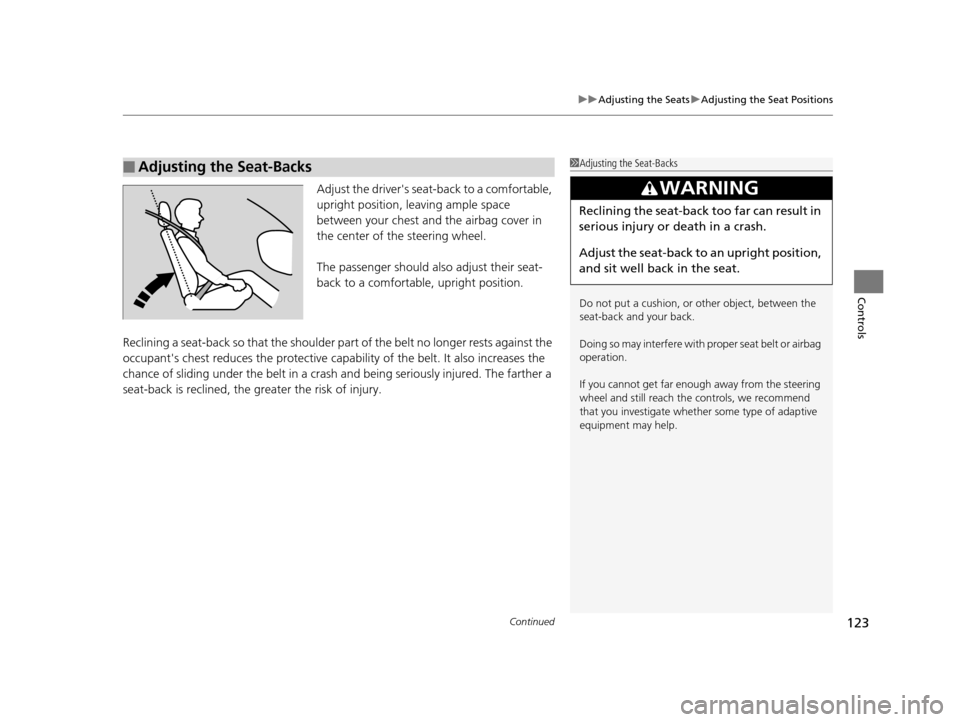
Adjust the driver's seat -back to a comfortable,
upright position, leaving ample space
between your chest and the airbag cover in
the center of the steering wheel.
The passenger should also adjust their seat-
back to a comfortable, upright position.
Reclining a seat-back so that the shoulder part of the belt no longer rests against the
occupant's chest reduces the protective capa bility of the belt. It also increases the
chance of sliding under the belt in a crash and being seriously injured. The farther a
seat-back is reclined, the gr eater the risk of injury.
■Adjusting the Seat-Backs1Adjusting the Seat-Backs
Do not put a cushion, or other object, between the
seat-back and your back.
Doing so may interfere with proper seat belt or airbag
operation.
If you cannot get far e nough away from the steering
wheel and still reach th e controls, we recommend
that you investigate whether some type of adaptive
equipment may help.
3WARNING
Reclining the seat-back too far can result in
serious injury or death in a crash.
Adjust the seat-back to an upright position,
and sit well back in the seat.
15 CR-Z-31SZT6400.book 123 ページ 2014年8月1日 金曜日 午後1時59分