2015 FORD TRANSIT warning light
[x] Cancel search: warning lightPage 256 of 461
You should always have your tires serviced
by an authorized dealer.
Check the tire pressure periodically (at
least monthly) using an accurate tire
gauge. See Inflating Your Tires in this
chapter.
Understanding the Tire Pressure
Monitoring System
The system measures the pressure in the
four road tires and sends the tire pressure
readings to your vehicle. The low tire
pressure warning light will illuminate if any
of the tire pressures are significantly low.
If the warning light is illuminated, one or
more of the tires are under-inflated and
need to be inflated to the correct pressure.
When the Temporary Spare Tire is
Installed
If one of the road wheels and tire needs to
be replaced with the temporary spare
wheel and tire, the system will continue to
identify a defect. This is to remind you that
the damaged road wheel and tire must be
repaired and refitted to your vehicle.
To restore the correct operation of the
system, you must have the repaired road
wheel and tire assembly refitted to your
vehicle. For additional information, see
Changing Tires with a Tire Pressure
Monitoring System in this section.
When You Believe the System is Not
Operating Correctly
The main function of the system is to warn
you when the tire pressures are low. It can
also warn you in the event the system is
no longer capable of operating correctly.
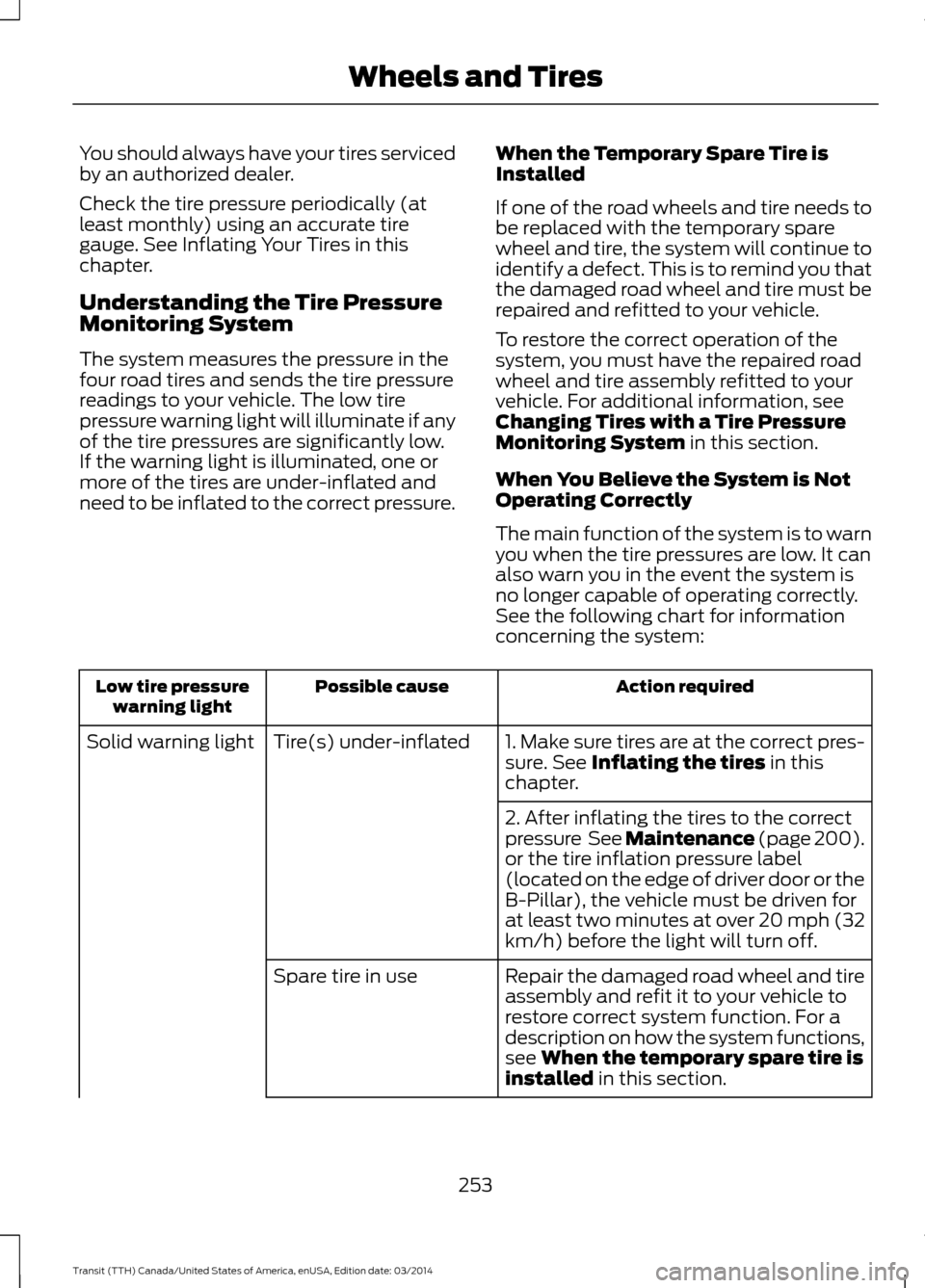
See the following chart for information
concerning the system: Action required
Possible cause
Low tire pressure
warning light
1. Make sure tires are at the correct pres-
sure. See
Inflating the tires in this
chapter.
Tire(s) under-inflated
Solid warning light
2. After inflating the tires to the correct
pressure
See Maintenance (page 200).
or the tire inflation pressure label
(located on the edge of driver door or the
B-Pillar), the vehicle must be driven for
at least two minutes at over 20 mph (32
km/h) before the light will turn off.
Repair the damaged road wheel and tire
assembly and refit it to your vehicle to
restore correct system function. For a
description on how the system functions,
see When the temporary spare tire is
installed in this section.
Spare tire in use
253Transit (TTH) Canada/United States of America, enUSA, Edition date: 03/2014 Wheels and Tires
Page 257 of 461

Action required
Possible cause
Low tire pressure
warning light
On vehicles with different front and rear
tire pressures, you must retrain the
system following every tire rotation. See
Tire Care (page 234).
Tire rotation without
sensor training
If the tires are correctly inflated and the
spare tire is not in use but the light
remains on, have your vehicle checked
by an authorized dealer as soon as
possible.
Tire pressure monitoring
system malfunction
Repair the damaged road wheel and tire
assembly and refit it to your vehicle to
restore correct system function. For a
description on how the system functions,
see When the temporary spare tire is
installed in this section.
Spare tire in use
Flashing warning
light
If the tires are correctly inflated and the
spare tire is not in use but the light
remains on, have your vehicle checked
by an authorized dealer as soon as
possible.
Tire pressure monitoring
system malfunction
When Inflating the Tires
When inflating the tires (for example; at a
gas station), the system may not respond
immediately to the air added to the tires.
It may take up to two minutes of driving
over 20 mph (32 km/h) for the light to turn
off after you have filled your tires to the
recommended inflation pressure.
How Temperature Affects the Tire
Pressures
While driving in a normal manner, tire
pressures may increase up to 4 psi (0.3
bar) from a cold start situation. If the
vehicle is stationary overnight and the
temperature significantly lower than the
daytime temperature, tire pressures may decrease up to 3 psi (0.2 bar) for a drop of
30°F (17°C) in ambient temperature. This
lower pressure value will be detected by
the system as being significantly lower
than the correct inflation pressure and the
warning light will illuminate.
If the warning light is on:
•
Check each tire to verify that none are
flat.
• If one or more tires are flat, repair as
necessary.
• Check the tire pressures and Inflate all
the tires to the correct pressure.
Tire Pressure Monitoring System
Reset Procedure
Note: The system reset procedure needs
to be carried out after each tire replacement.
254 Transit (TTH) Canada/United States of America, enUSA, Edition date: 03/2014 Wheels and Tires
Page 258 of 461

Overview
WARNING
To determine the required
pressure(s) for your vehicle, see the
Safety Compliance Certification
Label (affixed to either the door hinge
pillar, door-latch post, or the door edge
that meets the door-latch post, next to the
driver seating position), or Tire Label
located on the B-Pillar or the edge of the
driver door. To maintain your vehicle
’s load carrying
capability, this vehicle requires different
tire pressures in the front tires compared
to the rear tires. The system on your vehicle
is designed to illuminate the warning light
at different pressures for the front and rear
tires.
The tires need to be periodically rotated
to provide consistent performance and
maximum tire life, the system needs to
know when the tires have been rotated to
determine which set of tires are on the
front and rear axles. With this information,
the system can detect and correctly warn
of low tire pressures.
System Reset Tips:
• To reduce the chance of interference
from another vehicle, the system reset
procedure should be carried out at
least three feet (one meter) away from
another Ford vehicle undergoing the
system reset procedure.
• Do not wait more than two minutes
between resetting each tire sensor or
the system will time-out and the entire
procedure will have to be repeated on
all four wheels. A double horn chirp
indicates the need to repeat the
procedure. Carrying Out the System Reset
Procedure
Read the entire procedure before carrying
out a system reset.
1. Drive your vehicle above 20 mph (32
km/h) for at least two minutes and
then park in a safe location where you
can easily get to all four tires and have
access to a tire inflation pump.
2. Switch the ignition off.
3. Switch the ignition on with the engine off.
4. Turn the hazard flashers on then off three times, this must be completed
within 10 seconds. If the reset mode
has been entered successfully, the horn
will chirp once and the system indicator
will flash. If this does not occur, repeat
the procedure from step 2. If after
repeated attempts to enter the reset
mode, the horn does not chirp and the
system indicator does not flash, have
your vehicle checked by an authorized
dealer as soon as possible.
5. Train the system sensors in the tires using the following reset sequence
starting with the left front tire and
following a clockwise order: Left front,
right front, right rear, left rear.
6. Remove the valve cap from the valve stem on the left front tire. Decrease the
air pressure until the horn chirps.
Note: The single horn chirp confirms that
the sensor identification code has been
learned by your vehicle for this position. If a
double horn chirp is heard, the reset
procedure was unsuccessful and must be
repeated.
7. Remove the valve cap from the valve stem on the right front tire. Decrease
the air pressure until the horn chirps.
8. Remove the valve cap from the valve stem on the right rear tire. Decrease the
air pressure until the horn chirps.
255 Transit (TTH) Canada/United States of America, enUSA, Edition date: 03/2014 Wheels and Tires
Page 259 of 461

9. Remove the valve cap from the valve
stem on the left rear tire. Decrease the
air pressure until the horn chirps.
Training is complete when the horn
chirps after the last system sensor (left
rear) has been trained and the system
indicator stops flashing.
10. Switch the ignition off. If two short horn chirps are heard, the reset
procedure was unsuccessful and
must be repeated.
Note: If after repeating the procedure two
short horn chirps are heard again, have your
vehicle checked by an authorized dealer as
soon as possible.
11. Set all four tires to the correct pressure See Maintenance (page
200). or the tire inflation pressure label
(located on the edge of driver door or
the B-Pillar).
CHANGING A ROAD WHEEL WARNINGS
The use of tire sealant may damage
your tire pressure monitoring system
and should only be used in roadside
emergencies. If you must use a sealant, the
Ford Tire Mobility Kit sealant should be
used. The tire pressure monitoring system
sensor and valve stem on the wheel must
be replaced by an authorized dealer after
use of the sealant. If the tire pressure monitor sensor
becomes damaged, it will no longer
function. See
Tire Pressure
Monitoring System (page 251). Note:
The tire pressure monitoring system
indicator light will illuminate when the spare
tire is in use. To restore the full function of
the monitoring system, all road wheels
equipped with tire pressure monitoring
sensors must be mounted on this vehicle. If you get a flat tire while driving, do not
apply the brake heavily. Instead, gradually
decrease your speed. Hold the steering
wheel firmly and slowly move to a safe
place on the side of the road.
Have a flat serviced by an authorized
dealer in order to prevent damage to the
system sensors
See Tire Pressure
Monitoring System (page 251). Replace
the spare tire with a road tire as soon as
possible. During repairing or replacing of
the flat tire, have the authorized dealer
inspect the system sensor for damage.
Dissimilar Spare Wheel and Tire
Assembly Information WARNING
Failure to follow these guidelines
could result in an increased risk of
loss of vehicle control, injury or death.
If you have a dissimilar spare wheel and
tire, then it is intended for temporary use
only. This means that if you need to use it,
you should replace it as soon as possible
with a road wheel and tire assembly that
is the same size and type as the road tires
and wheels that were originally provided
by Ford. If the dissimilar spare tire or wheel
is damaged, it should be replaced rather
than repaired.
A dissimilar spare wheel and tire assembly
is defined as a spare wheel and tire
assembly that is different in brand, size or
appearance from the road tires and wheels
and can be one of three types:
1.
T-type mini-spare: This spare tire
begins with the letter T for tire size and
may have Temporary Use Only molded in
the sidewall.
2. Full-size dissimilar spare with label
on wheel:
This spare tire has a label on
the wheel that states: THIS WHEEL AND
TIRE ASSEMBLY FOR TEMPORARY USE
ONLY
256 Transit (TTH) Canada/United States of America, enUSA, Edition date: 03/2014 Wheels and Tires
Page 452 of 461

A
A/C
See: Climate Control.......................................... 89
About This Manual...........................................7 Protecting the Environment................................ 7
ABS See: Brakes............................................................ 137
ABS driving hints See: Hints on Driving With Anti-Lock
Brakes................................................................. 137
Accessories.....................................................414 Exterior Style........................................................ 414
Interior Style......................................................... 414
Lifestyle.................................................................. 414
Peace of Mind...................................................... 414
Accessories See: Replacement Parts
Recommendation............................................ 10
Adjusting the Headlamps..........................215 Horizontal Aim Adjustment............................ 216
Vertical Aim Adjustment.................................. 215
Adjusting the Steering Wheel....................61
Airbag Disposal...............................................43
Air Conditioning See: Climate Control.......................................... 89
Air Vents............................................................89 Center Air Vents.................................................... 89
Side Air Vent.......................................................... 90
Alarm See: Anti-Theft Alarm........................................ 60
Anti-Theft Alarm...........................................60 Alarm System....................................................... 60
Arming the Alarm................................................ 60
Disarming the Alarm.......................................... 60
Triggering the Alarm........................................... 60
Appendices.....................................................416
Audible Warnings and Indicators..............77
Airbag Secondary Warning................................ 77
Door Ajar................................................................... 77
Exterior Lamps On............................................... 78
Gearshift Lever not in Park (P)........................78
Key in Ignition......................................................... 78
Parking Brake On.................................................. 78
Safety Belt Minder............................................... 78
Audio Control - Vehicles With: Touchscreen Display..................................62 Audio Control - Vehicles Without:
Touchscreen Display...................................61
Seek, Next or Previous........................................ 62
Audio Input Jack...........................................297
Audio System................................................282 General Information......................................... 282
Audio Troubleshooting
..............................299
Audio Unit - Vehicles With: AM/FM/CD/ SYNC/Satellite Radio.............................290
A
udio Unit - Vehicles With: AM/FM/CD/
SYNC.............................................................288
Audio Unit - Vehicles With: AM/ FM...................................................................283
A
UX Button.......................................................... 286
Clock Button........................................................ 285
Menu Button....................................................... 286
Sound Button..................................................... 286
Station Preset Buttons.................................... 286
Station Tuning Buttons................................... 285
Audio Unit - Vehicles With: Premium AM/FM/CD.................................................286
Autolamps........................................................67 Windshield Wiper Activated Rain
Lights.................................................................... 67
Automatic Transmission
............................133
Brake-Shift Interlock......................................... 135
Hints on Driving with an Automatic Transmission................................................... 135
Understanding the Gearshift Lever Positions of the Automatic
Transmission................................................... 133
Automatic Transmission Fluid Check............................................................209
Autowipers.......................................................64
Auxiliary Power Points................................103 A
C Power Point................................................... 103
Auxiliary Power Point Locations...................103
Auxiliary Switches........................................
415
B
Bonnet Lock See: Opening and Closing the Hood.........200
Booster Seats..................................................22 Types of Booster Seats...................................... 22
Bottle Holder
..................................................105
Brake Fluid Check.........................................210
44
9 Transit (TTH) Canada/United States of America, enUSA, Edition date: 03/2014 Index