2015 FORD TRANSIT check oil
[x] Cancel search: check oilPage 206 of 461

Power steering fluid reservoir
*
. See Power Steering Fluid Check (page 210).
G
Washer fluid reservoir *
. See
Washer Fluid Check (page 210).
H
* The filler caps and the engine oil dipstick are colored for easy identification.
UNDER HOOD OVERVIEW - 3.2L POWER STROKE DIESEL Air cleaner. See Changing the Engine Air Filter (page 225
).
A
Engine oil dipstick *
. See Engine Oil Dipstick (page 204).
B
Engine oil filler cap *
. See
Engine Oil Check (page 204).
C
Brake and clutch fluid reservoir *
. See
Brake Fluid Check (page 210).
D
Engine coolant reservoir *
. See Engine Coolant Check (page 206).
E
Engine compartment fuse box. See Fuses
(page 187).
F
Power steering fluid reservoir *
. See
Power Steering Fluid Check (page 210).
G
Washer fluid reservoir *
. See Washer Fluid Check
(page 210).
H
* The filler caps and the engine oil dipstick are colored for easy identification.
203Transit (TTH) Canada/United States of America, enUSA, Edition date: 03/2014 MaintenanceE174603
ABCDE
FGH
Page 207 of 461

ENGINE OIL DIPSTICK - 3.5L
Minimum
A
Maximum
B
ENGINE OIL DIPSTICK - 3.7L Minimum
A
Maximum
B ENGINE OIL DIPSTICK - 3.2L
POWER STROKE DIESEL Minimum
A
Maximum
B
ENGINE OIL CHECK
1. Make sure that your vehicle is on level ground.
2. Switch off the engine and wait 10 minutes for the oil to drain into the oil
pan.
3. Remove the dipstick and wipe it with a clean, lint free cloth. Replace the
dipstick and remove it again to check
the oil level.
If the oil level is at the minimum mark, add
oil immediately. See Capacities and
Specifications (page 265).
Note: Check the oil level before starting the
engine.
Note: Make sure that the oil level is
between the minimum and the maximum
marks.
Note: Do not use oil additives or other
engine treatments. Under certain conditions,
they could damage the engine.
Note: The oil consumption of new engines
reaches its normal level after approximately
3000 mi (5,000 km)
.
204 Transit (TTH) Canada/United States of America, enUSA, Edition date: 03/2014 MaintenanceE174604
AB E174604
AB E71362
AB
Page 209 of 461

•
Sustained high-speed driving at Gross
Vehicle Weight Rating (maximum
loaded weight for vehicle operation).
• Sustained use of diesel fuel other than
ultra-low sulfur diesel (ULSD). Resetting the Oil Life Monitoring
System The indicator lamp will
illuminate when the engine oil
and oil filter requires changing.
To reset the Oil Life Monitoring System, switch the ignition on, do not start the
engine and scroll to: Action and Description
Message
Fully press the accelerator and brake pedals. Keep both
pedals fully pressed.
Oil change required
The information display will show this message after a short
period of time.
Oil reset in prog.
The information display will show this message after a short
period of time.
Oil reset complete
Release the accelerator and brake pedals and switch the
ignition off.
ENGINE COOLANT CHECK
Checking the Engine Coolant
When the engine is cold, check the
concentration and level of the engine
coolant at the intervals listed in the
scheduled maintenance information. See
Scheduled Maintenance (page 433).
Note: Make sure that the level is between
the MIN and MAX marks on the coolant
reservoir.
Note: Coolant expands when it is hot. The
level may extend beyond the MAX mark.
Note: If the level is at the MIN mark, below
the MIN mark, or empty, add coolant
immediately. See
Adding Engine Coolant
in this chapter.
The coolant concentration should be
maintained within 48% to 50%, which
equates to a freeze point between -29.2°F
(-34°C)
and -34.5°F (-37°C). Note:
For best results, coolant
concentration should be tested with a
refractometer, for example Robinair®
coolant and battery refractometer 75240.
We do not recommend the use of
hydrometers or coolant test strips for
measuring coolant concentrations.
Note: Automotive fluids are not
interchangeable. Do not use engine coolant,
antifreeze or windshield washer fluid outside
of its specified function and vehicle location.
Adding Engine Coolant WARNINGS
Do not add engine coolant when the
engine is hot. Steam and scalding
liquids released from a hot cooling
system can burn you badly. Also, spilling
coolant on hot engine parts can burn you. Do not put engine coolant in the
windshield washer fluid reservoir. If
sprayed on the windshield, engine
coolant could make it difficult to see
through the windshield.
206 Transit (TTH) Canada/United States of America, enUSA, Edition date: 03/2014 Maintenance
Page 235 of 461

Cooling system
•
Protect against freezing temperatures.
• When removing your vehicle from
storage, check coolant fluid level.
Confirm that there are no cooling
system leaks and that fluid is at the
recommended level.
Battery
• Check and recharge as necessary. Keep
connections clean.
• If storing your vehicle for more than 30
days without recharging the battery,
we recommend that you disconnect
the battery cables to maintain battery
charge for quick starting.
Note: It is necessary to reset memory
features if battery cables are disconnected.
Brakes
• Make sure the brakes and parking brake
release fully.
Tires
• Maintain recommended air pressure.
Miscellaneous
• Make sure all linkages, cables, levers
and pins under your vehicle are covered
with grease to prevent rust.
• Move vehicles at least 25 ft (7.5 m)
every 15 days to lubricate working parts
and prevent corrosion.
Removing Vehicle From Storage
When your vehicle is ready to come out of
storage, do the following:
• Wash your vehicle to remove any dirt
or grease film build-up on window
surfaces.
• Check windshield wipers for any
deterioration. •
Check under the hood for any foreign
material that may have collected
during storage such as mice or squirrel
nests.
• Check the exhaust for any foreign
material that may have collected
during storage.
• Check tire pressures and set tire
inflation per the Tire Label.
• Check brake pedal operation. Drive
your vehicle
15 ft (4.5 m) back and
forth to remove rust build-up.
• Check fluid levels (including coolant,
oil and gas) to make sure there are no
leaks, and fluids are at recommended
levels.
• If you remove the battery, clean the
battery cable ends and inspect.
Contact an authorized dealer if you have
any concerns or issues.
232 Transit (TTH) Canada/United States of America, enUSA, Edition date: 03/2014 Vehicle Care
Page 437 of 461

When the oil change message appears in
the information display, it is time for an oil
change. Make sure you perform the oil
change within two weeks or 500 miles
(800 kilometers) of the message
appearing. Make sure you reset the
Intelligent Oil-Life Monitor after each oil
change. See Changing the Engine Oil
and Oil Filter (page 205).
If your information display resets
prematurely or becomes inoperative, you
should perform the oil change interval at
six months or
5000 mi (8,000 km) from
your last oil change. Never exceed one year
or
10000 mi (16,000 km) between oil
change intervals.
All Vehicles
Your vehicle is very sophisticated and built
with multiple, complex, performance
systems. Every manufacturer develops
these systems using different
specifications and performance features.
That is why it is important to rely upon your
dealership to correctly diagnose and repair
your vehicle.
Ford Motor Company has recommended
maintenance intervals for various parts
and component systems based upon
engineering testing. Ford Motor Company
relies upon this testing to determine the
most appropriate mileage for replacement
of oils and fluids to protect your vehicle at
the lowest overall cost to you and
recommends against maintenance
schedules that deviate from the scheduled
maintenance information.
We strongly recommend the use of only
genuine Ford, Motorcraft or
Ford-authorized re-manufactured
replacement parts engineered for your
vehicle. Additives and Chemicals
This owner's manual and the Ford
Workshop Manual list the recommended
additives and chemicals for your vehicle.
We do not recommend using chemicals or
additives not approved by us as part of
your vehicle
’s normal maintenance. Please
consult your warranty information.
Oils, Fluids and Flushing
In many cases, fluid discoloration is a
normal operating characteristic and, by
itself, does not necessarily indicate a
concern or that the fluid needs to be
changed. However, a qualified expert, such
as the factory-trained technicians at your
dealership, should inspect discolored fluids
that also show signs of overheating or
foreign material contamination
immediately.
Make sure to change your vehicle ’s oils and
fluids at the specified intervals or in
conjunction with a repair. Flushing is a
viable way to change fluid for many vehicle
sub-systems during scheduled
maintenance. It is critical that systems are
flushed only with new fluid that is the same
as that required to fill and operate the
system or using a Ford-approved flushing
chemical.
Owner Checks and Services
Make sure you perform the following basic
maintenance checks and inspections every
month or at six-month intervals. Check every month
Engine oil level.
Function of all interior and exterior lights.
Tires (including spare) for wear and
correct pressure.
Windshield washer fluid level.
434 Transit (TTH) Canada/United States of America, enUSA, Edition date: 03/2014 Scheduled Maintenance
Page 438 of 461

Check every six months
Battery connections. Clean if necessary.
Body and door drain holes for obstruc-
tions. Clean if necessary.
Cooling system fluid level and coolant
strength.
Door weatherstrips for wear. Lubricate if
necessary.
Hinges, latches and outside locks for
correct operation. Lubricate if necessary.
Parking brake for correct operation.
Safety belts and seat latches for wear
and function.
Safety warning lamps (brake, ABS, airbag
and safety belt) for operation.
Washer spray and wiper operation. Clean
or replace blades as necessary.
Multi-point Inspection
In order to keep your vehicle running
correctly, it is important to have the
systems on your vehicle checked regularly.
This can help identify potential issues and
prevent major problems. We recommend
having the following multi-point inspection
performed at every scheduled
maintenance interval to help make sure
your vehicle keeps running correctly. Multi-point inspection
Accessory drive belt(s).
Battery performance.
Engine air filter.
Exhaust system. Multi-point inspection
Exterior lamps and hazard warning
system operation.
Fluid levels *
; fill if necessary.
For oil and fluid leaks.
Horn operation.
Radiator, cooler, heater and A/C hoses.
Suspension component for leaks or
damage.
Steering and linkage.
Tires (including spare) for wear and
correct pressure **
.
Windshield for cracks, chips or pits.
Washer spray and wiper operation.
* Brake, coolant recovery reservoir,
automatic transmission, power steering (if
equipped with hydraulic power assist
steering) and window washer.
** If your vehicle is equipped with a
temporary mobility kit, check the tire
sealant expiration Use By date on the
canister. Replace as needed.
Be sure to ask your dealership service
advisor or technician about the multi-point
vehicle inspection. It is a comprehensive
way to perform a thorough inspection of
your vehicle. Your checklist gives you
immediate feedback on the overall
condition of your vehicle.
435 Transit (TTH) Canada/United States of America, enUSA, Edition date: 03/2014 Scheduled Maintenance
Page 443 of 461

Exclusive use of E85 (Flex fuel vehicles only)
If ran exclusively on E85, fill the fuel tank full with regular
unleaded fuel.
Every oil change interval
Exceptions
There are several exceptions to the Normal
Schedule:
Normal vehicle axle maintenance: Rear
a
xles and power take-off units with
synthetic fluid and light-duty trucks
equipped with Ford-design axles are
lubricated for life; do not check or change
fluid unless a leak is suspected, service is
required or the assembly has been
submerged in water. During long periods
of trailer towing with outside temperatures
above
70°F (21°C) and at wide-open
throttle for long periods above 45 mph
(72 km/h), change non-synthetic rear axle
fluid every 3000 mi (4,800 km) or three
months, whichever comes first. This
interval can be waived if the axle is filled
with 75W140 synthetic gear fluid meeting
Ford specification WSL-M2C192-A; GL-5
or equivalent. Add friction modifier XL-3
EST-M2C118-A or equivalent for complete
refill of Traction-Lok rear axles. See
Capacities and Specifications
(page
265).
Police, Taxi and Livery vehicle axle
maintenance: Change rear axle fluid every
100000 mi (160,000 km). Rear axle fluid
change may be waived if the axle was filled
with 75W140 synthetic gear fluid meeting
Ford specification WSL-M2C192-A; GL-5 or equivalent. Add four ounces (118
milliliters) of additive friction modifier XL-3
EST-M2C118-A, or equivalent, for complete
refill of Traction-Lok rear axles. Change
the axle fluid anytime the axle submerges
in water.
California fuel filter replacement: If you
register your vehicle in California, the
California Air Resources Board has
determined that the failure to perform this
maintenance item does not nullify the
emission warranty or limit recall liability
before the completion of your vehicle's
useful life. Ford Motor Company, however,
urges you to have all recommended
maintenance services performed at the
specified intervals and to record all vehicle
service.
Hot climate oil change intervals:
Vehicles operating in the Middle East,
North Africa, Sub-Saharan Africa or
locations with similar climates using an
American Petroleum Institute (API)
Certified for Gasoline Engines (Certification
mark) oil of SM or SN quality, the normal
oil change interval is 5000 mi (8,000 km).
If the available API SM or SN oils are not
available, then the oil change interval is
3000 mi (4,800 km).
Engine air filter replacement: The life of
the engine air fil
ter is dependent on
exposure to dusty and dirty conditions.
Vehicles operated in these conditions
require frequent inspection and
replacement of the engine air filter.
440 Transit (TTH) Canada/United States of America, enUSA, Edition date: 03/2014 Scheduled Maintenance
Page 453 of 461
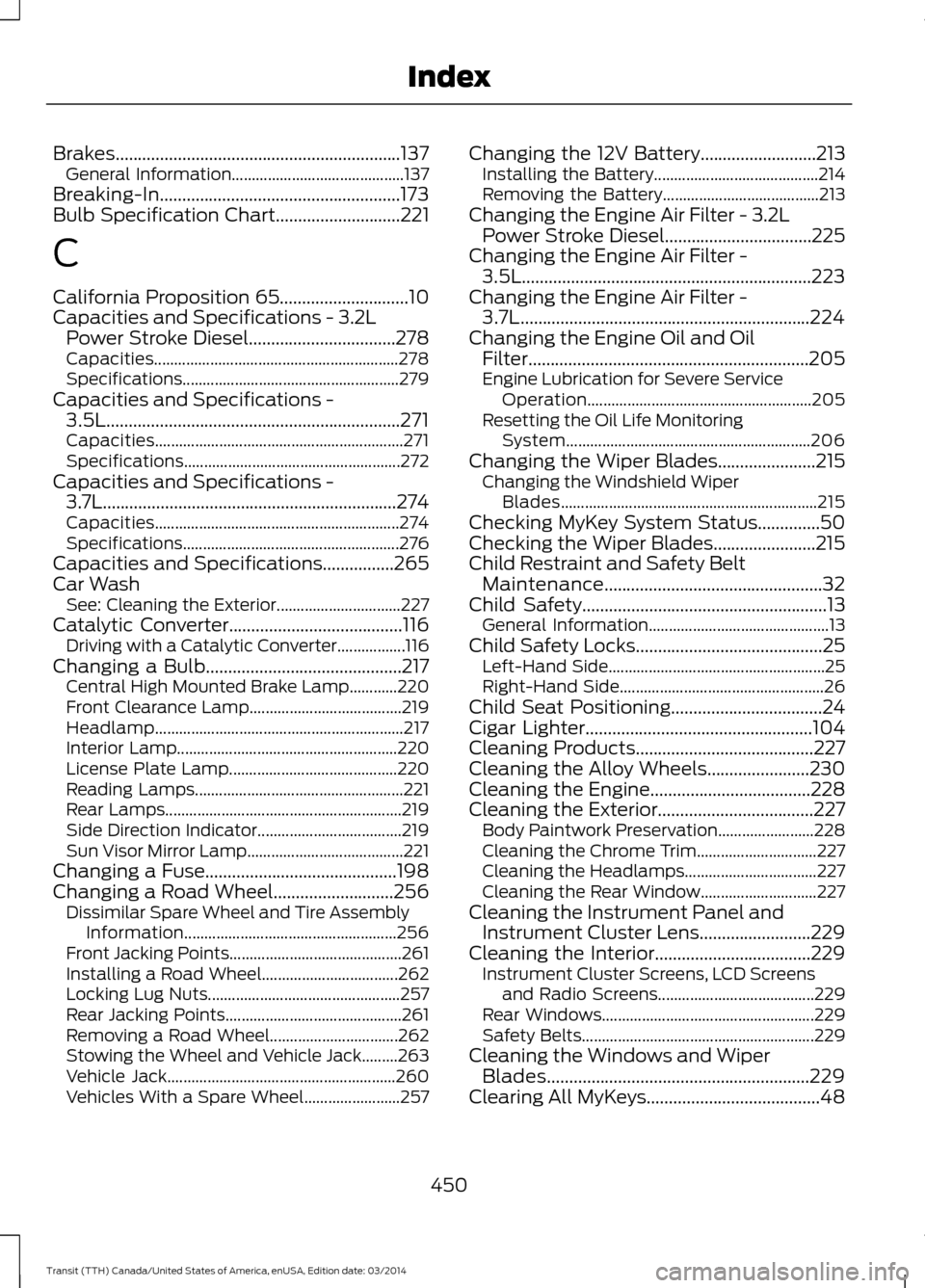
Brakes................................................................137
General Information........................................... 137
Breaking-In......................................................173
Bulb Specification Chart............................221
C
California Proposition 65.............................10
C
apacities and Specifications - 3.2L
Power Stroke Diesel.................................278
Capacities............................................................. 278
Specifications...................................................... 279
Capacities and Specifications - 3.5L..................................................................271
Capacities.............................................................. 271
Specifications...................................................... 272
Capacities and Specifications - 3.7L..................................................................274
Capacities............................................................. 274
Specifications...................................................... 276
Capacities and Specifications
................265
Car Wash See: Cleaning the Exterior............................... 227
Catalytic Converter
.......................................116
Driving with a Catalytic Converter.................116
Changing a Bulb............................................217 Central High Mounted Brake Lamp............220
Front Clearance Lamp...................................... 219
Headlamp.............................................................. 21
7
Interior Lamp....................................................... 220
License Plate Lamp.......................................... 220
Reading Lamps.................................................... 221
Rear Lamps........................................................... 219
Side Direction Indicator.................................... 219
Sun Visor Mirror Lamp....................................... 221
Changing a Fuse...........................................198
Changing a Road Wheel...........................256 Dissimilar Spare Wheel and Tire Assembly
Information..................................................... 256
Front Jacking Points........................................... 261
Installing a Road Wheel.................................. 262
Locking Lug Nuts................................................ 257
Rear Jacking Points............................................ 261
Removing a Road Wheel................................ 262
Stowing the Wheel and Vehicle Jack.........263
Vehicle Jack......................................................... 260
Vehicles With a Spare Wheel........................ 257Changing the 12V Battery
..........................213
Installing the Battery......................................... 214
Removing the Battery....................................... 213
Changing the Engine Air Filter - 3.2L Power Stroke Diesel.................................225
Changing the Engine Air Fil
ter -
3.5L.................................................................223
Changing the Engine Air Filter - 3.7L.................................................................224
Changing the Engine Oil and Oil Filter...............................................................205
Engine Lubrication for Severe Service Operation........................................................ 205
Resetting the Oil Life Monitoring System............................................................. 206
Changing the Wiper Blades......................
215
Changing the Windshield Wiper
Blades................................................................ 215
Checking MyKey System Status..............50
Checking the Wiper Blades.......................215
Child Restraint and Safety Belt Maintenance.................................................32
Child Safety.......................................................
13
General Information............................................. 13
Child Safety Locks
..........................................25
Left-Hand Side...................................................... 25
Right-Hand Side................................................... 26
Child Seat Positioning..................................24
Cigar Lighter
...................................................104
Cleaning Products........................................227
Cleaning the Alloy Wheels.......................230
Cl
eaning the Engine....................................228
Cleaning the Exterior...................................227 Body P
aintwork Preservation........................ 228
Cleaning the Chrome Trim.............................. 227
Cleaning the Headlamps................................. 227
Cleaning the Rear Window............................. 227
Cleaning the Instrument Panel and Instrument Cluster Lens.........................229
Cl
eaning the Interior...................................229
Instrument Cluster Screens, LCD Screens
and Radio Screens....................................... 229
Rear Windows..................................................... 229
Safety Belts.......................................................... 229
Cleaning the Windows and Wiper Blades...........................................................229
Clearing All MyKeys.......................................48
4
50 Transit (TTH) Canada/United States of America, enUSA, Edition date: 03/2014 Index