2015 FORD TAURUS child seat
[x] Cancel search: child seatPage 46 of 558

DRIVER AND PASSENGER AIRBAGS
WARNING:Never place your arm or any objects over an airbag
module. Placing your arm over a deploying airbag can result in
serious arm fractures or other injuries. Objects placed on or over the
airbag inflation area may cause those objects to be propelled by the
airbag into your face and torso causing serious injury.
WARNING: Airbags can kill or injure a child in a child seat.
Never place a rear-facing child seat in front of an active airbag. If
you must use a forward-facing child seat in the front seat, move the
seat upon which the child seat is installed all the way back.
The driver and front passenger
airbags will deploy during significant
frontal and near-frontal crashes.
The driver and passenger front airbag system consists of:
• Driver and passenger airbag modules.
• Front passenger sensing system.
•Crash sensors and monitoring system with readiness
indicator. See Crash Sensors and Airbag Indicator later in
this chapter.
Supplementary Restraints System 45
2015 Taurus
Owners Guide gf, 1st Printing, April 2014
USA(fus)
Page 47 of 558
Proper Driver and Front Passenger Seating Adjustment
WARNING:The National Highway Traffic Safety Administration
recommends a minimum distance of at least 10 inches (25
centimeters) between an occupant’s chest and the driver airbag
module.
To properly position yourself away from the airbag:
• Move your seat to the rear as far as you can while still reaching the
pedals comfortably.
• Recline the seat slightly (one or two degrees) from the upright
position.
After all occupants have adjusted their seats and put on safety belts, it is
very important that they continue to sit properly. Properly seated
occupants sit upright, lean against the seat back, and center themselves
on the seat cushion, with their feet comfortably extended on the floor.
Sitting improperly can increase the chance of injury in a crash event. For
example, if an occupant slouches, lies down, turns sideways, sits forward,
leans forward or sideways, or puts one or both feet up, the chance of
injury during a crash is greatly increased.
Children and Airbags
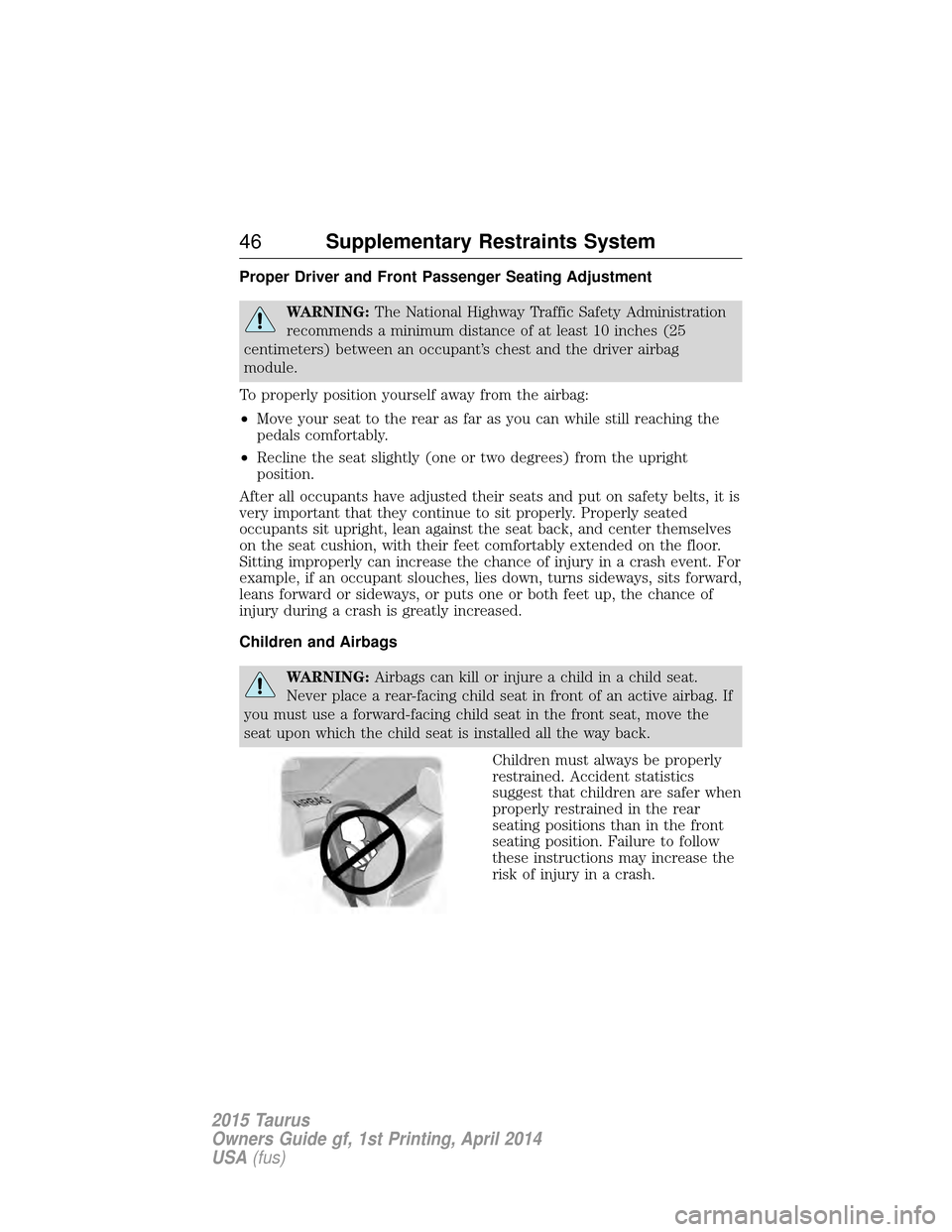
WARNING: Airbags can kill or injure a child in a child seat.
Never place a rear-facing child seat in front of an active airbag. If
you must use a forward-facing child seat in the front seat, move the
seat upon which the child seat is installed all the way back.
Children must always be properly
restrained. Accident statistics
suggest that children are safer when
properly restrained in the rear
seating positions than in the front
seating position. Failure to follow
these instructions may increase the
risk of injury in a crash.
46Supplementary Restraints System
2015 Taurus
Owners Guide gf, 1st Printing, April 2014
USA(fus)
Page 48 of 558

FRONT PASSENGER SENSING SYSTEM
WARNING:Even with Advanced Restraints Systems, children 12
and under should be properly restrained in a rear seating position.
Failure to follow this could seriously increase the risk of injury or death.
WARNING: Sitting improperly out of position or with the seat
back reclined too far can take off weight from the seat cushion
and affect the decision of the front passenger sensing system, resulting
in serious injury or death in a crash.
Always sit upright against your seat back, with your feet on the floor.
WARNING: To reduce the risk of possible serious injury:
Do not stow objects in seat back map pocket or hang objects off
seat back if a child is in the front passenger seat.
Do not place objects underneath the front passenger seat or between
the seat and the center console.
Check the passenger airbag off for proper airbag status.
Failure to follow these instructions may interfere with the passenger
seat sensing system.
WARNING: Any alteration or modification to the front passenger
seat may affect the performance of the front passenger sensing
system which could seriously increase the risk of injury or death.
This system works with sensors that are part of the front passenger’s
seat and safety belt to detect the presence of a properly-seated occupant
and determine if the front passenger’s frontal airbag should be enabled
(may inflate) or not.
The front passenger sensing system
uses a passenger airbag status
indicator which will illuminate
indicating that the front passenger
frontal airbag is either ON (enabled)
or OFF (disabled). The indicator
lamp is located in the center stack of
the instrument panel.
Supplementary Restraints System 47
2015 Taurus
Owners Guide gf, 1st Printing, April 2014
USA(fus)
Page 49 of 558

Note:When the ignition is first turned on, the passenger airbag status
indicator OFF and ON lamps will illuminate for a short period of time to
confirm it is functional.
The front passenger sensing system is designed to disable (will not
inflate) the front passenger’s frontal airbag when the front passenger
seat is unoccupied, or a rear facing infant seat, a forward-facing child
restraint, or a booster seat is detected. Even with this technology,
parents are stronglyencouraged to always properly restrain children in
the rear seat. The sensor also turns off the passenger front airbag and
seat-mounted side airbag when the passenger seat is empty.
• When the front passenger sensing system disables (will not inflate)
the front passenger frontal airbag, the passenger airbag status
indicator will illuminate the OFF lamp and stay lit to remind you that
the front passenger frontal airbag is disabled.
• If the child restraint has been installed and the passenger airbag
status indicator illuminates the ON lamp, then turn the vehicle off,
remove the child restraint from the vehicle and reinstall the restraint
following the child restraint manufacturer’s instructions.
The front passenger sensing system is designed to enable (may inflate)
the front passenger’s frontal airbag anytime the system senses that a
person of adult size is sitting properly in the front passenger seat.
• When the front passenger sensing system enables the front passenger
frontal airbag (may inflate), the passenger airbag status indicator will
illuminate the ON lamp and remain illuminated.
If a person of adult size is sitting in the front passenger’s seat, but the
passenger airbag status indicator OFF lamp is lit, it is possible that the
person isn’t sitting properly in the seat. If this happens:
• Turn the vehicle off and ask the person to place the seat back in the
full upright position.
• Have the person sit upright in the seat, centered on the seat cushion,
with the person’s legs comfortably extended.
• Restart the vehicle and have the person remain in this position for
about two minutes. This will allow the system to detect that person
and enable the passenger’s frontal airbag.
• If the indicator OFF lamp remains lit even after this, the person
should be advised to ride in the rear seat.
48 Supplementary Restraints System
2015 Taurus
Owners Guide gf, 1st Printing, April 2014
USA(fus)
Page 50 of 558

OccupantPassenger airbag
status indicator Passenger airbag
Empty OFF: Lit
Disabled
ON: Unlit
Child OFF: Lit
Disabled
ON: Unlit
Adult OFF: Unlit
Enabled
ON: Lit
Note: When the passenger airbag status indicator OFF lamp is
illuminated, the passenger side airbag (seat mounted) may be disabled to
avoid the risk of airbag deployment injuries.
After all occupants have adjusted their seats and put on safety belts, it’s
very important that they continue to sit properly. A properly seated
occupant sits upright, leaning against the seat back, and centered on the
seat cushion, with their feet comfortably extended on the floor. Sitting
improperly can increase the chance of injury in a crash event. For
example, if an occupant slouches, lies down, turns sideways, sits forward,
leans forward or sideways, or puts one or both feet up, the chance of
injury during a crash is greatly increased.
If you think that the state of the passenger airbag status indicator lamp
is incorrect, check for the following:
• Objects lodged underneath the seat
• Objects between the seat cushion and the center console
• Objects hanging off the seat back
• Objects stowed in the seat back map pocket
• Objects placed on the occupant’s lap
• Cargo interference with the seat
• Other passengers pushing or pulling on the seat
• Rear passenger feet and knees resting or pushing on the seat
The conditions listed above may cause the weight of a properly seated
occupant to be incorrectly interpreted by the front passenger sensing
system. The person in the front passenger seat may appear heavier or
lighter due to the conditions described in the previous list.
Supplementary Restraints System 49
2015 Taurus
Owners Guide gf, 1st Printing, April 2014
USA(fus)
Page 54 of 558

The Safety Canopy will deploy during significant side crashes or when a
certain likelihood of a rollover event is detected by the rollover sensor.
The Safety Canopy is mounted to the roof side-rail sheet metal, behind
the headliner, above each row of seats. In certain sideways crashes or
rollover events, the Safety Canopy will be activated, regardless of which
seats are occupied. The Safety Canopy is designed to inflate between the
side window area and occupants to further enhance protection provided
in side impact crashes and rollover events.The system consists of:
•Safety canopy curtain airbags
located above the trim panels
over the front and rear side
windows identified by wording on
the B-pillar trim.
• A flexible headliner which opens above the side doors to allow air
curtain deployment.
•Crash sensors and monitoring system with readiness
indicator. See Crash Sensors and Airbag Indicator in this
chapter.
Children 12 years old and under should always be properly restrained in
the rear seats. The Safety Canopy will not interfere with children
restrained using a properly installed child or booster seat because it is
designed to inflate downward from the headliner above the doors along
the side window opening.
The design and development of the Safety Canopy included
recommended testing procedures that were developed by a group of
automotive safety experts known as the Side Airbag Technical Working
Group. These recommended testing procedures help reduce the risk of
injuries related to the deployment of side airbags (including the Safety
Canopy).
Supplementary Restraints System 53
2015 Taurus
Owners Guide gf, 1st Printing, April 2014
USA(fus)
Page 551 of 558

911 Assist™ ......................408, 483
A
ABS (see Brakes) .....................196
Accessing and using your
USB port ....................................461
Accessing call history/phone
book during active call .............398
Accessing your calendar ..........482
Accessing your media menu
features ......................................419
Accessing your phone menu
features ......................................399
Accessory delay ..........................97
Active call menu options .........398
Active Park Assist .....................203
Adaptive Cruise Control ...........213
Adding (pairing) a phone ........469
Advanced menu options ...406, 425
Advanced menu options
(prompts, languages, defaults,
master reset, installing
applications) ..............................406
Airbag supplemental restraint
system ..........................................45and child safety seats ..............46
description ................................45
disposal ......................................55
driver airbag ..............................45
passenger airbag .......................45
side airbag ...........................45, 50
Air cleaner filter .......301–302, 363
Air conditioning ........................130 manual heating and air
conditioning system ...............130
Air filter, cabin ..........................140 All Wheel Drive (AWD),
driving off road .........................188
Ambient mood/lighting .............489
AM/FM .......................................448
Antifreeze
(see Engine coolant) ................287
Anti-lock brake system
(see Brakes) ..............................196
Anti-theft system ..................77, 80
arming the system ..............77, 80
disarming a triggered system ..80
Audio system Single CD ................373, 378–379
Audio system
(see Radio) ................373, 378–379
Automatic transmission driving an automatic
overdrive .................................183
fluid, adding ....................292–293
fluid, checking ................292–293
fluid, refill capacities ..............358
fluid, specification ..................358
Selectshift (SST) ....................184
Auxiliary Input Jack .................457
Auxiliary input jack (Line in) ..386
Auxiliary powerpoint ................161
A/V inputs ..........................388, 465
B
Battery .......................................298 acid, treating emergencies .....298
jumping a disabled battery ....260
maintenance-free ....................298
replacement, specifications ...363
servicing ..................................298
Blind Spot Information
System .......................................228
550 Index
2015 Taurus
Owners Guide gf, 1st Printing, April 2014
USA(fus)
Page 552 of 558

Booster seats ...............................22
Brakes ........................................195anti-lock ...................................196
anti-lock brake system (ABS)
warning light ...........................196
brake warning light ................196
fluid, checking and adding ....297
fluid, refill capacities ..............358
fluid, specifications .................358
lubricant specifications ..........358
parking ....................................196
shift interlock ..........................186
trailer .......................................249
C
Capacities for refilling fluids ....358
Cargo net ...................................239
CD ..............................373, 378–379
CD player ..........................371, 459
CD voice commands .................460
Cell phone use ............................15
Changing a tire .........................339
Child safety restraints ..........28, 30
Child safety seats attaching with tether straps ....30
automatic locking mode
(retractor) .................................36
LATCH .......................................28
Child safety seats -
booster seats ...............................22
Cleaning the touchscreen ........438
Cleaning your vehicle ...............309 engine compartment ..............311
instrument panel ....................313
interior .....................................313
plastic parts ............................310
washing ....................................309 waxing .....................................311
wheels ......................................315
wiper blades ............................312
Climate control (see Air
conditioning or Heating) ..........130
Climate voice commands .........501
Clock ..................................373, 487
Collision Warning System .........233
Compass Display .......................114
Console ......................................162 overhead ..................................163
Coolant ......................................287 checking and adding ..............287
refill capacities ........................358
specifications ..........................358
Cross Traffic Alert ....................228
Cruise control ...........................212
Cupholder(s) .............................155
Customer Assistance ................257 Ford Extended Service
Plan ..........................................368
Getting roadside assistance ...257
Getting the service you
need .........................................263
Ordering additional owner’s
literature .................................269
Utilizing the
Mediation/Arbitration
Program ...................................267
D
Defrost ...............130–131, 133, 135 rear window ............................139
Dipstick automatic transmission
fluid ..................................292–293
engine oil .................................286
Index 551
2015 Taurus
Owners Guide gf, 1st Printing, April 2014
USA(fus)