Page 18 of 84
FUEL QUALITY
Fuel Requirements - Choosing The
Right Fuel: Vehicles Operated
Where Ultra Low Sulfur Diesel Fuel
Is Required (United
States/Canada/Puerto Rico/U.S.
Virgin Islands And Other Locales)
Note:
Your warranty will not cover damage
caused by using an improper type of fuel or
fuel additive.
Note: Do not blend used engine oil with
diesel fuel under any circumstances.
Blending used oil with the fuel will
significantly increase your vehicle ’s exhaust
emissions and reduce engine life due to
increased internal wear.
You should use Ultra-Low Sulfur Diesel
fuel (also known as ULSD) designated as
number 1-D or 2-D with a maximum of
15-ppm sulfur in your diesel vehicle. You
may operate your vehicle on diesel fuels
containing up to 20% biodiesel, also
known as B20. These fuels should meet
the ASTM D975 diesel or the ASTM D7467
B6-B20 biodiesel industry specifications.
Outside of North America, use fuels
meeting EN590 or equivalent local market
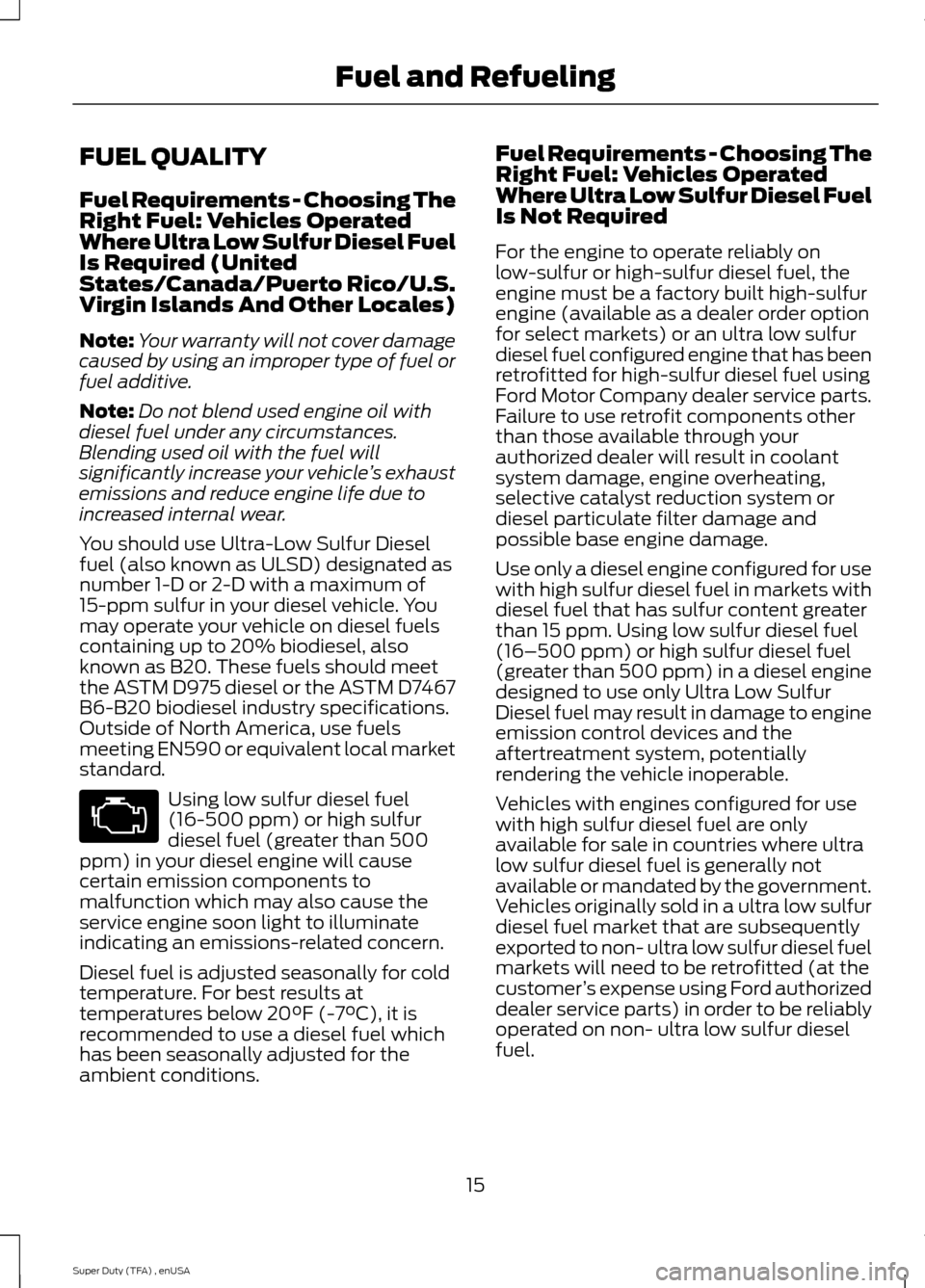
standard. Using low sulfur diesel fuel
(16-500 ppm) or high sulfur
diesel fuel (greater than 500
ppm) in your diesel engine will cause
certain emission components to
malfunction which may also cause the
service engine soon light to illuminate
indicating an emissions-related concern.
Diesel fuel is adjusted seasonally for cold
temperature. For best results at
temperatures below 20°F (-7°C), it is
recommended to use a diesel fuel which
has been seasonally adjusted for the
ambient conditions. Fuel Requirements - Choosing The
Right Fuel: Vehicles Operated
Where Ultra Low Sulfur Diesel Fuel
Is Not Required
For the engine to operate reliably on
low-sulfur or high-sulfur diesel fuel, the
engine must be a factory built high-sulfur
engine (available as a dealer order option
for select markets) or an ultra low sulfur
diesel fuel configured engine that has been
retrofitted for high-sulfur diesel fuel using
Ford Motor Company dealer service parts.
Failure to use retrofit components other
than those available through your
authorized dealer will result in coolant
system damage, engine overheating,
selective catalyst reduction system or
diesel particulate filter damage and
possible base engine damage.
Use only a diesel engine configured for use
with high sulfur diesel fuel in markets with
diesel fuel that has sulfur content greater
than 15 ppm. Using low sulfur diesel fuel
(16–500 ppm) or high sulfur diesel fuel
(greater than 500 ppm) in a diesel engine
designed to use only Ultra Low Sulfur
Diesel fuel may result in damage to engine
emission control devices and the
aftertreatment system, potentially
rendering the vehicle inoperable.
Vehicles with engines configured for use
with high sulfur diesel fuel are only
available for sale in countries where ultra
low sulfur diesel fuel is generally not
available or mandated by the government.
Vehicles originally sold in a ultra low sulfur
diesel fuel market that are subsequently
exported to non- ultra low sulfur diesel fuel
markets will need to be retrofitted (at the
customer
’s expense using Ford authorized
dealer service parts) in order to be reliably
operated on non- ultra low sulfur diesel
fuel.
15
Super Duty (TFA) , enUSA Fuel and Refueling
Page 28 of 84
Diesel Exhaust Fluid (DEF) bottle fill with
spout
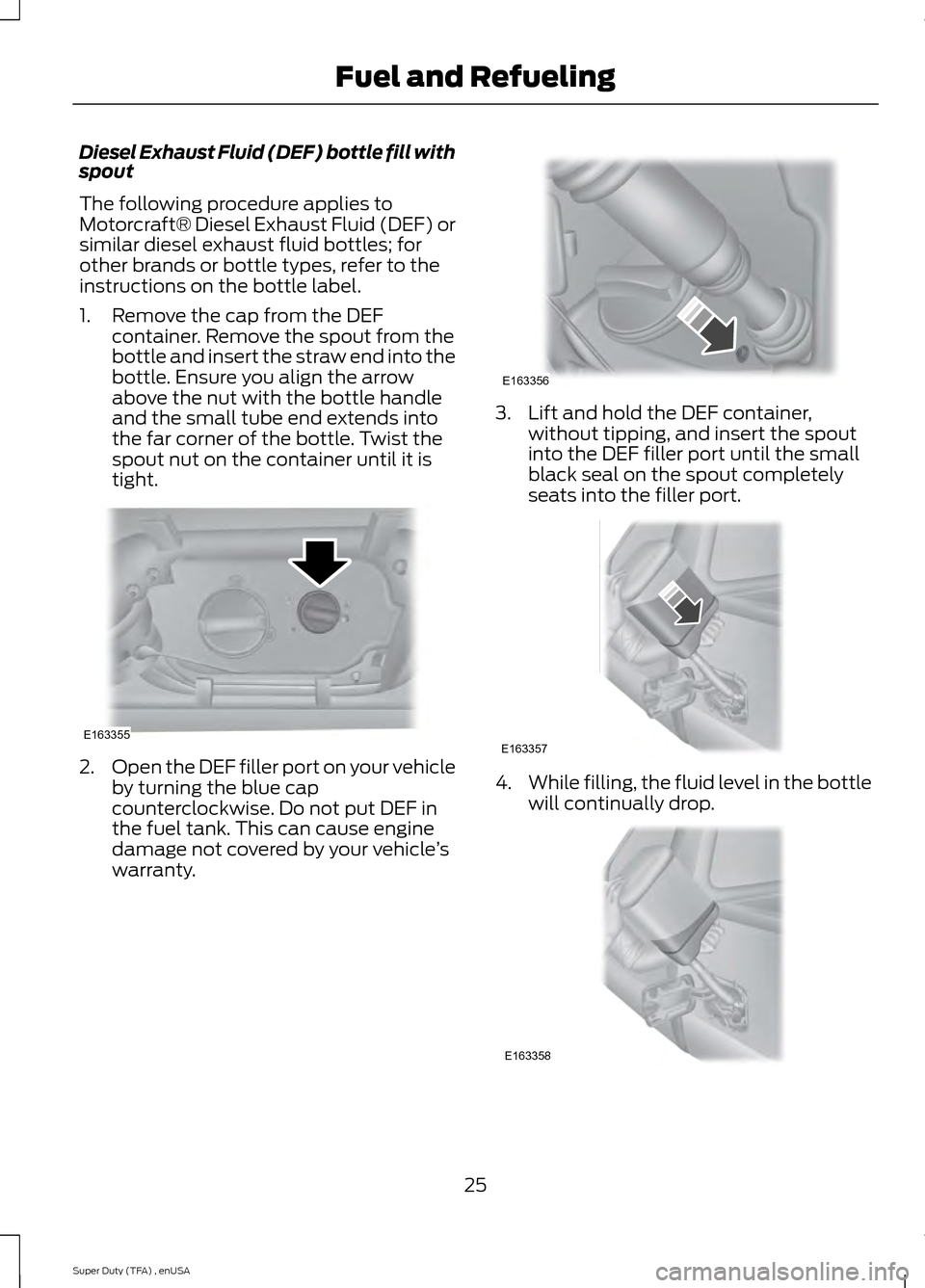
The following procedure applies to
Motorcraft® Diesel Exhaust Fluid (DEF) or
similar diesel exhaust fluid bottles; for
other brands or bottle types, refer to the
instructions on the bottle label.
1. Remove the cap from the DEF
container. Remove the spout from the
bottle and insert the straw end into the
bottle. Ensure you align the arrow
above the nut with the bottle handle
and the small tube end extends into
the far corner of the bottle. Twist the
spout nut on the container until it is
tight. 2.
Open the DEF filler port on your vehicle
by turning the blue cap
counterclockwise. Do not put DEF in
the fuel tank. This can cause engine
damage not covered by your vehicle ’s
warranty. 3. Lift and hold the DEF container,
without tipping, and insert the spout
into the DEF filler port until the small
black seal on the spout completely
seats into the filler port. 4.
While filling, the fluid level in the bottle
will continually drop. 25
Super Duty (TFA) , enUSA Fuel and RefuelingE163355 E163356 E163357 E163358
Page 61 of 84
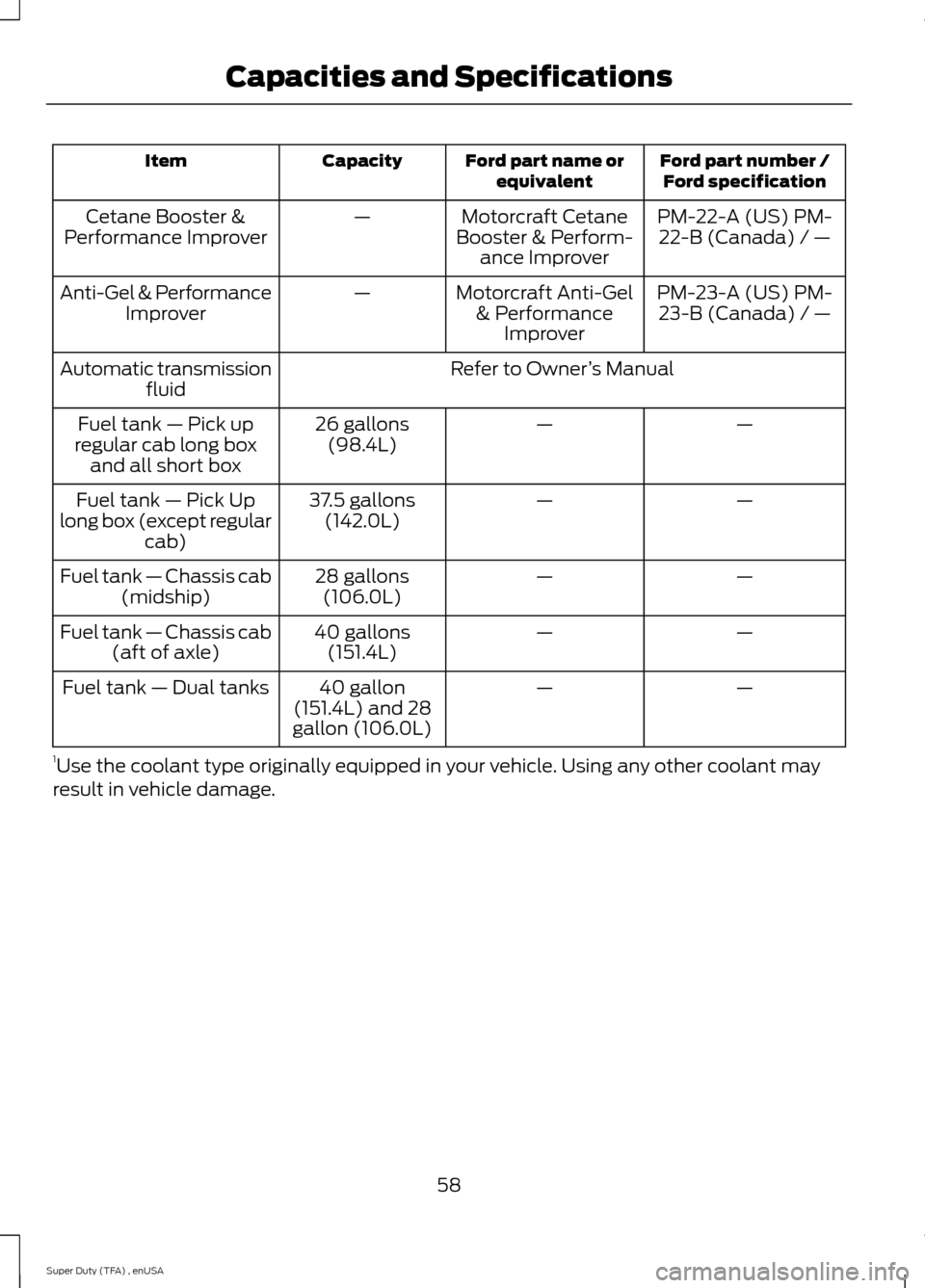
Ford part number /
Ford specification
Ford part name or
equivalent
Capacity
Item
PM-22-A (US) PM-22-B (Canada) / —
Motorcraft Cetane
Booster & Perform- ance Improver
—
Cetane Booster &
Performance Improver
PM-23-A (US) PM-23-B (Canada) / —
Motorcraft Anti-Gel
& Performance Improver
—
Anti-Gel & Performance
Improver
Refer to Owner’s Manual
Automatic transmission
fluid
—
—
26 gallons
(98.4L)
Fuel tank — Pick up
regular cab long box and all short box
—
—
37.5 gallons
(142.0L)
Fuel tank — Pick Up
long box (except regular cab)
—
—
28 gallons
(106.0L)
Fuel tank — Chassis cab
(midship)
—
—
40 gallons
(151.4L)
Fuel tank — Chassis cab
(aft of axle)
—
—
40 gallon
(151.4L) and 28
gallon (106.0L)
Fuel tank — Dual tanks
1 Use the coolant type originally equipped in your vehicle. Using any other coolant may
result in vehicle damage.
58
Super Duty (TFA) , enUSA Capacities and Specifications