2015 FORD SUPER DUTY trailer
[x] Cancel search: trailerPage 41 of 84
TOWING A TRAILER
Refer to your Owner
’s Manual for full
details on towing a trailer.
38
Super Duty (TFA) , enUSA Towing
Page 48 of 84
5.
Reset the Intelligent Oil Life Monitor™.
See the Information Displays chapter
in the Owner's Manual for more
information.
Engine lubrication for severe service
operation
The following conditions define severe
operation for which engine operation with
SAE 5W-40 API CJ-4 is recommended. Oil
and oil filter change intervals will be
determined by the Intelligent Oil Life
Monitor™ as noted previously.
• Frequent or extended idling (over 10
minutes per hour of normal driving)
• Low-speed operation/stationary use
• If vehicle is operated in sustained
ambient temperatures below -10°F
(-23°C) or above 100°F (38°C)
• Frequent low-speed operation,
consistent heavy traffic less than 25
mph (40 km/h)
• Operating in severe dust conditions
• Operating the vehicle off road
• Towing a trailer over 1,000 miles (1,600
km)
• Sustained, high-speed driving at Gross
Vehicle Weight Rating (maximum
loaded weight for vehicle operation)
• Use of fuels with sulfur content other
than ultra-low sulfur diesel (ULSD)
• Use of high-sulfur diesel fuel
ENGINE COOLANT CHECK
Checking the Engine Coolant
When the engine is cold, check the
concentration and level of engine coolant
at the intervals listed in the scheduled
maintenance chapter. See Scheduled
Maintenance (page 59). Note:
Make sure that the level is between
the MIN and MAX marks on the coolant
reservoirs.
Note: Coolant expands when it is hot. The
level may extend beyond the MAX mark
Note: If the level is at the MIN mark, below
the MIN mark, or empty, add coolant
immediately. See
Adding Engine Coolant
in this chapter.
Note: The coolant concentration should be
maintained within 48% to 50%, which
equates to a freeze point between -30 °F
(-34 °C) and -34 °F (-37 °C).
Note: For best results, the coolant
concentration should be tested with a
refractometer such as Rotunda tool
300-ROB75240 available from your dealer.
Ford does not recommend the use of
hydrometers or coolant test strips for
measuring coolant concentrations.
Note: Automotive fluids are not
interchangeable. Do not use engine coolant
or antifreeze or windshield washer fluid
outside of its specified function and vehicle
location.
Adding Engine Coolant WARNINGS
Do not add engine coolant when the
engine is hot. Steam and scalding
liquids released from a hot cooling
system can burn you badly. Also, you can
be burned if you spill coolant on hot engine
parts. Do not put engine coolant in the
windshield washer fluid container. If
sprayed on the windshield, engine
coolant could make it difficult to see
through the windshield.
45
Super Duty (TFA) , enUSA Maintenance
Page 53 of 84
Coolant Change
At specific mileage intervals, as listed in
the scheduled maintenance information,
the coolant should be changed. The
optional information display, if equipped,
will also display the message COOLANT
CHANGE REQUIRED at this time.
See Capacities and Specifications
(page 55). for the proper coolant.
Engine-driven Cooling Fan (Fan
Clutch)
Your vehicle is equipped with an engine
driven cooling fan drive (also called a fan
clutch). This fan drive changes the fan
speed to match the vehicle ’s changing
cooling air flow requirements. Fan speed,
fan noise level and fuel consumption all
will increase based on the driving
conditions that include trailer towing, hill
climbing, heavy loads, high speed and high
ambient temperature, individually or in
combination.
The fan drive is designed to provide the
minimum fan speed (and resulting
minimum fan noise and fuel consumption)
required to meet the ever changing vehicle
cooling air flow requirements. You will hear
the amount of fan noise increasing and
decreasing as the engine power
requirements and vehicle driving conditions
change as you drive. This is to be expected
as being normal to the operation of your
vehicle. High levels of fan noise might also
be heard when your engine is first started,
and should normally decrease after driving
for a short time. CHANGING THE ENGINE AIR
FILTER
Air Filter Restriction Gauge WARNING
To reduce the risk of vehicle damage
and/or personal burn injuries do not
start your engine with the air filter
removed and do not remove it while the
engine is running. Note:
Operating your vehicle in heavy
snowfall or extreme rain conditions may
allow excessive amounts of snow or water
into the air intake system. This could plug
or soak the air filter that could cause the
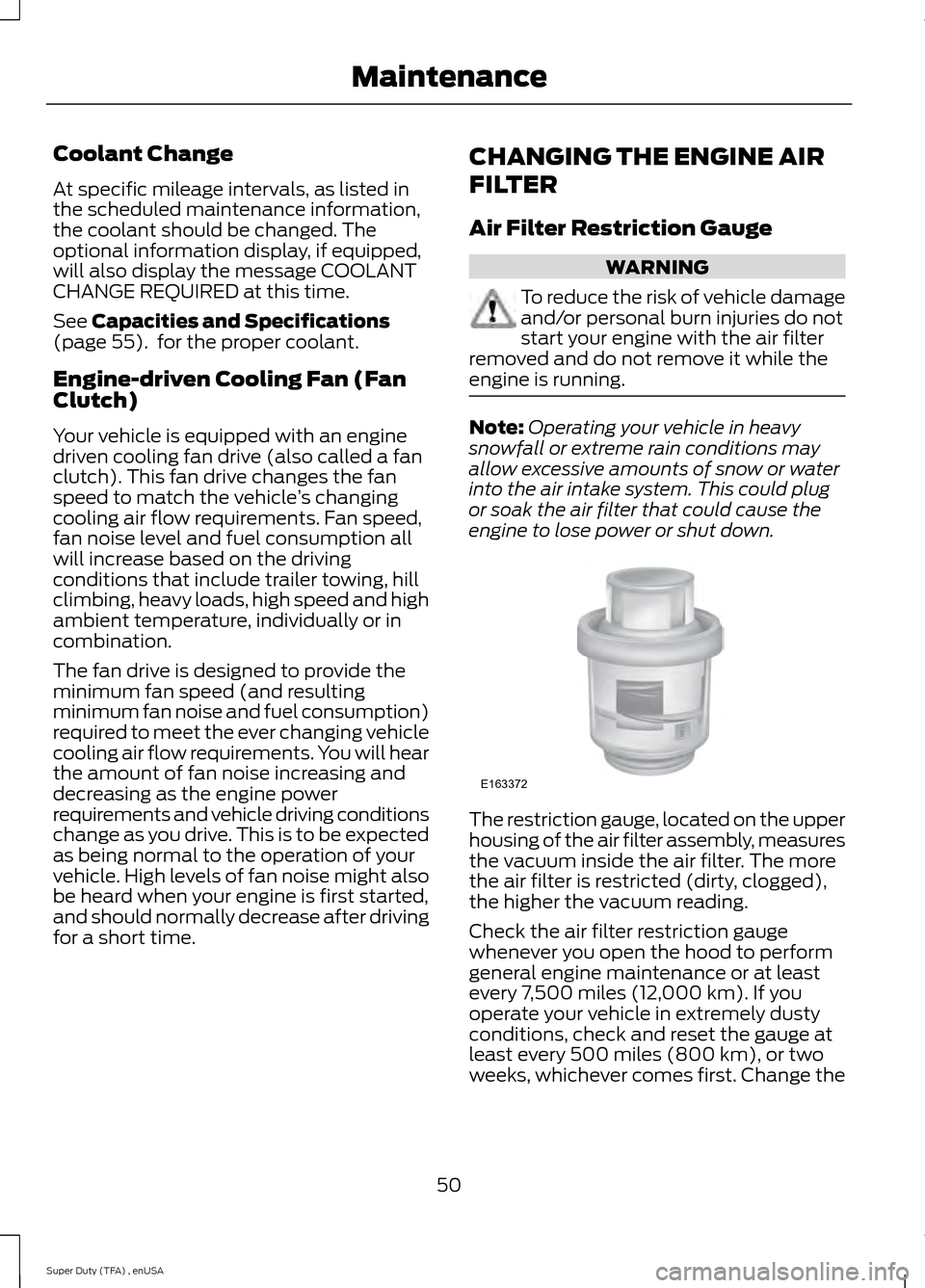
engine to lose power or shut down. The restriction gauge, located on the upper
housing of the air filter assembly, measures
the vacuum inside the air filter. The more
the air filter is restricted (dirty, clogged),
the higher the vacuum reading.
Check the air filter restriction gauge
whenever you open the hood to perform
general engine maintenance or at least
every 7,500 miles (12,000 km). If you
operate your vehicle in extremely dusty
conditions, check and reset the gauge at
least every 500 miles (800 km), or two
weeks, whichever comes first. Change the
50
Super Duty (TFA) , enUSA MaintenanceE163372
Page 68 of 84
SPECIAL OPERATING
CONDITIONS SCHEDULED
MAINTENANCE
If you operate your vehicle primarily in any
of the f
ollowing conditions, you need to perform extra maintenance as indicated.
If you operate your vehicle
occasionally
under any of these conditions, it is not
necessary to perform the extra
maintenance. For specific
recommendations, see your dealership
service advisor or technician. Towing a trailer or using a car-top carrier
Change the engine oil and filter as indicated by the
information display, and perform the services listed in the
scheduled maintenance chart.
As required
See the axle maintenance items under
Exceptions.
Inspect the coolant concentration (freeze-point protec-
tion) and additive (corrosion inhibitor) strength. Add
engine coolant additive if necessary.
Every 15000 miles (24000
km) or 600 engine hours
Replace the engine-mounted and frame-mounted fuel
filters.
Every 15000 miles (24000
km), 6 months, 600 engine
hours, or as indicated by the
information display
Replace the wheel bearing grease and grease seals if using
non-sealed bearings. (Two-wheel drive vehicles)
Every 30000 miles (48000
km)
Change the transfer case fluid. (Four-wheel drive vehicles)
Every 60000 miles (96000
km)
Flush and refill the engine coolant. Do not add engine
coolant additive.
Every 60000 miles (96000
km) or 2400 engine hours
Note: When adding coolant additive, do not exceed the specified maximum of 48 fluid
ounces (1.4 liters). Operating the engine with excessive coolant additive may cause
overheating which could lead to severe, permanent engine damage.
Note: After the initial coolant flush and fill at 60000 miles (96000 kilometers) or 2400
engine hours, flush and fill every 45000 miles (72000 kilometers) or 1800 engine hours
thereafter.
65
Super Duty (TFA) , enUSA Scheduled Maintenance
Page 73 of 84
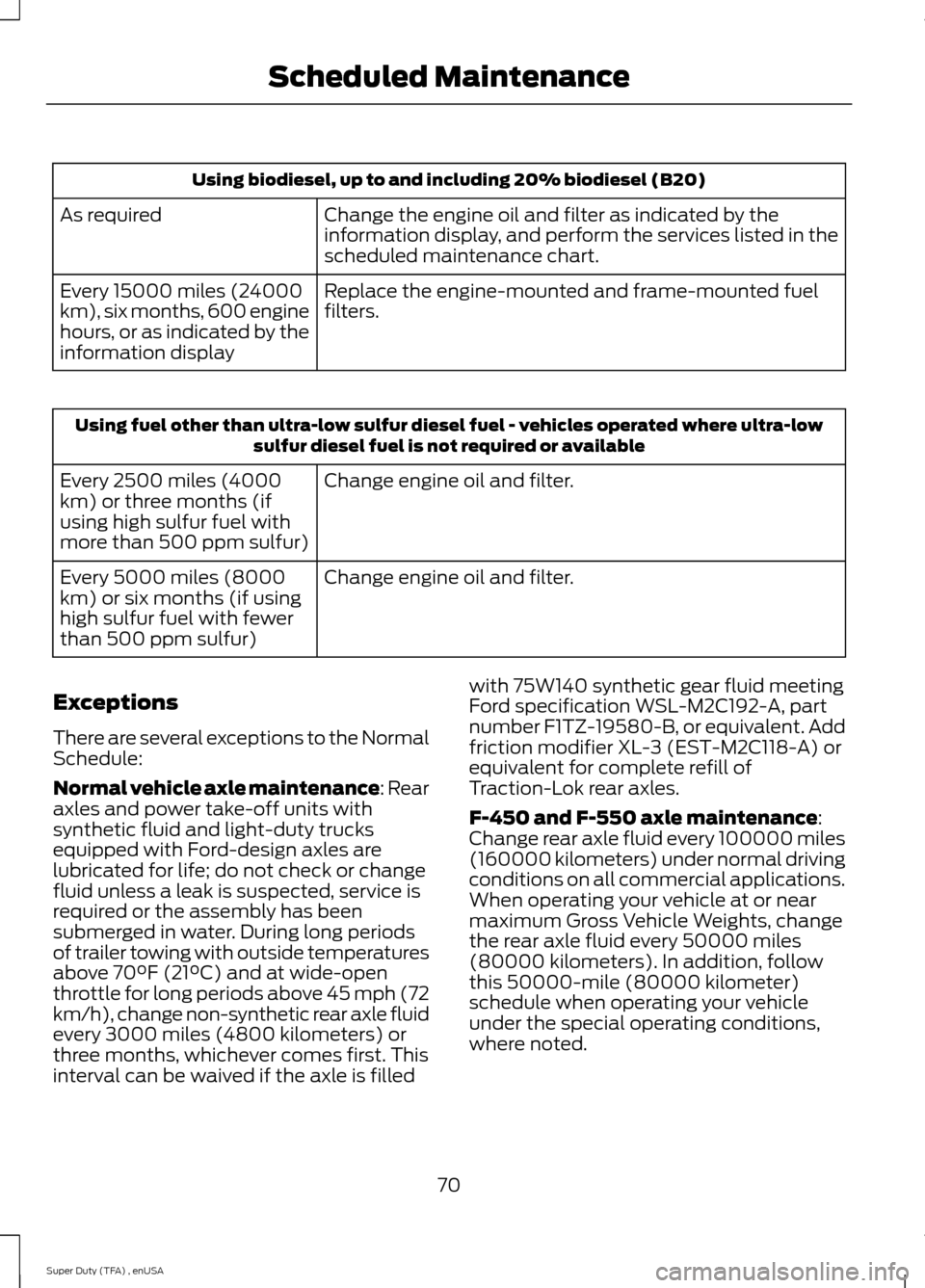
Using biodiesel, up to and including 20% biodiesel (B20)
Change the engine oil and filter as indicated by the
information display, and perform the services listed in the
scheduled maintenance chart.
As required
Replace the engine-mounted and frame-mounted fuel
filters.
Every 15000 miles (24000
km), six months, 600 engine
hours, or as indicated by the
information display Using fuel other than ultra-low sulfur diesel fuel - vehicles operated where ultra-low
sulfur diesel fuel is not required or available
Change engine oil and filter.
Every 2500 miles (4000
km) or three months (if
using high sulfur fuel with
more than 500 ppm sulfur)
Change engine oil and filter.
Every 5000 miles (8000
km) or six months (if using
high sulfur fuel with fewer
than 500 ppm sulfur)
Exceptions
There are several exceptions to the Normal
Schedule:
Normal vehicle axle maintenance: Rear
axles and power take-off units with
synthetic fluid and light-duty trucks
equipped with Ford-design axles are
lubricated for life; do not check or change
fluid unless a leak is suspected, service is
required or the assembly has been
submerged in water. During long periods
of trailer towing with outside temperatures
above 70°F (21°C) and at wide-open
throttle for long periods above 45 mph (72
km/h), change non-synthetic rear axle fluid
every 3000 miles (4800 kilometers) or
three months, whichever comes first. This
interval can be waived if the axle is filled with 75W140 synthetic gear fluid meeting
Ford specification WSL-M2C192-A, part
number F1TZ-19580-B, or equivalent. Add
friction modifier XL-3 (EST-M2C118-A) or
equivalent for complete refill of
Traction-Lok rear axles.
F-450 and F-550 axle maintenance:
Change rear axle fluid every 100000 miles
(160000 kilometers) under normal driving
conditions on all commercial applications.
When operating your vehicle at or near
maximum Gross Vehicle Weights, change
the rear axle fluid every 50000 miles
(80000 kilometers). In addition, follow
this 50000-mile (80000 kilometer)
schedule when operating your vehicle
under the special operating conditions,
where noted.
70
Super Duty (TFA) , enUSA Scheduled Maintenance
Page 83 of 84
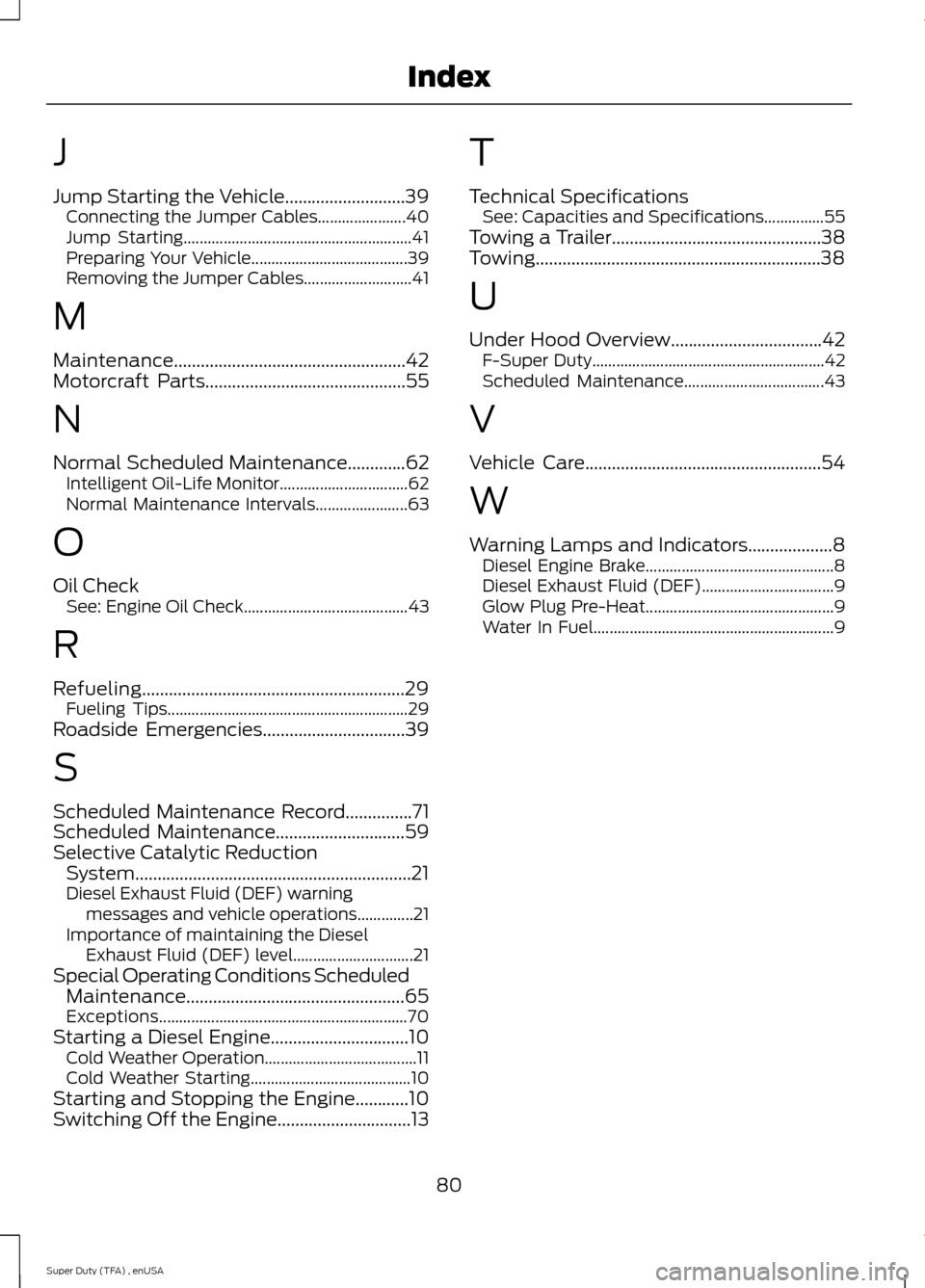
J
Jump Starting the Vehicle...........................39
Connecting the Jumper Cables...................... 40
Jump Starting......................................................... 41
Preparing Your Vehicle....................................... 39
Removing the Jumper Cables........................... 41
M
Maintenance....................................................42
Motorcraft Parts.............................................55
N
Normal Scheduled Maintenance.............62 Intelligent Oil-Life Monitor................................ 62
Normal Maintenance Intervals....................... 63
O
Oil Check See: Engine Oil Check......................................... 43
R
Refueling...........................................................29 Fueling Tips............................................................ 29
Roadside Emergencies
................................39
S
Scheduled Maintenance Record...............71
Scheduled Maintenance.............................59
Selective Catalytic Reduction System..............................................................21
Diesel Exhaust Fluid (DEF) warning messages and vehicle operations..............21
Importance of maintaining the Diesel Exhaust Fluid (DEF) level.............................. 21
Special Operating Conditions Scheduled Maintenance.................................................65
Exceptions.............................................................. 70
Starting a Diesel Engine...............................10 Cold Weather Operation...................................... 11
Cold Weather Starting........................................ 10
Starting and Stopping the Engine............10
Switching Off the Engine..............................13 T
Technical Specifications
See: Capacities and Specifications...............55
Towing a Trailer...............................................38
Towing................................................................38
U
Under Hood Overview..................................42 F-Super Duty.......................................................... 42
Scheduled Maintenance................................... 43
V
Vehicle Care
.....................................................54
W
Warning Lamps and Indicators...................8 Diesel Engine Brake............................................... 8
Diesel Exhaust Fluid (DEF)................................. 9
Glow Plug Pre-Heat............................................... 9
Water In Fuel............................................................ 9
80
Super Duty (TFA) , enUSA Index