2015 FORD SUPER DUTY lock
[x] Cancel search: lockPage 24 of 84
Installation – Engine-mounted fuel
filter
1. Install the new filter into the filter
bracket. Turn the filter clockwise to
lock it in place.
2. Reconnect both fuel lines.
Note: Using a fuel that has more than
average impurities may require you to
replace the fuel filter more frequently than
the service interval specifies.
Note: You will need to purge the system of
air after removal or changing of the filter.
See purging air from the fuel system later
in this chapter.
Purging air from the fuel system
Turn the ignition key to on for 30 seconds,
then turn it to off. Do this six times in a row
to purge any trapped air from the fuel
system.
After filter service, a no start or rough
running engine may indicate that air is
entering the system through the filter bowl
seal or drain. Make sure the drain is tight
and you tightened the filter bowl to the
mechanical stop.
SELECTIVE CATALYTIC
REDUCTION SYSTEM
Your vehicle is equipped with a selective
catalytic reduction system to help reduce
emission levels of oxides of nitrogen from
the exhaust of the diesel engine. The
system automatically injects Diesel
Exhaust Fluid (DEF) into the exhaust
system to enable proper selective catalytic
reduction function. Importance of maintaining the
Diesel Exhaust Fluid (DEF) level
In order for the selective catalytic reduction
system to operate properly, the DEF level
must be maintained. Generally, the DEF
tank should be filled during the oil change
service interval. See General
Maintenance Information (page 59).
However, certain conditions or driving
styles, such as trailer towing or fast rates
of acceleration, will require the refilling of
the DEF tank more often.
The engine control unit will monitor the
amount of fluid available in the DEF tank.
Running a system check in the information
display will indicate whether the DEF level
is ok or if it is less than 1/2 full. A message
will display in the information display when
the DEF level is low and needs to be
refilled. When you see this message, you
should refill your tank. See the Information
displays chapter of your Owner ’s Manual
for information display functions. For
instructions on refilling your DEF tank, see
filling the Diesel Exhaust Fluid (DEF) tank
in this supplement.
Diesel Exhaust Fluid (DEF)
warning messages and vehicle
operations WARNINGS
Diesel Exhaust Fluid (DEF) must be
refilled when low or replaced when
contaminated or your vehicle speed
will be speed limited to 50 mph (80 km/h).
In these conditions, drive with caution and
refill DEF immediately. If the DEF becomes
empty or contaminated and fluid is not
replaced, your vehicle will become limited
to idle speed only once stopped. In these
conditions, be cautious where you stop
your vehicle because you may not be able
to drive long distances and will not be able
to maintain highway speeds until you refill
or replace the DEF.
21
Super Duty (TFA) , enUSA Fuel and Refueling
Page 28 of 84
Diesel Exhaust Fluid (DEF) bottle fill with
spout
The following procedure applies to
Motorcraft® Diesel Exhaust Fluid (DEF) or
similar diesel exhaust fluid bottles; for
other brands or bottle types, refer to the
instructions on the bottle label.
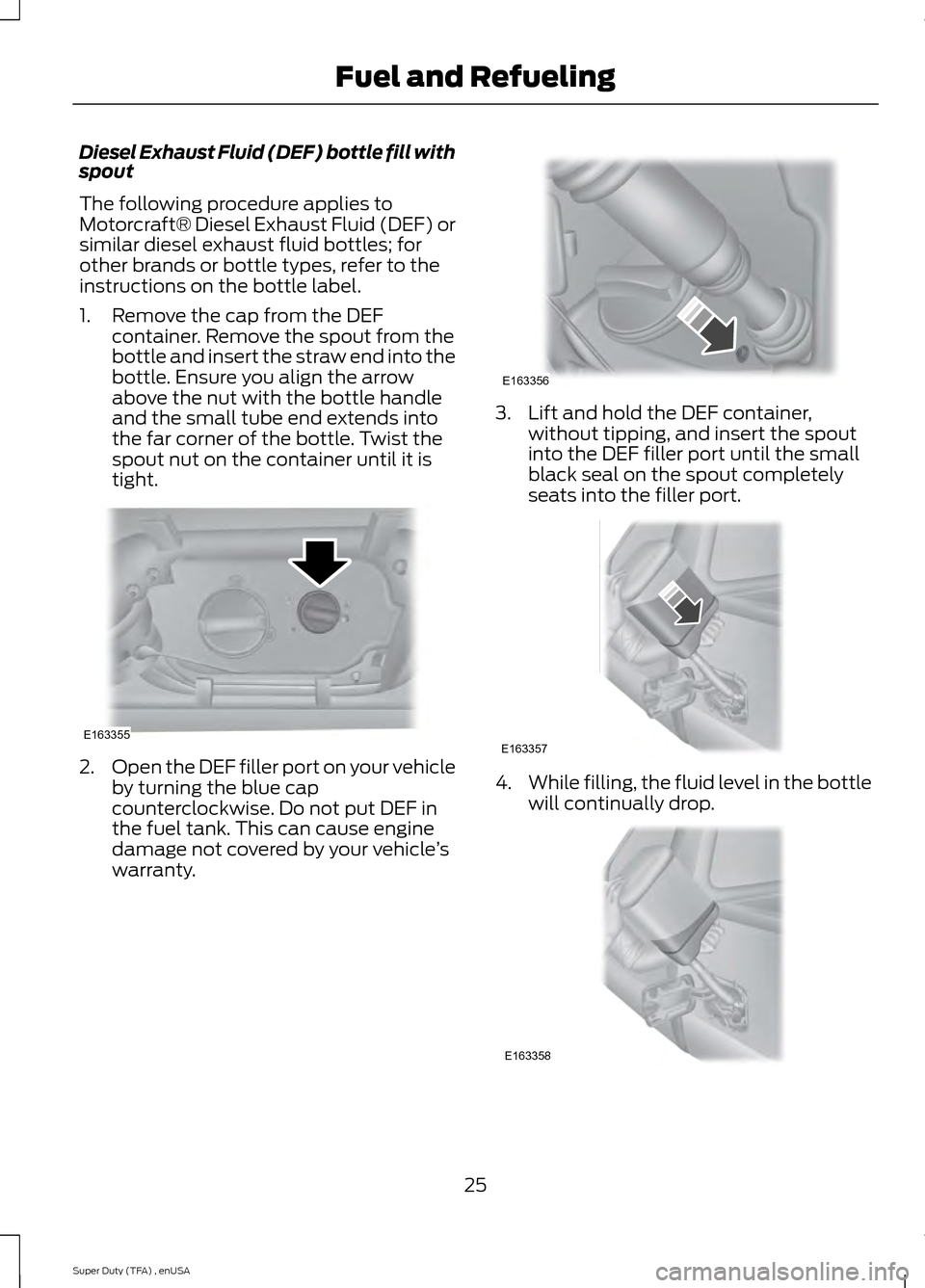
1. Remove the cap from the DEF
container. Remove the spout from the
bottle and insert the straw end into the
bottle. Ensure you align the arrow
above the nut with the bottle handle
and the small tube end extends into
the far corner of the bottle. Twist the
spout nut on the container until it is
tight. 2.
Open the DEF filler port on your vehicle
by turning the blue cap
counterclockwise. Do not put DEF in
the fuel tank. This can cause engine
damage not covered by your vehicle ’s
warranty. 3. Lift and hold the DEF container,
without tipping, and insert the spout
into the DEF filler port until the small
black seal on the spout completely
seats into the filler port. 4.
While filling, the fluid level in the bottle
will continually drop. 25
Super Duty (TFA) , enUSA Fuel and RefuelingE163355 E163356 E163357 E163358
Page 33 of 84
Diesel fuel dispensing nozzle fill rate
Your truck is equipped with a fuel fill pipe
that is able to accept fuel up to 20 gallons
per minute from an 11⁄8 fuel-dispensing
nozzle. Pumping fuel at greater flow rates
may result in premature nozzle shut-off or
spit back.
Fuel filler cap
WARNINGS
The fuel system may be under
pressure. If the fuel filler cap is
venting vapor or if you hear a hissing
sound, wait until it stops before completely
removing the fuel filler cap. Otherwise, fuel
may spray out and injure you or others. If you do not use the proper fuel filler
cap, excessive pressure or vacuum
in the fuel tank may damage the fuel
system or cause the fuel cap to disengage
in a collision, which may result in possible
personal injury. Note:
If you must replace the fuel filler cap,
replace it with a fuel filler cap designed for
your vehicle. The vehicle warranty may be
void for any damage to the fuel tank or fuel
system if the correct genuine Ford or
Motorcraft® fuel filler cap is not used.
Your fuel tank filler cap has an indexed
design with a 1/4 turn on/off feature.
When fueling your vehicle:
1. Turn the engine off.
2. Carefully turn the filler cap counterclockwise until it spins off.
3. Pull to remove the cap from the fuel filler pipe.
4. To install the cap, align the tabs on the
cap with the notches on the filler pipe.
5. Turn the filler cap clockwise 1/4 of a turn until it clicks at least once. EMISSION CONTROL SYSTEM
Diesel Exhaust System: Oxidation
Catalyst And Diesel Particulate
Filter System (If Equipped)
Your vehicle is equipped with a diesel
particulate filter. The diesel particulate
filter is an inline filter in the exhaust system
that reduces carbon emissions by trapping
exhaust particles before they reach the
tailpipe. The diesel particulate filter looks
similar to a traditional exhaust catalyst,
except larger, and is part of the exhaust
system under the vehicle. The filter couples
to a diesel oxidation catalyst that reduces
the amount of harmful exhaust emitted
from the tailpipe. As soot gathers in the
system, it begins to restrict the filter. You
need to periodically clean the soot that
gathers inside the filter. You can clean the
soot in two different ways, passive
regeneration and active regeneration. Both
methods occur automatically and require
no actions from the driver. During either
one of these regeneration methods, you
may notice a change in exhaust tone. At
certain times, the information display will
display various messages related to the
diesel particulate filter. See the Information
Displays chapter in the Owner Guide for
more information.
Passive regeneration
In passive regeneration, the exhaust
system temperature and constituents
automatically clean the filter, or reduce
the soot level, by burning (oxidizing) the
soot. Cleaning occurs naturally because of
normal engine operating conditions (at
varying levels, due to driving patterns).
30
Super Duty (TFA) , enUSA Fuel and Refueling
Page 37 of 84
mileage can vary greatly depending upon
engine/vehicle operating conditions) and
replaced with a new or remanufactured
(ash cleaned) part. The filter may need to
be replaced at approximately 250,000
miles (400,000 km) depending upon
vehicle operating conditions.
In both cases, the engine control
system will set a service light to
inform you to bring the vehicle
to the dealer for service.
If there are any issues with the diesel
particulate filter system a service light will
be set by the engine control system to
inform you to bring your vehicle into an
authorized dealer for service. Powertrain fault indicator or
Service engine soon
Resonator and Tailpipe assembly
maintenance WARNINGS
Failure to maintain the functional
holes, in the tailpipe section of the
exhaust, clean and free of debris or
foreign material may result in the holes
becoming blocked or plugged. Do not
modify or remove the tail-pipe section.
Blocked or plugged holes or
removal/modification of the system could
result in elevated exhaust gas
temperatures which may result in
vehicle/property damage or personal
injury. The normal operating temperature
of the exhaust system is very high.
Never work around or attempt to
repair any part of the exhaust system until
it has cooled. Use special care when
working around the diesel oxidation
catalytic converter and/or the diesel WARNINGS
particulate filter (DPF). The diesel
oxidation catalytic converter and/or the
DPF heats up to a high temperature after
only a short period of engine operation and
can stay hot even after the engine is turned
off. Failure to follow these instructions may
result in personal injury. Note:
Additions of aftermarket devices or
modifications to the exhaust system can
reduce the effectiveness of the exhaust
system as well as cause damage to the
exhaust system or engine. These actions
may also affect your vehicle ’s warranty. See
the Warranty Guide for more information.
The diesel resonator tail-pipe assembly is
a uniquely functioning device that
accompanies the diesel particulate filter
assembly. The tail-pipe assembly serves
multiple functions. First, it serves as an
acoustic device to attenuate exhaust noise.
Second, it provides an exit path for the
exhaust from your vehicle. It also helps
control the temperature of the exhaust
during diesel particulate filter regeneration
events. The visible holes in each leg of the
twin tip and the holes under the shield just
inboard of the right rear tire(s) are
functional. You need to keep the holes
clear of mud, debris or foreign material to
maintain proper function of the exhaust
system. Clean and remove debris or foreign
material if present as needed. Spraying
with a hose during regular washing of your
vehicle should help keep holes clean and
clear of debris or foreign material.
34
Super Duty (TFA) , enUSA Fuel and Refueling
Page 47 of 84
•
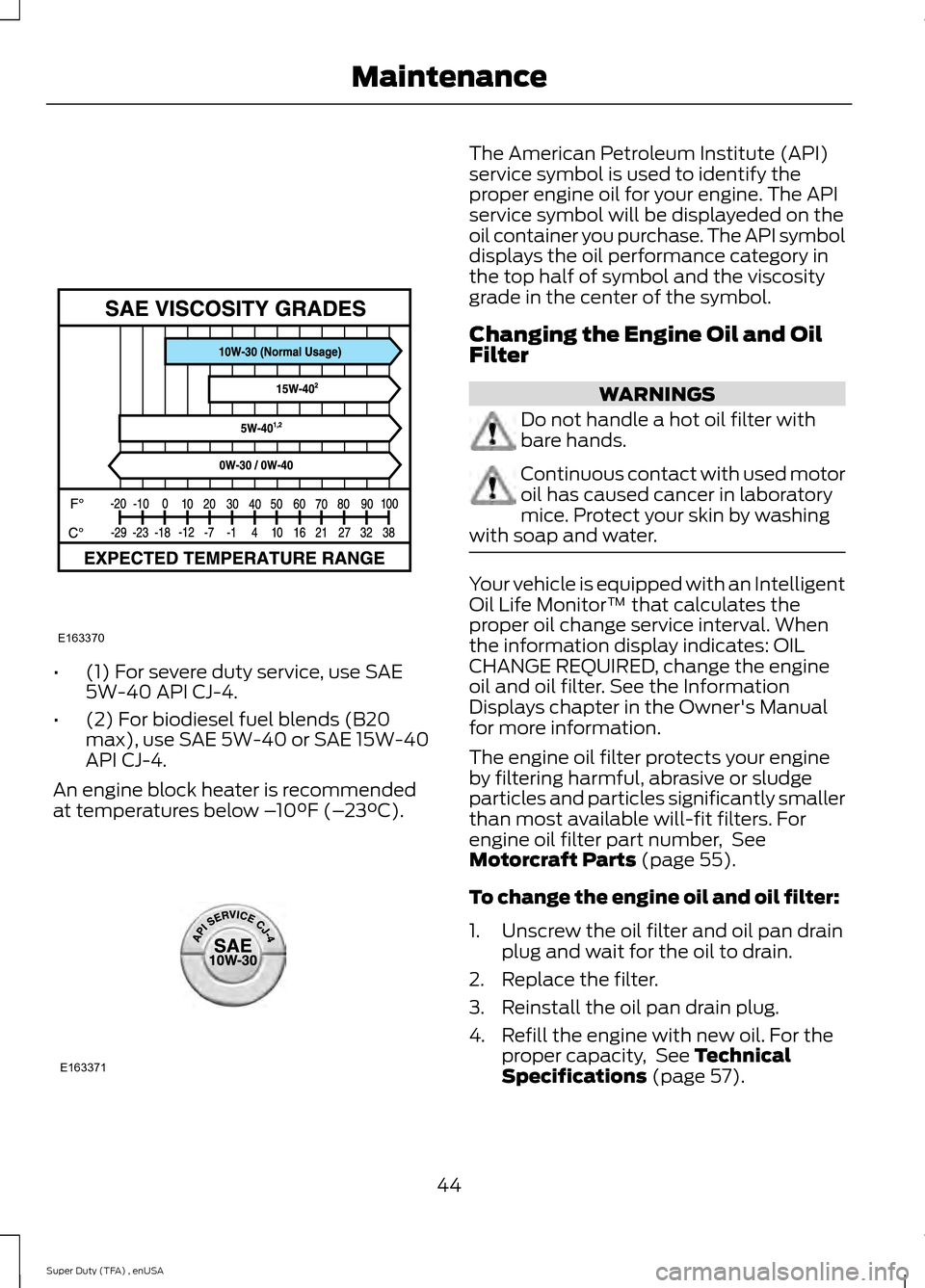
(1) For severe duty service, use SAE
5W-40 API CJ-4.
• (2) For biodiesel fuel blends (B20
max), use SAE 5W-40 or SAE 15W-40
API CJ-4.
An engine block heater is recommended
at temperatures below – 10°F (–23°C). The American Petroleum Institute (API)
service symbol is used to identify the
proper engine oil for your engine. The API
service symbol will be displayeded on the
oil container you purchase. The API symbol
displays the oil performance category in
the top half of symbol and the viscosity
grade in the center of the symbol.
Changing the Engine Oil and Oil
Filter
WARNINGS
Do not handle a hot oil filter with
bare hands.
Continuous contact with used motor
oil has caused cancer in laboratory
mice. Protect your skin by washing
with soap and water. Your vehicle is equipped with an Intelligent
Oil Life Monitor™ that calculates the
proper oil change service interval. When
the information display indicates: OIL
CHANGE REQUIRED, change the engine
oil and oil filter. See the Information
Displays chapter in the Owner's Manual
for more information.
The engine oil filter protects your engine
by filtering harmful, abrasive or sludge
particles and particles significantly smaller
than most available will-fit filters. For
engine oil filter part number, See
Motorcraft Parts (page 55).
To change the engine oil and oil filter:
1. Unscrew the oil filter and oil pan drain plug and wait for the oil to drain.
2. Replace the filter.
3. Reinstall the oil pan drain plug.
4. Refill the engine with new oil. For the proper capacity, See
Technical
Specifications (page 57).
44
Super Duty (TFA) , enUSA MaintenanceE163370 E163371
Page 50 of 84
For vehicles with overflow coolant systems
with a non-pressurized cap on the coolant
recovery system, add coolant to the
coolant recovery reservoir when the engine
is cool. Add prediluted engine coolant
(Motorcraft Orange Antifreeze/Coolant
Prediluted) to the FULL COLD level. For all
other vehicles which have a coolant degas
system with a pressurized cap, or if it is
necessary to remove the coolant pressure
relief cap on the radiator of a vehicle with
an overflow system, follow these steps to
add engine coolant.
1. Turn the engine off and let it cool.
2. When the engine is cool, wrap a thick
cloth around the coolant pressure relief
cap on the coolant reservoir (a
translucent plastic bottle). Slowly turn
cap counterclockwise until pressure
begins to release. When you are sure
that all the pressure has been released,
use the cloth to turn it
counterclockwise and remove the cap.
3. Fill the coolant reservoir slowly with prediluted engine coolant to within the
FULL COLD level, or between the MIN
and MAX marks (within the COLD FILL
RANGE), as listed on the engine
coolant reservoir. If you removed the
radiator cap in an overflow system, fill
the radiator until the coolant is visible
and radiator is almost full. If coolant is
added to bring the level within the
COLD FILL RANGE when the engine is
not cold, the system may remain under
filled.
4. Replace the cap. Turn until tightly installed. Cap must be tightly installed
to prevent coolant loss.
Whenever coolant has been added, the
coolant level in the coolant reservoir
should be checked the next few times you
drive the vehicle. If necessary, add enough
prediluted engine coolant to bring the
coolant level to the proper level. If you have to add more than 1.0 quart (1.0
liter) of engine coolant per month, have
your authorized dealer check the engine
cooling system. Your cooling system may
have a leak. Operating an engine with a
low level of coolant can result in engine
overheating and possible engine damage.
Engine and Secondary Cooling
System Refill Procedure
The following procedure should be used
when refilling the engine or secondary
cooling systems after it has been drained
or become extremely low.
1. Before you remove the cap, turn the
engine off and let it cool.
2. When the engine is cool, wrap a thick cloth around the cap. Slowly turn cap
counterclockwise until pressure begins
to release.
3. Step back while the pressure releases.
4. When you are sure that all the pressure
has been released, use the cloth to turn
it counterclockwise and remove the
cap.
5. Slowly add prediluted engine coolant to the coolant reservoir until the
coolant level is within the COLD FILL
RANGE as listed on the reservoir.
6. Reinstall the pressure relief cap.
7. Start and run the engine at 2000 rpm for 2 minutes.
8. Shut engine off, and remove the pressure relief cap as previously
outlined.
9. If required, add prediluted engine coolant to the coolant reservoir until
the coolant level is within the COLD
FILL RANGE as listed on the reservoir.
47
Super Duty (TFA) , enUSA Maintenance
Page 55 of 84
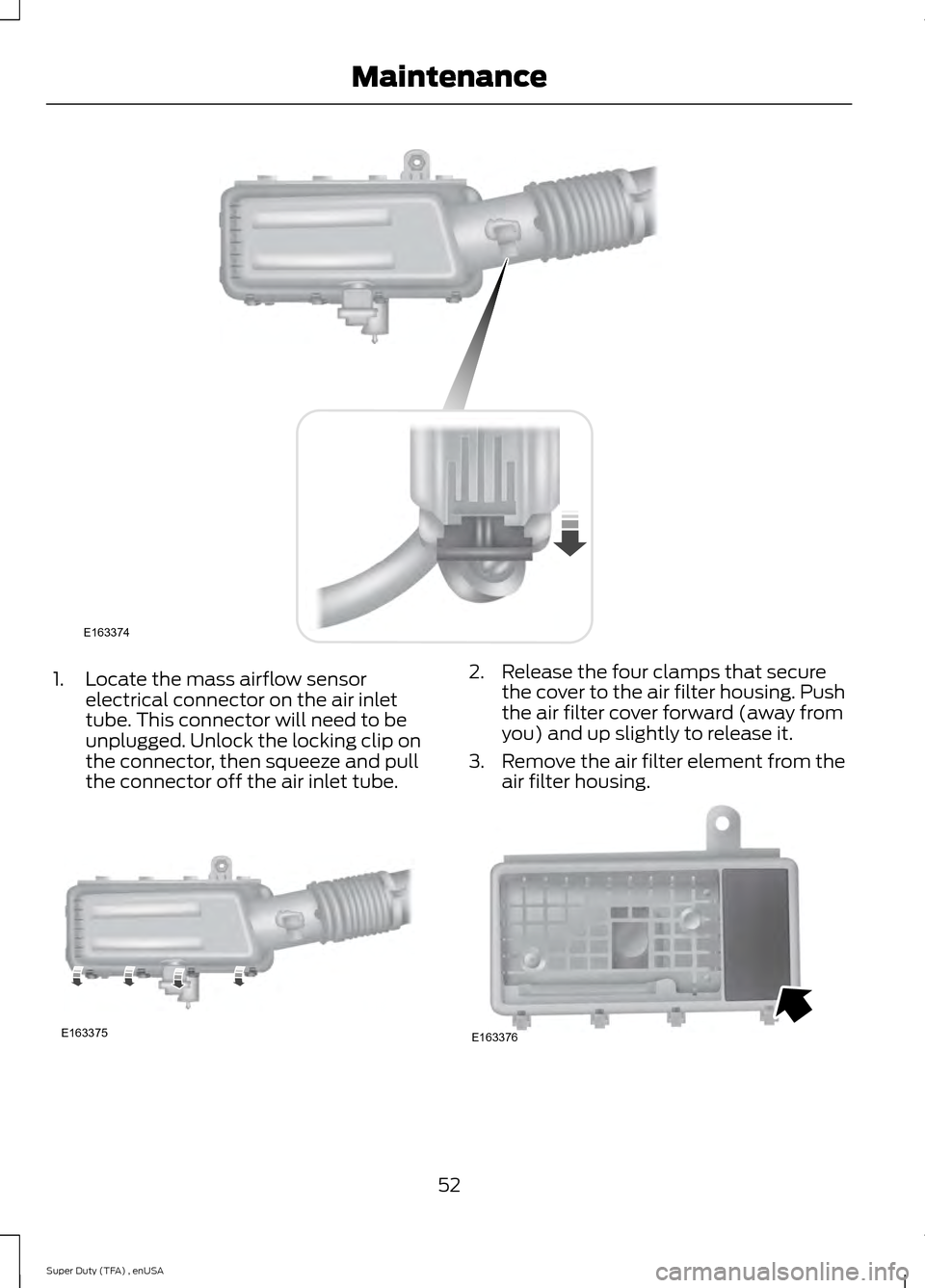
1. Locate the mass airflow sensor
electrical connector on the air inlet
tube. This connector will need to be
unplugged. Unlock the locking clip on
the connector, then squeeze and pull
the connector off the air inlet tube. 2. Release the four clamps that secure
the cover to the air filter housing. Push
the air filter cover forward (away from
you) and up slightly to release it.
3. Remove the air filter element from the
air filter housing. 52
Super Duty (TFA) , enUSA MaintenanceE163374 E163375 E163376
Page 56 of 84
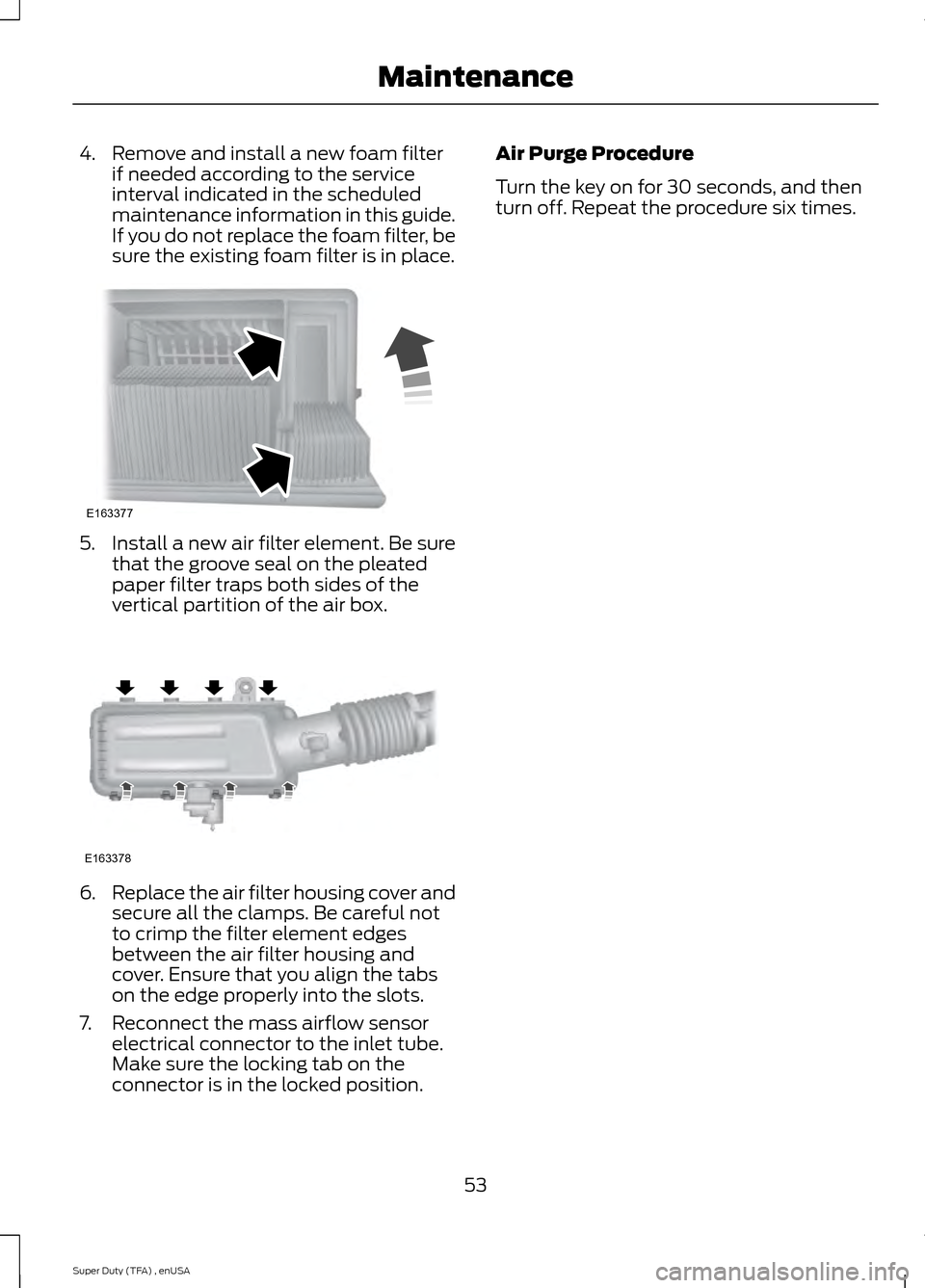
4. Remove and install a new foam filter
if needed according to the service
interval indicated in the scheduled
maintenance information in this guide.
If you do not replace the foam filter, be
sure the existing foam filter is in place. 5. Install a new air filter element. Be sure
that the groove seal on the pleated
paper filter traps both sides of the
vertical partition of the air box. 6.
Replace the air filter housing cover and
secure all the clamps. Be careful not
to crimp the filter element edges
between the air filter housing and
cover. Ensure that you align the tabs
on the edge properly into the slots.
7. Reconnect the mass airflow sensor electrical connector to the inlet tube.
Make sure the locking tab on the
connector is in the locked position. Air Purge Procedure
Turn the key on for 30 seconds, and then
turn off. Repeat the procedure six times.
53
Super Duty (TFA) , enUSA MaintenanceE163377 E163378