2015 FORD POLICE INTERCEPTOR UTILITY belt
[x] Cancel search: beltPage 56 of 398
CRASH SENSORS AND AIRBAG INDICATOR
WARNING:Modifying or adding equipment to the front end of
your vehicle (including frame, bumper, front end body structure
and tow hooks) may affect the performance of the airbag system,
increasing the risk of injury. Do not modify the front end of your
vehicle.
Your vehicle has a collection of crash and occupant sensors which
provide information to the restraints control module. The restraints
control module deploys (activates) the front safety belt pretensioners,
driver airbag, passenger airbag, seat mounted side airbags, and the
Safety Canopy. Based on the type of accident (frontal impact, side
impact or rollover) the restraints control module will deploy the
appropriate safety devices.
The restraints control module also monitors the readiness of the above
safety devices plus the crash sensors. The readiness of the safety system
is indicated by a warning indicator light in the instrument cluster or by a
backup tone if the warning light is not working. See theInstrument
Clusterchapter. Routine maintenance of the airbag is not required.
A difficulty with the system is indicated by one or more of the following:
•The readiness light will either flash or stay lit.
•The readiness light will not illuminate immediately after the
ignition is turned on.
•A series of five beeps will be heard. The tone pattern will repeat
periodically until the problem or light are repaired.
If any of these things happen, even intermittently, have the supplemental
restraint system serviced at an authorized dealer immediately. Unless
serviced, the system may not function properly in the event of a crash.
The safety belt pretensioners and the airbag supplemental restraint
system are designed to activate when the vehicle sustains frontal or
sideways deceleration sufficient to cause the restraints control module to
deploy a safety device or when a certain likelihood of a rollover event is
detected by the rollover sensor.
The fact that the safety belt pretensioners or airbags did not activate for
both front seat occupants in a crash does not mean that something is
wrong with the system. Rather, it means the restraints control module
determined the accident conditions (such as crash severity, belt usage)
were not appropriate to activate these safety devices.
Supplementary Restraints System55
2015 Police(pol)
Owners Guide gf, 1st Printing, April 2014
USA(fus)
Page 57 of 398
•The design of the front airbags is to activate only in frontal and
near-frontal crashes (not rollovers, side impacts or rear impacts)
unless the crash causes sufficient frontal deceleration.
•The design of the safety belt pretensioners is to activate in frontal,
near-frontal and side crashes, and in rollovers.
•The design of the side airbags is to inflate in certain side impact
crashes. Side airbags may activate in other types of crashes if the
vehicle experiences sufficient sideways motion or deformation.
•The design of the Safety Canopy is to inflate in certain side impact
crashes or rollover events. The Safety Canopy may activate in other
types of crashes if the vehicle experiences sufficient sideways motion
or deformation, or a certain likelihood of rollover.
Airbags and Police Equipment
WARNING:Do not place objects or mount equipment in front of
the airbag module cover or in front of the seat areas that may
come in contact with a deploying airbag. Failure to follow this
instruction could result in personal injury.
WARNING:Dash, tunnel or console-mounted equipment should
not be placed outside of the specified zone. Failure to follow this
instruction could result in personal injury.
WARNING:Do not mount equipment between the side of front
seat to the door trim to block deployment of the side airbag.
Failure to follow this instruction could result in personal injury.
Dual driver and passenger airbags, side airbags and knee airbags affect
the way police equipment can be mounted in police vehicles.
Any surfaces that could come into contact with an airbag, once it has
deployed, must not damage the airbag or alter its deployment path.
Once the airbag has fully deployed, any peripheral equipment surfaces
that could come into contact with the airbag (such as when the airbag
deflates with the loading of an occupant) must not damage the airbag or
alter its deployment path. Sharp edges, corners or protrusions could
damage the nylon airbag material and reduce the effectiveness of the
airbag.
56Supplementary Restraints System
2015 Police(pol)
Owners Guide gf, 1st Printing, April 2014
USA(fus)
Page 97 of 398
Safety belt
Reminds you to fasten your safety belt. A Belt-Minder® chime
will also sound to remind you to fasten your safety belt.
Service engine soon
Theservice engine soonindicator light illuminates when the
ignition is first turned to the on position to check the bulb and
to indicate whether the vehicle is ready for
Inspection/Maintenance (I/M) testing. Normally, the “service engine soon”
light will stay on until the engine is cranked, then turn itself off if no
malfunctions are present. However, if after 15 seconds the “service
engine soon” light blinks eight times, it means that the vehicle is not
ready for I/M testing. See theReadiness for inspection/maintenance
(I/M) testingin theFuel and Refuelingchapter.
Solid illumination after the engine is started indicates the on-board
diagnostics system (OBD-II) has detected a malfunction. Refer to
On-board diagnostics (OBD-II)in theFuel and Refuelingchapter. If
the light is blinking, engine misfire is occurring which could damage your
catalytic converter. Drive in a moderate fashion (avoid heavy acceleration
and deceleration) and have your vehicle serviced immediately by your
authorized dealer.
WARNING:Under engine misfire conditions, excessive exhaust
temperatures could damage the catalytic converter, the fuel
system, interior floor coverings or other vehicle components, possibly
causing a fire.
Speed control (if equipped) (RTT)
The speed control system indicator light changes color to
indicate what mode the system is in:
•On (gray light): Illuminates when the speed control system is turned
on. Turns off when the speed control system is turned off.
•Engaged (white light): Illuminates when the speed control system is
engaged. Turns off when the speed control system is disengaged.
96Instrument Cluster
2015 Police(pol)
Owners Guide gf, 1st Printing, April 2014
USA(fus)
Page 111 of 398
SITTING IN THE CORRECT POSITION
WARNING:Sitting improperly out of position or with the seat
back reclined too far can take off weight from the seat cushion
and affect the decision of the passenger sensing system, resulting in
serious injury or death in a crash. Always sit upright against your seat
back, with your feet on the floor.
WARNING:Do not recline the seat back as this can cause the
occupant to slide under the seat’s safety belt, resulting in severe
personal injury in the event of a crash.
WARNING:Do not place objects higher than the seat backs to
reduce the risk of injury in a crash or during heavy braking or
when stopping suddenly.
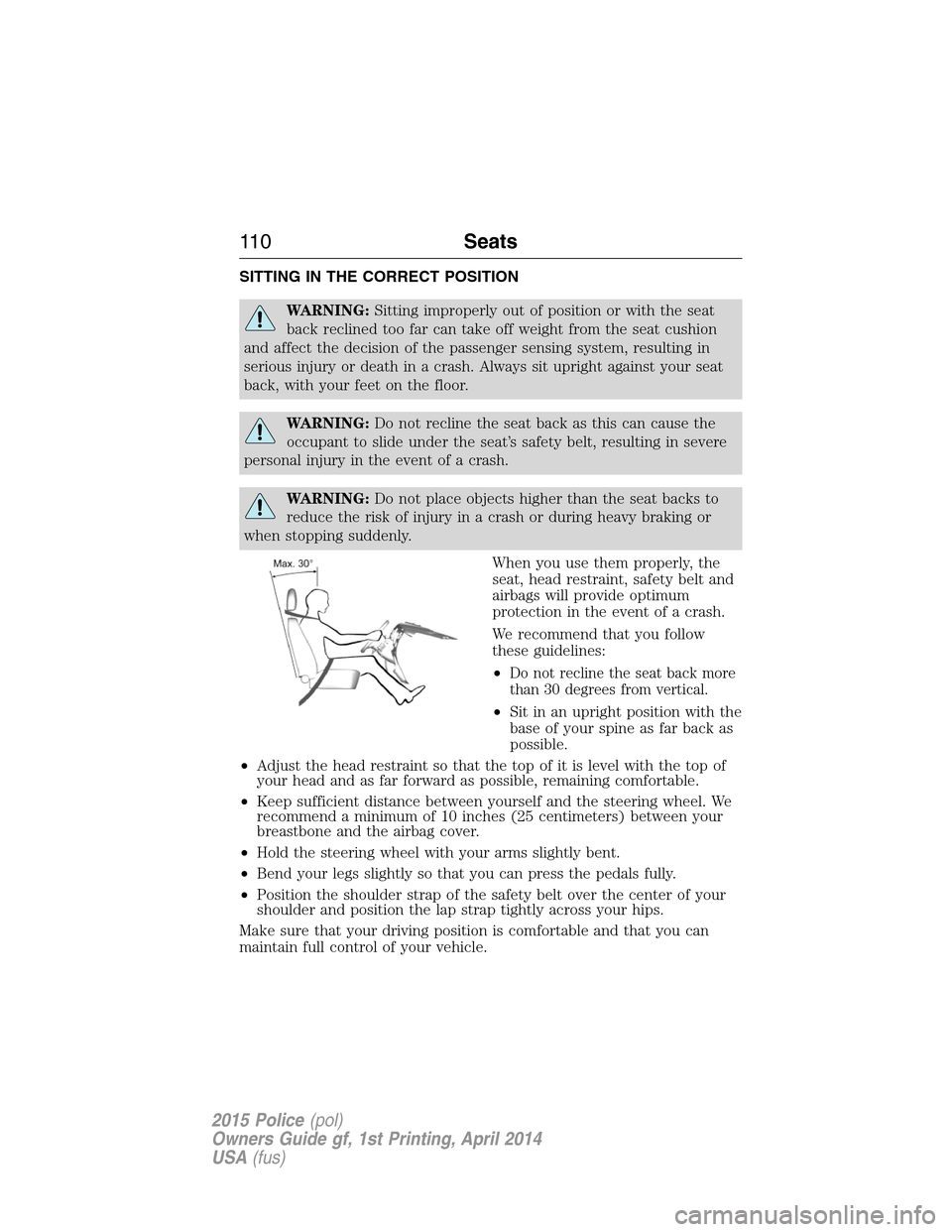
When you use them properly, the
seat, head restraint, safety belt and
airbags will provide optimum
protection in the event of a crash.
We recommend that you follow
these guidelines:
•
Do not recline the seat back more
than 30 degrees from vertical.
•Sit in an upright position with the
base of your spine as far back as
possible.
•Adjust the head restraint so that the top of it is level with the top of
your head and as far forward as possible, remaining comfortable.
•Keep sufficient distance between yourself and the steering wheel. We
recommend a minimum of 10 inches (25 centimeters) between your
breastbone and the airbag cover.
•Hold the steering wheel with your arms slightly bent.
•Bend your legs slightly so that you can press the pedals fully.
•Position the shoulder strap of the safety belt over the center of your
shoulder and position the lap strap tightly across your hips.
Make sure that your driving position is comfortable and that you can
maintain full control of your vehicle.
11 0Seats
2015 Police(pol)
Owners Guide gf, 1st Printing, April 2014
USA(fus)
Page 116 of 398
REAR SEATS (Utility Only)
Recline Adjustment (If Equipped)
WARNING:Always drive and ride with your seatback upright
and the lap belt snug and low across the hips.
WARNING:Reclining the seatback can cause an occupant to
slide under the seat’s safety belt, resulting in severe personal
injuries in the event of a crash.
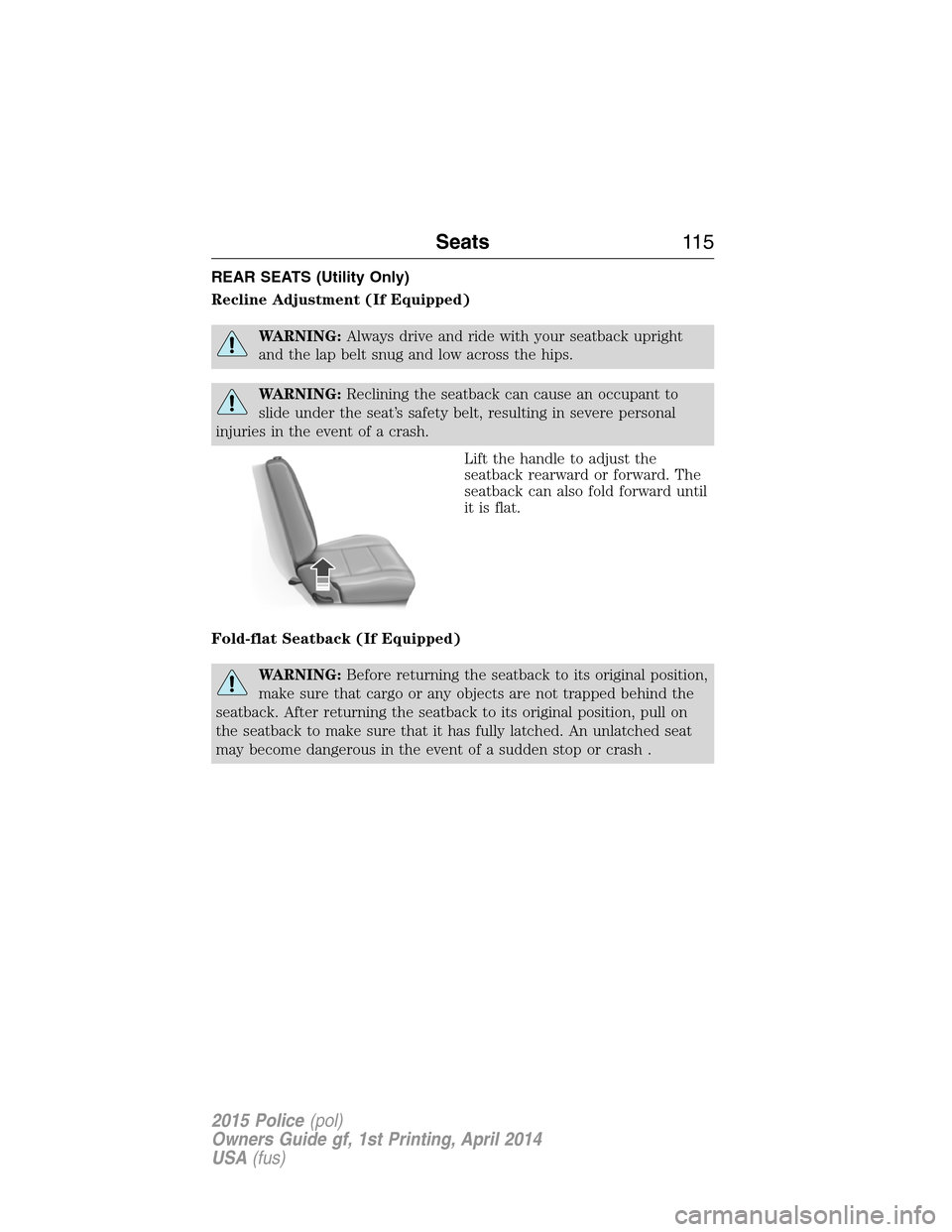
Lift the handle to adjust the
seatback rearward or forward. The
seatback can also fold forward until
it is flat.
Fold-flat Seatback (If Equipped)
WARNING:Before returning the seatback to its original position,
make sure that cargo or any objects are not trapped behind the
seatback. After returning the seatback to its original position, pull on
the seatback to make sure that it has fully latched. An unlatched seat
may become dangerous in the event of a sudden stop or crash .
Seats11 5
2015 Police(pol)
Owners Guide gf, 1st Printing, April 2014
USA(fus)
Page 117 of 398
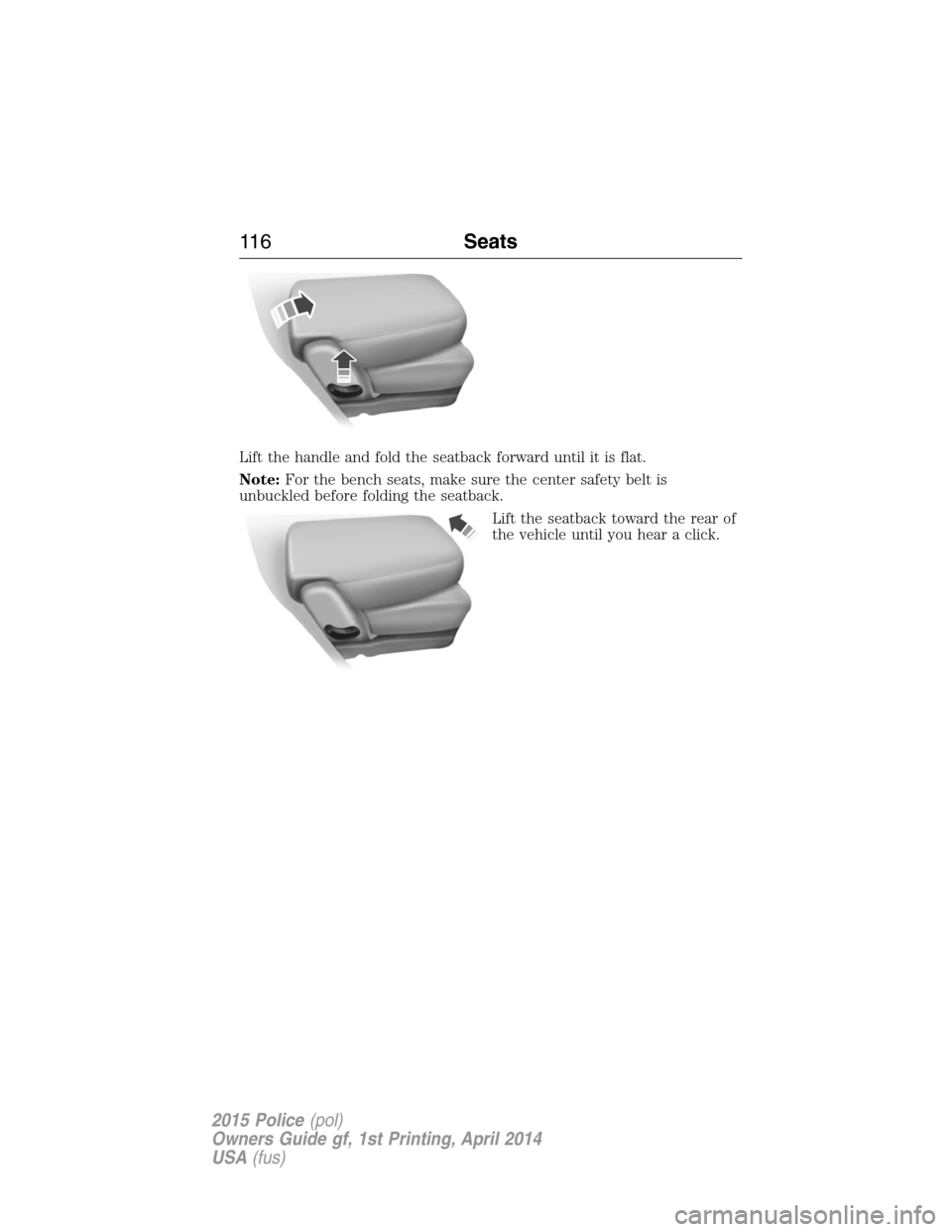
Lift the handle and fold the seatback forward until it is flat.
Note:For the bench seats, make sure the center safety belt is
unbuckled before folding the seatback.
Lift the seatback toward the rear of
the vehicle until you hear a click.
11 6Seats
2015 Police(pol)
Owners Guide gf, 1st Printing, April 2014
USA(fus)
Page 122 of 398

IGNITION SWITCH
Note:Do not store the key in the ignition after the vehicle is turned off
and you have left the vehicle. This could cause a drain on the battery.
A.Off:The ignition is off.
B.Accessory:Allows the electrical accessories, such as the radio, to
operate while the engine is not running.
C.On:All the electrical circuits are operational. Warning lights are
illuminated. This is the key position when driving.
D.Start:Cranks the engine. Release the key as soon as the engine
starts.
STARTING A GASOLINE ENGINE
When the engine starts, the idle RPM runs faster to warm the engine. If
the engine idle speed does not slow down automatically, have the vehicle
checked.
Note:You can crank the engine for a total of 60 seconds (without the
engine starting) before the starting system temporarily disables. The
60 seconds does not have to be all at once. For example, if you crank the
engine three times for 20 seconds each time, without the engine starting,
you reached the 60-second time limit. A message appears in the
information display alerting you that you exceeded the cranking time.
You cannot attempt to start the engine for at least 15 minutes. After
15 minutes, you are limited to a 15-second engine cranking time. You
need to wait 60 minutes before you can crank the engine for 60 seconds
again.
Before starting the vehicle:
•Make sure all occupants buckle their safety belts.
C
D
B
A
Starting and Stopping the Engine121
2015 Police(pol)
Owners Guide gf, 1st Printing, April 2014
USA(fus)
Page 182 of 398

TRANSPORTING THE VEHICLE
If you need to have your vehicle towed, contact a professional towing
service or, if you are a member of a roadside assistance program, your
roadside assistance service provider.
We recommend the use of a wheel lift and dollies or flatbed equipment
to tow your vehicle. Do not tow with a slingbelt. Ford Motor Company
has not approved a slingbelt towing procedure. Vehicle damage may
occur if towed incorrectly, or by any other means.
Ford Motor Company produces a towing manual for all authorized tow
truck operators. Have your tow truck operator refer to this manual for
proper hook-up and towing procedures for your vehicle.
It is acceptable to have your front-wheel drive vehicle towed from the
front if using proper wheel lift equipment to raise the front wheels off
the ground. When towing in this manner, the rear wheels can remain on
the ground.
Front-wheel drive vehicles must have the front wheels placed on a tow
dolly when towing your vehicle from the rear using wheel lift equipment.
This prevents damage to the transmission.
Towing181
2015 Police(pol)
Owners Guide gf, 1st Printing, April 2014
USA(fus)