2015 FORD F SERIES MOTORHOME AND COMMERCIAL CHASSIS reset
[x] Cancel search: resetPage 78 of 144
4.After three seconds, the Service: Oilreset in prog. message will bedisplayed.
5.After 25 seconds, the Service: Oil resetcomplete message will be displayed.
6.Release the accelerator and brakepedals, then rotate the key to the offposition.
Note:The Service: Oil reset completemessage will no longer be displayed.
ENGINE COOLANT CHECK
WARNINGS
Do not add engine coolant when theengine is hot. Steam and scaldingliquids released from a hot coolingsystem can burn you badly. Also, spillingcoolant on hot engine parts can burn you.
Do not put engine coolant in thewindshield washer fluid container. Ifsprayed on the windshield, enginecoolant could make it difficult to seethrough the windshield.
To reduce the risk of personal injury,make sure the engine is cool beforeunscrewing the coolant pressurerelief cap. The cooling system is underpressure; steam and hot liquid can comeout forcefully when you loosen the capslightly.
Do not add coolant further than theMAX mark.
When the engine is cold, check theconcentration and level of the enginecoolant at the intervals listed in thescheduled maintenance information. SeeScheduled Maintenance (page 121).
Note:Make sure that the level is betweenthe MIN and MAX marks on the coolantreservoir.
Note:Coolant expands when it is hot. Thelevel may extend beyond the MAX mark
Note:If the level is at the MIN mark, belowthe MIN mark, or empty, add coolantimmediately. See Adding Engine Coolantin this chapter.
The coolant concentration should bemaintained within 48% to 50%, whichequates to a freeze point between -30°F(-34°C) and -34°F (-37°C).
Note:For best results, coolantconcentration should be tested with arefractometer such as Robinair Coolant andBattery Refractometer 75240. We do notrecommend the use of hydrometers orcoolant test strips for measuring coolantconcentrations.
Note:Automotive fluids are notinterchangeable. Do not use engine coolant,antifreeze or windshield washer fluid outsideof its specified function and vehicle location.
Adding Engine Coolant
Note:Do not use stop leak pellets, coolingsystem sealants, or additives as they cancause damage to the engine cooling orheating systems. Your vehicle’s warrantydoes not cover this damage.
75Motorhome (), enUSAMaintenance
Page 80 of 144
What you Should Know About Fail-Safe Cooling
If you deplete the engine coolant supply,this feature allows you to drive your vehicletemporarily before you incur incrementalcomponent damage. The fail-safe distancedepends on ambient temperatures, vehicleload and terrain.
How Fail-Safe Cooling Works
If the engine begins to overheat, the enginecoolant temperature gauge will move tothe red (hot) area and:
The coolant temperaturewarning indicator will light.
The service engine soonindicator will light.
If the engine reaches a presetover-temperature condition, the enginewill automatically switch to alternatingcylinder operation. Each disabled cylinderacts as an air pump and cools the engine.
When this occurs, the vehicle will stilloperate. However:
•The engine power will be limited.
•This will disable the air conditioningsystem.
Continued operation will increase theengine temperature and the engine willcompletely shut down, causing steeringand braking effort to increase.
Once the engine temperature cools, theengine can be re-started. Take your vehicleto an authorized dealer as soon as possibleto minimize engine damage.
When Fail-Safe Mode Is Activated
WARNINGS
Fail-safe mode is for use duringemergencies only. Operate thevehicle in fail-safe mode only as longas necessary to bring the vehicle to rest ina safe location and seek immediate repairs.When in fail-safe mode, the vehicle willhave limited power, will not be able tomaintain high-speed operation and maycompletely shut down without warning,potentially losing engine power, powersteering assist and power brake assist,which may increase the possibility of acrash resulting in serious injury.
Never remove the coolant reservoircap while the engine is running or hot.
You have limited engine power when in thefail-safe mode, so drive the vehicle withcaution. The vehicle will not be able tomaintain high-speed operation and theengine will run rough. Remember that theengine is capable of completely shuttingdown automatically to prevent enginedamage, therefore:
1.Pull off the road as soon as safelypossible and switch off the engine.
2.Have your vehicle towed to anauthorized dealer.
3.If this is not possible, wait a shortperiod for the engine to cool.
4.Check the coolant level and replenishif low.
5.Re-start the engine and take yourvehicle to an authorized dealer.
Note:Driving the vehicle without repairingthe engine problem increases the chance ofengine damage. Take your vehicle to anauthorized dealer as soon as possible.
77Motorhome (), enUSAMaintenance
Page 87 of 144
•The transmission must relearn itsadaptive strategy. As a result of this,the transmission may shift firmly. Thisoperation is considered normal and willnot affect function or durability of thetransmission. Over time the adaptivelearning process will fully updatetransmission operation to its optimumshift feel.
•The clock and the preset radio stationsmust be reset once the battery isreconnected.
•Your vehicle’s engine is electronicallycontrolled by a computer, some controlconditions are maintained by powerfrom the battery, the engine mustrelearn its idle and fuel trim strategy.
When the battery is disconnected or a newbattery is installed, begin the batteryrelearn process:
1.With the vehicle at a complete stop,set the parking brake.
2.Put the gearshift lever in P (Park), turnoff all accessories and start the engine.
3.Run the engine until it reaches normaloperating temperature.
4.Allow the engine to idle for at least oneminute.
5.Turn the A/C on and allow the engineto idle for at least one minute.
6.Drive the vehicle to complete therelearning process.
•The vehicle may need to be drivento relearn the idle and fuel trimstrategy.
CHANGING THE ENGINE AIR
FILTER
WARNING
To reduce the risk of vehicle damageand personal burn injuries, do notstart your engine with the air cleanerremoved and do not remove it while theengine is running.
Change the air filter element at the properinterval. See Scheduled Maintenance(page 121).
When changing the air filter element, useonly the air filter element listed. SeeCapacities and Specifications (page110).
Note:Failure to use the correct air filterelement may result in severe enginedamage. The customer warranty may bevoid for any damage to the engine if thecorrect air filter element is not used.
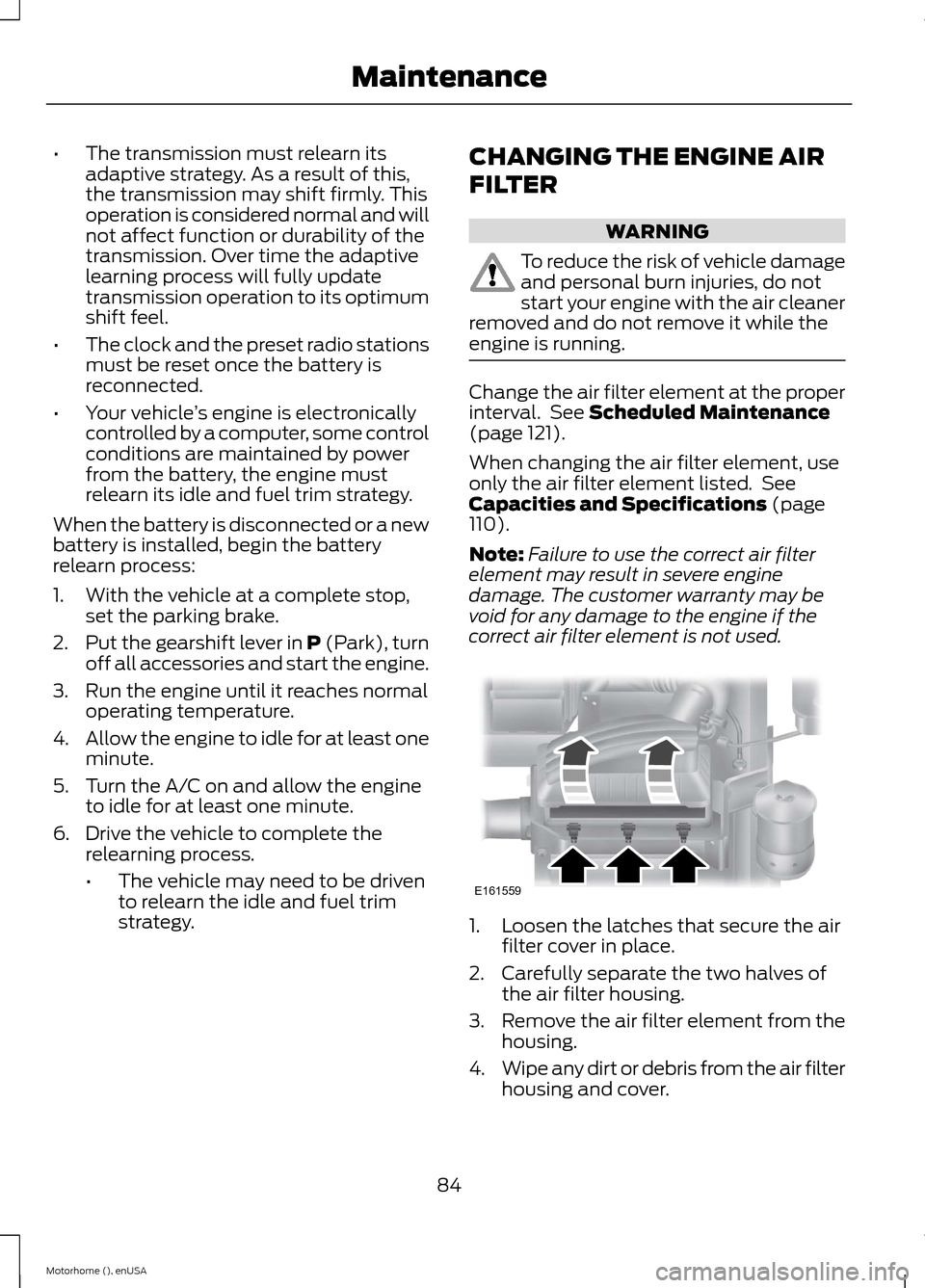
1.Loosen the latches that secure the airfilter cover in place.
2.Carefully separate the two halves ofthe air filter housing.
3.Remove the air filter element from thehousing.
4.Wipe any dirt or debris from the air filterhousing and cover.
84Motorhome (), enUSAMaintenanceE161559
Page 91 of 144
Body
•Wash your vehicle thoroughly toremove dirt, grease, oil, tar or mud fromexterior surfaces, rear-wheel housingand the underside of front fenders.
•Periodically wash your vehicle if it isstored in exposed locations.
•Touch-up exposed or primed metal toprevent rust.
•Cover chrome and stainless steel partswith a thick coat of auto wax to preventdiscoloration. Re-wax as necessarywhen you wash your vehicle.
•Lubricate all hood, door and trunk lidhinges, and latches with a light gradeoil.
•Cover interior trim to prevent fading.
•Keep all rubber parts free from oil andsolvents.
Engine
•The engine oil and filter should bechanged prior to storage because usedengine oil contains contaminates thatmay cause engine damage.
•Start the engine every 15 days for aminimum of 15 minutes. Run at fast idlewith the climate controls set to defrostuntil the engine reaches normaloperating temperature.
•With your foot on the brake, shiftthrough all the gears while the engineis running.
•We recommend that you change theengine oil before you use your vehicleagain.
Fuel system
•Fill the fuel tank with high-quality fueluntil the first automatic shutoff of thefuel pump nozzle.
Cooling system
•Protect against freezing temperatures.
•When removing your vehicle fromstorage, check coolant fluid level.Confirm that there are no coolingsystem leaks and that fluid is at therecommended level.
Battery
•Check and recharge as necessary. Keepconnections clean.
•If storing your vehicle for more than 30days without recharging the battery,we recommend that you disconnectthe battery cables to maintain batterycharge for quick starting.
Note:It is necessary to reset memoryfeatures if battery cables are disconnected.
Brakes
•Make sure the brakes and parking brakerelease fully.
Tires
•Maintain recommended air pressure.
Miscellaneous
•Make sure all linkages, cables, leversand pins under your vehicle are coveredwith grease to prevent rust.
•Move vehicles at least 25 ft (7.5 m)every 15 days to lubricate working partsand prevent corrosion.
Removing Vehicle From Storage
When your vehicle is ready to come out ofstorage, do the following:
•Wash your vehicle to remove any dirtor grease film build-up on windowsurfaces.
•Check windshield wipers for anydeterioration.
88Motorhome (), enUSAVehicle Care
Page 141 of 144
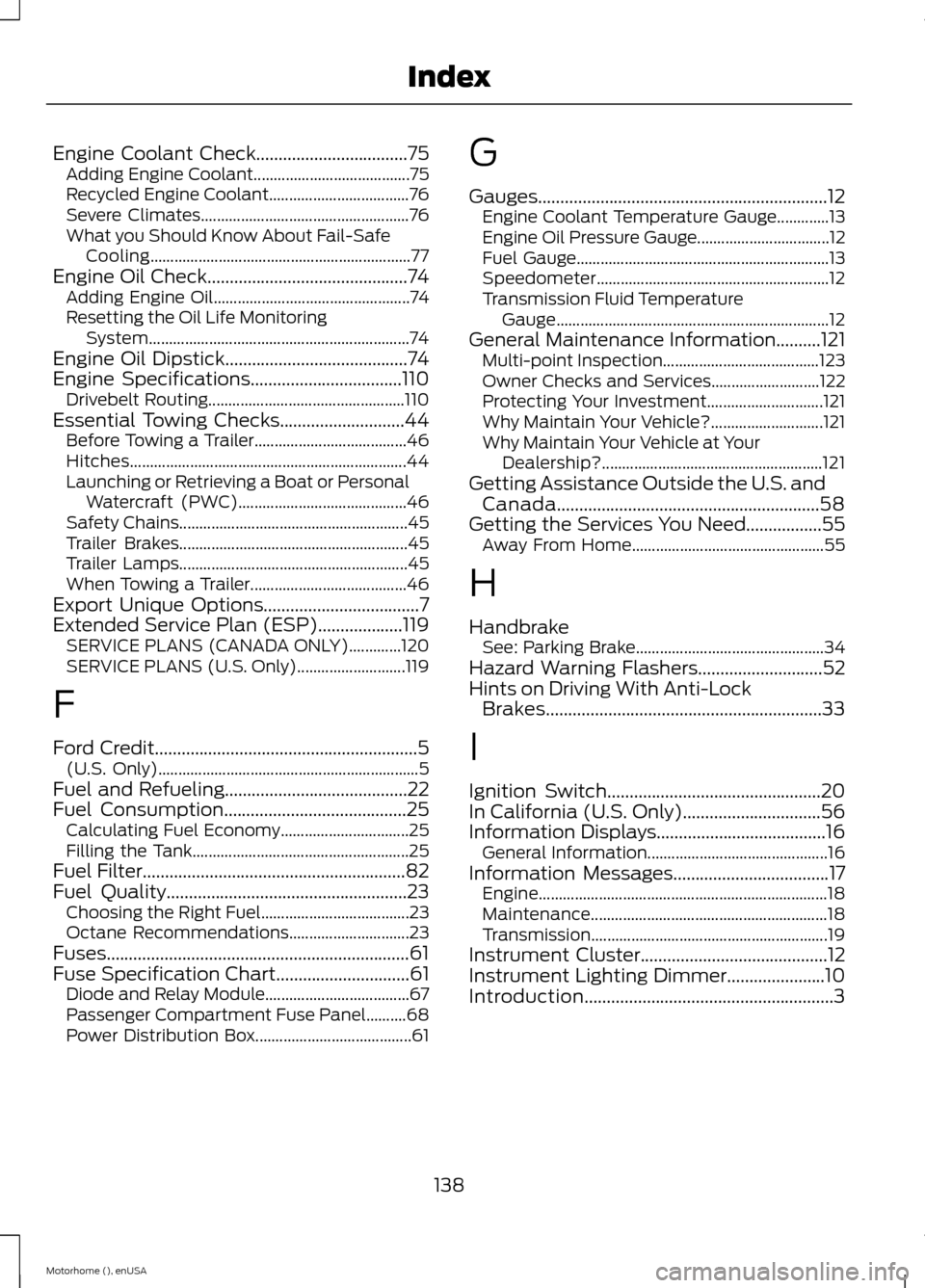
Engine Coolant Check..................................75Adding Engine Coolant.......................................75Recycled Engine Coolant...................................76Severe Climates....................................................76What you Should Know About Fail-SafeCooling.................................................................77Engine Oil Check.............................................74Adding Engine Oil.................................................74Resetting the Oil Life MonitoringSystem.................................................................74Engine Oil Dipstick.........................................74Engine Specifications..................................110Drivebelt Routing.................................................110Essential Towing Checks............................44Before Towing a Trailer......................................46Hitches.....................................................................44Launching or Retrieving a Boat or PersonalWatercraft (PWC)..........................................46Safety Chains.........................................................45Trailer Brakes.........................................................45Trailer Lamps.........................................................45When Towing a Trailer.......................................46Export Unique Options...................................7Extended Service Plan (ESP)...................119SERVICE PLANS (CANADA ONLY).............120SERVICE PLANS (U.S. Only)...........................119
F
Ford Credit...........................................................5(U.S. Only).................................................................5Fuel and Refueling.........................................22Fuel Consumption.........................................25Calculating Fuel Economy................................25Filling the Tank......................................................25Fuel Filter...........................................................82Fuel Quality......................................................23Choosing the Right Fuel.....................................23Octane Recommendations..............................23Fuses....................................................................61Fuse Specification Chart..............................61Diode and Relay Module....................................67Passenger Compartment Fuse Panel..........68Power Distribution Box.......................................61
G
Gauges.................................................................12Engine Coolant Temperature Gauge.............13Engine Oil Pressure Gauge.................................12Fuel Gauge...............................................................13Speedometer..........................................................12Transmission Fluid TemperatureGauge....................................................................12General Maintenance Information..........121Multi-point Inspection.......................................123Owner Checks and Services...........................122Protecting Your Investment.............................121Why Maintain Your Vehicle?............................121Why Maintain Your Vehicle at YourDealership?.......................................................121Getting Assistance Outside the U.S. andCanada...........................................................58Getting the Services You Need.................55Away From Home................................................55
H
HandbrakeSee: Parking Brake...............................................34Hazard Warning Flashers............................52Hints on Driving With Anti-LockBrakes..............................................................33
I
Ignition Switch................................................20In California (U.S. Only)...............................56Information Displays......................................16General Information.............................................16Information Messages...................................17Engine........................................................................18Maintenance...........................................................18Transmission...........................................................19Instrument Cluster..........................................12Instrument Lighting Dimmer......................10Introduction........................................................3
138Motorhome (), enUSAIndex