2015 FORD EXPLORER child lock
[x] Cancel search: child lockPage 40 of 596

WARNING:When possible, all children 12 years old and under
should be properly restrained in a rear seating position. Failure
to follow this could seriously increase the risk of injury or death.
WARNING:Safety belts and seats can become hot in a vehicle
that has been closed up in sunny weather; they could burn a
small child. Check seat covers and buckles before you place a child
anywhere near them.
WARNING:Front and rear seat occupants, including pregnant
women, should wear safety belts for optimum protection in an
accident.
All seating positions in this vehicle have lap and shoulder safety belts. All
occupants of the vehicle should always properly wear their safety belts,
even when an airbag supplemental restraint system is provided.
The safety belt system consists of:
•Lap and shoulder safety belts.
•Shoulder safety belt with automatic locking mode (except driver and
rear inflatable safety belt).
•Height adjuster at the front outboard seating positions.
•Safety belt pretensioner at the front outboard seating positions.
•Belt tension sensor at the front outboard passenger seating position.
•Safety belt warning light and chime. SeeSafety Belt
Warning Light and Indicator Chimelater in this chapter.
•Crash sensors and monitoring system with readiness
indicator. SeeCrash Sensors and Airbag Indicatorin the
Supplemental Restraint Systemchapter.
The safety belt pretensioners and rear inflatable safety belts are designed
to activate in frontal, near-frontal and side crashes, and in rollovers. The
safety belt pretensioners at the front seating positions are designed to
tighten the safety belts firmly against the occupant’s body when
activated. This helps increase the effectiveness of the safety belts. In
frontal crashes, the safety belt pretensioners can be activated alone or, if
the crash is of sufficient severity, together with the front airbags.
Safety Belts39
2015 Explorer(exp)
Owners Guide gf, 2nd Printing, September 2014
USA(fus)
Page 42 of 596

Pregnant women should always
wear their safety belts. The lap belt
portion of a combination lap and
shoulder belt should be positioned
low across the hips below the belly
and worn as tight as comfort will
allow. The shoulder belt should be
positioned to cross the middle of
the shoulder and the center of the
chest.
Safety Belt Locking Modes
WARNING:After any vehicle crash, the safety belt system at all
passenger seating positions must be checked by an authorized
dealer to verify that the automatic locking retractor feature for child
seats is still functioning properly. In addition, all safety belts should be
checked for proper function.
WARNING:The belt and retractor assembly must be replaced if
the safety belt assembly automatic locking retractor feature or
any other safety belt function is not operating properly when checked
by an authorized dealer. Failure to replace the belt and retractor
assembly could increase the risk of injury in crashes.
All safety restraints in the vehicle are combination lap and shoulder
belts. The driver safety belt has the first locking mode. The front
outboard passenger and rear seat safety belts have both types of locking
modes described as follows:
Vehicle Sensitive Mode
This is the normal retractor mode, which allows free shoulder or lap belt
length adjustment to your movements and locking in response to vehicle
movement. For example, if the driver brakes suddenly or turns a corner
sharply, or the vehicle receives an impact of about 5 mph (8 km/h) or
more, the combination safety belts will lock to help reduce forward
movement of the driver and passengers.
In addition, the retractor(s) is designed to lock if the webbing is pulled
out too quickly. If this occurs, let the belt retract slightly and pull
webbing out again in a slow and controlled manner.
Safety Belts41
2015 Explorer(exp)
Owners Guide gf, 2nd Printing, September 2014
USA(fus)
Page 43 of 596
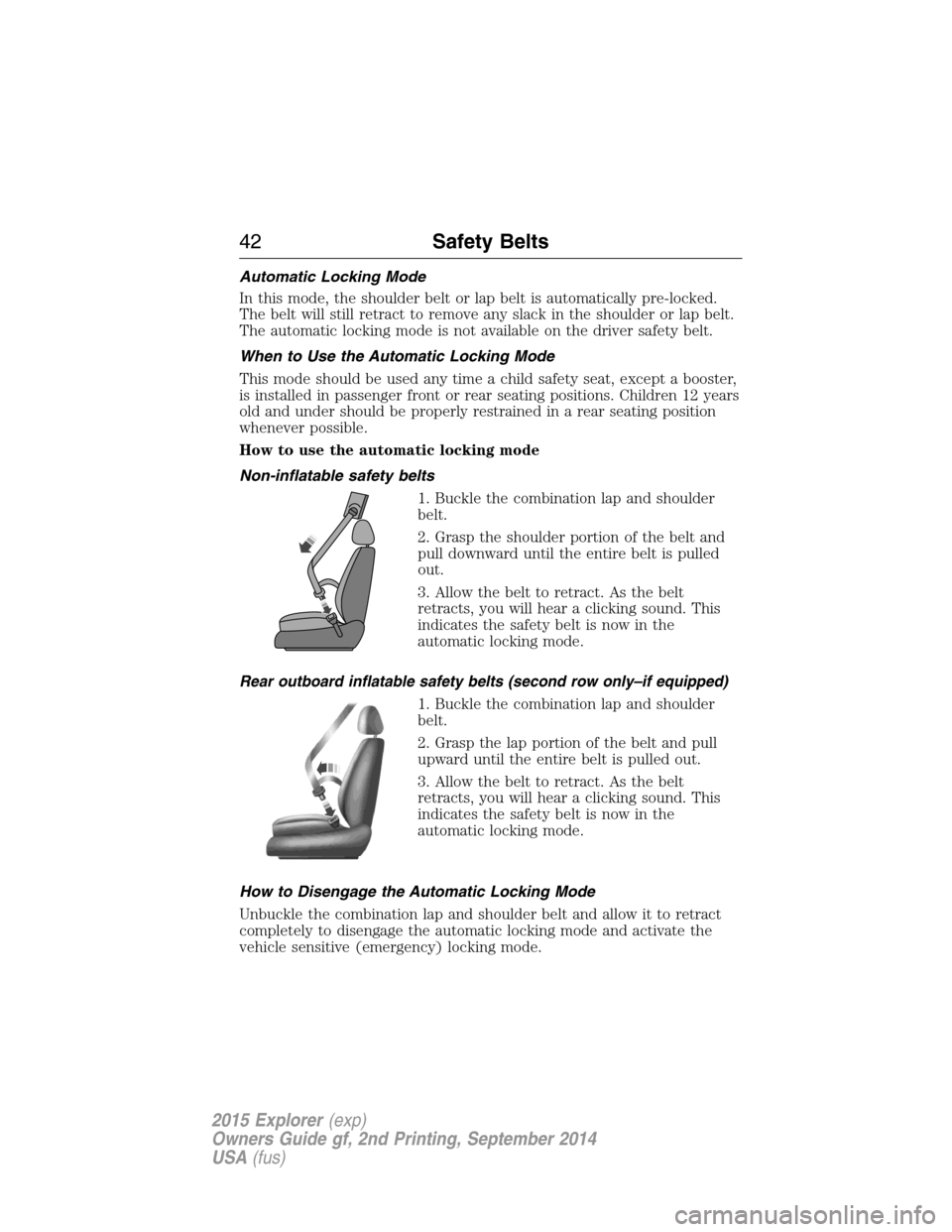
Automatic Locking Mode
In this mode, the shoulder belt or lap belt is automatically pre-locked.
The belt will still retract to remove any slack in the shoulder or lap belt.
The automatic locking mode is not available on the driver safety belt.
When to Use the Automatic Locking Mode
This mode should be used any time a child safety seat, except a booster,
is installed in passenger front or rear seating positions. Children 12 years
old and under should be properly restrained in a rear seating position
whenever possible.
How to use the automatic locking mode
Non-inflatable safety belts
1. Buckle the combination lap and shoulder
belt.
2. Grasp the shoulder portion of the belt and
pull downward until the entire belt is pulled
out.
3. Allow the belt to retract. As the belt
retracts, you will hear a clicking sound. This
indicates the safety belt is now in the
automatic locking mode.
Rear outboard inflatable safety belts (second row only–if equipped)
1. Buckle the combination lap and shoulder
belt.
2. Grasp the lap portion of the belt and pull
upward until the entire belt is pulled out.
3. Allow the belt to retract. As the belt
retracts, you will hear a clicking sound. This
indicates the safety belt is now in the
automatic locking mode.
How to Disengage the Automatic Locking Mode
Unbuckle the combination lap and shoulder belt and allow it to retract
completely to disengage the automatic locking mode and activate the
vehicle sensitive (emergency) locking mode.
42Safety Belts
2015 Explorer(exp)
Owners Guide gf, 2nd Printing, September 2014
USA(fus)
Page 47 of 596

3. Wait 10 seconds after the safety belt warning light turns off.
•Step 4 must be completed within 20 seconds after the completion of
Step 3.
4. For the seating position being disabled, buckle then unbuckle the
safety belt three times at a moderate speed, ending in the unbuckled
state.
•After Step 4, the safety belt warning light will be turned on for three
seconds.
5. Within about seven seconds of the light turning off, buckle then
unbuckle the safety belt.
•This will disable the feature for that seating position if it is currently
enabled.
•This will enable the feature for that seating position if it is currently
disabled.
REAR INFLATABLE SAFETY BELT (IF EQUIPPED)
WARNING:Do not attempt to service, repair, or modify the rear
inflatable safety belt as you could be seriously injured or killed.
Note:The rear inflatable safety belts are compatible with most infant
and child safety car seats and belt positioning booster seats when
properly installed. This is because they are designed to fill with a cool
gas at a lower pressure and at a slower rate than traditional airbags.
After inflation, the shoulder portion of the safety belt remains cool to the
touch.
The rear inflatable safety belts are located in the shoulder portion of the
safety belts of the second-row outboard seating positions.
The rear inflatable safety belt consists of the following:
•An inflatable bag located in the shoulder safety belt webbing.
•Lap safety belt webbing with automatic locking mode.
•Crash sensors and monitoring system with readiness
indicator.
SeeCrash Sensors and Airbag Indicatorin theSupplemental
Restraint Systemchapter.
46Safety Belts
2015 Explorer(exp)
Owners Guide gf, 2nd Printing, September 2014
USA(fus)
Page 80 of 596

Power Liftgate (If Equipped)
WARNING:Make sure all persons are clear of the power liftgate
area before using the power liftgate control.
WARNING:Keep keys out of reach of children. Do not allow
children to play near an open or moving power liftgate.
Note:Cycling the ignition while the liftgate is power closing and is near
the latch may cause the liftgate to reverse to full open position. Make
sure that you close the liftgate before operating or moving the vehicle,
especially in an enclosure like a garage or a parking structure. You could
damage the liftgate or its components.
Note:Do not drive with the liftgate open without first disabling the
power function and securing the liftgate to the vehicle.
Note:In case of operation in extreme cold -40°F (-40°C), or on extreme
inclines, manual operation of the liftgate is suggested.
You can enable or disable the power liftgate using the information
display. The remote control and instrument panel button will still operate
the liftgate regardless of the setting.
Opening and Closing the Power Liftgate
Note:You can reverse the liftgate movement direction with a second
press of the instrument panel button, or the control button on the
liftgate, or a second double press of the transmitter button.
The liftgate will only operate with the transmission inP.
A chime will sound three times as the liftgate begins to power close. A
single chime indicates a problem with the close request, caused by:
•the ignition is on and the transmission is not inP;or
•the battery voltage is below the minimum operating voltage; or
•the vehicle speed is at or above 3 mph (5 km/h).
If the liftgate reverses and starts to close after an open request, a fast
continuous chime indicates excessive load on the gate or a possible strut
failure. Have your vehicle checked by an authorized dealer if you still
have a fast chime after you remove the load.
Locks79
2015 Explorer(exp)
Owners Guide gf, 2nd Printing, September 2014
USA(fus)
Page 589 of 596
911 Assist™ ......................436, 513
A
ABS (see Brakes) .....................220
Accessing and using your USB
port ............................................493
Accessing call history/phone
book during active call .............425
Accessing your calendar ..........513
Accessing your media menu
features ......................................448
Accessing your phone menu
features ......................................427
Accessory delay ........................108
Active call menu options .........425
Active Park Assist .....................230
Adaptive Cruise Control ...........240
Adding (pairing) a phone ........500
Advanced menu options ...434, 454
Advanced menu options
(prompts, languages, defaults,
master reset, installing
applications) ..............................434
Airbag supplemental restraint
system ..........................................52
and child safety seats ..............53
description ................................52
disposal ......................................61
driver airbag ..............................52
passenger airbag .......................52
side airbag ...........................52, 57
Air cleaner filter .......331–332, 391
Air conditioning ........................144
manual heating and air
conditioning system ...............144
Air filter .....................................332Air filter, cabin ..........................153
All Wheel Drive (AWD),
driving off road .........................212
Ambient mood/lighting .............520
Ambulance packages ..................16
AM/FM .......................................480
Antifreeze
(see Engine coolant) ................316
Anti-lock brake system
(see Brakes) ..............................220
Anti-theft system ..................85, 88
arming the system ..............85, 88
disarming a triggered system ..88
AppLink™ .................................444
Audio system
Single CD ................401, 406–407
Audio system
(see Radio) ................401, 406–407
Automatic transmission ............205
fluid, adding ............................322
fluid, checking ........................322
fluid, refill capacities ..............386
fluid, specification ..................386
Selectshift (SST) ....................208
Auxiliary Input Jack .................489
Auxiliary input jack (Line in) ..414
Auxiliary powerpoint ................182
A/V inputs ..........................416, 497
Axle
lubricant specifications ..........386
refill capacities ........................386
B
Battery .......................................327
acid, treating emergencies .....327
jumping a disabled battery ....289
588Index
2015 Explorer(exp)
Owners Guide gf, 2nd Printing, September 2014
USA(fus)
Page 590 of 596
maintenance-free ....................327
replacement, specifications ...391
servicing ..................................327
Blind Spot Information
System .......................................254
Booster seats ...............................23
Brakes ........................................219
anti-lock ...................................220
anti-lock brake system (ABS)
warning light ...........................220
brake warning light ................220
fluid, checking and adding ....326
fluid, refill capacities ..............386
fluid, specifications .................386
lubricant specifications ..........386
parking ....................................220
shift interlock ..........................209
trailer .......................................278
C
Capacities for refilling fluids ....386
Cargo net ...................................264
CD ..............................401, 406–407
CD player ..........................399, 491
CD voice commands .................492
Cell phone use ............................17
Changing a tire .........................375
Changing the air filter ..............332
Child safety restraints ..........31, 33
Child safety seats
attaching with tether straps ....33
automatic locking mode
(retractor) .................................41
LATCH .......................................31
Child safety seats - booster
seats .............................................23
Cleaning the touchscreen ........470Cleaning your vehicle ...............341
engine compartment ..............343
instrument panel ....................345
interior .....................................345
plastic parts ............................342
washing ....................................341
waxing .....................................343
wheels ......................................347
wiper blades ............................344
Climate control (see Air
conditioning or Heating) ..........144
Climate voice commands .........532
Clock ..................................401, 518
Collision Warning System .........259
Console ......................................185
overhead ..................................186
rear ..........................................185
Coolant ......................................316
checking and adding ..............316
refill capacities ........................386
specifications ..........................386
Cross Traffic Alert ....................254
Cruise control ...........................239
Customer Assistance ................286
Ford Extended Service
Plan ..........................................396
Getting roadside assistance ...286
Getting the service you
need .........................................292
Ordering additional owner’s
literature .................................298
Utilizing the
Mediation/Arbitration
Program ...................................296
D
Defrost .......................144, 146, 148
rear window ............................153
Index589
2015 Explorer(exp)
Owners Guide gf, 2nd Printing, September 2014
USA(fus)
Page 592 of 596
Gauges ...............................115–116
odometer .................................127
trip odometer ..........................127
H
Hazard flashers .........................288
HD Radio™ ...............................481
Headlamps
aiming ......................................333
bulb specifications ..................339
flash to pass ..............................98
high beam .........................98, 101
Head restraints .........................156
Heated steering wheel ..............530
Heating ......................144, 146, 148
Help ............................................529
Hill descent mode .....................226
Hill start assist ..........................221
Homelink wireless control
system ........................................177
Hood ..........................................311
How to use voice commands ...475
I
Ignition ...............................188, 384
Illuminated visor mirror ...112–113
Information displays .................123
Inspection/maintenance (I/M)
testing ........................................204
Instrument panel
cleaning ...................................345
cluster ......................................117
Intelligent Access Key ................63J
Jack ............................................375
positioning ...............................375
storage .....................................375
Joining two calls
(multiparty/conference call) ....425
Jump-starting your vehicle ......289
K
Keyless entry system
autolock .....................................76
keypad .......................................82
locking and unlocking doors ....84
programming entry code .........82
Keys .......................................63, 85
positions of the ignition .........188
L
Lamps
bulb replacement
specifications chart ................339
headlamps, flash to pass ..........98
interior lamps .................104–105
Lane keeping system ................250
LATCH anchors ...........................31
Liftgate ............................74, 78–79
Lights, warning and indicator ..117
Listening to music ....................478
Loading instructions .................272
Load limits .................................265
Locks
autolock .....................................76
childproof ..................................37
doors ..........................................73
Lubricant specifications ...........386
Index591
2015 Explorer(exp)
Owners Guide gf, 2nd Printing, September 2014
USA(fus)