2015 FORD EXPEDITION warning lights
[x] Cancel search: warning lightsPage 260 of 564
Trailer Lamps
WARNING:Never connect any trailer lamp wiring to the
vehicle’s tail lamp wiring; this may damage the electrical system
resulting in a fire. Contact an authorized dealer as soon as possible for
assistance in proper trailer tow wiring installation. Additional electrical
equipment may be required.
Trailer lamps are required on most towed vehicles. Make sure all running
lights, brake lights, turn signals and hazard lights are working.
Before Towing a Trailer
Practice turning, stopping and backing up to get the feel of your
vehicle-trailer combination before starting on a trip. When turning, make
wider turns so the trailer wheels clear curbs and other obstacles.
When Towing a Trailer
•Do not drive faster than 70 mph (113 km/h) during the first 500 miles
(800 kilometers).
•Do not make full-throttle starts.
•Check your hitch, electrical connections and trailer wheel lug nuts
thoroughly after you have traveled 50 miles (80 kilometers).
•When stopped in congested or heavy traffic during hot weather, place
the gearshift in positionPto aid engine and transmission cooling and
to help air conditioning performance.
•Turn off the speed control with heavy loads or in hilly terrain. The
speed control may turn off automatically when you are towing on
long, steep grades.
•Shift to a lower gear when driving down a long or steep hill. Do not
apply the brakes continuously, as they may overheat and become less
effective.
•If your transmission is equipped with a Grade Assist or Tow/Haul
feature, use this feature when towing. This provides engine braking
and helps eliminate excessive transmission shifting for optimum fuel
economy and transmission cooling.
•If your vehicle is equipped with AdvanceTrac™ with RSC, this system
may turn on during typical cornering maneuvers with a heavily loaded
trailer. This is normal. Turning the corner at a slower speed while
towing may reduce this tendency.
Towing259
2015 Expedition(exd)
Owners Guide gf, 1st Printing, July 2014
USA(fus)
Page 267 of 564
•Add particular accessories to your vehicle (e.g.; bug deflectors,
rollbars or light bars, running boards, ski racks).
•Drive with the wheels out of alignment.
DRIVING THROUGH WATER
WARNING:Do not drive through flowing or deep water as you
may lose control of your vehicle.
Note:Driving through standing water can cause vehicle damage.
Note:Engine damage can occur if water enters the air filter.
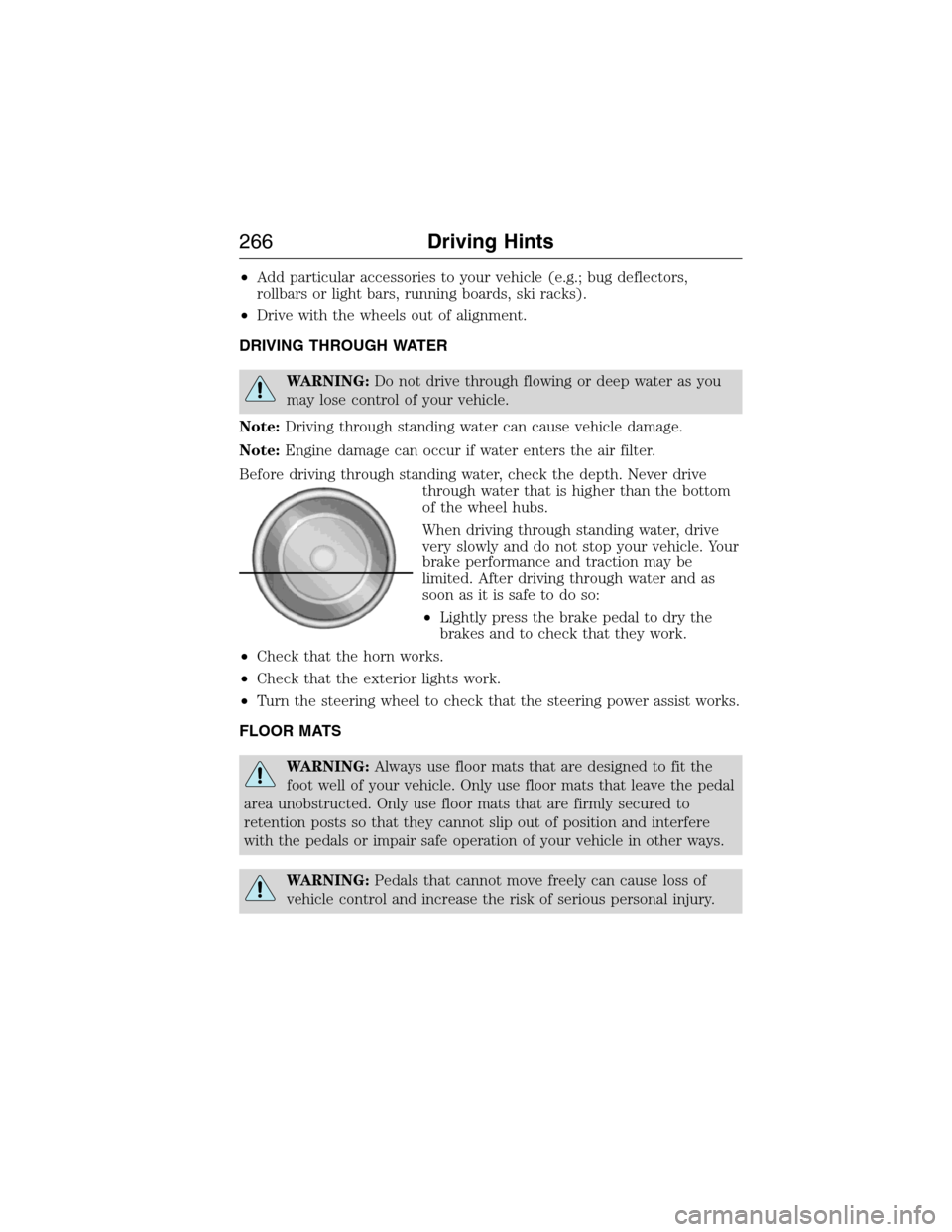
Before driving through standing water, check the depth. Never drive
through water that is higher than the bottom
of the wheel hubs.
When driving through standing water, drive
very slowly and do not stop your vehicle. Your
brake performance and traction may be
limited. After driving through water and as
soon as it is safe to do so:
•Lightly press the brake pedal to dry the
brakes and to check that they work.
•Check that the horn works.
•Check that the exterior lights work.
•Turn the steering wheel to check that the steering power assist works.
FLOOR MATS
WARNING:Always use floor mats that are designed to fit the
foot well of your vehicle. Only use floor mats that leave the pedal
area unobstructed. Only use floor mats that are firmly secured to
retention posts so that they cannot slip out of position and interfere
with the pedals or impair safe operation of your vehicle in other ways.
WARNING:Pedals that cannot move freely can cause loss of
vehicle control and increase the risk of serious personal injury.
266Driving Hints
2015 Expedition(exd)
Owners Guide gf, 1st Printing, July 2014
USA(fus)
Page 347 of 564
Low tire
pressure
warning lightPossible cause Customer action required
Flashing warning
lightSpare tire in use Repair the damaged road wheel and
tire and reinstall it on the vehicle to
restore system function. For a
description on how the system
functions, seeWhen your spare tire
is installedin this section.
Tire pressure
monitoring
system
malfunctionIf the tires are properly inflated and
the spare tire is not in use but the
light remains on, contact your
authorized dealer as soon as possible.
When inflating your tires
When putting air into your tires (such as at a gas station or in your
garage), the tire pressure monitoring system may not respond
immediately to the air added to your tires.
It may take up to two minutes of driving over 20 mph (32 km/h) for the
light to turn off after you have filled your tires to the recommended
inflation pressure.
How temperature affects your tire pressure
The tire pressure monitoring system monitors tire pressure in each
pneumatic tire. While driving in a normal manner, a typical passenger
tire inflation pressure may increase approximately 2 to 4 psi (14 to
28 kPa) from a cold start situation. If the vehicle is stationary overnight
with the outside temperature significantly lower than the daytime
temperature, the tire pressure may decrease approximately 3 psi
(21 kPa) for a drop of 30°F (17°C) in ambient temperature. This lower
pressure value may be detected by the system as being significantly
lower than the recommended inflation pressure and activate the system
warning light for low tire pressure. If the low tire pressure warning light
is on, visually check each tire to verify that no tire is flat. If one or more
tires are flat, repair as necessary. Check air pressure in the road tires. If
any tire is under-inflated, carefully drive the vehicle to the nearest
location where air can be added to the tires. Inflate all the tires to the
recommended inflation pressure.
346Wheels and Tires
2015 Expedition(exd)
Owners Guide gf, 1st Printing, July 2014
USA(fus)
Page 541 of 564
Oils, Fluids and Flushing
In many cases, fluid discoloration is a normal operating characteristic
and, by itself, does not necessarily indicate a concern or that the fluid
needs to be changed. However, discolored fluids that also show signs of
overheating and foreign material contamination should be inspected
immediately by a qualified expert, such as the factory-trained technicians
at your dealership. Your vehicle’s oils and fluids should be changed at the
specified intervals or in conjunction with a repair. Flushing is a viable
way to change fluid for many vehicle sub-systems during scheduled
maintenance. It is critical that systems are flushed only with new fluid
that is the same as that required to fill and operate the system, or using
a Ford-approved flushing chemical.
Owner Checks and Services
Certain basic maintenance checks and inspections should be performed
every month or at six month intervals.
Check every month
Engine oil level.
Function of all interior and exterior lights.
Tires (including spare) for wear and proper pressure.
Windshield washer fluid level.
Check every six months
Battery connections. Clean if necessary.
Body and door drain holes for obstructions. Clean if necessary.
Cooling system fluid level and coolant strength.
Door weatherstrips for wear. Lubricate if necessary.
Hinges, latches and outside locks for proper operation. Lubricate if
necessary.
Parking brake for proper operation.
Safety belts and seat latches for wear and function.
Safety warning lamps (brake, ABS, airbag, safety belt) for operation.
Washer spray and wiper operation. Clean or replace blades as
necessary.
540Scheduled Maintenance
2015 Expedition(exd)
Owners Guide gf, 1st Printing, July 2014
USA(fus)
Page 560 of 564
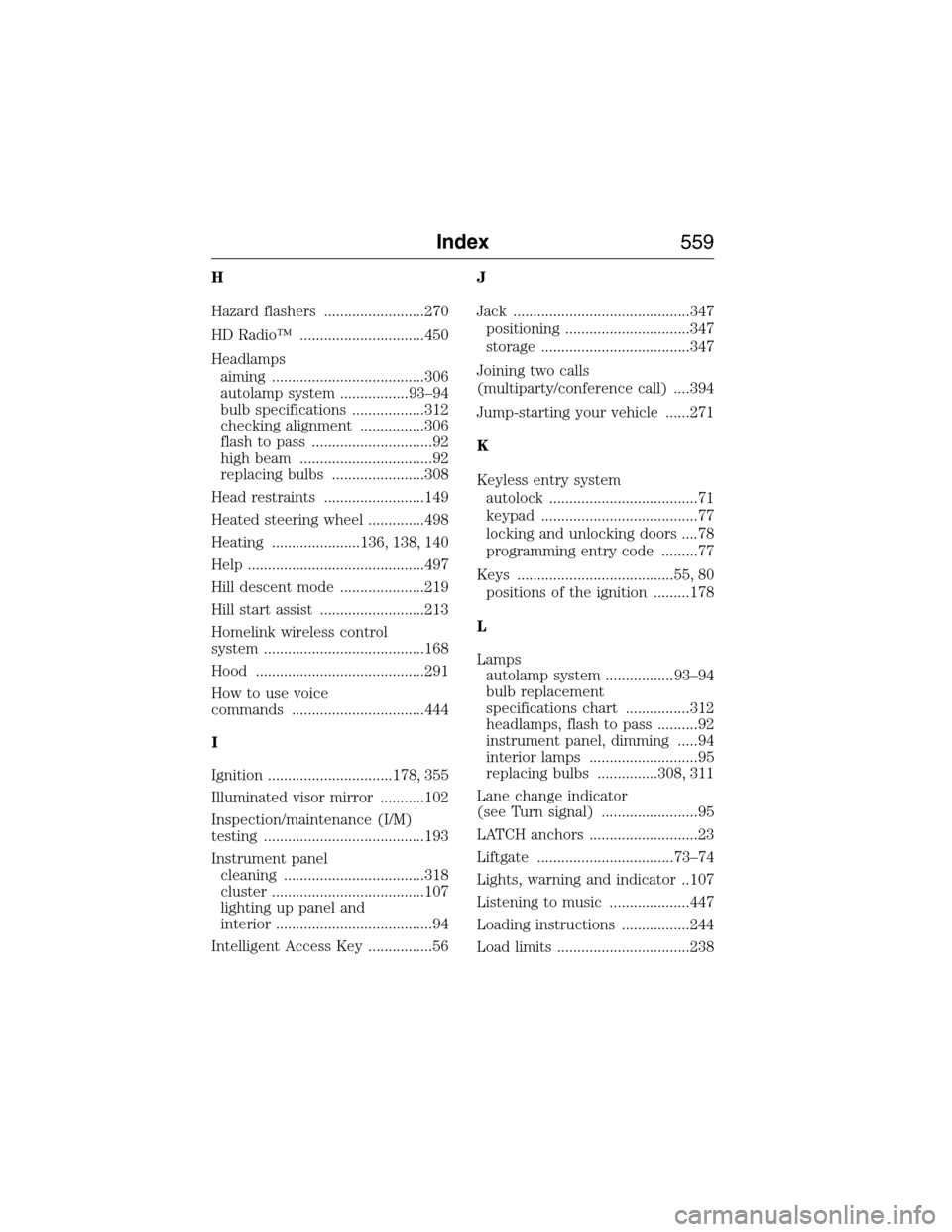
H
Hazard flashers .........................270
HD Radio™ ...............................450
Headlamps
aiming ......................................306
autolamp system .................93–94
bulb specifications ..................312
checking alignment ................306
flash to pass ..............................92
high beam .................................92
replacing bulbs .......................308
Head restraints .........................149
Heated steering wheel ..............498
Heating ......................136, 138, 140
Help ............................................497
Hill descent mode .....................219
Hill start assist ..........................213
Homelink wireless control
system ........................................168
Hood ..........................................291
How to use voice
commands .................................444
I
Ignition ...............................178, 355
Illuminated visor mirror ...........102
Inspection/maintenance (I/M)
testing ........................................193
Instrument panel
cleaning ...................................318
cluster ......................................107
lighting up panel and
interior .......................................94
Intelligent Access Key ................56J
Jack ............................................347
positioning ...............................347
storage .....................................347
Joining two calls
(multiparty/conference call) ....394
Jump-starting your vehicle ......271
K
Keyless entry system
autolock .....................................71
keypad .......................................77
locking and unlocking doors ....78
programming entry code .........77
Keys .......................................55, 80
positions of the ignition .........178
L
Lamps
autolamp system .................93–94
bulb replacement
specifications chart ................312
headlamps, flash to pass ..........92
instrument panel, dimming .....94
interior lamps ...........................95
replacing bulbs ...............308, 311
Lane change indicator
(see Turn signal) ........................95
LATCH anchors ...........................23
Liftgate ..................................73–74
Lights, warning and indicator ..107
Listening to music ....................447
Loading instructions .................244
Load limits .................................238
Index559
2015 Expedition(exd)
Owners Guide gf, 1st Printing, July 2014
USA(fus)
Page 564 of 564
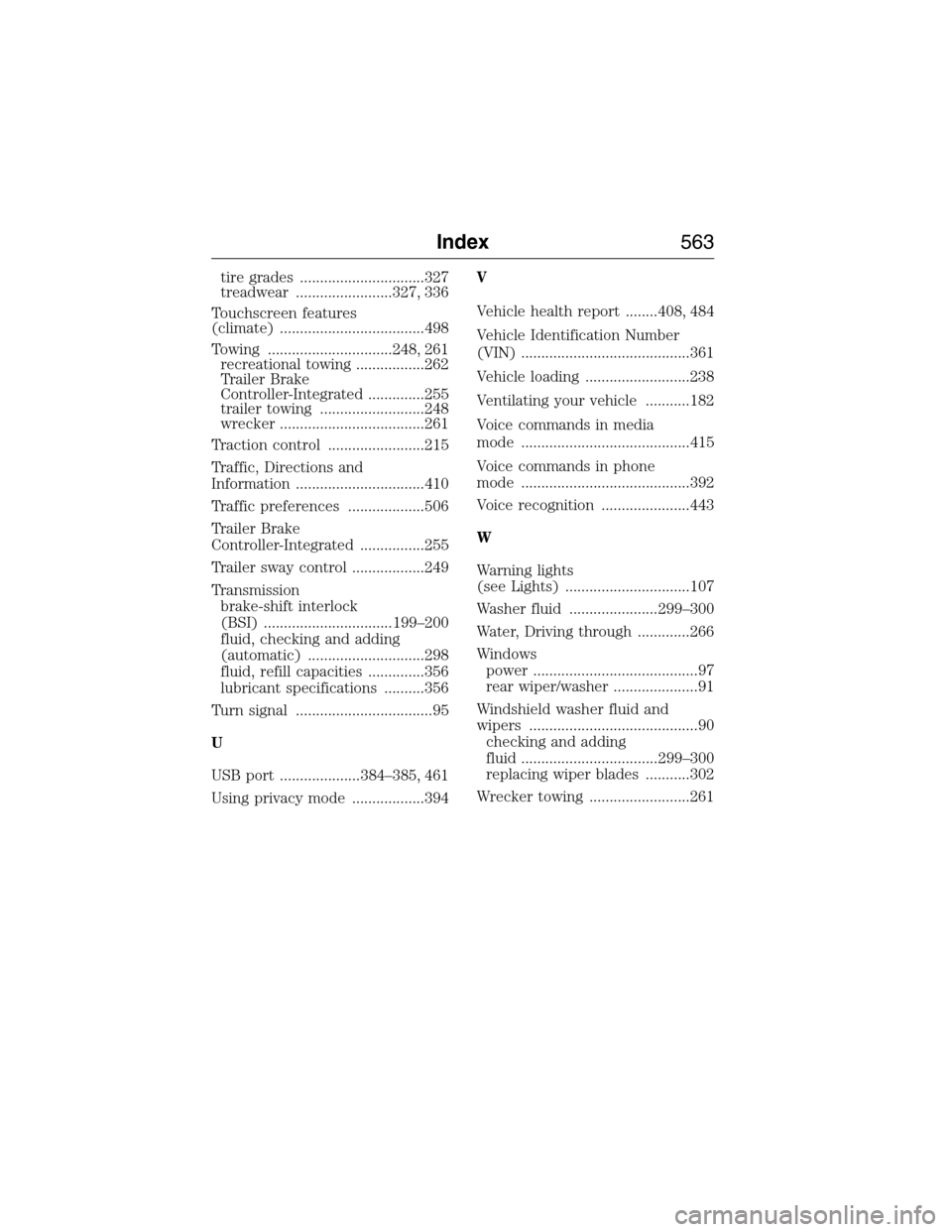
tire grades ...............................327
treadwear ........................327, 336
Touchscreen features
(climate) ....................................498
Towing ...............................248, 261
recreational towing .................262
Trailer Brake
Controller-Integrated ..............255
trailer towing ..........................248
wrecker ....................................261
Traction control ........................215
Traffic, Directions and
Information ................................410
Traffic preferences ...................506
Trailer Brake
Controller-Integrated ................255
Trailer sway control ..................249
Transmission
brake-shift interlock
(BSI) ................................199–200
fluid, checking and adding
(automatic) .............................298
fluid, refill capacities ..............356
lubricant specifications ..........356
Turn signal ..................................95
U
USB port ....................384–385, 461
Using privacy mode ..................394V
Vehicle health report ........408, 484
Vehicle Identification Number
(VIN) ..........................................361
Vehicle loading ..........................238
Ventilating your vehicle ...........182
Voice commands in media
mode ..........................................415
Voice commands in phone
mode ..........................................392
Voice recognition ......................443
W
Warning lights
(see Lights) ...............................107
Washer fluid ......................299–300
Water, Driving through .............266
Windows
power .........................................97
rear wiper/washer .....................91
Windshield washer fluid and
wipers ..........................................90
checking and adding
fluid ..................................299–300
replacing wiper blades ...........302
Wrecker towing .........................261
Index563
2015 Expedition(exd)
Owners Guide gf, 1st Printing, July 2014
USA(fus)