2015 FIAT 500X gearbox
[x] Cancel search: gearboxPage 140 of 240
WARNING
54)In the event of a puncture caused by
foreign bodies, the kit may be used to
repair tyres showing damage on the tread
or shoulder up to max. 4 mm diameter.
WARNING
3)Dispose of the bottle and the sealant
properly. Dispose of the components
in compliance with national and local
regulations.
EMERGENCY
STARTING
55)
If the battery is flat, a jump starting can
be performed using the battery and
the cables of another vehicle, or using
an auxiliary battery. In all cases, the
battery used must have a capacity
equal to or a little higher than the flat
one.IMPORTANTDo not use an auxiliary battery or any
other source of external supply with
a voltage above 12 V: the battery, the
starter, the alternator and the electrical
system of the vehicle could be
damaged.
Do not attempt jump starting if the
battery is frozen. The battery could
break and explode!JUMP STARTINGThe vehicle battery is located in the
engine compartment, behind the left
light cluster.
148) 149) 150) 151)
IMPORTANT The positive terminal (+) of
the battery is shielded by a protective
element. Raise it to access the terminal.Proceed as follows:
❒operate the parking brake, move the
lever to P (Park), for versions equipped
with automatic transmission, or neutral,
for versions with manual gearbox,
then set the ignition device to STOP;
❒switch off all the other electrical
appliances in the vehicle;
❒should you be using the battery of
another vehicle, park the other vehicle
within the range of the cables used
for the connection, operate the parking
brake and ensure that its ignition is
off.
IMPORTANT If the procedure below is
carried out incorrectly, it can cause
severe injury to people or damage the
recharging system of one or both
vehicles. Carefully follow the
instructions given below.
Cable connection
56)
Proceed as follows to carry out bump
starting fig. 129:
❒connect one end of the cable used
for positive (+) to the positive terminal
(+) of the vehicle with flat battery;
❒connect the other end of the cable
used for positive (+) to the positive
terminal (+) of the auxiliary battery;
138
IN AN EMERGENCY
15-12-2014 8:23 Pagina 138
Page 141 of 240

❒connect one end of the cable used
for negative (–) to the negative terminal
(–) of the auxiliary battery;
❒Connect the other end of the cable
used for negative (–) to an engine earth
(a visible metal part of the engine
or gearbox/transmission of the vehicle
with flat battery) away from the battery
and the fuel injection system;
❒start the vehicle engine with the
auxiliary battery, let it run for a
few minutes at idling. Start the engine
of the vehicle with flat battery.
Cable disconnection.Once the engine is started, remove the
leads, reversing the order above.
If after a few attempts the engine does
not start, do not persist but contact
a Fiat Dealership.If it is often necessary to perform an
emergency starting, have the vehicle
battery and the recharging system
checked by a Fiat Dealership.
IMPORTANT Any accessories (e.g.
mobile phones, etc.) connected to the
vehicle power sockets, draw current
even if they are not used. These
devices, if left connected too much time
with engine off, may cause the battery
to drain with following reduction of
its life and/or failure to start the engine.
WARNING
148)Before opening the bonnet, make
sure that the engine is off and that the
ignition key is in the STOP position. Follow
the indications on the plate underneath
the bonnet. We recommend that you
remove the key from the ignition if other
people remain in the vehicle. The vehicle
should always be left after the key has
been removed or turned to the STOP
position. During refuelling, make sure that
the engine is off (and that the ignition key is
in the STOP position).
149)Do not get too close to the radiator
cooling fan: the electric fan may start;
danger of injury. Scarves, ties and other
loose clothing may be pulled by moving
parts.150)Remove any metal objects (e.g. rings,
watches, bracelets), that might cause an
accidental electrical contact and cause
serious injury.
151)Batteries contain acid which may burn
skin and eyes. Batteries produce
hydrogen, which is easily flammable and
explosive. Therefore, keep away flames or
devices which may cause sparks.
WARNING
55)Never use a fast battery-charger to
start the engine as this could damage the
electronic systems of your vehicle,
particularly the ignition and fuel supply
control units.
56)Do not connect the cable to the
negative terminal (–) of the flat battery. The
following spark could lead to battery
explosion and cause serious harm. Only
use the specific earth point; do not use any
other exposed metallic part.
129
F1B0217C
139
15-12-2014 8:23 Pagina 139
Page 144 of 240
WARNING
57)It is advisable to contact a Fiat
Dealership to have the refitting procedure
carried out. If you would like to proceed
autonomously, special attention must
be paid to the correct coupling of
the retaining clips. Otherwise, noise might
be heard due to an incorrect fastening
of the lower cover with the upper cover.
TOWING THE
VEHICLEATTACHING THE TOW
HOOK
153) 154) 155)
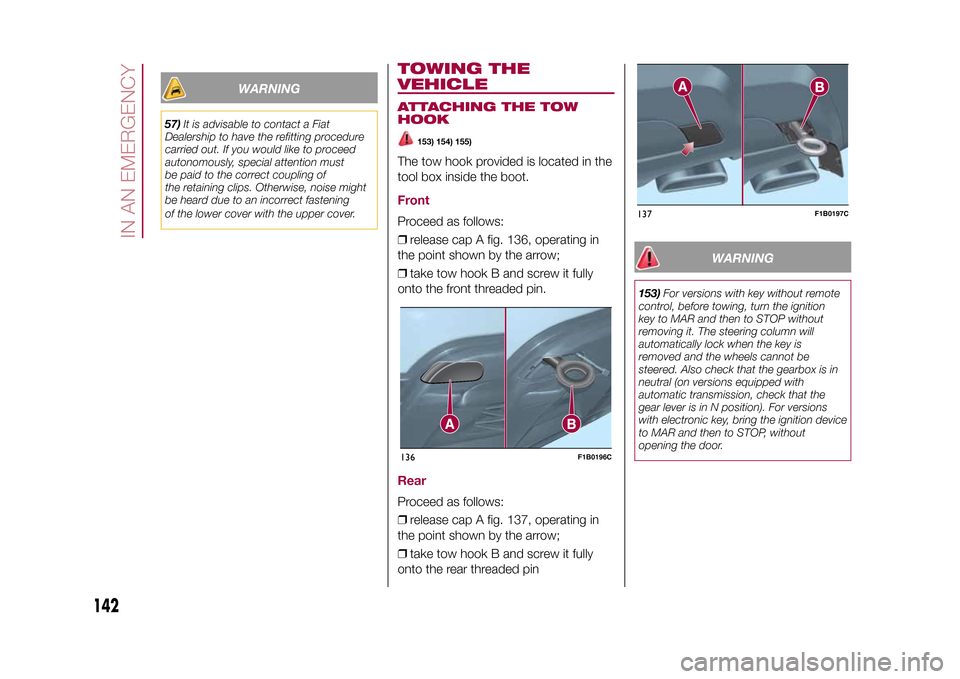
The tow hook provided is located in the
tool box inside the boot.FrontProceed as follows:
❒release cap A fig. 136, operating in
the point shown by the arrow;
❒take tow hook B and screw it fully
onto the front threaded pin.RearProceed as follows:
❒release cap A fig. 137, operating in
the point shown by the arrow;
❒take tow hook B and screw it fully
onto the rear threaded pin
WARNING
153)For versions with key without remote
control, before towing, turn the ignition
key to MAR and then to STOP without
removing it. The steering column will
automatically lock when the key is
removed and the wheels cannot be
steered. Also check that the gearbox is in
neutral (on versions equipped with
automatic transmission, check that the
gear lever is in N position). For versions
with electronic key, bring the ignition device
to MAR and then to STOP, without
opening the door.
136
F1B0196C
137
F1B0197C
142
IN AN EMERGENCY
15-12-2014 8:23 Pagina 142
Page 157 of 240

PERIODIC CHECKSEvery1,000km or before long trips
check and, if necessary, top up:
❒engine coolant level;
❒brake fluid level;
❒windscreen washer fluid level;
❒tyre inflation pressure and condition;
❒operation of lighting system
(headlights, direction indicators, hazard
warning lights, etc.);
❒operation of screen washer/wiper
system and positioning/wear of
windscreen/rear window wiper blades.
Every3,000km, check and top up if
required: engine oil level.HEAVY-DUTY USE OF THE
VEHICLEIf the vehicle is used mainly under one
of the following conditions:
❒towing a trailer or motorhome;
❒dusty roads;
❒short, repeated journeys (less than
7-8 km) at sub-zero outside
temperatures;
❒engine often idling or driving long
distances at low speeds or long periods
of inactivity;
the following checks must be carried
out more often than indicated in the
Scheduled Servicing Plan:❒check front disc brake pad condition
and wear;
❒check cleanliness of bonnet and boot
locks, cleanliness and lubrication of
linkage;
❒visually inspect conditions of: engine,
gearbox, transmission, pipes and
hoses (exhaust/fuel system/brakes) and
rubber elements (boots/sleeves/
bushes, etc.);
❒check battery charge and battery
fluid level (electrolyte);
❒visually inspect conditions of the
accessory drive belts;
❒check and, if necessary, change
engine oil and replace oil filter;
❒check and, if necessary, replace
pollen filter;
❒check and, if necessary, replace air
cleaner.
On versions equipped with automatic
transmission AT9, change the
transmission oil and replace filters after
90,000 km (or 2 years) if the vehicle
is used in the following conditions: city
driving, short and repeated journeys
(less than 7-8 km) or frequent towing of
trailers or caravans.
155
15-12-2014 8:23 Pagina 155
Page 167 of 240

WINDSCREEN/REAR
WINDOW WIPERReplacing the windscreen wiper
bladesProceed as follows:
❒raise the wiper arm, press button A
fig. 143 of the attachment spring and
remove the blade from the arm;
❒fit the new blade, inserting the tab in
the dedicated housing in the arm and
checking that it is locked;
❒lower the wiper arm on the
windscreen.
IMPORTANT Do not operate the
windscreen wiper with the blades lifted
from the windscreen.
Replacing the rear window wiper
bladeProceed as follows:
❒widen the two tabs as shown by the
arrows and rotate cover A fig. 144
outwards;
❒undo nut B and remove arm C from
the central pin;
❒correctly align the new arm;
❒fully tighten nut B and then refit cover
A.
IMPORTANT Do not operate the rear
window wiper with the blade lifted from
the rear window.Windscreen washerThe window washer nozzles are fixed. If
there is no jet of fluid, firstly check that
there is fluid in the reservoir (see
paragraph “Engine compartment” in
this chapter). Only use the prescribed
fluid; do not use only water.Then check that the nozzle holes are
not clogged; use a needle to unblock
them if necessary.
IMPORTANT In versions with sun roof,
make sure that the roof is closed before
operating the windscreen washer
nozzles.
Rear window washerThe rear window washer nozzle is fixed.
The jet nozzle is located at the side of
the third brake light.EXHAUST SYSTEM
168) 169)71)
Adequate maintenance of the engine
exhaust system represents the best
protection against leaks of carbon
monoxide into the passenger
compartment.AUTOMATIC
TRANSMISSION
72)
Use only a gearbox fluid with the same
characteristics as those indicated in
the "Fluids and lubricants" table (see
"Technical specifications" chapter).
143
F1B0302C
144
F1B0303C
165
15-12-2014 8:23 Pagina 165
Page 168 of 240

WARNING
167)The air intake system (air cleaner,
rubber hoses, etc.) can be a protection in
the case of blowbacks from the engine.
DO NOT REMOVE this system unless you
need to carry out repair or servicing
operations. Before starting the engine
make sure the system is not dismantled:
failure to comply with this precaution
may cause serious injuries.
168)Exhaust emissions are very
dangerous and may be fatal. They contain
carbon monoxide, a colourless and
odourless gas which, if inhaled, may cause
fainting and poisoning.
169)The exhaust system can reach high
temperatures and cause a fire if the vehicle
is parked on flammable material. Dry grass
or leaves can also catch fire if they come
into contact with the exhaust system.
Do not park or use the vehicle in a place in
which the exhaust system might come
into contact with flammable material.
WARNING
65)It is recommended to have the vehicle
serviced by a Fiat Dealership. When
carrying out normal periodic operations
and small servicing interventions personally
on the vehicle, it is recommended to use
suitable equipment, genuine spare parts
and the necessary fluids. Do not carry out
any interventions if you don't have the
necessary experience.66)Incorrect maintenance of the vehicle or
failure to carry out operations or repairs
(when necessary) may lead to more
expensive repairs, damage to other
components or have a negative impact on
the vehicle performance. Have any
operating faults immediately checked by a
Fiat Dealership.
67)The vehicle is equipped with fluids
optimised for protecting its performance
and duration, and to extend servicing
intervals. Do not use chemicals for washing
these components since they may
damage the engine, the gearbox or the
climate control system. This damage is not
covered by the vehicle’s warranty. If, due
to malfunction of a component, washing is
needed, only use the fluid specific for
that procedure.
68)An excessive or insufficient amount of
oil in the block is extremely harmful for
the engine. Make sure it is always at an
adequate level.
69)Always require the use of only
compressor coolants and lubricants
approved and suitable for the specific air
conditioning system fitted on the vehicle.
Some non-approved coolants are
flammable and may explode, with the risk
of injuries. The use of non-approved
coolants or lubricants may adversely affect
system efficiency, leading to expensive
repairs.
70)The air conditioning system contains
high-pressure coolant: to prevent damage
to people or the system, any topping up
with fuel or repairs that involves
disconnection of the pipes must be carried
out by a Fiat Dealership.71)Vehicles equipped with a catalytic
converter must be exclusively supplied with
unleaded petrol. Leaded petrol would
permanently damage the catalytic
converter and eliminate its ability to reduce
polluting emissions, seriously
compromising the engine performance,
which would be irreparably damaged. If the
engine does not work correctly, especially
if it starts irregularly or if there is a reduction
of its performance, immediately go to a
Fiat Dealership. Prolonged and faulty
operation of the engine may cause
overheating of the catalytic converter and,
as a consequence, possible damage to
it and the vehicle.
72)Using a gearbox fluid different from the
prescribed one may compromise
gearshifting quality and/or cause
anomalous vibration of the gearbox.
166
SERVICING AND MAINTENANCE
15-12-2014 8:23 Pagina 166
Page 177 of 240

Versions 1.6 MultiJet 2.0 MultiJet manual gearbox2.0 MultiJet AT9 automatic
transmission
Type code 55260384 55263087 55263088
Cycle Diesel Diesel Diesel
Number and position of cylinders 4 in line 4 in line 4 in line
Piston bore and stroke (mm) 79.5 x 80.5 83 x 90.4 83 x 90.4
Total displacement (cm³) 1598 1956 1956
Compression ratio 16.5 ± 0.4 16.5 ± 0.4 16.5 ± 0.4
Maximum power (EEC) (kW)
88 / 84,4
(*)
103 / 100
(*)
103 / 100
(*)
Maximum power (EEC) (HP)
120 / 115
(*)
140 / 136
(*)
140 / 136
(*)
corresponding engine speed
(rpm)3750 4000 3750
Maximum torque (EEC) (Nm) 320 350 350
corresponding engine speed
(rpm)1750 1750 1500
FuelDiesel for motor vehicles (EN 590
Specification)Diesel for motor vehicles (EN 590
Specification)Diesel for motor vehicles (EN 590
Specification)(*) Version for specific markets
WARNING
178)Modifications or repairs to the supply system that are not carried out correctly or do not take the system technical specifications into
account can cause malfunctions leading to the risk of fire.
175
15-12-2014 8:23 Pagina 175
Page 183 of 240
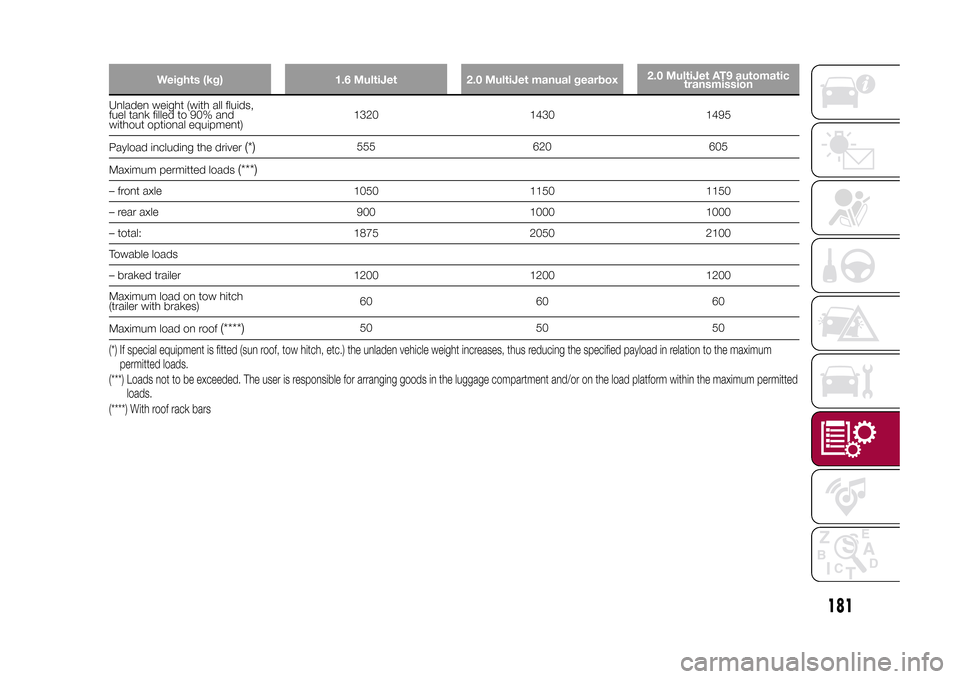
Weights (kg) 1.6 MultiJet 2.0 MultiJet manual gearbox2.0 MultiJet AT9 automatic
transmission
Unladen weight (with all fluids,
fuel tank filled to 90% and
without optional equipment)1320 1430 1495
Payload including the driver
(*)
555 620 605
Maximum permitted loads
(***)
– front axle 1050 1150 1150
– rear axle 900 1000 1000
– total: 1875 2050 2100
Towable loads
– braked trailer 1200 1200 1200
Maximum load on tow hitch
(trailer with brakes)60 60 60
Maximum load on roof
(****)
50 50 50
(*) If special equipment is fitted (sun roof, tow hitch, etc.) the unladen vehicle weight increases, thus reducing the specified payload in relation to the maximum
permitted loads.
(***) Loads not to be exceeded. The user is responsible for arranging goods in the luggage compartment and/or on the load platform within the maximum permitted
loads.
(****) With roof rack bars
181
15-12-2014 8:23 Pagina 181