Page 308 of 367
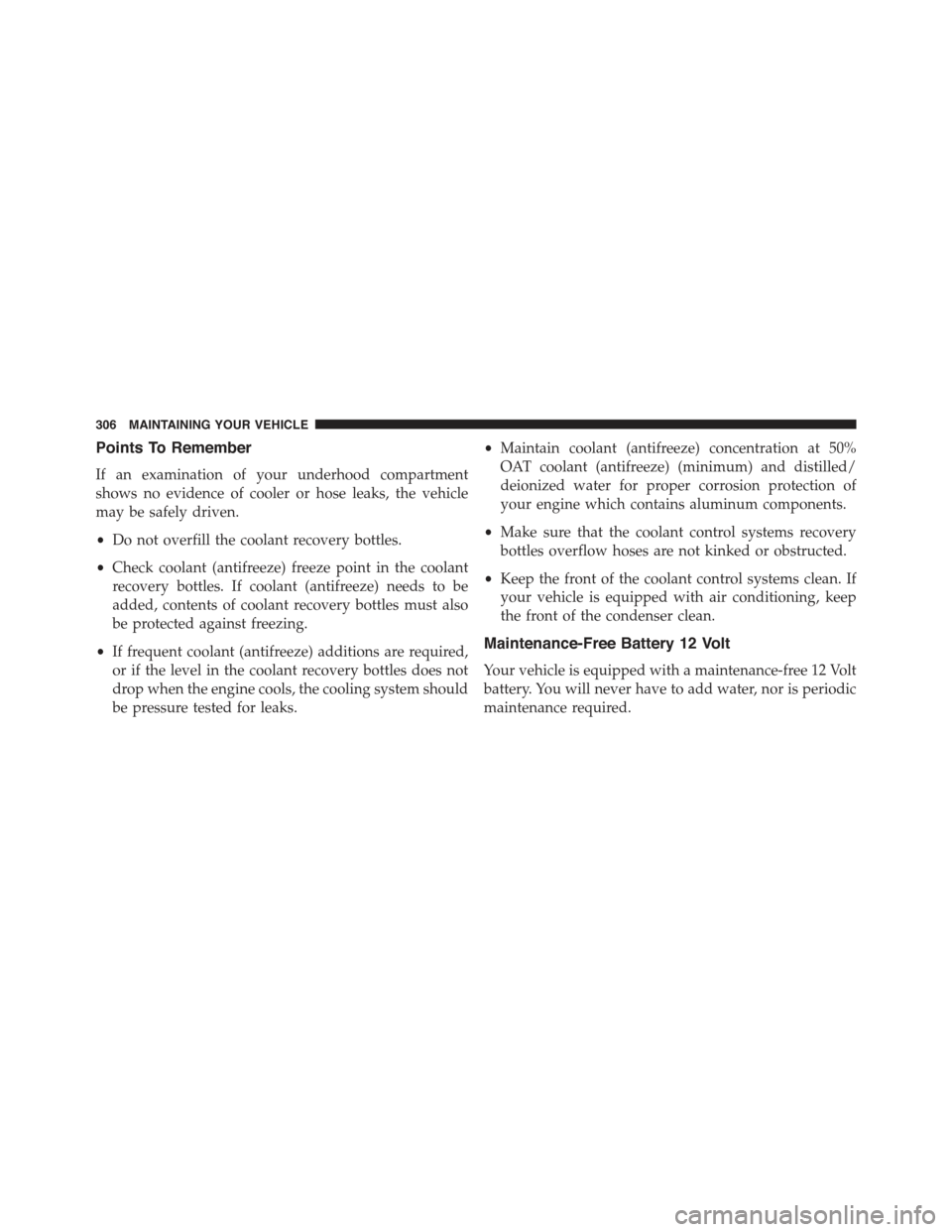
Points To Remember
If an examination of your underhood compartment
shows no evidence of cooler or hose leaks, the vehicle
may be safely driven.
•Do not overfill the coolant recovery bottles.
•Check coolant (antifreeze) freeze point in the coolant
recovery bottles. If coolant (antifreeze) needs to be
added, contents of coolant recovery bottles must also
be protected against freezing.
•If frequent coolant (antifreeze) additions are required,
or if the level in the coolant recovery bottles does not
drop when the engine cools, the cooling system should
be pressure tested for leaks.
•Maintain coolant (antifreeze) concentration at 50%
OAT coolant (antifreeze) (minimum) and distilled/
deionized water for proper corrosion protection of
your engine which contains aluminum components.
•Make sure that the coolant control systems recovery
bottles overflow hoses are not kinked or obstructed.
•Keep the front of the coolant control systems clean. If
your vehicle is equipped with air conditioning, keep
the front of the condenser clean.
Maintenance-Free Battery 12 Volt
Your vehicle is equipped with a maintenance-free 12 Volt
battery. You will never have to add water, nor is periodic
maintenance required.
306 MAINTAINING YOUR VEHICLE
Page 335 of 367
5. Remove the backup lamp bulb by pulling straight out.
6. Replace lamps as required and reinstall lamp.
Center High Mounted Stop Lamp (CHMSL)
1. Remove the two guard caps and the two fastening
screws.
2. Remove the center high mounted stop lamp assembly.
3. Disconnect the electric connector.
4. Remove the two screws.
5. Replace the CHMSL assembly.
6. Reinstall the two screws.
FLUID CAPACITIES
SystemsU.S.Metric
Power Electronics Cooling System3.6 Quarts3.5 Liters
Battery Thermal Management Cooling System7.0 Quarts6.7 Liters
Single-Speed Transmission0.8 Quart750 ml
7
MAINTAINING YOUR VEHICLE 333
Page 337 of 367
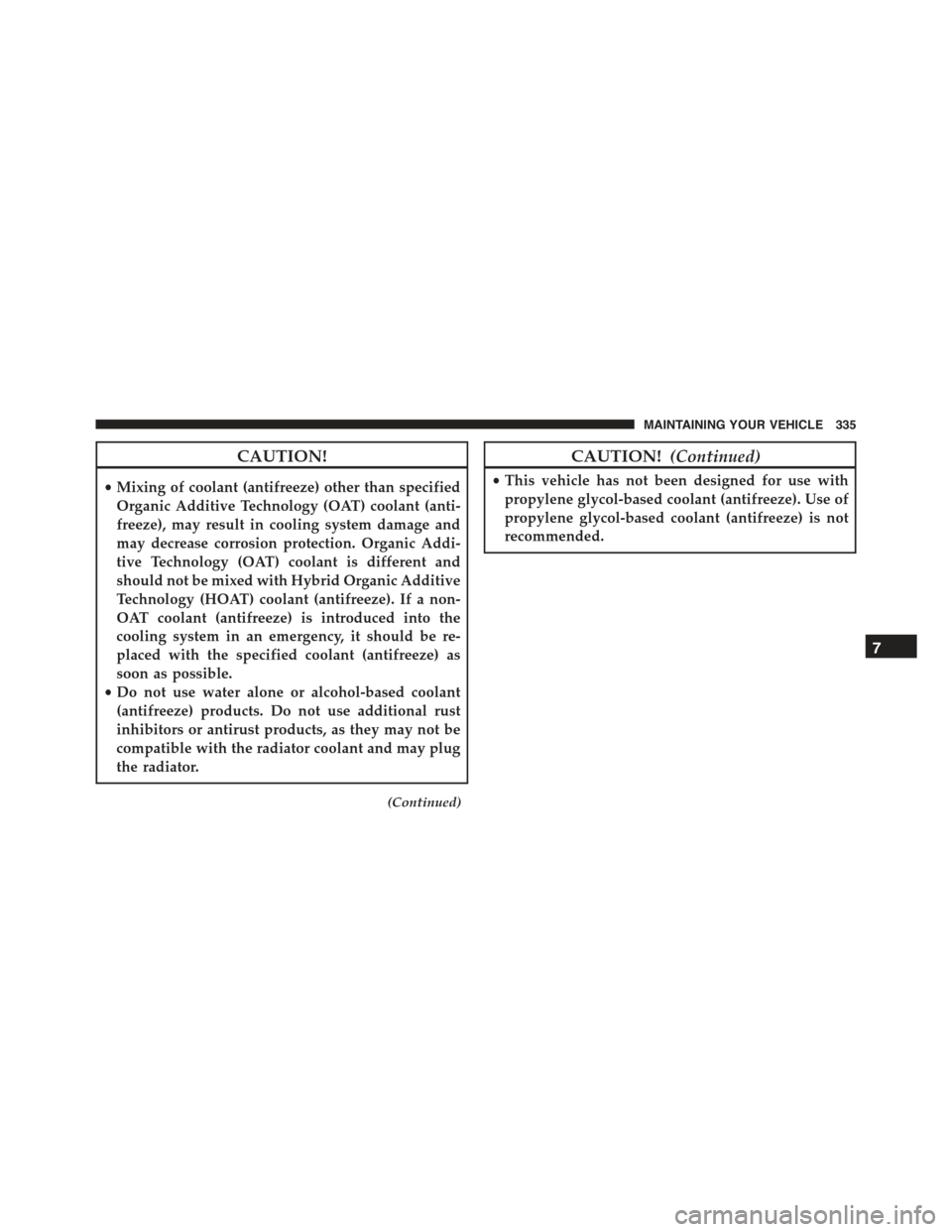
CAUTION!
•Mixing of coolant (antifreeze) other than specified
Organic Additive Technology (OAT) coolant (anti-
freeze), may result in cooling system damage and
may decrease corrosion protection. Organic Addi-
tive Technology (OAT) coolant is different and
should not be mixed with Hybrid Organic Additive
Technology (HOAT) coolant (antifreeze). If a non-
OAT coolant (antifreeze) is introduced into the
cooling system in an emergency, it should be re-
placed with the specified coolant (antifreeze) as
soon as possible.
•Do not use water alone or alcohol-based coolant
(antifreeze) products. Do not use additional rust
inhibitors or antirust products, as they may not be
compatible with the radiator coolant and may plug
the radiator.
(Continued)
CAUTION!(Continued)
•This vehicle has not been designed for use with
propylene glycol-based coolant (antifreeze). Use of
propylene glycol-based coolant (antifreeze) is not
recommended.
7
MAINTAINING YOUR VEHICLE 335
Page 340 of 367
MAINTENANCE SCHEDULE
Once A Month Or Before A Trip:
•Check windshield washer fluid level
•Check the tire inflation pressures and look for unusual
wear or damage
•Check the fluid levels of the coolant reservoirs and
brake master cylinder
•Check function of all interior and exterior lights
Required Maintenance Intervals
Refer to the maintenance schedules on the following
page for the required maintenance intervals.
At Every Service Interval:
•Rotate the tires.Rotate at the first sign of irregu-
lar wear.
•Inspect brake pads, shoes, rotors, drums, and
hoses.
•Inspect battery cooling system protection and
hoses.
•Check and adjust hand brake.
338 MAINTENANCE SCHEDULES
Page 358 of 367

Universal Consumer Interface (UCI)..........199
Contract, Service..........................347
Cooling System
Coolant Capacity.......................333
Selection of Coolant (Antifreeze).............334
Corrosion Protection.......................314
Cupholders.............................148
Customer Assistance.......................345
Data Recorder, Event.......................75
Daytime Running Lights....................124
Dealer Service............................298
Defroster, Windshield.......................96
Door Locks..............................40
Door Locks, Automatic......................43
Driving
Through Flowing, Rising, or Shallow
Standing Water.........................223
Electrical Power Outlets.....................145
Electric Remote Mirrors.....................104
Electronic Brake Control System
Brake Assist System.....................230
Electronic Speed Control (Cruise Control)........132
Electronic Stability Control (ESC)..............231
Electronic Vehicle Information Center (EVIC)......166
Emergency, In Case of
Hazard Warning Flasher..................274
Towing..............................293
Engine
Compartment..........................297
Starting..............................214
Enhanced Accident Response Feature............69
Event Data Recorder........................75
Exterior Lights............................98
Flashers
Turn Signal............................98
356 INDEX