Page 307 of 367
Please note that it is the owner ’s responsibility to main-
tain the proper level of protection against freezing ac-
cording to the temperatures occurring in the area where
the vehicle is operated.
NOTE:Mixing coolant (antifreeze) types will decrease
the life of the Power Electronics and Battery Thermal
Management Systems coolant (antifreeze) and will re-
quire more frequent coolant (antifreeze) changes.
Power Electronics and Battery Thermal
Management Systems — Drain, Flush And Refill
Refer to “Maintenance Schedules” in Section 7 of this
supplement for the proper maintenance intervals.
If the coolant (antifreeze) is dirty or contains a consider-
able amount of sediment, clean and flush with a reliable
cooling system cleaner. Follow with a thorough rinsing to
remove all deposits and chemicals. Properly dispose of
old coolant (antifreeze) solution.
CAUTION!
It is recommended to have the cooling systems ser-
viced at your authorized dealer. Failure to do so could
result in poor cooling system performance and/or
vehicle damage.
Disposal Of Used Power Electronics and Battery
Thermal Management Systems Coolant
Used antifreeze is a regulated substance requiring proper
disposal. Check with your local authorities to determine
the disposal rules for your community. To prevent inges-
tion by animals or children, do not store antifreeze in
open containers or allow it to remain in puddles on the
ground. If ingested by a child, contact a physician
immediately. Clean up any ground spills immediately.
7
MAINTAINING YOUR VEHICLE 305
Page 308 of 367
Points To Remember
If an examination of your underhood compartment
shows no evidence of cooler or hose leaks, the vehicle
may be safely driven.
•Do not overfill the coolant recovery bottles.
•Check coolant (antifreeze) freeze point in the coolant
recovery bottles. If coolant (antifreeze) needs to be
added, contents of coolant recovery bottles must also
be protected against freezing.
•If frequent coolant (antifreeze) additions are required,
or if the level in the coolant recovery bottles does not
drop when the engine cools, the cooling system should
be pressure tested for leaks.
•Maintain coolant (antifreeze) concentration at 50%
OAT coolant (antifreeze) (minimum) and distilled/
deionized water for proper corrosion protection of
your engine which contains aluminum components.
•Make sure that the coolant control systems recovery
bottles overflow hoses are not kinked or obstructed.
•Keep the front of the coolant control systems clean. If
your vehicle is equipped with air conditioning, keep
the front of the condenser clean.
Maintenance-Free Battery 12 Volt
Your vehicle is equipped with a maintenance-free 12 Volt
battery. You will never have to add water, nor is periodic
maintenance required.
306 MAINTAINING YOUR VEHICLE
Page 313 of 367
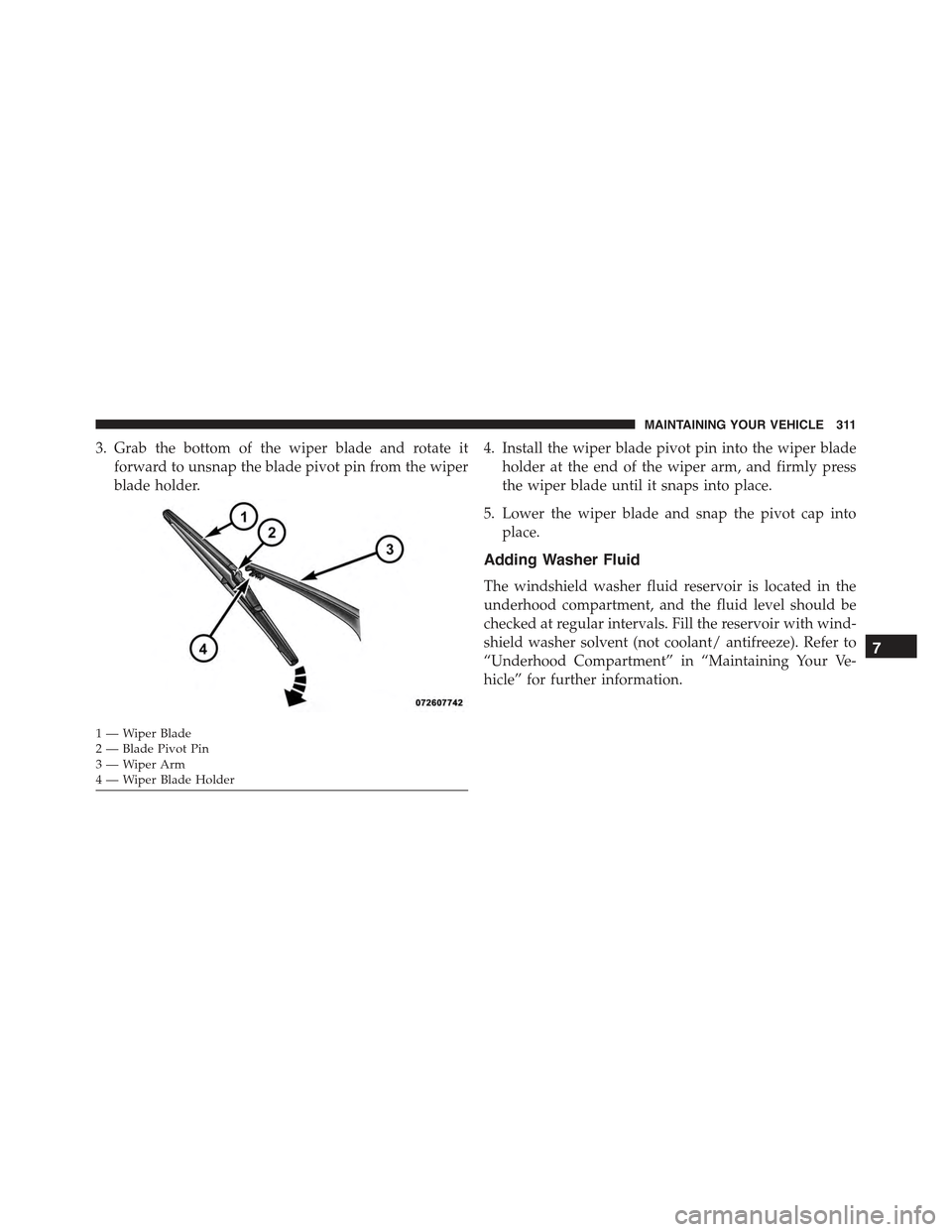
3. Grab the bottom of the wiper blade and rotate it
forward to unsnap the blade pivot pin from the wiper
blade holder.
4. Install the wiper blade pivot pin into the wiper blade
holder at the end of the wiper arm, and firmly press
the wiper blade until it snaps into place.
5. Lower the wiper blade and snap the pivot cap into
place.
Adding Washer Fluid
The windshield washer fluid reservoir is located in the
underhood compartment, and the fluid level should be
checked at regular intervals. Fill the reservoir with wind-
shield washer solvent (not coolant/ antifreeze). Refer to
“Underhood Compartment” in “Maintaining Your Ve-
hicle” for further information.
1—WiperBlade2—BladePivotPin3—WiperArm4—WiperBladeHolder
7
MAINTAINING YOUR VEHICLE 311
Page 330 of 367
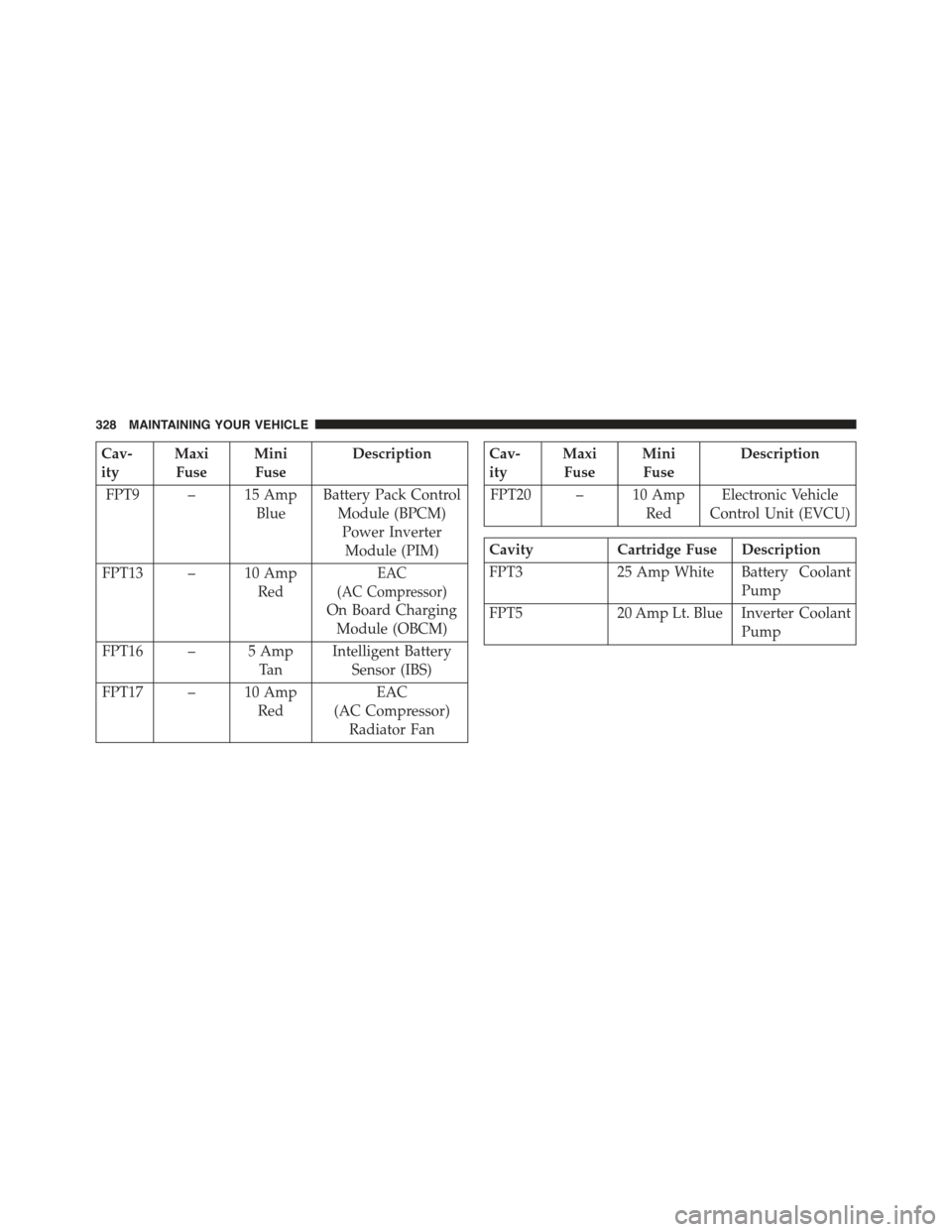
Cav-
ity
Maxi
Fuse
Mini
Fuse
Description
FPT9 – 15 Amp
Blue
Battery Pack Control
Module (BPCM)
Power Inverter
Module (PIM)
FPT13 – 10 Amp
Red
EAC
(AC Compressor)
On Board Charging
Module (OBCM)
FPT16 – 5 Amp
Ta n
Intelligent Battery
Sensor (IBS)
FPT17 – 10 Amp
Red
EAC
(AC Compressor)
Radiator Fan
Cav-
ity
Maxi
Fuse
Mini
Fuse
Description
FPT20 – 10 Amp
Red
Electronic Vehicle
Control Unit (EVCU)
CavityCartridge Fuse Description
FPT325 Amp White Battery Coolant
Pump
FPT520 Amp Lt. Blue Inverter Coolant
Pump
328 MAINTAINING YOUR VEHICLE
Page 336 of 367
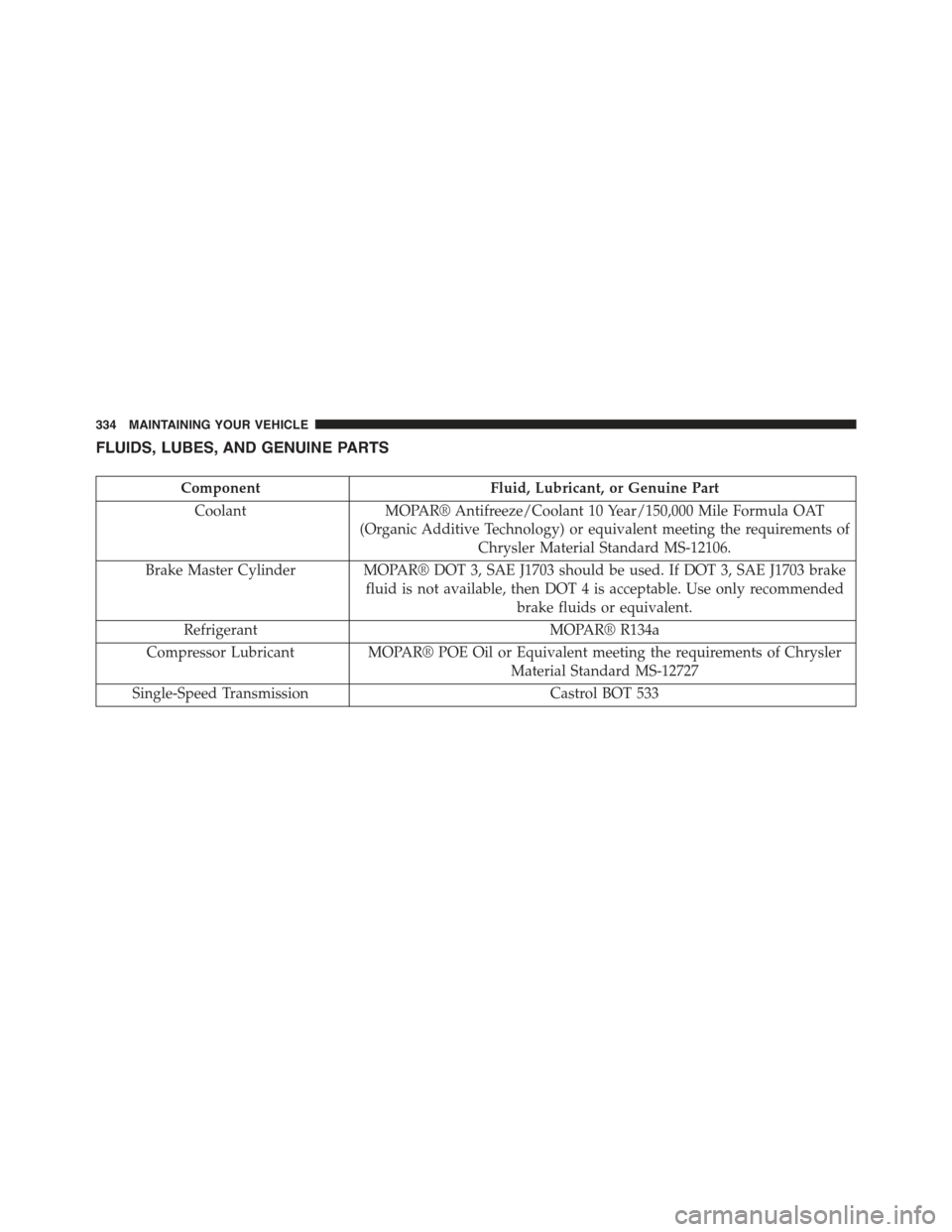
FLUIDS, LUBES, AND GENUINE PARTS
ComponentFluid, Lubricant, or Genuine Part
CoolantMOPAR® Antifreeze/Coolant 10 Year/150,000 Mile Formula OAT
(Organic Additive Technology) or equivalent meeting the requirements of
Chrysler Material Standard MS-12106.
Brake Master Cylinder MOPAR® DOT 3, SAE J1703 should be used. If DOT 3, SAE J1703 brake
fluid is not available, then DOT 4 is acceptable. Use only recommended
brake fluids or equivalent.
RefrigerantMOPAR® R134a
Compressor Lubricant MOPAR® POE Oil or Equivalent meeting the requirements of Chrysler
Material Standard MS-12727
Single-Speed TransmissionCastrol BOT 533
334 MAINTAINING YOUR VEHICLE
Page 337 of 367
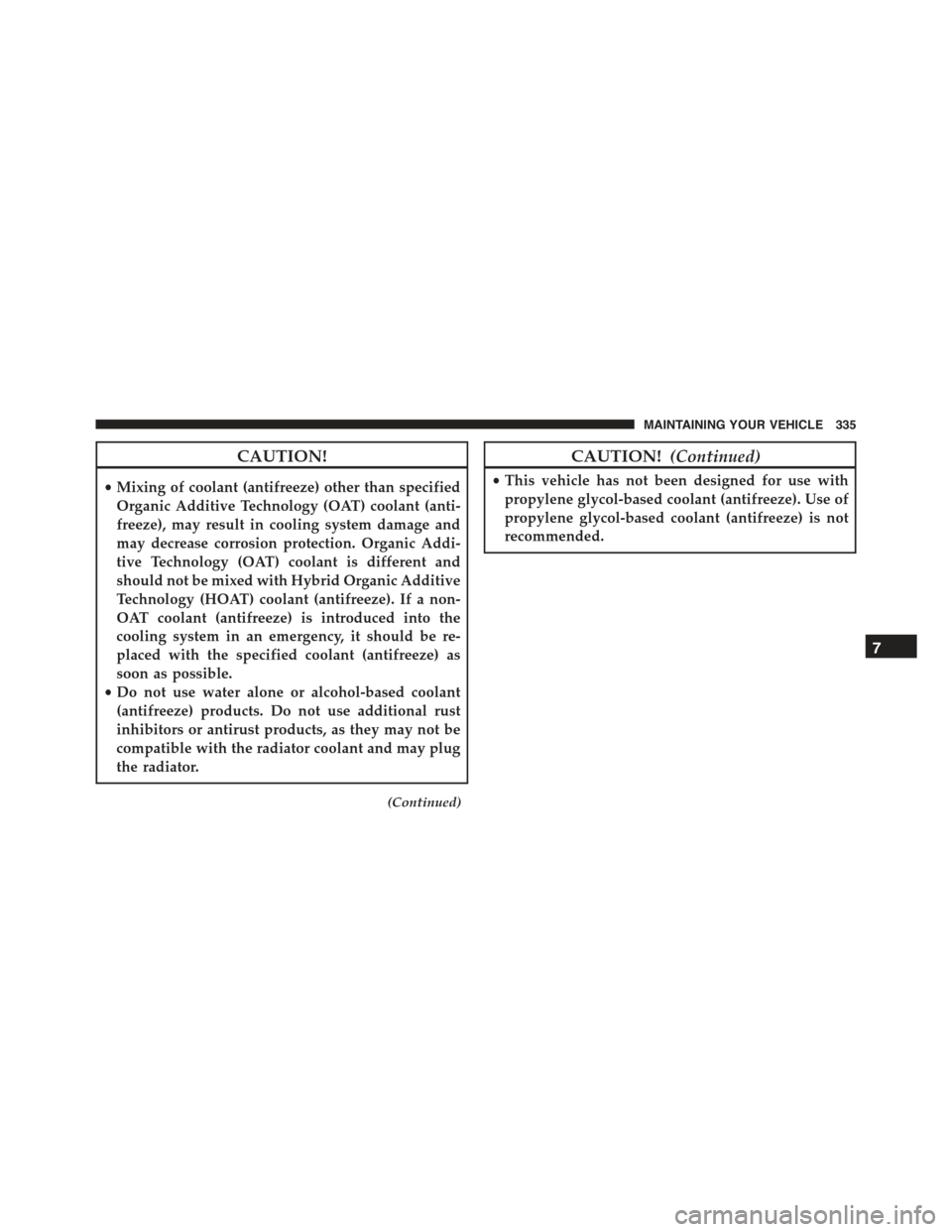
CAUTION!
•Mixing of coolant (antifreeze) other than specified
Organic Additive Technology (OAT) coolant (anti-
freeze), may result in cooling system damage and
may decrease corrosion protection. Organic Addi-
tive Technology (OAT) coolant is different and
should not be mixed with Hybrid Organic Additive
Technology (HOAT) coolant (antifreeze). If a non-
OAT coolant (antifreeze) is introduced into the
cooling system in an emergency, it should be re-
placed with the specified coolant (antifreeze) as
soon as possible.
•Do not use water alone or alcohol-based coolant
(antifreeze) products. Do not use additional rust
inhibitors or antirust products, as they may not be
compatible with the radiator coolant and may plug
the radiator.
(Continued)
CAUTION!(Continued)
•This vehicle has not been designed for use with
propylene glycol-based coolant (antifreeze). Use of
propylene glycol-based coolant (antifreeze) is not
recommended.
7
MAINTAINING YOUR VEHICLE 335
Page 340 of 367
MAINTENANCE SCHEDULE
Once A Month Or Before A Trip:
•Check windshield washer fluid level
•Check the tire inflation pressures and look for unusual
wear or damage
•Check the fluid levels of the coolant reservoirs and
brake master cylinder
•Check function of all interior and exterior lights
Required Maintenance Intervals
Refer to the maintenance schedules on the following
page for the required maintenance intervals.
At Every Service Interval:
•Rotate the tires.Rotate at the first sign of irregu-
lar wear.
•Inspect brake pads, shoes, rotors, drums, and
hoses.
•Inspect battery cooling system protection and
hoses.
•Check and adjust hand brake.
338 MAINTENANCE SCHEDULES
Page 358 of 367

Universal Consumer Interface (UCI)..........199
Contract, Service..........................347
Cooling System
Coolant Capacity.......................333
Selection of Coolant (Antifreeze).............334
Corrosion Protection.......................314
Cupholders.............................148
Customer Assistance.......................345
Data Recorder, Event.......................75
Daytime Running Lights....................124
Dealer Service............................298
Defroster, Windshield.......................96
Door Locks..............................40
Door Locks, Automatic......................43
Driving
Through Flowing, Rising, or Shallow
Standing Water.........................223
Electrical Power Outlets.....................145
Electric Remote Mirrors.....................104
Electronic Brake Control System
Brake Assist System.....................230
Electronic Speed Control (Cruise Control)........132
Electronic Stability Control (ESC)..............231
Electronic Vehicle Information Center (EVIC)......166
Emergency, In Case of
Hazard Warning Flasher..................274
Towing..............................293
Engine
Compartment..........................297
Starting..............................214
Enhanced Accident Response Feature............69
Event Data Recorder........................75
Exterior Lights............................98
Flashers
Turn Signal............................98
356 INDEX