2015 FIAT 500 ABARTH ESP
[x] Cancel search: ESPPage 373 of 426
Special Care
•If you drive on salted or dusty roads or if you drive
near the ocean, hose off the undercarriage at least once
a month.
•It is important that the drain holes in the lower edges
of the doors, rocker panels, and trunk be kept clear and
open.
•If you detect any stone chips or scratches in the paint,
touch them up immediately. The cost of such repairs is
considered the responsibility of the owner.
•If your vehicle is damaged due to a collision or similar
cause that destroys the paint and protective coating,
have your vehicle repaired as soon as possible. The
cost of such repairs is considered the responsibility of
the owner.
•If you carry special cargo such as chemicals, fertilizers,
de-icer salt, etc., be sure that such materials are well
packaged and sealed.
•If a lot of driving is done on gravel roads, consider
mud or stone shields behind each wheel.
•Use MOPAR® Touch Up Paint on scratches as soon as
possible. Your authorized dealer has touch up paint to
match the color of your vehicle.
Wheel And Wheel Trim Care
•All wheels and wheel trim, especially aluminum and
chrome plated wheels, should be cleaned regularly
with a mild soap and water to prevent corrosion.
•To remove heavy soil and/or excessive brake dust, use
MOPAR® Wheel Cleaner.
7
MAINTAINING YOUR VEHICLE 371
Page 375 of 426
Interior Care
Use MOPAR® Total Clean to clean fabric upholstery and
carpeting.
Use MOPAR® Total Clean to clean vinyl upholstery.
MOPAR® Total Clean is specifically recommended for
leather upholstery.
Your leather upholstery can be best preserved by regular
cleaning with a damp soft cloth. Small particles of dirt
can act as an abrasive and damage the leather upholstery
and should be removed promptly with a damp cloth.
Stubborn soils can be removed easily with a soft cloth
and MOPAR® Total Clean. Care should be taken to avoid
soaking your leather upholstery with any liquid. Please
do not use polishes, oils, cleaning fluids, solvents, deter-
gents, or ammonia-based cleaners to clean your leather
upholstery. Application of a leather conditioner is not
required to maintain the original condition.
WARNING!
Do not use volatile solvents for cleaning purposes.
Many are potentially flammable, and if used in
closed areas they may cause respiratory harm.
CAUTION!
Do not use Alcohol and Alcohol-based and/or Keton
based cleaning products to clean leather seats, as
damage to the seat may result.
Cleaning Headlights
Your vehicle has plastic headlights that are lighter and
less susceptible to stone breakage than glass headlights.
Plastic is not as scratch resistant as glass and therefore
different lens cleaning procedures must be followed.
7
MAINTAINING YOUR VEHICLE 373
Page 381 of 426
Underhood Fuses
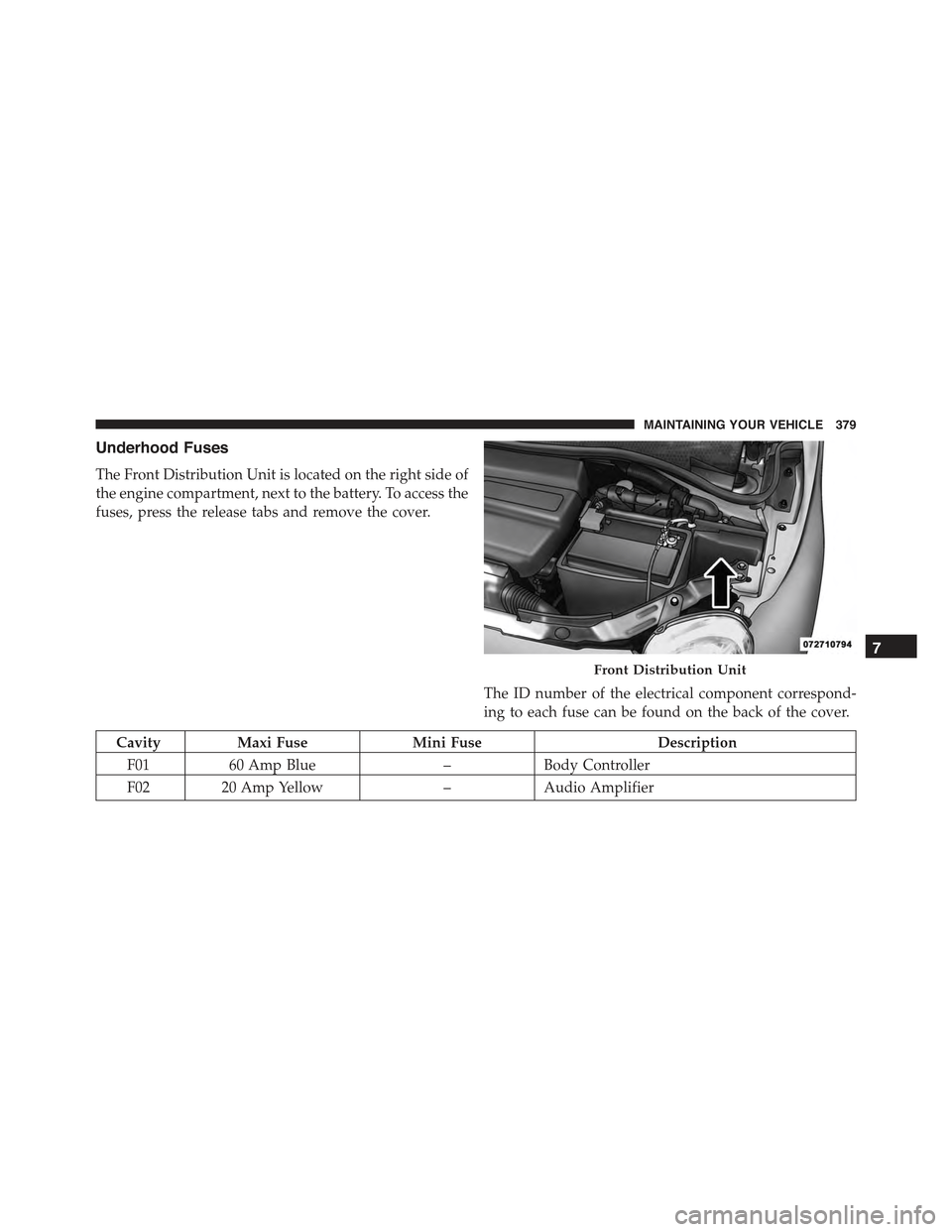
The Front Distribution Unit is located on the right side of
the engine compartment, next to the battery. To access the
fuses, press the release tabs and remove the cover.
The ID number of the electrical component correspond-
ing to each fuse can be found on the back of the cover.
CavityMaxi FuseMini FuseDescription
F0160 Amp Blue–Body Controller
F02 20 Amp Yellow–Audio Amplifier
Front Distribution Unit
7
MAINTAINING YOUR VEHICLE 379
Page 402 of 426

has access to a TDD or a conventional teletypewriter
(TTY) in the United States, can communicate with the
manufacturer by dialing 1-800-380-CHRY.
Canadian residents with hearing difficulties that require
assistance can use the special needs relay service offered
by Bell Canada. For TTY teletypewriter users, dial 711
and for Voice callers, dial 1-800-855-0511 to connect with
a Bell Relay Service operator.
Service Contract
You may have purchased a service contract for a vehicle
to help protect you from the high cost of unexpected
repairs after the manufacturer’s New Vehicle Limited
Warranty expires. The manufacturer stands behind only
the manufacturer’s service contracts. If you purchased a
manufacturer’s service contract, you will receive Plan
Provisions and an Owner Identification Card in the mail
within three weeks of the vehicle delivery date. If you
have any questions about the service contract, call the
manufacturer’s Service Contract National Customer
Hotline at 1-800-521-9922 (Canadian residents, call (800)
465-2001 English / (800) 387-9983 French).
The manufacturer will not stand behind any service
contract that is not the manufacturer’s service contract. It
is not responsible for any service contract other than the
manufacturer’s service contract. If you purchased a ser-
vice contract that is not a manufacturer’s service contract,
and you require service after the manufacturer’s New
Vehicle Limited Warranty expires, please refer to the
contract documents, and contact the person listed in
those documents.
We appreciate that you have made a major investment
when you purchased the vehicle. An authorized dealer
has also made a major investment in facilities, tools, and
400 IF YOU NEED CONSUMER ASSISTANCE
Page 406 of 426
Treadwear
The Treadwear grade is a comparative rating, based on
the wear rate of the tire when tested under controlled
conditions on a specified government test course. For
example, a tire graded 150 would wear one and one-half
times as well on the government course as a tire graded
100. The relative performance of tires depends upon the
actual conditions of their use, however, and may depart
significantly from the norm due to variations in driving
habits, service practices, and differences in road charac-
teristics and climate.
Traction Grades
The Traction grades, from highest to lowest, are AA, A, B,
and C. These grades represent the tire’s ability to stop on
wet pavement, as measured under controlled conditions
on specified government test surfaces of asphalt and
concrete. A tire marked C may have poor traction perfor-
mance.
WARNING!
The traction grade assigned to this tire is based on
straight-ahead braking traction tests, and does not
include acceleration, cornering, hydroplaning, or
peak traction characteristics.
Temperature Grades
The temperature grades are A (the highest), B, and C,
representing the tire’s resistance to the generation of heat
and its ability to dissipate heat, when tested under
controlled conditions on a specified indoor laboratory
test wheel. Sustained high temperature can cause the
material of the tire to degenerate and reduce tire life, and
excessive temperature can lead to sudden tire failure. The
grade C corresponds to a level of performance, which all
passenger car tires must meet under the Federal Motor
404 IF YOU NEED CONSUMER ASSISTANCE
Page 410 of 426

Adding Engine Coolant (Antifreeze)............360
Adding Fuel.............................300
Adding Washer Fluid......................355
Additives, Fuel...........................298
Air bag . . . . . . . . . . . . . . . . . . . . . . . . . . . . . . . . .39
Air Bag
Air bag Operation.......................42
Air Bag Warning Light....................52
Driver Knee Air Bag......................44
Enhanced Accident Response................50
Event Data Recorder (EDR).................55
Front Air Bag . . . . . . . . . . . . . . . . . . . . . . . . . . .39
If A Deployment Occurs...................48
Knee Impact Bolsters.....................43
Maintaining Your Air Bag System............54
Air bag Deployment........................39
Air bag Light.............................52
Air bag Maintenance........................54
Air Cleaner, Engine (Engine Air Cleaner Filter) . . . .346
Air Conditioner Maintenance.................349
Air Conditioning..........................212
Air Conditioning Controls...................212
Air Conditioning Filter.....................350
Air Conditioning, Operating Tips..............220
Air Conditioning Refrigerant.................349
Air Conditioning System....................212
Air Pressure, Tires.........................273
Alterations/Modifications, Vehicle...............8
Antifreeze (Engine Coolant)..................359
Capacities............................387
Disposal..............................362
Anti-Lock Brake System (ABS)................252
Anti-Lock Warning Light....................148
Appearance Care.........................369
Automatic Dimming Mirror...................90
Automatic Door Locks......................23
Automatic Temperature Control (ATC)..........215
Automatic Transaxle........................11
408 INDEX
Page 414 of 426

Emergency, In Case of
Hazard Warning Flasher..................307
Jacking...............................320
Jump Starting..........................327
Towing..............................334
Emission Control System Maintenance..........340
Engine
Air Cleaner...........................346
Break-In Recommendations.................76
Checking Oil Level......................344
Compartment..........................339
Cooling..............................358
Exhaust Gas Caution.....................78
Fails to Start...........................229
Flooded, Starting.......................229
Fuel Requirements......................295
Oil . . . . . . . . . . . . . . . . . . . . . . . . . . . . . . . . ..344
Oil Filler Cap..........................345
Oil Selection...........................345
Overheating...........................307
Starting..............................227
Enhanced Accident Response Feature............50
Euro Twin Clutch Transmission
Fluid Type............................367
Event Data Recorder........................55
Exhaust Gas Caution........................78
Exhaust System...........................78
Exterior Lights............................81
Filters
Air Cleaner...........................346
Air Conditioning.......................350
Engine Oil............................346
Engine Oil Disposal.....................346
Flashers
Turn Signal............................81
Flash-To-Pass............................110
Flooded Engine Starting....................229
412 INDEX
Page 425 of 426
VEHICLES SOLD IN CANADA
With respect to any Vehicles Sold in Canada, the name
Chrysler Group LLC shall be deemed to be deleted and the
name Chrysler Canada Inc. used in substitution therefore.
DRIVING AND ALCOHOL
Drunken driving is one of the most frequent causes of
accidents.
Your driving ability can be seriously impaired with blood
alcohol levels far below the legal minimum. If you are
drinking, don’t drive. Ride with a designated non-
drinking driver, call a cab, a friend, or use public trans-
portation.
WARNING!
Driving after drinking can lead to an accident.
Your perceptions are less sharp, your reflexes are
slower, and your judgment is impaired when you
have been drinking. Never drink and then drive.
This manual illustrates and describes the operation of
features and equipment that are either standard or op-
tional on this vehicle. This manual may also include a
description of features and equipment that are no longer
available or were not ordered on this vehicle. Please
disregard any features and equipment described in this
manual that are not on this vehicle.
Chrysler Group LLC reserves the right to make changes
in design and specifications, and/or make additions to or
improvements to its products without imposing any
obligation upon itself to install them on products previ-
ously manufactured.
FIAT is a registered trademark of Fiat Group Marketing &
Corporate Communication S.p.A., used under license
by Chrysler Group LLC.
Copyright © 2014 Chrysler Group LLC
INSTALLATION OF RADIO TRANSMITTING
EQUIPMENT
Special design considerations are incorporated into this
vehicle’s electronic system to provide immunity to radio
frequency signals. Mobile two-way radios and telephone
equipment must be installed properly by trained person-
nel. The following must be observed during installation.
The positive power connection should be made directly
to the battery and fused as close to the battery as possible.
The negative power connection should be made to body
sheet metal adjacent to the negative battery connection.
This connection should not be fused.
Antennas for two-way radios should be mounted on the
roof or the rear area of the vehicle. Care should be used
in mounting antennas with magnet bases. Magnets may
affect the accuracy or operation of the compass on
vehicles so equipped.
The antenna cable should be as short as practical and
routed away from the vehicle wiring when possible. Use
only fully shielded coaxial cable.
Carefully match the antenna and cable to the radio to
ensure a low Standing Wave Ratio (SWR).
Mobile radio equipment with output power greater than
normal may require special precautions.
All installations should be checked for possible interfer-
ence between the communications equipment and the
vehicle’s electronic systems.