2015 DODGE JOURNEY ECO
[x] Cancel search: ECOPage 114 of 140
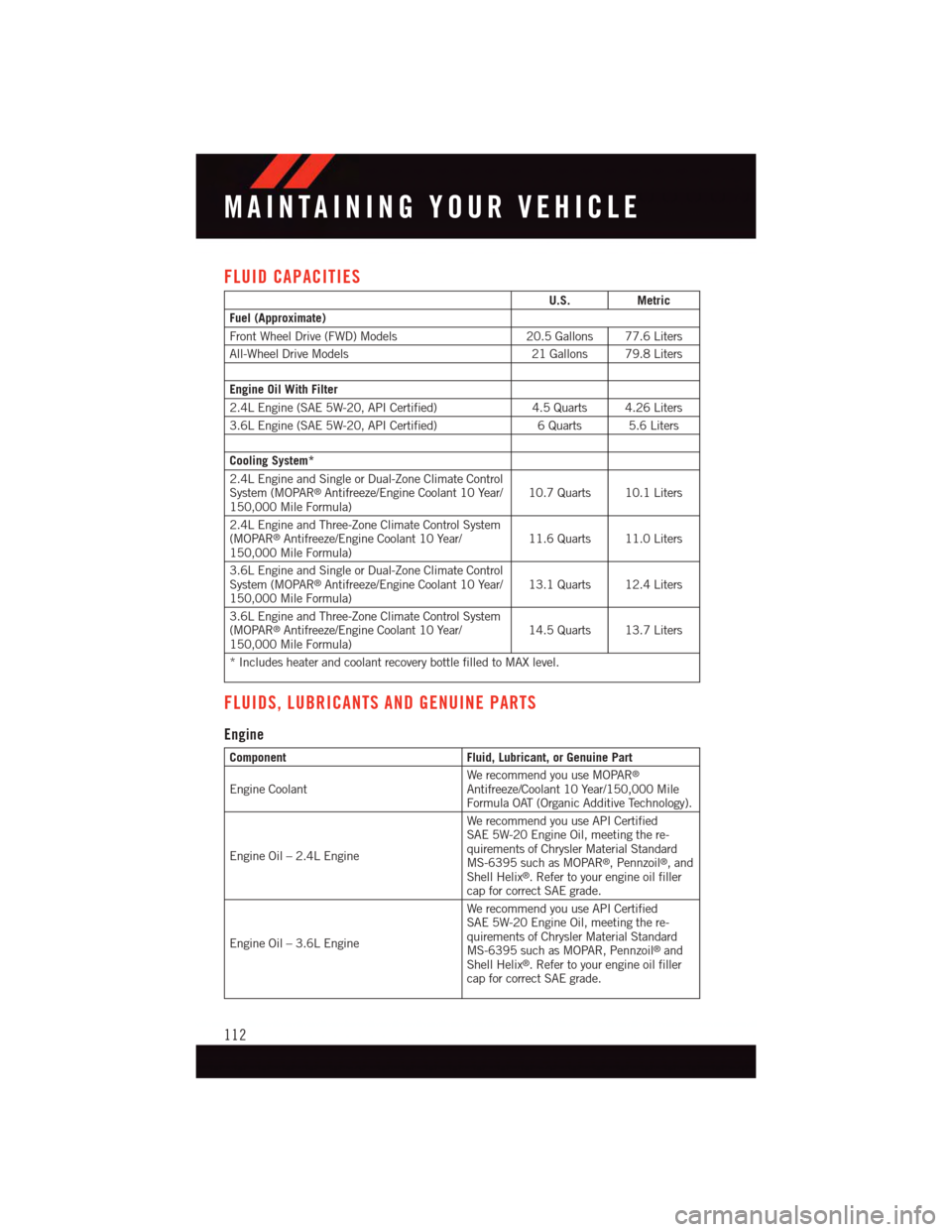
FLUID CAPACITIES
U.S.Metric
Fuel (Approximate)
Front Wheel Drive (FWD) Models20.5 Gallons 77.6 Liters
All-Wheel Drive Models21 Gallons 79.8 Liters
Engine Oil With Filter
2.4L Engine (SAE 5W-20, API Certified)4.5 Quarts 4.26 Liters
3.6L Engine (SAE 5W-20, API Certified)6Quarts 5.6Liters
Cooling System*
2.4L Engine and Single or Dual-Zone Climate ControlSystem (MOPAR®Antifreeze/Engine Coolant 10 Year/150,000 Mile Formula)10.7 Quarts 10.1 Liters
2.4L Engine and Three-Zone Climate Control System(MOPAR®Antifreeze/Engine Coolant 10 Year/150,000 Mile Formula)11.6 Quarts 11.0 Liters
3.6L Engine and Single or Dual-Zone Climate ControlSystem (MOPAR®Antifreeze/Engine Coolant 10 Year/150,000 Mile Formula)13.1 Quarts 12.4 Liters
3.6L Engine and Three-Zone Climate Control System(MOPAR®Antifreeze/Engine Coolant 10 Year/150,000 Mile Formula)14.5 Quarts 13.7 Liters
*IncludesheaterandcoolantrecoverybottlefilledtoMAXlevel.
FLUIDS, LUBRICANTS AND GENUINE PARTS
Engine
ComponentFluid, Lubricant, or Genuine Part
Engine CoolantWe recommend you use MOPAR®
Antifreeze/Coolant 10 Year/150,000 MileFormula OAT (Organic Additive Technology).
Engine Oil – 2.4L Engine
We recommend you use API CertifiedSAE 5W-20 Engine Oil, meeting the re-quirements of Chrysler Material StandardMS-6395 such as MOPAR®,Pennzoil®,andShell Helix®.Refertoyourengineoilfillercap for correct SAE grade.
Engine Oil – 3.6L Engine
We recommend you use API CertifiedSAE 5W-20 Engine Oil, meeting the re-quirements of Chrysler Material StandardMS-6395 such as MOPAR, Pennzoil®andShell Helix®.Refertoyourengineoilfillercap for correct SAE grade.
MAINTAINING YOUR VEHICLE
112
Page 115 of 140

ComponentFluid, Lubricant, or Genuine Part
Engine Oil FilterWe recommend you use MOPAR®EngineOil Filter.
Spark Plugs – 2.4L EngineWe recommend you use MOPAR®SparkPlugs.
Spark Plugs – 3.6L EngineWe recommend you use MOPAR®SparkPlugs.
Fuel Selection 87 Octane
CAUTION!
•Mixingofenginecoolant(antifreeze)otherthanspecifiedOrganicAdditiveTech-
nology (OAT) engine coolant (antifreeze), may result in engine damage and may
decrease corrosion protection. Organic Additive Technology (OAT) engine coolant is
different and should not be mixed with Hybrid Organic Additive Technology (HOAT)
engine coolant (antifreeze) or any “globally compatible” coolant (antifreeze). If a
non-OAT engine coolant (antifreeze) is introduced into the cooling system in an
emergency, the cooling system will need to be drained, flushed, and refilled with
fresh OAT coolant (conforming to MS-12106), by an authorized dealer as soon as
possible.
•Donotusewateraloneoralcohol-basedenginecoolant(antifreeze)products.Do
not use additional rust inhibitors or antirust products, as they may not be compat-
ible with the radiator engine coolant and may plug the radiator.
•Thisvehiclehasnotbeendesignedforusewithpropyleneglycol-basedengine
coolant (antifreeze). Use of propylene glycol-based engine coolant (antifreeze) is
not recommended.
E-85 Flexible Fuel — 3.6L Engine Only
CAUTION!
Only vehicles with the E-85 fuel filler door label or a yellow gas cap can operate on
E-85.
Refer to your Owner's Manual on the DVD for further details.
MAINTAINING YOUR VEHICLE
113
Page 116 of 140
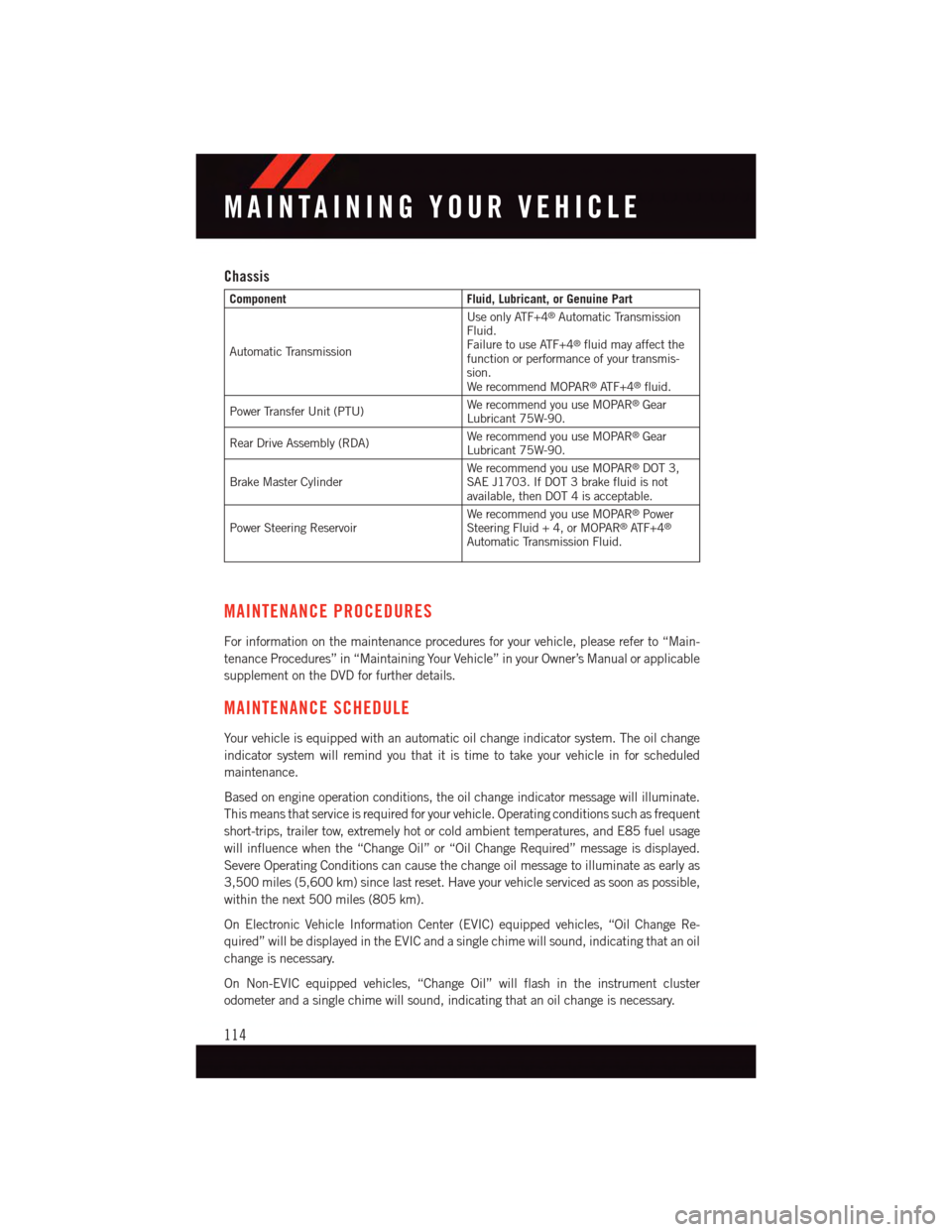
Chassis
ComponentFluid, Lubricant, or Genuine Part
Automatic Transmission
Use only ATF+4®Automatic TransmissionFluid.Failure to use ATF+4®fluid may affect thefunction or performance of your transmis-sion.We recommend MOPAR®AT F + 4®fluid.
Power Transfer Unit (PTU)We recommend you use MOPAR®GearLubricant 75W-90.
Rear Drive Assembly (RDA)We recommend you use MOPAR®GearLubricant 75W-90.
Brake Master CylinderWe recommend you use MOPAR®DOT 3,SAE J1703. If DOT 3 brake fluid is notavailable, then DOT 4 is acceptable.
Power Steering ReservoirWe recommend you use MOPAR®PowerSteering Fluid + 4, or MOPAR®AT F + 4®
Automatic Transmission Fluid.
MAINTENANCE PROCEDURES
For information on the maintenance procedures for your vehicle, please refer to “Main-
tenance Procedures” in “Maintaining Your Vehicle” in your Owner’s Manual or applicable
supplement on the DVD for further details.
MAINTENANCE SCHEDULE
Yo u r v e h i c l e i s e q u i p p e d w i t h a n a u t o m a t i c o i l c h a n g e i n d i c a t o r s y s t e m . T h e o i l c h a n g e
indicator system will remind you that it is time to take your vehicle in for scheduled
maintenance.
Based on engine operation conditions, the oil change indicator message will illuminate.
This means that service is required for your vehicle. Operating conditions such as frequent
short-trips, trailer tow, extremely hot or cold ambient temperatures, and E85 fuel usage
will influence when the “Change Oil” or “Oil Change Required” message is displayed.
Severe Operating Conditions can cause the change oil message to illuminate as early as
3,500 miles (5,600 km) since last reset. Have your vehicle serviced as soon as possible,
within the next 500 miles (805 km).
On Electronic Vehicle Information Center (EVIC) equipped vehicles, “Oil Change Re-
quired” will be displayed in the EVIC and a single chime will sound, indicating that an oil
change is necessary.
On Non-EVIC equipped vehicles, “Change Oil” will flash in the instrument cluster
odometer and a single chime will sound, indicating that an oil change is necessary.
MAINTAINING YOUR VEHICLE
114
Page 117 of 140

Yo u r a u t h o r i z e d d e a l e r w i l l r e s e t t h e o i l c h a n g e i n d i c a t o r m e s s a g e a f t e r c o m p l e t i n g t h e
scheduled oil change. If a scheduled oil change is performed by someone other than your
authorized dealer, the message can be reset by referring to the steps described under
“Instrument Cluster Warning Lights” in “What To Do In Emergencies” in this guide or
“Electronic Vehicle Information Center (EVIC)” in “Understanding Your Instrument
Panel” in your Owners Manual on the DVD for further information.
NOTE:
Under no circumstances should oil change intervals exceed 10,000 miles (16,000 km)
or twelve months, whichever comes first.
Severe Duty All Models
Change Engine Oil at 4000 miles (6,500 km) if the vehicle is operated in a dusty and off
road environment. This type of vehicle use is considered Severe Duty.
Once A Month Or Before A Long Trip:
•Checkengineoillevel.
•Checkwindshieldwasherfluidlevel.
•Checktirepressureandlookforunusualwearordamage.Rotatetiresatthefirstsign
of irregular wear, even if it occurs before the oil indicator system turns on.
•Checkthefluidlevelsofthecoolantreservoir,brakemastercylinder,powersteering
and transmission (4-speed only) and fill as needed.
•Checkfunctionofallinteriorandexteriorlights.
Required Maintenance Intervals.
Refer to the Maintenance Schedules on the following page for the required maintenance
intervals.
At Every Oil Change Interval As Indicated By Oil Change Indicator System:
•Change oil and filter.
•Rotatethetires.Rotate at the first sign of irregular wear, even if it occurs before the oil
indicator system turns on.
•Inspect battery and clean and tighten terminals as required.
•Inspect automatic transmission fluid if equipped with dipstick.
•Inspect brake pads, shoes, rotors, drums, hoses and park brake.
•Inspect engine cooling system protection and hoses.
•Inspect exhaust system.
•Inspect engine air cleaner if using in dusty or off-road conditions.
MAINTAINING YOUR VEHICLE
115
Page 119 of 140

Mileage or time passed(whichever comes first)
20,000
30,000
40,000
50,000
60,000
70,000
80,000
90,000
100,000
110,000
120,000
130,000
140,000
150,000
Or Years: 2 3 4 5 6 7 8 9 10 11 12 13 14 15
Or Kilometers:
32,000
48,000
64,000
80,000
96,000
112,000
128,000
144,000
160,000
176,000
192,000
208,000
224,000
240,000
Replace rear drive assembly (RDA) fluid.
X
X
Replace power transfer unit (PTU) fluid.
X
X
Inspect and replace PCV valve if necessary.
X
** The spark plug change interval is mileage based only, yearly intervals do not apply.
WARNING!
•Youcanbebadlyinjuredworkingonoraroundamotorvehicle.Doonlyserviceworkforwhichyouhavetheknowledgeandtheright
equipment. If you have any doubt about your ability to perform a service job, take your vehicle to a competent mechanic.
•Failuretoproperlyinspectandmaintainyourvehiclecouldresultinacomponentmalfunctionandeffectvehiclehandlingand
performance. This could cause an accident.
MAINTAINING YOUR VEHICLE
117
Page 120 of 140
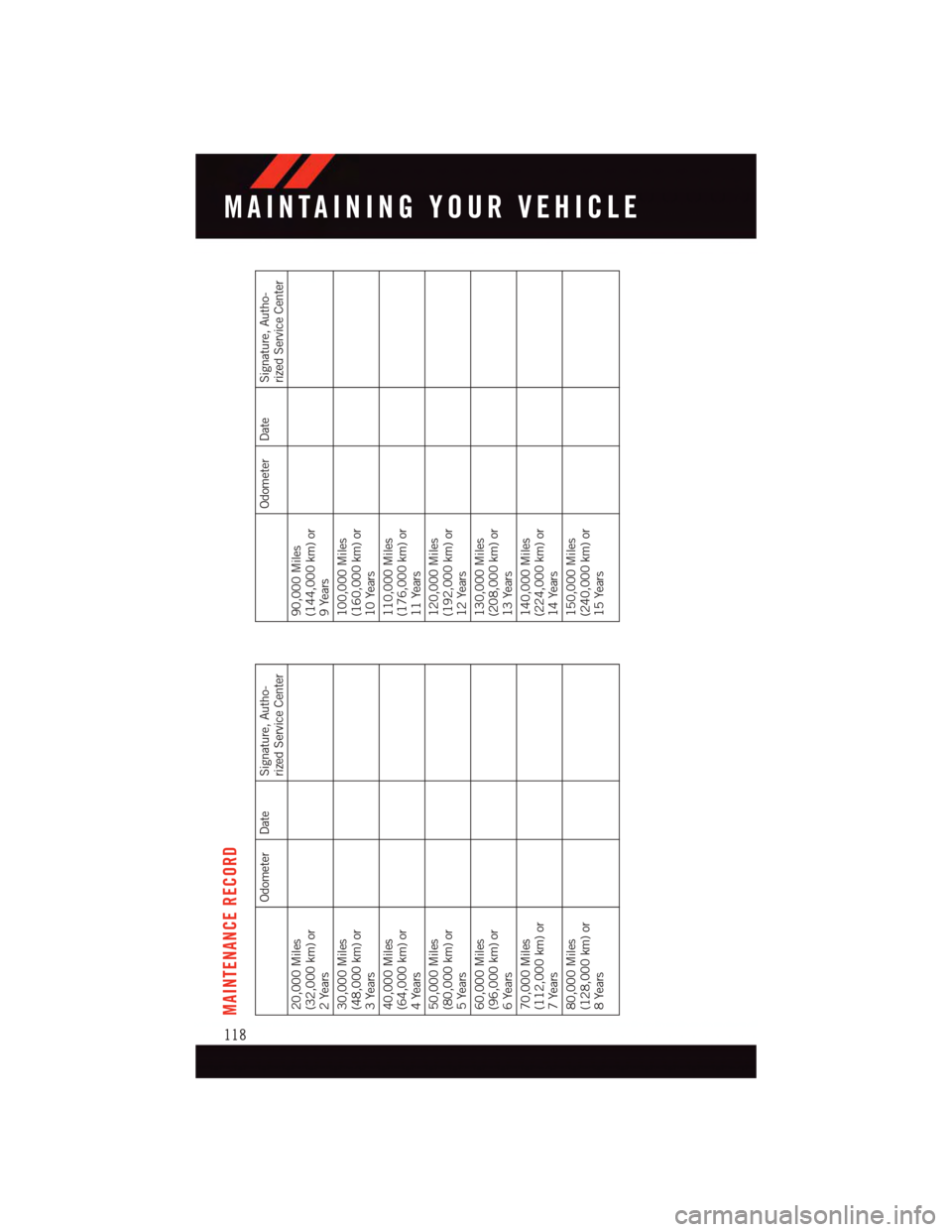
MAINTENANCE RECORD
Odometer Date Signature, Autho-
rized Service Center
20,000 Miles(32,000 km) or2Years30,000 Miles(48,000 km) or3Years40,000 Miles(64,000 km) or4Years50,000 Miles(80,000 km) or5Years60,000 Miles(96,000 km) or6Years70,000 Miles(112,000 km) or7Years80,000 Miles(128,000 km) or8Years
Odometer Date Signature, Autho-
rized Service Center
90,000 Miles(144,000 km) or9Years100,000 Miles(160,000 km) or10 Years110,000 Miles(176,000 km) or11 Years120,000 Miles(192,000 km) or12 Years130,000 Miles(208,000 km) or13 Years140,000 Miles(224,000 km) or14 Years150,000 Miles(240,000 km) or15 Years
MAINTAINING YOUR VEHICLE
118
Page 123 of 140

Cavity Cartridge Fuse Mini-FuseDescription
F166–20AmpYellowSpare
F167–30AmpGreenPowertrainShutdown
F168–10AmpRedAirConditionerClutch
F169 40 Amp Green –Emissions – Partial Zero EmissionsVehicle Motor
F170–15AmpBlueEmissions – Partial Zero EmissionsVehicle Actuators
F172–20AmpYellowSpare
F173–25AmpClearAntiLockBrakeValves
F174–20AmpYellowSiren–IfEquipped
F175–30AmpGreenSpare
F176–10AmpRedPowertrainControlModules
F177–20AmpYellowAll Wheel Drive Module – IfEquipped
F178–25AmpClearSunroof–IfEquipped
F179–10AmpRedBattery Sensor
F181 100 Amp Blue –Electrohydraulic Steering (EHPS)–IfEquipped
F182 50 Amp Red – Cabin Heater #3 – If Equipped
F184 30 Amp Pink –Front Wiper Motor
TIRE PRESSURES
Check the inflation pressure of each tire, including the spare tire, at least monthly and
inflate to the recommended pressure for your vehicle.
The tire pressures recommended for your vehicle are found on the “Tire and Loading
Information” label located on the driver’s side door opening.
NOTE:
Refer to the Owner's Manual on the DVD for
more information regarding tire warnings
and instructions.
Tire And Loading Information Location(Example)
MAINTAINING YOUR VEHICLE
121
Page 124 of 140

WARNING!
•Overloadingofyourtiresisdangerous.Overloadingcancausetirefailure,affect
vehicle handling, and increase your stopping distance. Use tires of the recom-
mended load capacity for your vehicle. Never overload them.
•Improperlyinflatedtiresaredangerousandcancausecollisions.Under-inflation
increases tire flexing and can result in over-heating and tire failure. Over-inflation
reduces a tire’s ability to cushion shock. Objects on the road and chuck holes can
cause damage that results in tire failure. Unequal tire pressures can cause steering
problems. You could lose control of your vehicle. Over-inflated or under-inflated
tires can affect vehicle handling and can fail suddenly, resulting in loss of vehicle
control. Always drive with each tire inflated to the recommended cold tire inflation
pressure.
SPARE TIRES — IF EQUIPPED
NOTE:
For vehicles equipped with Tire Service Kit instead of a spare tire, please refer to “Tire
Service Kit” in “What To Do In Emergencies” on your DVD for further information.
CAUTION!
Because of the reduced ground clearance, do not take your vehicle through an
automatic car wash with a compact or limited-use temporary spare installed. Damage
to the vehicle may result.
Spare Tire Matching Original Equipped Tire And Wheel — If Equipped
Yo u r v e h i c l e m a y b e e q u i p p e d w i t h a s p a r e t i r e a n d w h e e l e q u i v a l e n t i n l o o k a n d f u n c t i o n
to the original equipment tire and wheel found on the front or rear axle of your vehicle. This
spare tire may be used in the tire rotation for your vehicle. If your vehicle has this option,
refer to an authorized tire dealer for the recommended tire rotation pattern.
Compact Spare Tire — If Equipped
The compact spare is for temporary emergency use only. You can identify if your vehicle
is equipped with a compact spare by looking at the spare tire description on the Tire and
Loading Information Placard located on the driver’s side door opening or on the sidewall
of the tire. Compact spare tire descriptions begin with the letter “T” or “S” preceding the
size designation. Example: T145/80D18 103M.
T, S = Temporary Spare Tire
Since this tire has limited tread life, the original equipment tire should be repaired (or
replaced) and reinstalled on your vehicle at the first opportunity.
MAINTAINING YOUR VEHICLE
122