Page 541 of 648
MAINTAINING YOUR VEHICLE
CONTENTS
!ENGINE COMPARTMENT — 2.4L..........541
!ENGINE COMPARTMENT — 3.6L..........542
!ONBOARD DIAGNOSTIC SYSTEM — OBD II . .543
▫Loose Fuel Filler Cap Message............543
!EMISSIONS INSPECTION AND MAINTENANCE
PROGRAMS..........................544
!REPLACEMENT PARTS..................545
!DEALER SERVICE......................545
!MAINTENANCE PROCEDURES...........546
▫Engine Oil..........................547
▫Engine Oil Filter......................550
▫Engine Air Cleaner Filter................550
▫Maintenance-Free Battery...............551
▫Air Conditioner Maintenance.............552
▫A/C Air Filter — If Equipped............554
▫Body Lubrication.....................555
▫Windshield Wiper Blades...............556
▫Adding Washer Fluid..................558
▫Exhaust System......................559
▫Cooling System......................561
7
Page 545 of 648

ONBOARD DIAGNOSTIC SYSTEM — OBD II
Your vehicle is equipped with a sophisticated onboard
diagnostic system called OBD II. This system monitors
the performance of the emissions, engine, and automatic
transmission control systems. When these systems are
operating properly, your vehicle will provide excellent
performance and fuel economy, as well as engine emis-
sions well within current government regulations.
If any of these systems require service, the OBD II system
will turn on the “Malfunction Indicator Light” (MIL). It
will also store diagnostic codes and other information to
assist your service technician in making repairs. Al-
though your vehicle will usually be drivable and not
need towing, see your authorized dealer for service as
soon as possible.
CAUTION!
•Prolonged driving with the MIL on could cause
further damage to the emission control system. It
could also affect fuel economy and driveability.
The vehicle must be serviced before any emissions
tests can be performed.
•If the MIL is flashing while the engine is running,
severe catalytic converter damage and power loss
will soon occur. Immediate service is required.
Loose Fuel Filler Cap Message
If the vehicle diagnostic system determines that the fuel
filler cap is loose, improperly installed, or damaged, the
word “gASCAP” will display in the odometer. If this
occurs, tighten the fuel filler cap until a “clicking” sound
is heard and press the TRIP ODOMETER button to turn
off the message. If the problem persists, the message will
appear the next time the vehicle is started.
7
MAINTAINING YOUR VEHICLE 543
Page 546 of 648

A loose, improperly installed, or damaged fuel filler cap
may also turn on the MIL.
EMISSIONS INSPECTION AND MAINTENANCE
PROGRAMS
In some localities, it may be a legal requirement to pass
an inspection of your vehicle’s emissions control system.
Failure to pass could prevent vehicle registration.
For states that require an Inspection and Mainte-
nance (I/M), this check verifies the “Malfunction
Indicator Light (MIL)” is functioning and is not
on when the engine is running, and that the OBD II
system is ready for testing.
Normally, the OBD II system will be ready. The OBD II
system maynotbe ready if your vehicle was recently
serviced, recently had a dead battery or a battery replace-
ment. If the OBD II system should be determined not
ready for the I/M test, your vehicle may fail the test.
Your vehicle has a simple ignition actuated test, which
you can use prior to going to the test station. To check if
your vehicle’s OBD II system is ready, you must do the
following:
1. Cycle the ignition switch to the ON position, but do
not crank or start the engine.
NOTE:If you crank or start the engine, you will have to
start this test over.
2. As soon as you cycle the ignition switch to the ON
position, you will see the MIL symbol come on as part
of a normal bulb check.
3. Approximately 15 seconds later, one of two things will
happen:
•The MIL will flash for about 10 seconds and then
return to being fully illuminated until you turn OFF
544 MAINTAINING YOUR VEHICLE
Page 549 of 648

CAUTION!(Continued)
•Your vehicle has been built with improved fluids
that protect the performance and durability of your
vehicle and also allow extended maintenance inter-
vals. Do not use chemical flushes in these compo-
nents as the chemicals can damage your engine,
transmission, power steering or air conditioning.
Such damage is not covered by the New Vehicle
Limited Warranty. If a flush is needed because of
component malfunction, use only the specified
fluid for the flushing procedure.
Engine Oil
Checking Oil Level
To assure proper engine lubrication, the engine oil must be
maintained at the correct level. Check the oil level at
regular intervals, such as every fuel stop. The best time to
check the engine oil level is about five minutes after a fully
warmed engine is shut off. Checking engine oil level when
the engine is cold will give you an incorrect reading.
Checking the oil while the vehicle is on level ground and
only when the engine is hot, will improve the accuracy of
the oil level readings. Maintain the oil level between the
range markings on the dipstick. Either the range mark-
ings consist of a crosshatch zone marked SAFE or a
crosshatch zone marked with MIN at the low end of the
range and MAX at the high end of the range. Adding
1.0 qt (1.0 l) of oil when the reading is at the low end of
the range marking will raise the oil level to the high end
of the range marking.
CAUTION!
Do not overfill the engine. Overfilling the engine
will cause oil aeration, which can lead to loss of oil
pressure and an increase in oil temperature. This
(Continued)
7
MAINTAINING YOUR VEHICLE 547
Page 551 of 648

Engine Oil Viscosity — 2.4L Engine
MOPAR® SAE 5W-20 engine oil or equivalent Pennzoil®
or Shell Helix® is recommended for all operating tem-
peratures. This engine oil improves low temperature
starting and vehicle fuel economy.
The engine oil filler cap also shows the recommended
engine oil viscosity for your engine. For information on
the engine oil filler cap location, refer to “Engine Com-
partment” in “Maintaining Your Vehicle” for further
information.
Lubricants that do not have both, the engine oil certifi-
cation mark and the correct SAE viscosity grade number
should not be used.
Engine Oil Viscosity — 3.6L Engine
MOPAR® SAE 5W-20 engine oil approved to Chrysler
Material Standard MS-6395 such as Pennzoil®, Shell
Helix® or equivalent is recommended for all operating
temperatures. This engine oil improves low temperature
starting and vehicle fuel economy.
The engine oil filler cap also shows the recommended
engine oil viscosity for your engine. For information on
engine oil filler cap location, refer to the “Engine Com-
partment” illustration in this section.
NOTE:MOPAR® SAE 5W-30 engine oil approved to
Chrysler Material Standard MS-6395 such as Pennzoil®,
Shell Helix® or equivalent may be used when SAE 5W-20
engine oil meeting MS-6395 is not available.
Synthetic Engine Oils
You may use synthetic engine oils provided the recom-
mended oil quality requirements are met, and the recom-
mended maintenance intervals for oil and filter changes
are followed.
7
MAINTAINING YOUR VEHICLE 549
Page 562 of 648

CAUTION!
•The catalytic converter requires the use of un-
leaded fuel only. Leaded gasoline will destroy the
effectiveness of the catalyst as an emissions control
device and may seriously reduce engine perfor-
mance and cause serious damage to the engine.
•Damage to the catalytic converter can result if your
vehicle is not kept in proper operating condition.
In the event of engine malfunction, particularly
involving engine misfire or other apparent loss of
performance, have your vehicle serviced promptly.
Continued operation of your vehicle with a severe
malfunction could cause the converter to overheat,
resulting in possible damage to the converter and
vehicle.
Under normal operating conditions, the catalytic con-
verter will not require maintenance. However, it is im-
portant to keep the engine properly tuned to assure
proper catalyst operation and prevent possible catalyst
damage.
NOTE:Intentional tampering with emissions control
systems can result in civil penalties being assessed
against you.
In unusual situations involving grossly malfunctioning
engine operation, a scorching odor may suggest severe
and abnormal catalyst overheating. If this occurs, stop
the vehicle, turn off the engine and allow it to cool.
Service, including a tune-up to manufacturer’s specifica-
tions, should be obtained immediately.
560 MAINTAINING YOUR VEHICLE
Page 589 of 648
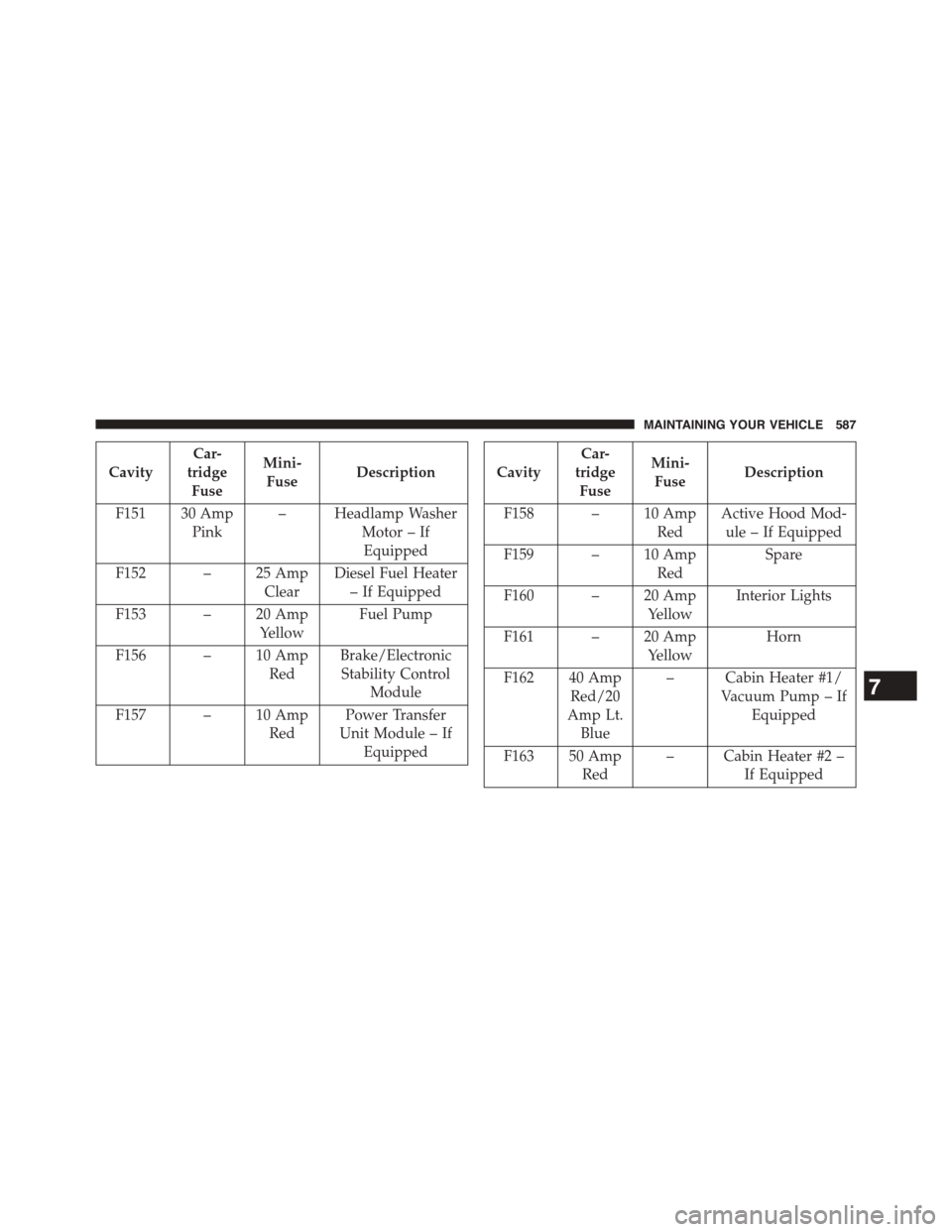
Cavity
Car-
tridge
Fuse
Mini-
FuseDescription
F151 30 Amp
Pink
– Headlamp Washer
Motor – If
Equipped
F152 – 25 Amp
Clear
Diesel Fuel Heater
– If Equipped
F153 – 20 Amp
Yellow
Fuel Pump
F156 – 10 Amp
Red
Brake/Electronic
Stability Control
Module
F157 – 10 Amp
Red
Power Transfer
Unit Module – If
Equipped
Cavity
Car-
tridge
Fuse
Mini-
FuseDescription
F158 – 10 Amp
Red
Active Hood Mod-
ule – If Equipped
F159 – 10 Amp
Red
Spare
F160 – 20 Amp
Yellow
Interior Lights
F161 – 20 Amp
Yellow
Horn
F162 40 Amp
Red/20
Amp Lt.
Blue
– Cabin Heater #1/
Vacuum Pump – If
Equipped
F163 50 Amp
Red
– Cabin Heater #2 –
If Equipped
7
MAINTAINING YOUR VEHICLE 587
Page 599 of 648
FLUID CAPACITIES
U.S.Metric
Fuel (Approximate)
Front Wheel Drive (FWD) Models20.5 Gallons 77.6 Liters
All-Wheel Drive Models21 Gallons 79.8 Liters
Engine Oil With Filter
2.4L Engine (SAE 5W-20, API Certified)4.5 Quarts 4.26 Liters
3.6L Engine (SAE 5W-20, API Certified)6 Quarts 5.6 Liters
Cooling System*
2.4L Engine and Single or Dual-Zone Climate Control System (MOPAR®
Antifreeze/Engine Coolant 10 Year/150,000 Mile Formula)
10.7 Quarts 10.1 Liters
2.4L Engine and Three-Zone Climate Control System (MOPAR®
Antifreeze/Engine Coolant 10 Year/150,000 Mile Formula)
11.6 Quarts 11.0 Liters
7
MAINTAINING YOUR VEHICLE 597