Page 521 of 689

rear axle systems (GAWR). Total load must be limited so
GVWR and front and rear GAWR are not exceeded.
Payload
The payload of a vehicle is defined as the allowable load
weight a truck can carry, including the weight of the
driver, all passengers, options and cargo.
Gross Axle Weight Rating (GAWR)
The GAWR is the maximum permissible load on the front
and rear axles. The load must be distributed in the cargo
area so that the GAWR of each axle is not exceeded.
Each axle GAWR is determined by the components in the
system with the lowest load carrying capacity (axle,
springs, tires or wheels). Heavier axles or suspension
components sometimes specified by purchasers for in-
creased durability does not necessarily increase the vehi-
cle’s GVWR.
Tire Size
The tire size on the Vehicle Certification Label represents
the actual tire size on your vehicle. Replacement tires
must be equal to the load capacity of this tire size.
Rim Size
This is the rim size that is appropriate for the tire size
listed.
Inflation Pressure
This is the cold tire inflation pressure for your vehicle for
all loading conditions up to full GAWR.
Curb Weight
The curb weight of a vehicle is defined as the total weight
of the vehicle with all fluids, including vehicle fuel, at full
capacity conditions, and with no occupants or cargo loaded
into the vehicle. The front and rear curb weight values are
5
STARTING AND OPERATING 519
Page 533 of 689
WARNING!(Continued)
•Total weight must be distributed between the tow
vehicle and the trailer such that the following four
ratings are not exceeded:
1. GVWR
2. GTW
3. GAWR
4.Tongue weight rating for the trailer hitch utilized.
Towing Requirements — Tires
•Do not attempt to tow a trailer while using a compact
spare tire.
•Proper tire inflation pressures are essential to the safe
and satisfactory operation of your vehicle. Refer to
“Tires – General Information” in “Starting And Oper-
ating” for proper tire inflation procedures.
•Check the trailer tires for proper tire inflation pres-
sures before trailer usage.
•Check for signs of tire wear or visible tire damage
before towing a trailer. Refer to “Tires – General
Information” in “Starting And Operating” for the
proper inspection procedure.
5
STARTING AND OPERATING 531
Page 551 of 689

CAUTION!
Driving with a hot cooling system could damage
your vehicle. If the temperature gauge reads HOT
(H), pull over and stop the vehicle. Idle the vehicle
with the air conditioner turned off until the pointer
drops back into the normal range. If the pointer
remains on HOT (H), and you hear continuous
chimes, turn the engine off immediately and call for
service.
WARNING!
You or others can be badly burned by hot engine
coolant (antifreeze) or steam from your radiator. If
you see or hear steam coming from under the hood,
do not open the hood until the radiator has had time
to cool. Never try to open a cooling system pressure
cap when the radiator or coolant bottle is hot.
WHEEL AND TIRE TORQUE SPECIFICATIONS
Proper lug nut/bolt torque is very important to ensure
that the wheel is properly mounted to the vehicle. Any
time a wheel has been removed and reinstalled on the
vehicle the lug nuts/bolts should be torqued using a
properly calibrated torque wrench.
Torque Specifications
Lug Nut/Bolt Torque **Lug Nut/
Bolt Size
Lug Nut/
Bolt Socket
Size
130 Ft-Lbs (176 N·m) M14 x 1.50 22 mm
**Use only Chrysler recommended lug nuts/bolts and
clean or remove any dirt or oil before tightening.
Inspect the wheel mounting surface prior to mounting
the tire and remove any corrosion or loose particles.
6
WHAT TO DO IN EMERGENCIES 549
Page 610 of 689

for any accumulation of bugs, leaves, etc. If dirty, clean by
gently spraying water from a garden hose vertically
down the face of the condenser.
Check the engine cooling system hoses for brittle rubber,
cracking, tears, cuts, and tightness of the connection at
the coolant recovery bottle and radiator. Inspect the
entire system for leaks.
With the engine at normal operating temperature (but
not running), check the cooling system pressure cap for
proper vacuum sealing by draining a small amount of
engine coolant (antifreeze) from the radiator drain cock.
If the cap is sealing properly, the engine coolant (anti-
freeze) will begin to drain from the coolant recovery
bottle. DO NOT REMOVE THE COOLANT PRESSURE
CAP WHEN THE COOLING SYSTEM IS HOT.
Cooling System — Drain, Flush And Refill
NOTE:Some vehicles require special tools to add coolant
properly. Failure to fill these systems properly could lead
to severe internal engine damage. If any coolant is
needed to be added to the system please contact your
local authorized dealer.
If the engine coolant (antifreeze) is dirty or contains
visible sediment, have an authorized dealer clean and
flush with OAT coolant (antifreeze) (conforming to
MS.90032).
Refer to the “Maintenance Schedule” for the proper
maintenance intervals.
Selection Of Coolant
Refer to “Fluids, Lubricants, and Genuine Parts” in
“Maintaining Your Vehicle” for further information.
608 MAINTAINING YOUR VEHICLE
Page 631 of 689
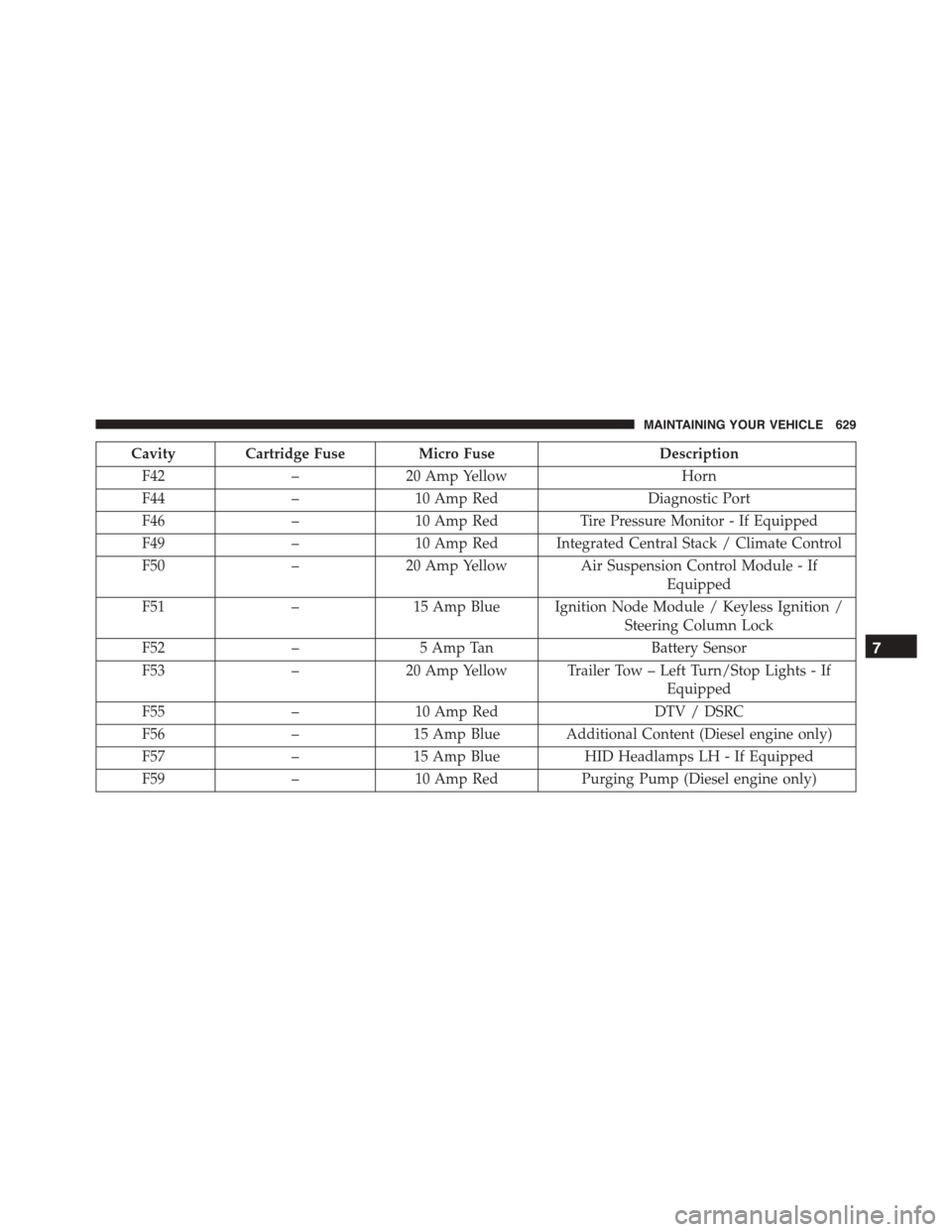
Cavity Cartridge Fuse Micro FuseDescription
F42–20 Amp YellowHorn
F44–10 Amp RedDiagnostic Port
F46–10 Amp RedTire Pressure Monitor - If Equipped
F49–10 Amp Red Integrated Central Stack / Climate Control
F50–20 Amp Yellow Air Suspension Control Module - If
Equipped
F51–15 Amp Blue Ignition Node Module / Keyless Ignition /
Steering Column Lock
F52–5 Amp TanBattery Sensor
F53–20 Amp Yellow Trailer Tow – Left Turn/Stop Lights - If
Equipped
F55–10 Amp RedDTV / DSRC
F56–15 Amp Blue Additional Content (Diesel engine only)
F57–15 Amp BlueHID Headlamps LH - If Equipped
F59–10 Amp RedPurging Pump (Diesel engine only)
7
MAINTAINING YOUR VEHICLE 629
Page 650 of 689

MAINTENANCE SCHEDULE
Your vehicle is equipped with an automatic oil change
indicator system. The oil change indicator system will
remind you that it is time to take your vehicle in for
scheduled maintenance.
Based on engine operation conditions, the oil change
indicator message will illuminate. This means that ser-
vice is required for your vehicle. Operating conditions
such as frequent short-trips, trailer tow, extremely hot or
cold ambient temperatures, and E85 fuel usage will
influence when the “Oil Change Required” message is
displayed. Severe Operating Conditions can cause the
change oil message to illuminate as early as 3,500 miles
(5,600 km) since last reset. Have your vehicle serviced as
soon as possible, within the next 500 miles (805 km).
Your authorized dealer will reset the oil change indicator
message after completing the scheduled oil change.
NOTE:Under no circumstances should oil change inter-
vals exceed 10,000 miles (16,000 km) or twelve months,
whichever comes first.
Severe Duty All Models
•Change Engine Oil at 4000 miles (6,500 km) if the vehicle
is operated in a dusty and off road environment. This
type of vehicle use is considered Severe Duty.
Once A Month Or Before A Long Trip:
•Check engine oil level
•Check windshield washer fluid level
•Check the tire inflation pressures and look for unusual
wear or damage
•Check the fluid levels of the coolant reservoir, brake
master cylinder and power steering, and fill as needed.
•Check function of all interior and exterior lights
648 MAINTENANCE SCHEDULES
Page 668 of 689

About Your Brakes........................459
Adaptive Cruise Control (ACC) (Cruise Control) . . .196
Adding Engine Coolant (Antifreeze)............609
Adding Fuel.............................515
Additives, Fuel...........................509
Air bag . . . . . . . . . . . . . . . . . . . . . . . . . . . . . . . . .66
Air Bag
Advance Front Air Bag....................67
Air Bag Components.....................66
Air bag Operation.......................69
Air Bag Warning Light....................78
Driver Knee Air Bag......................71
Enhanced Accident Response................77
Event Data Recorder (EDR).................81
Front Air Bag . . . . . . . . . . . . . . . . . . . . . . . . . . .66
If A Deployment Occurs...................76
Knee Impact Bolsters.....................70
Maintaining Your Air Bag System............80
Side Air Bags...........................71
Transporting Pets.......................107
Air bag Deployment........................66
Air bag Light.............................78
Air bag Maintenance........................80
Air Cleaner, Engine (Engine Air Cleaner Filter) . . . .594
Air Conditioner Maintenance.................596
Air Conditioning Filter.....................397
Air Conditioning, Operating Tips..............396
Air Conditioning, Rear Zone.................391
Air Conditioning Refrigerant.................596
Air Conditioning System....................390
Air Pressure, Tires.........................485
Alarm
Arm The System........................19
Disarm The System.......................20
Tamper Alert...........................21
Alarm, Panic.............................24
Alarm (Security Alarm)......................19
All Wheel Drive (AWD).....................440
666 INDEX
Page 670 of 689

Brake/Transmission Interlock.................430
Bulb Replacement.........................634
Bulbs, Light.............................112
Camera, Rear............................237
Capacities, Fluid..........................640
Caps, Filler
Fuel.................................566
Oil (Engine)...........................593
Power Steering.........................455
Radiator (Coolant Pressure)................611
Carbon Monoxide Warning..................109
Cargo Area Cover.........................272
Cargo Area Features.......................269
Cargo Compartment.......................269
Light................................271
Luggage Carrier........................276
Cargo Light.............................271
Cargo Tie-Downs.........................273
Car Washes.............................620
Cellular Phone...........................379
Center High Mounted Stop Light..............639
Certification Label.........................518
Chains, Tire.............................496
Changing A Flat Tire.......................551
Chart, Tire Sizing.........................473
Check Engine Light (Malfunction Indicator Light) . .588
Checking Your Vehicle For Safety..............108
Checks, Safety...........................108
Child Restraint............................82
Child Restraints
Booster Seats...........................86
Child Restraints.........................82
Child Seat Installation....................102
How To Stow An Unused ALR Seat Belt........98
Infants And Child Restraints................84
Install A LATCH-compatible Child Restraint.....97
668 INDEX