Page 419 of 689
STARTING AND OPERATING
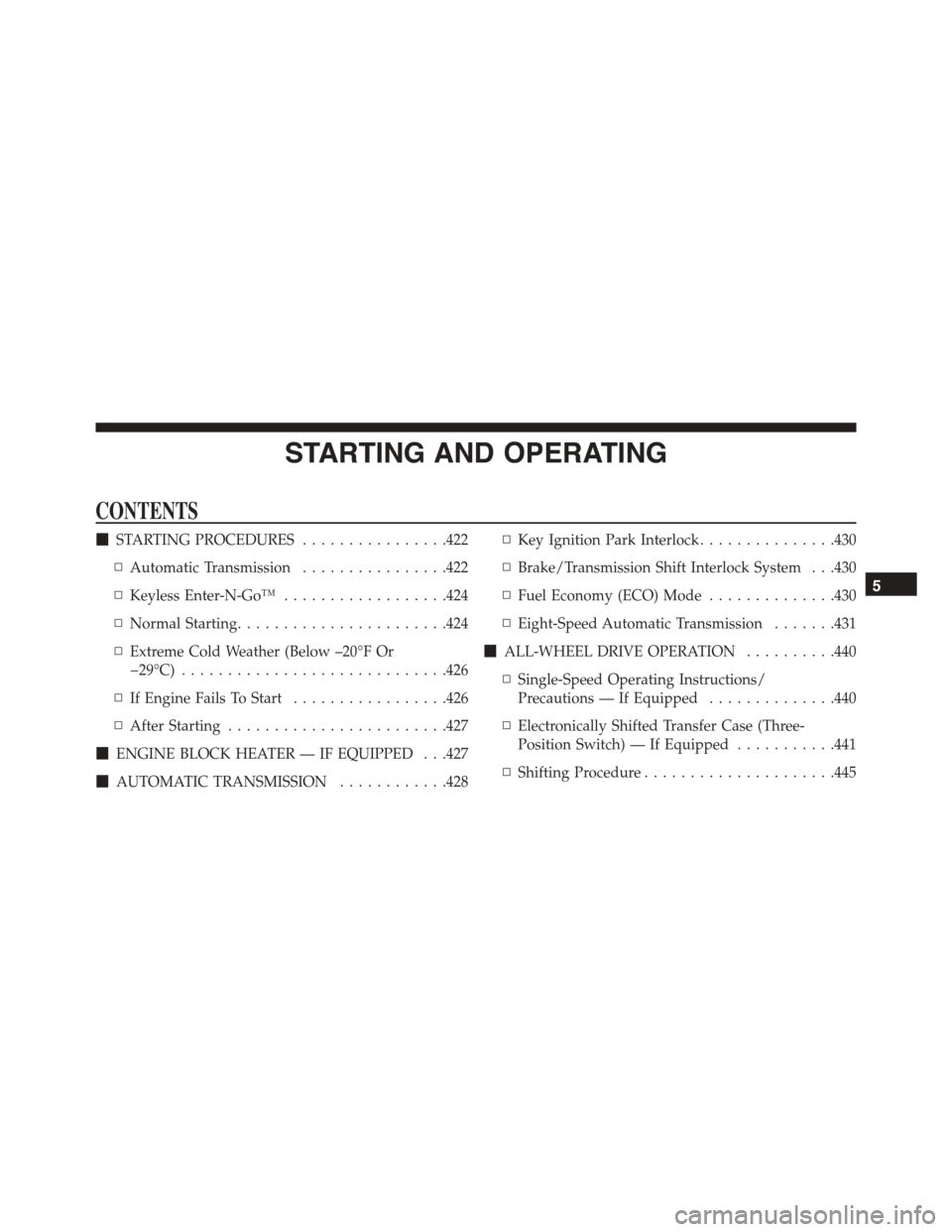
CONTENTS
!STARTING PROCEDURES................422
▫Automatic Transmission................422
▫Keyless Enter-N-Go™..................424
▫Normal Starting.......................424
▫Extreme Cold Weather (Below –20°F Or
−29°C).............................426
▫If Engine Fails To Start.................426
▫After Starting........................427
!ENGINE BLOCK HEATER — IF EQUIPPED . . .427
!AUTOMATIC TRANSMISSION............428
▫Key Ignition Park Interlock...............430
▫Brake/Transmission Shift Interlock System . . .430
▫Fuel Economy (ECO) Mode..............430
▫Eight-Speed Automatic Transmission.......431
!ALL-WHEEL DRIVE OPERATION..........440
▫Single-Speed Operating Instructions/
Precautions — If Equipped..............440
▫Electronically Shifted Transfer Case (Three-
Position Switch) — If Equipped...........441
▫Shifting Procedure.....................445
5
Page 420 of 689

!ON-ROAD DRIVING TIPS................448
!OFF-ROAD DRIVING TIPS................448
▫When To Use LOW Range — If Equipped . . . .448
▫Driving Through Water.................449
▫Driving In Snow, Mud And Sand..........450
▫Hill Climbing........................451
▫Traction Downhill.....................452
▫After Driving Off-Road.................452
!POWER STEERING.....................453
▫3.6L Engine..........................453
▫5.7L Engine..........................454
▫Power Steering Fluid Check..............455
!FUEL SAVER TECHNOLOGY 5.7L ENGINE
ONLY — IF EQUIPPED..................456
!PARKING BRAKE......................456
!BRAKE SYSTEM.......................459
!ELECTRONIC BRAKE CONTROL SYSTEM . . . .460
▫Anti-Lock Brake System (ABS)............460
▫Traction Control System (TCS)............461
▫Brake Assist System (BAS)...............461
▫Electronic Roll Mitigation (ERM)..........462
▫Electronic Stability Control (ESC)..........463
▫Trailer Sway Control (TSC)..............466
▫Hill Start Assist (HSA).................467
▫Ready Alert Braking...................469
418 STARTING AND OPERATING
Page 422 of 689

▫Service Tpm System Warning.............504
▫General Information...................506
!FUEL REQUIREMENTS..................506
▫3.6L Engine — If Equipped...............506
▫5.7L Engine — If Equipped...............507
▫Reformulated Gasoline.................507
▫Gasoline/Oxygenate Blends..............508
▫E-85 Usage In Non-Flex Fuel Vehicles.......508
▫MMT In Gasoline.....................509
▫Materials Added To Fuel................509
▫Fuel System Cautions...................510
▫Carbon Monoxide Warnings..............511
!FLEXIBLE FUEL (3.6L ENGINE ONLY) — IF
EQUIPPED...........................511
▫E-85 General Information................511
▫Ethanol Fuel (E-85)....................512
▫Fuel Requirements....................512
▫Selection Of Engine Oil For Flexible Fuel Vehicles
(E-85) And Gasoline Vehicles.............513
▫Starting............................513
▫Cruising Range.......................514
▫Replacement Parts....................514
▫Maintenance........................514
!ADDING FUEL........................515
▫Emergency Fuel Filler Door Release.........517
!VEHICLE LOADING....................518
420 STARTING AND OPERATING
Page 428 of 689

Extreme Cold Weather (Below –20°F Or−29°C)
To ensure reliable starting at these temperatures, use of
an externally powered electric engine block heater (avail-
able from your authorized dealer) is recommended.
If Engine Fails To Start
WARNING!
•Never pour fuel or other flammable liquid into the
throttle body air inlet opening in an attempt to start
the vehicle. This could result in flash fire causing
serious personal injury.
(Continued)
WARNING!(Continued)
•Do not attempt to push or tow your vehicle to get it
started. Vehicles equipped with an automatic trans-
mission cannot be started this way. Unburned fuel
could enter the catalytic converter and once the
engine has started, ignite and damage the converter
and vehicle.
•If the vehicle has a discharged battery, booster
cables may be used to obtain a start from a booster
battery or the battery in another vehicle. This type
of start can be dangerous if done improperly. Refer
to “Jump Starting” in “What To Do In Emergen-
cies” for further information.
426 STARTING AND OPERATING
Page 429 of 689

Clearing A Flooded Engine (Using ENGINE
START/STOP Button)
If the engine fails to start after you have followed the
“Normal Starting” or “Extreme Cold Weather#proce-
dures, it may be flooded. To clear any excess fuel:
1. Press and hold the brake pedal.
2. Press the accelerator pedal all the way to the floor and
hold it.
3. Push and release the ENGINE START/STOP button
once.
The starter motor will engage automatically, run for 10
seconds, and then disengage. Once this occurs, release
the accelerator pedal and the brake pedal, wait 10 to 15
seconds, then repeat the “Normal Starting” procedure.
After Starting
The idle speed is controlled automatically and it will
decrease as the engine warms up.
ENGINE BLOCK HEATER — IF EQUIPPED
The engine block heater warms the engine, and permits
quicker starts in cold weather. Connect the cord to a
standard 110-115 Volt AC electrical outlet with a
grounded, three-wire extension cord.
The engine block heater must be plugged in at least one
hour to have an adequate warming effect on the engine.
The engine block heater cord is located:
•3.6L Engine — Coiled and strapped to the engine oil
dipstick tube.
•5.7L Engine — Bundled and fastened to the injector
harness.
5
STARTING AND OPERATING 427
Page 432 of 689

Key Ignition Park Interlock
This vehicle is equipped with a Key Ignition Park Inter-
lock which requires the transmission to be in PARK
before the engine can be turned off. This helps the driver
avoid inadvertently leaving the vehicle without placing
the transmission in PARK.
This system also locks the transmission in PARK when-
ever the ignition switch is in the OFF position.
Brake/Transmission Shift Interlock System
This vehicle is equipped with a Brake Transmission Shift
Interlock System (BTSI) that holds the transmission gear
selector in PARK unless the brakes are applied. To shift
the transmission out of PARK, the engine must be
running and the brake pedal must be pressed.
The brake pedal must also be pressed to shift from
NEUTRAL into DRIVE or REVERSE when the vehicle is
stopped or moving at low speeds.
Fuel Economy (ECO) Mode
The Fuel Economy (ECO) mode can improve the vehi-
cle’s overall fuel economy during normal driving condi-
tions. Each time the vehicle is started ECO mode is
engaged and an amber light in the center stack of the
instrument panel will be illuminated. To disable ECO
mode, press the “ECO” switch in the center stack of the
instrument panel and the amber light will go out indi-
cating ECO mode is disabled.
430 STARTING AND OPERATING
Page 433 of 689

When the Fuel Economy (ECO) Mode is engaged, the
vehicle control systems will change the following:
•The transmission will upshift sooner and downshift
later.
•The overall driving performance will be more conser-
vative.
•Some ECO mode functions may be temporarily inhib-
ited based on temperature and other factors.
Eight-Speed Automatic Transmission
The transmission is controlled using a rotary electronic
gear selector located on the center console. The transmis-
sion gear range (PRND) is displayed both above the gear
selector and in the Driver Information Display (DID). To
select a gear range, simply rotate the gear selector. You
must also press the brake pedal to shift the transmission
out of PARK, or to shift from NEUTRAL into DRIVE or
REVERSE when the vehicle is stopped or moving at low
speeds (refer to “Brake/Transmission Shift Interlock Sys-
tem” in this section). To shift past multiple gear ranges at
once (such as PARK to DRIVE), simply rotate the gear
selector to the appropriate detent. Select the DRIVE range
for normal driving.
Fuel Economy Mode Switch
5
STARTING AND OPERATING 431
Page 438 of 689

REVERSE (R)
This range is for moving the vehicle backward. Shift into
REVERSE only after the vehicle has come to a complete
stop.
NEUTRAL (N)
Use this range when the vehicle is standing for prolonged
periods with the engine running. Apply the parking
brake and shift the transmission into PARK if you must
leave the vehicle.
WARNING!
Do not coast in NEUTRAL and never turn off the
ignition to coast down a hill. These are unsafe
practices that limit your response to changing traffic
or road conditions. You might lose control of the
vehicle and have a collision.
CAUTION!
Towing the vehicle, coasting, or driving for any other
reason with the transmission in NEUTRAL can cause
severe transmission damage. Refer to “Recreational
Towing” in “Starting And Operating” and “Towing A
Disabled Vehicle” in “What To Do In Emergencies”
for further information.
DRIVE (D)
This range should be used for most city and highway
driving. It provides the smoothest upshifts and down-
shifts, and the best fuel economy. The transmission
automatically upshifts through all forward gears. The
DRIVE position provides optimum driving characteris-
tics under all normal operating conditions.
436 STARTING AND OPERATING