Page 354 of 575
1–4 Skip Shift
There are times when you must shift the transmission
directly from first gear to fourth gear instead of from first
gear to second gear. This is to help you get the best
possible fuel economy from your vehicle. This occurs
when the engine coolant (antifreeze) is higher than 106°F
(41°C), vehicle speed is greater than 19 mph (30 km/h)
but less than 21 mph (34 km/h), and the transmission is
in first gear, and the accelerator is at ¼ throttle or less.
After you shift the transmission to fourth gear, you can
press the clutch in and shift to another forward gear.
Downshifting
To maintain a safe speed and prolong brake life, down-
shift to maintain a safe speed when descending a steep
grade.
WARNING!
Skipping more than one gear while downshifting,
could cause you to lose control of your vehicle. You
could have a collision.
CAUTION!
•If you skip more than one gear while downshifting
or downshift at too high an engine speed, you
could damage the engine, transmission, or clutch.
• Do not downshift into first gear when the vehicle is
moving faster than 15 mph (24 km/h), as you could
damage the engine and/or clutch.
352 STARTING AND OPERATING
Page 375 of 575

4. Make sure the vehicle is not moving.
5. Make sure the steering wheel is pointing straight.
6. Fully depress the clutch pedal and make sure thevehicle is in first gear.
7. While holding the clutch depressed, rapidly apply the accelerator pedal to wide open throttle. The engine
speed will hold at the pre-selected launch RPM. The
engine speed will hold at the RPM that was set in the
“Launch RPM Set-up” screen.
NOTE: Messages will appear in the Driver Information
Display (DID) to inform the driver if one or more of the
above conditions have not been met.
8. When conditions 5 through 8 have been met, the Driver Information Display (DID) will read “Launch
Ready Release Clutch”. Release the clutch quickly and continue to hold wide open throttle to launch execute
shifts. Refer to “Manual Transmission – Shifting” in
this section for further information.
Release the brake and continue to hold wide open
throttle to launch.
9. Keep the vehicle pointed straight.
Launch control will be active until the vehicle reaches
62 mph (100 km/h), at which point the ESC system will
return to its current ESC mode.
Launch control will abort before launch completion,
display “Launch Aborted” in the cluster and return to
ESC Full ON under any the following conditions:
• The brake is applied during launch.
• The ESC system detects that the vehicle is no longer
moving in a straight line.
5
STARTING AND OPERATING 373
Page 377 of 575

•If equipped with a removable lower front fascia grille,
it is recommended to remove it for track use during
warm/hot weather to improve cooling airflow to
critical powertrain and cooling system components.
• All SRT vehicles are track tested for 24 hours of
endurance, however, it is recommended that suspen-
sion system, brake system, prop shaft, and ½ shaft
boots should be checked for wear or damage after
every track event.
• Track usage results in increased operating tempera-
tures of the engine, transmission, clutch – if equipped,
driveline and brake system. This may affect noise
(NVH) countermeasures designed into your vehicle.
New components may need to be installed to return
the system to the original NVH performance.
• Tire pressure:
• 40psi hot, recommend 32psi front, 30psi rear cold NOTE:
It is recommended that you target 40psi Hot Tire
Pressure at the conclusion of each track session. Starting
at 32psi Front & 30psi Rear Cold and adjusting based on
ambient & track conditions is recommended. Tire pres-
sure can be monitored via the Driver Information Display
(DID) and can assist with adjustments.
Track burnishing your brakes:
To avoid “green lining fade” during track use, the brake
pads and rotors must have a thermal burnish for factory
installed components or when new brake friction com-
ponents are installed:
1. Use one track session to burnish brakes by driving at 75% speed. Brake at approximately 0.60-0.80g max
without ABS intervention.
2. Lap the track in this manner until you start smelling the brakes. Continue for another ½ lap at speed, then
5
STARTING AND OPERATING 375
Page 458 of 575
accelerator. Use the least amount of accelerator pedal
pressure that will maintain the rocking motion, without
spinning the wheels or racing the engine.
NOTE:For vehicles with automatic transmission: Shifts
between DRIVE and REVERSE can only be achieved at
wheel speeds of 5 mph (8 km/h) or less. Whenever the
transmission remains in NEUTRAL for more than 2
seconds, you must press the brake pedal to engage
DRIVE or REVERSE.
CAUTION!
Racing the engine or spinning the wheels may lead to
transmission overheating and failure. Allow the en-
gine to idle with the transmission in NEUTRAL for at
least one minute after every five rocking-motion
cycles. This will minimize overheating and reduce
the risk of clutch or transmission failure during
prolonged efforts to free a stuck vehicle. NOTE:
Press the �ESC Off� switch to place the Electronic
Stability Control (ESC) system in �Partial Off�mode
before rocking the vehicle. Refer to “Electronic Brake
Control” in “Starting And Operating” for further infor-
mation. Once the vehicle has been freed, press the �ESC
Off� switch again to restore �ESC On�mode.
CAUTION!
•When “rocking” a stuck vehicle by shifting be-
tween DRIVE / 1ST GEAR and REVERSE, do not
spin the wheels faster than 15 mph (24 km/h), or
drivetrain damage may result.
• Revving the engine or spinning the wheels too fast
may lead to transmission overheating and failure.
It can also damage the tires. Do not spin the wheels
above 30 mph (48 km/h) while in gear (no trans-
mission shifting occurring).
456 WHAT TO DO IN EMERGENCIES
Page 466 of 575

▫Brake System ....................... .491
▫ Clutch Hydraulic System (Manual Transmission)
— If Equipped ...................... .493
▫ Manual Transmission — If Equipped .......493
▫ Automatic Transmission — If Equipped .....494
▫ Rear Axle .......................... .496
▫ Appearance Care And Protection From
Corrosion .......................... .496
� FUSES ............................. .502
▫ Front Power Distribution Center (Fuses) .....503
▫ Rear Power Distribution Center (Fuses) .....508
� VEHICLE STORAGE ....................516
� REPLACEMENT BULBS .................516
� BULB REPLACEMENT ..................519 ▫
Low Beam Headlamp, High Beam Headlamp,
Park/Turn Lamp — Models with Halogen
Headlamps — If Equipped ...............519
▫ Low Beam Headlamp, High Beam Headlamp, and
Park/Turn Lamp — Models with High Intensity
Discharge (HID) Headlamps — If Equipped . . .520
▫ Front/Rear Side Marker Lamp ............521
▫ Tail/Turn And Stop Lamp ...............521
▫ Center Tail/Backup Lamp ...............521
▫ Center High-Mounted Stop Lamp (CHMSL) . .521
▫ License Lamp ....................... .521
� FLUID CAPACITIES ....................522
�
FLUIDS, LUBRICANTS AND GENUINE PARTS . . .523
▫ Engine ............................ .523
▫ Chassis ........................... .525
464 MAINTAINING YOUR VEHICLE
Page 495 of 575

WARNING!(Continued)
cylinder reservoir cap secured at all times. Brake
fluid in a open container absorbs moisture from the
air resulting in a lower boiling point. This may
cause it to boil unexpectedly during hard or pro-
longed braking, resulting in sudden brake failure.
This could result in a collision.
• Overfilling the brake fluid reservoir can result in
spilling brake fluid on hot engine parts, causing
the brake fluid to catch fire. Brake fluid can also
damage painted and vinyl surfaces, care should be
taken to avoid its contact with these surfaces.
• Do not allow petroleum based fluid to contaminate
the brake fluid. Brake seal components could be
damaged, causing partial or complete brake failure.
This could result in a collision. Use only brake fluid that has been in a tightly closed
container to avoid contamination from foreign matter or
moisture.
Clutch Hydraulic System (Manual Transmission)
— If Equipped
The clutch hydraulic system is fed by a segregated
volume of fluid within the brake system master cylinder
reservoir. In the event of leakage or wear, use only the
manufacturer’s recommended brake fluid. Refer to “Flu-
ids, Lubricants, And Genuine Parts” in “Maintaining
Your Vehicle” for further information.
Manual Transmission — If Equipped
Fluid Level Check
Check the fluid level by removing the fill plug on the left
side of the transmission. The fluid level should be 1/4
inch (6.4mm) below the bottom of the fill hole. Add fluid,
7
MAINTAINING YOUR VEHICLE 493
Page 507 of 575
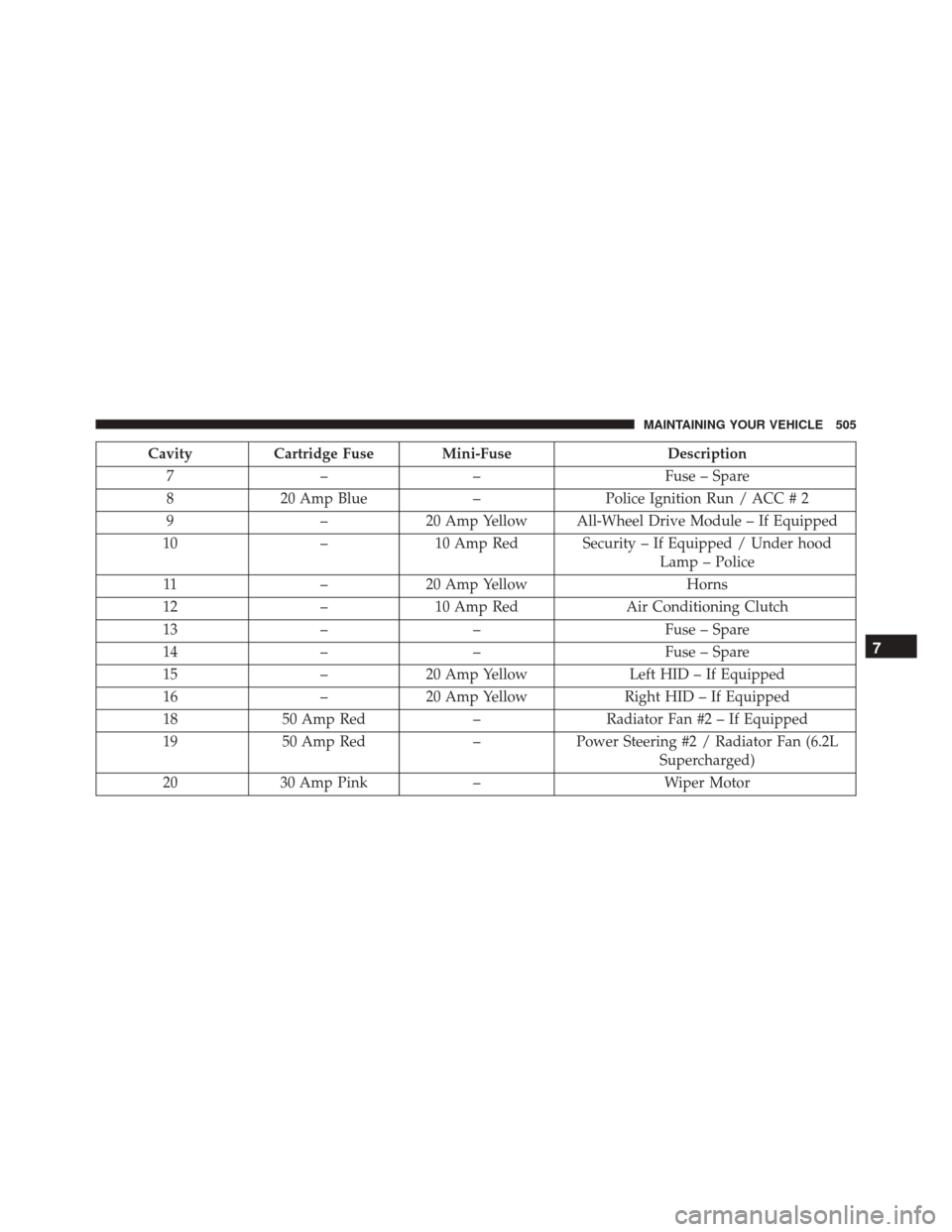
CavityCartridge Fuse Mini-Fuse Description
7 –– Fuse – Spare
8 20 Amp Blue –Police Ignition Run / ACC # 2
9 –20 Amp Yellow All-Wheel Drive Module – If Equipped
10 –10 Amp Red Security – If Equipped / Under hood
Lamp – Police
11 –20 Amp Yellow Horns
12 –10 Amp Red Air Conditioning Clutch
13 –– Fuse – Spare
14 –– Fuse – Spare
15 –20 Amp Yellow Left HID – If Equipped
16 –20 Amp Yellow Right HID – If Equipped
18 50 Amp Red –Radiator Fan #2 – If Equipped
19 50 Amp Red –Power Steering #2 / Radiator Fan (6.2L
Supercharged)
20 30 Amp Pink –Wiper Motor
7
MAINTAINING YOUR VEHICLE 505
Page 509 of 575
CavityCartridge Fuse Mini-Fuse Description
36 –10 Amp Red Anti-Lock Brake Module
37 –10 Amp Red Engine Controller/Rad Fan Relays – If
Equipped
38 –10 Amp Red Airbag Module
39 –10 Amp Red Power Steering Module/AC Clutch Relay
48 –10 Amp Red AWD Module/Front Axle Disconnect (LX)
/ Adaptive Cruise (LA) – If Equipped
49 –– Fuse – Spare
50 –– Fuse – Spare
51 –20 Amp Yellow Vacuum Pump
52 –5 Amp Tan Adaptive Cruise (LD/LX) – If Equipped
53 –– Fuse – Spare
7
MAINTAINING YOUR VEHICLE 507