Page 379 of 603
NOTE:
•Even if the power steering assistance is no longer
operational, it is still possible to steer the vehicle.
Under these conditions there will be a substantial
increase in steering effort, especially at low speeds and
during parking maneuvers.
•If the condition persists, see your authorized dealer for
service.
FUEL SAVER TECHNOLOGY 5.7L/6.4L ENGINES
ONLY — IF EQUIPPED
This feature offers improved fuel economy by shutting
off four of the engine’s eight cylinders during light load
and cruise conditions. The system is automatic with no
driver inputs or additional driving skills required.
NOTE:This system may take some time to return to full
functionality after a battery disconnect.
PARKING BRAKE
Before leaving the vehicle, make sure that the parking
brake is fully applied and place the shift lever in the
PARK or REVERSE (manual transmission only) position.
When the parking brake is applied and the ignition
switch is in the ON position (RUN position with Keyless
Enter-N-Go™), the “Brake Warning Light” in the instru-
ment cluster will illuminate.
NOTE:
•When the parking brake is applied and the transmis-
sion is placed in gear, the “Brake Warning Light” will
flash. If vehicle speed is detected, a chime will sound
to alert the driver. Fully release the parking brake
before attempting to move the vehicle.
•This light only shows that the parking brake is ap-
plied. It does not show the degree of brake application.
5
STARTING AND OPERATING 377
Page 389 of 603
by applying the brake of the appropriate wheel. Engine
power may also be reduced to assist in counteracting the
condition of oversteer or understeer and help the vehicle
maintain the desired path.
The ESC uses sensors in the vehicle to determine the path
that the driver intends to steer the vehicle and compares
it to the actual path of the vehicle. When the actual path
does not match the intended path, the ESC applies the
brake of the appropriate wheel to assist in counteracting
the condition of oversteer or understeer.
•Oversteer - when the vehicle is turning more than
appropriate for the steering wheel position.
•Understeer - when the vehicle is turning less than
appropriate for the steering wheel position.
WARNING!
The Electronic Stability Control System (ESC) cannot
prevent the natural laws of physics from acting on
the vehicle, nor can it increase the traction afforded
by prevailing road conditions. ESC cannot prevent
all accidents, including those resulting from exces-
sive speed in turns, driving on very slippery surfaces,
or hydroplaning. ESC also cannot prevent accidents
resulting from loss of vehicle control due to inappro-
priate driver input for the conditions. Only a safe,
attentive, and skillful driver can prevent accidents.
The capabilities of an ESC equipped vehicle must
never be exploited in a reckless or dangerous manner
which could jeopardize the user ’s safety or the safety
of others.
5
STARTING AND OPERATING 387
Page 481 of 603
6. Once the engine is started, remove the jumper cables
in the reverse sequence:
Disconnecting The Jumper Cables
1. Disconnect the negative(-)end of the jumper cable
from the remote negative(-)post of the vehicle with
the discharged battery.
2. Disconnect the opposite end of the negative(-)jumper
cable from the negative(-)post of the booster battery.
3. Disconnect the positive(+)end of the jumper cable
from the positive(+)post of the booster battery.
4. Disconnect the opposite end of the positive(+)jumper
cable from the remote positive(+)post of the vehicle
with the discharged battery.
If frequent jump-starting is required to start your vehicle
you should have the battery and charging system in-
spected at your authorized dealer.
CAUTION!
Accessories plugged into the vehicle power outlets
draw power from the vehicle’s battery, even when not
in use (i.e., cellular phones, etc.). Eventually, if
plugged in long enough without engine operation,
the vehicle’s battery will discharge sufficiently to
degrade battery life and/or prevent the engine from
starting.
FREEING A STUCK VEHICLE
If your vehicle becomes stuck in mud, sand, or snow, it
can often be moved using a rocking motion. Turn the
steering wheel right and left to clear the area around the
front wheels. For vehicles with automatic transmission,
press and hold the lock button on the shift lever. Then
shift back and forth between DRIVE and REVERSE (with
automatic transmission) or FIRST GEAR and REVERSE
(with manual transmission), while gently pressing the
6
WHAT TO DO IN EMERGENCIES 479
Page 498 of 603
CAUTION!(Continued)
•Your vehicle has been built with improved fluids
that protect the performance and durability of your
vehicle and also allow extended maintenance inter-
vals. Do not use chemical flushes in these compo-
nents as the chemicals can damage your engine,
transmission, power steering or air conditioning.
Such damage is not covered by the New Vehicle
Limited Warranty. If a flush is needed because of
component malfunction, use only the specified
fluid for the flushing procedure.
Engine Oil
Checking Oil Level — 3.6L Engine
To assure proper engine lubrication, the engine oil must
be maintained at the correct level. Check the oil level at
regular intervals, such as every fuel stop. The best time to
check the engine oil level is about five minutes after a
fully warmed engine is shut off.
Checking the oil while the vehicle is on level ground will
improve the accuracy of the oil level readings. Maintain
the oil level between the MIN and MAX markings on the
dipstick. Adding 1.0 qt (1.0 L) of oil when the reading is
at the MIN mark will result in a MAX reading on these
engines.
CAUTION!
Overfilling or underfilling will cause oil aeration or
loss of oil pressure. This could damage your engine.
Checking Oil Level — 5.7L and 6.4L Engine
To assure proper engine lubrication, the engine oil must
be maintained at the correct level. Check the oil level at
496 MAINTAINING YOUR VEHICLE
Page 532 of 603
WARNING!(Continued)
•If a general protection fuse for safety systems (air
bag system, braking system), power unit systems
(engine system, gearbox system) or steering system
blows, contact an authorized dealer.
Front Power Distribution Center (Fuses)
The Front Power Distribution Center is located in the
engine compartment. This module contains fuses and
relays.
Front Power Distribution Center
530 MAINTAINING YOUR VEHICLE
Page 534 of 603
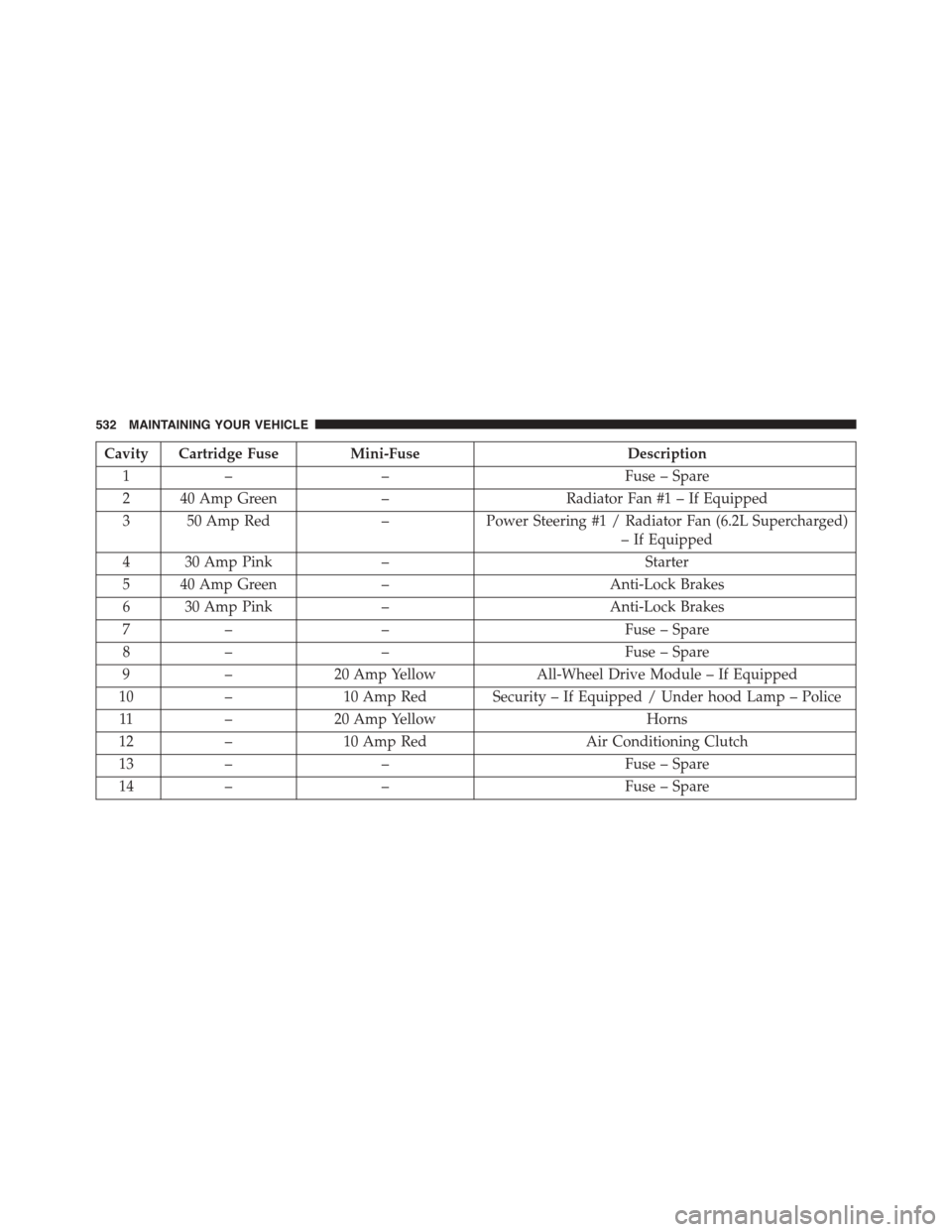
Cavity Cartridge Fuse Mini-FuseDescription
1––Fuse – Spare
2 40 Amp Green–Radiator Fan #1 – If Equipped
3 50 Amp Red–Power Steering #1 / Radiator Fan (6.2L Supercharged)
– If Equipped
4 30 Amp Pink–Starter
5 40 Amp Green–Anti-Lock Brakes
6 30 Amp Pink–Anti-Lock Brakes
7––Fuse – Spare
8––Fuse – Spare
9–20 Amp YellowAll-Wheel Drive Module – If Equipped
10–10 Amp Red Security – If Equipped / Under hood Lamp – Police
11–20 Amp YellowHorns
12–10 Amp RedAir Conditioning Clutch
13––Fuse – Spare
14––Fuse – Spare
532 MAINTAINING YOUR VEHICLE
Page 535 of 603
Cavity Cartridge Fuse Mini-FuseDescription
15–20 Amp YellowLH HID
16–20 Amp YellowRH HID
18 40 Amp Green–Radiator Fan #2 – If Equipped
19 50 Amp Red–Power Steering #2 / Radiator Fan (6.2L Supercharged)
20 30 Amp Pink–Wiper Motor
21 30 Amp Pink–Headlamp Washers – If Equipped
22 40 Amp Green /
20 Amp Blue –
Police
–Engine Cooling/Intercooler Pump / Police Bat Feed #
3 – If Equipped
23 20 Amp Blue–Police Bat Feed#1–IfEquipped
24 20 Amp Blue–Police Bat Feed#3–IfEquipped
28––Fuse – Spare
29–15 Amp BlueTransmission – If Equipped
30––Fuse – Spare
31–25 Amp ClearEngine Module
7
MAINTAINING YOUR VEHICLE 533
Page 536 of 603
Cavity Cartridge Fuse Mini-FuseDescription
32––Fuse – Spare
33––Fuse – Spare
34–25 Amp ClearPowertrain #1
35–20 Amp YellowPowertrain #2
36–10 Amp RedAnti-Lock Brake Module
37–10 Amp RedEngine Controller/Rad Fan Relays – If Equipped
38–10 Amp RedAirbag Module
39–10 Amp RedPower Steering Module/AC Clutch Relay
48–10 Amp Red AWD Module/Front Axle Disconnect/Adaptive Cruise
– if Equipped
49––Fuse – Spare
50––Fuse – Spare
51–20 Amp YellowVacuum Pump
52–10 Amp RedDriver Assistance Systems Module – If Equipped
53––Fuse – Spare
534 MAINTAINING YOUR VEHICLE