Page 96 of 344
94
C5_en_Chap03_ergo-et-confort_ed01-2014
High load retaining net
(Tourer)
Hooked onto the special upper and lower
fixings, this permits use of the entire loading
volume up to the roof:
-
b
ehind the rear seats (row 2),
-
b
ehind the front seats (row 1) when the rear
seats are folded.
When positioning the net, check that the strap
loops are visible from the boot; this will make
slackening or tightening easier.
Installation
F fold down the backs of the rear seats,
F p osition the high load retaining net roller
above the two rails 1 located behind
the rear seats (2/3 bench seat). The
two
notches 2 must be placed above the
two rails, F
s lide the two rails 1 into the notches 2 and
push the roller (lengthways) from right to
left to secure it,
F
r
eposition the rear seat backs.
Ease of use and comfort
Page 97 of 344
95
C5_en_Chap03_ergo-et-confort_ed01-2014
Row 1
To use it in row 1:
F f old down the backs of the rear seats,
F
o
pen the covers 3 of the corresponding
upper fixings,
F
u
nroll the high load retaining net and
position one of the ends of the net's metal
bar in the corresponding fixing cover.
Check that the hook is secured in the rail
located inside the cover 3 ,
F
p
ull the high load retaining net's metal bar
to position the other hook in the second
fixing cover.
Row 2
To use it in row 2:
F o pen the covers 4 of the corresponding
upper fixings,
F
f
rom the rear bench seat, unroll the high
load retaining net, pushing it to detach it
from the retaining hooks,
F
p
osition one of the ends of the net's metal
bar in the corresponding fixing cover.
Check that the hook is secured in the rail
located inside the cover,
F
p
osition the other hook in the second fixing
cover and pull the metal bar towards you.
3
Ease of use and comfort
Page 156 of 344
154
C5_en_Chap06_securite_ed01-2014
Direction indicators
F Left: lower the lighting stalk beyond the point of resistance.
F
R
ight: raise the lighting stalk beyond the
point of resistance.
Three flashes of the direction
indicators
F Press briefly upwards or downwards, without going beyond the point of
resistance; the direction indicators will
flash 3 times.
Hazard warning lamps
A visual warning by means of the direction
indicators to alert other road users to a vehicle
breakdown, towing or accident.Automatic operation of
hazard warning lamps
When braking in an emergency, depending on
the deceleration, the hazard warning lamps
come on automatically.
They switch off automatically the first time you
accelerate.
F
Y
ou can also switch them off by pressing
the button.
Selection of the left or right direction indicators
to signal a change of direction of the vehicle.
F
P
ress this button, the direction indicators
flash.
They can operate with the ignition off.
Safety
Page 157 of 344
155
C5_en_Chap06_securite_ed01-2014
Horn
Audible warning to alert other road users to
an imminent danger.
F
P
ress the left or right-hand part of the fixed
centred controls steering wheel. This system allows you to make an emergency
or assistance call to the emergency services or
to the dedicated CITROËN service.
Emergency or
assistance call
For more information on the use of this
function, refer to the "Audio and telematics"
section.
6
Safety
Page 158 of 344

156
C5_en_Chap06_securite_ed01-2014
Braking assistance systems
Anti-lock braking system
and electronic brake force
distribution
Linked systems which improve the stability and
manoeuvrability of your vehicle when braking,
in particular on poor or slippery sur faces.
Activation
The anti-lock braking system comes into
operation automatically when there is a risk of
wheel lock.
Normal operation of the ABS may make itself
felt by slight vibration of the brake pedal.
Operating fault
If this warning lamp comes on,
accompanied by an audible signal
and a message in the instrument
panel screen, it indicates a fault with
the anti-lock braking system which could result
in loss of control of the vehicle when braking.
If this warning lamp comes on,
together with the STOP and ABS
warning lamps, accompanied by an
audible signal and a message in the
instrument panel screen, it indicates a fault with
the electronic brake force distribution which
could result in loss of control of the vehicle
when braking.
You MUST stop as soon as it is safe to do so.
In both cases, contact a CITROËN dealer or a
qualified workshop.
Emergency braking
assistance
System which, in an emergency, enables you
to obtain the optimum braking pressure more
quickly, thus reducing the stopping distance.
Activation
It is triggered by the speed at which the brake
pedal is pressed.
The effect of this is a reduction in the
resistance of the pedal and an increase in
braking efficiency.
Group of supplementary systems which help
you to obtain optimum braking in complete
safety in emergency situations:
-
a
nti-lock braking system (ABS),
-
e
lectronic brake force distribution (EBFD),
-
e
mergency braking assistance (EBA).
When replacing wheels (tyres and
rims), ensure that they conform to the
manufacturer's recommendations.When braking in an emergency, press
firmly without releasing the pressure.
When braking in an emergency,
press very firmly without releasing
the
pressure.
Safety
Page 159 of 344

157
C5_en_Chap06_securite_ed01-2014
Trajectory control systems
Anti-slip regulation (ASR) and dynamic stability control
(DSC)
Activation
This is indicated by flashing of this
warning lamp in the instrument panel.
Your vehicle has a system to improve traction
on snow: intelligent traction control
.
This system detects situations of low adhesion
that might make moving off and progress
difficult on deep fresh snow or compacted
snow.
In these situations the intelligent traction
control system regulates the amount of wheel
slip to optimise the traction and trajectory
control of your vehicle.
For vehicles with Hydractive III + suspension,
manual adjustment of ground clearance to
the intermediate position improves further the
ability to make progress in deep snow (see the
relevant paragraph).
The use of snow tyres is strongly
recommended on sur faces with low adhesion.
The anti-slip regulation (also known as traction
control) optimises traction to prevent skidding
of the wheels, by acting on the brakes of the
driving wheels and on the engine.
The electronic stability control acts on the
brake of one or more wheels and on the engine
to keep the vehicle on the trajectory required
by the driver, within the limits of the laws of
physics.
Intelligent traction control
system ("Snow motion")
These systems are activated automatically
each time the vehicle is started.
They come into operation in the event of a grip
or trajectory problem.
6
Safety
Page 160 of 344
158
C5_en_Chap06_securite_ed01-2014
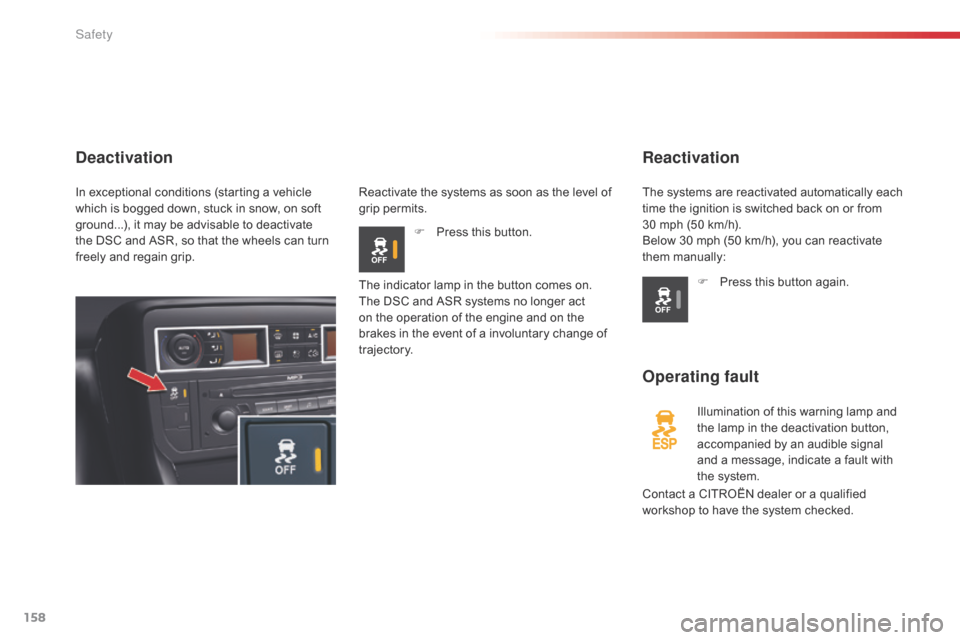
Reactivation
Operating fault
Illumination of this warning lamp and
the lamp in the deactivation button,
accompanied by an audible signal
and a message, indicate a fault with
the system.
Deactivation
Reactivate the systems as soon as the level of
grip permits.F
P
ress this button.
Contact a CITROËN dealer or a qualified
workshop to have the system checked.
The indicator lamp in the button comes on.
The DSC and ASR systems no longer act
on the operation of the engine and on the
brakes in the event of a involuntary change of
trajectory.
F
P
ress this button again.
The systems are reactivated automatically each
time the ignition is switched back on or from
30
mph (50 km/h).
Below 30 mph (50 km/h), you can reactivate
them manually:
In exceptional conditions (starting a vehicle
which is bogged down, stuck in snow, on soft
ground...), it may be advisable to deactivate
the DSC and ASR, so that the wheels can turn
freely and regain grip.
Safety
Page 161 of 344
159
C5_en_Chap06_securite_ed01-2014
DSC/ASR
The DSC and ASR systems offer increased
safety in normal driving, but they should not
encourage the driver to take extra risks or
drive at high speed.
It is in conditions of reduced grip (rain,
snow, ice) that the risk of loss of grip
increases. It is therefore important for your
safety to keep the DSC and ASR systems
activated in all conditions, and particularly
in difficult conditions.
The correct operation of these systems
depends on observation of the
manufacturer's recommendations regarding
as much the wheels (tyres and rims),
braking and electronic components as the
assembly and repair procedures used by
CITROËN dealers.To benefit in full from the effectiveness
of the DSC and ASR systems in wintry
conditions, the vehicle must be fitted with
four snow tyres, allowing the the vehicle to
retain neutral behaviour on the road.
After an impact, have these systems
checked by a CITROËN dealer or a
qualified workshop.
6
Safety