2015 Citroen C4 CACTUS Rear
[x] Cancel search: RearPage 204 of 326

202
C4-cactus_en_Chap09_info-pratiques_ed02-2014
Load reduction mode
System which manages the use of certain functions according to the level of charge
r
emaining in the battery.
When
the vehicle is being driven, the load
r
eduction function temporarily deactivates
c
ertain functions, such as the air conditioning,
t
he heated rear screen...
The deactivated functions are reactivated
automatically
as soon as conditions permit.System
which manages the duration of use of c
ertain functions to conserve a sufficient level
of
charge in the battery.
After
the engine has stopped, you can
s
till use functions such as the audio and
telematics
system, windscreen wipers, dipped
b
eam headlamps, courtesy lamps, etc. for
a
maximum combined duration of about
f
orty minutes.
Energy economy mode
Switching to economy mode
A message then appears in the instrument p
anel screen indicating that the vehicle has
s
witched to economy mode and the active
f
unctions are put on standby.
If
a telephone call is being made at this time,
i
t will be maintained for around 10 minutes
w
ith the Bluetooth hands-free system of your
a
udio system.
Exiting economy mode
These functions are reactivated automatically n ext time the vehicle is driven.
In order to restore the use of these functions
immediately,
start the engine and let it run:
-
f
or less than ten minutes, to use the
e
quipment for approximately five minutes,
-
f
or more than ten minutes, to use the
e
quipment for up to approximately
t
hirty minutes.
Let
the engine run for the duration specified to
e
nsure that the battery charge is sufficient.
do n
ot repeatedly and continuously restart the
engine
in order to charge the battery.
A
flat battery prevents the engine from
s
tarting (refer to the "Battery" section).
Practical information
Page 207 of 326

205
C4-cactus_en_Chap09_info-pratiques_ed02-2014
Towing another vehicle
F On the rear bumper, press the bottom of t
he cover to unclip it.
F
S
crew the towing eye in fully.
F
I
nstall a towing arm.
F
S
witch on the hazard warning lamps on
b
oth vehicles.
F
M
ove off gently and drive slowly over a
s
hort distance only.
F
O
n
the
front
bumper,
press
at
the
bottom
of
t
he
cover
to
unclip
it.
F
S
crew
the
towing
eye
in
fully.
F
I
nstall
a
towing
arm.
F
P
ut
the
gear
lever
into
neutral
(control
N for
an
electronic
gearbox).
Towing the vehicle
Failure to follow this instruction could
lead to damage to certain components
(
brakes, transmission, ...) and the
a
bsence of braking assistance on
r
estarting the engine. F
U
nlock the steering by turning the ignition
k
ey one notch and release the parking
b
rake.
F
S
witch on the hazard warning lamps on
b
oth vehicles.
F
M
ove off gently and drive slowly over a
s
hort distance only.
9
Practical information
Page 209 of 326

207
C4-cactus_en_Chap09_info-pratiques_ed02-2014
Driving advice
Distribution of loads
F distribute the load in the trailer so that the heaviest items are as close as
p
ossible to the axle and the nose weight
a
pproaches the maximum permitted
w
ithout exceeding it.
ai
r density decreases with altitude, thus
reducing
engine per formance. Above
1 0
00 metres, the maximum towed load must
b
e reduced by 10 % for every 1 000 metres of
al
titude.
Side wind
F Take into account the increased sensitivity t
o side wind.
Cooling
Towing a trailer on a slope increases the temperature of the coolant.
As
the fan is electrically controlled, its cooling
c
apacity is not dependent on the engine speed.
F
T
o lower the engine speed, reduce your
s
peed.
The
maximum towed load on a long incline
d
epends on the gradient and the ambient
t
emperature.
In
all cases, keep a check on the coolant
t
emperature. F
I
f the warning lamp and the
S
TOP
warning lamp come on,
s
top the vehicle and switch off
the
engine as soon as possible.
Braking
Towing a trailer increases the braking distance.
T o avoid overheating of the brakes on a long
m
ountain type of descent, the use of engine
b
raking is recommended.
Ty r e s
F Check the tyre pressures of the towing v
ehicle and of the trailer, observing the
re
commended
p
ressures.
Lighting
F Check the electrical lighting and signalling o
n the trailer.
Refer to the "Technical data" section for details
of
the
weights
and
towed
loads
which
apply
to
y
our
vehicle.
When
not
towing
a
trailer,
remove
the
q
uickly-detachable
tow
ball
before
d
riving. The
rear parking sensors will be
d
eactivated automatically if a genuine
C
ITROËN towbar is used.
9
Practical information
Page 213 of 326
211
C4-cactus_en_Chap09_info-pratiques_ed02-2014
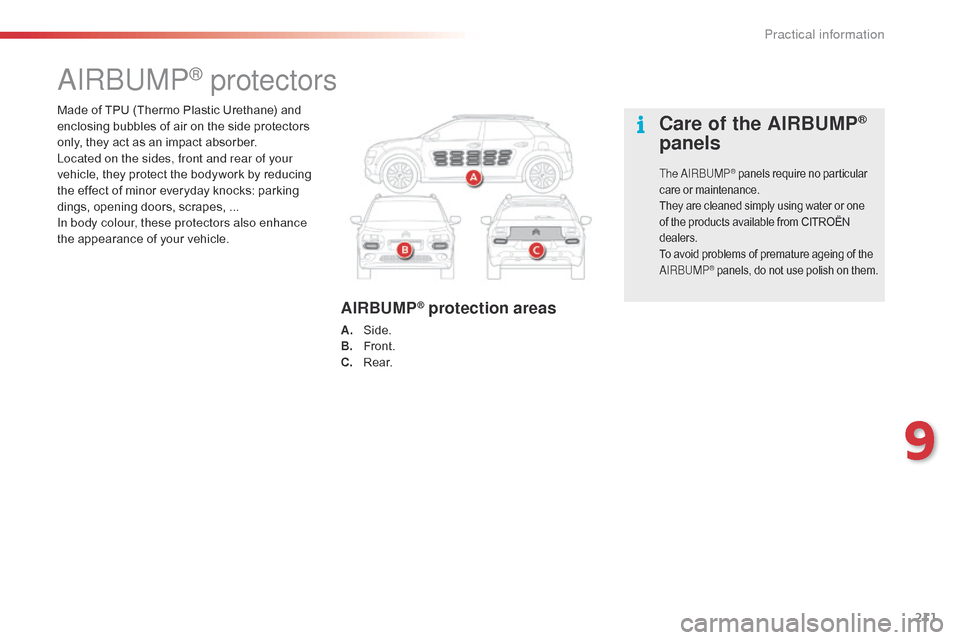
Made of TPU (Thermo Plastic Urethane) and enclosing bubbles of air on the side protectors
o
nly, they act as an impact absorber.
Located on the sides, front and rear of your
vehicle,
they protect the bodywork by reducing
t
he effect of minor everyday knocks: parking
d
ings, opening doors, scrapes, ...
In body colour, these protectors also enhance
the
appearance of your vehicle.
aIRbUMP® protectors
AIRBUMP® protection areas
A. Side.
B. Fr
ont.
C.
R
e a r.
Care of the AIRBUMP®
panels
The aIRb UMP® panels require no particular c
are o
r m
aintenance.
They
are
cleaned simply using water or one
o
f
the
products
available from CITROËN
d
ealers.
To
avoid
problems of premature ageing of the
aI
R
b
UM
P
® panels, do not use polish on them.
9
Practical information
Page 214 of 326

212
C4-cactus_en_Chap09_info-pratiques_ed02-2014
accessories
A wide range of accessories and genuine parts is available from the CITROËN dealer network.
T hese accessories and parts are all suitable for your vehicle and benefit from CITROËN's recommendation and warranty.
"Comfort"
door deflectors, side sun blinds, insulated
module, coat hanger fixed to head restraint,
m
obile reading lamp, front and rear parking
s
ensors, portable ashtray, scented air
freshener,
blind for sunroof...
"Transport systems"
boot carpet, boot liner, boot net, boot spacers,
transverse roof bars, ski carrier, roof box,
t
owbar, towbar wiring harness, bicycle carrier...
"Styling"
Leather gear lever knob, aluminium foot rest, alloy wheels, front spoiler, rear diffuser, exterior
e
xpressive
s
tickers...
"Security and safety":
Anti-intrusion alarm, vehicle tracking system, first aid kit, fire extinguisher, warning triangle,
h
igh visibility vest, wheel security bolts, snow
c
hains, non-slip covers, front foglamp kit, dog
g
uard, pet seat belt, seat belt cutter/glass
h
ammer...
"Protection"
Mats*, seat covers, mud flaps, vehicle cover, b oot...
If
a
towbar
and
wiring
harness
are
f
itted outside the CITR
oËn
dealer
network,
the
installation
must
be
done
s
trictly
in
line
with
the
manufacturer's
r
ecommendations. *
T
o avoid any risk of jamming the pedals:
-
e
nsure that mats are correctly positioned
a
nd secured,
-
n
ever fit one mat on top of another.
Practical information
Page 215 of 326
213
C4-cactus_en_Chap09_info-pratiques_ed02-2014
The fitting of electrical equipment or accessories which are not
recommended
by CITROËN may result
i
n a failure of your vehicle's electronic
s
ystem and excessive electrical
c
onsumption.
Contact a CITR
oËn
dealer
for
information on the range of
r
ecommended equipment and
a
ccessories.
Installation of radio
communication
transmitters
Before installing any after-market radio communication transmitter, you can
c
ontact a CITR
oËn
dealer for the
specification
of transmitters which can
b
e fitted (frequency, maximum power,
a
erial position, specific installation
requirements),
in line with the Vehicle
E
lectromagnetic
C
ompatibility
D
irective (2004/104/EC). Depending
on the legislation in force in
t
he country, certain safety equipment
m
ay be compulsory: high visibility s
afety vests, warning triangles, b
reathalyzers, spare bulbs, spare fuses,
fire
extinguisher, first aid kit, mud flaps
a
t the rear of the vehicle.
"Multimedia"
Bluetooth hands-free system, portable satellite navigation system, driving assistance systems,
s
martphone carrier, DVD player, CD player,
2
30 V socket, semi-integral satellite navigation
s
ystem, rear multimedia carrier, navigation
m
apping updates, aftermarket digital radio...
By
visiting a CITROËN dealer you can also
o
btain cleaning and maintenance products
(
interior and exterior) - including ecological
p
roducts in the "TECHNATURE" range,
p
roducts for topping up (screenwash...), paint
t
ouch-up pens and aerosols for the exact
c
olour of your vehicle, refills (sealant cartridge
f
or the temporary puncture repair kit...), ...
9
Practical information
Page 216 of 326
214
C4-cactus_en_Chap09_info-pratiques_ed02-2014
Advice on care and maintenance
Recommendations on the care and maintenance your vehicle are given in the maintenance and warranty guide.
T he headlamps have polycarbonate
l
enses, finished with a protective
l a c q u e r.
Do
not clean them with a dry or
a
brasive cloth, nor with detergent or
so
lvent
pro
ducts.
Use
a sponge and soapy water.
The
use of a high pressure jet wash
f
or cleaning the headlamps, lamps
a
nd their surrounds may damage the
l
acquer and seals.
Observe
the recommendations on
p
ressure and distance for jet washing.
First clean persistent stains with a
sponge
and warm soapy water.For
the care of the stickers in the rear
d
oor glasses, we recommend the
fo
llowing:
-
U
se a wide jet at a temperature of
b
etween 25°C and 40°C.
-
W
here possible, direct the jet at
r
ight angles to the stickers.
Leather
Care of the expressive stickers
These styling stickers are treated to give good resistance to ageing and tearing.
They
have been designed to allow you to
c
ustomise your vehicle's bodywork.
When
using a high pressure jet wash, keep the
e
nd of the lance at least 30 centimetres from
t
he stickers
Leather
is
a
natural
product.
Appropriate
r
egular
care
and
cleaning
is
essential
for
its
du
rability.
Refer
to
your
vehicle's
maintenance
and
w
arranty
guide
for
information
on
the
special
p
recautions
to
observe.
Headlamps and lampsCare of the AIRBUMP® panels
The aIRb UMP® panels require no particular c
are o
r m
aintenance.
They
are
cleaned simply using water or one of
t
he
products
available from CITROËN dealers.
To
avoid
problems of premature ageing of the
a
I
R
b
UM
P
® panels, do not use polish on them.
Practical information
Page 232 of 326

230
C4-cactus_en_Chap11_caracteristiques-techniques_ed02-2014
Identification markingsVarious visible markings for the identification of your vehicle.
A.
V
ehicle Identification Number (VIN)
under the bonnet.
T
his number is engraved on the chassis
n
ear the right hand front wheel arch. The
tyre pressures must be checked
w
hen the tyres are cold, at least once
a
month.
If the tyre pressures are too low, this
increases
fuel consumption.
C.
M
anufacturer's label.
T
his self-destroying label on the middle
d
oor pillar, right or left hand side, contains
th
e
f
ollowing
i
nformation:
-
t
he manufacturer's name,
-
t
he European whole vehicle type
a
pproval number,
-
t
he vehicle identification number (VIN),
-
t
he maximum authorised weight (gross
ve
hicle
w
eight),
-
t
he maximum authorised weight with
t
railer (gross train weight),
-
t
he maximum front axle weight,
-
t
he maximum rear axle weight.D.
T
yre/paint label.
T
his label on the middle door pillar, driver's
s
ide, contains the following information:
-
t
he tyre inflation pressures, laden and
unladen,
-
t
he tyre sizes (including the tyre load
i
ndex and speed rating),
-
t
he inflation pressure for the spare
wheel,
-
t
he paint colour code.
B.
V
ehicle Identification Number (VIN) on
the windscreen lower cross member.
T
his number is indicated on a self-
adhesive
label which is visible through
t
he windscreen.
Technical data