2015 AUDI TT ROADSTER traction control
[x] Cancel search: traction controlPage 143 of 244
Intelligent technology Notice about data
recorded by vehicle
control modules
Your vehicle is not equipped with an Event Da
ta Recorder (EDR), installed by some manu
facturers for the express purpose of capturing
data for retrieval after an accident or crash
event. EDR's are sometimes called "crash re
corders".
Some state laws restrict the retr ieval or down
loading of data stored by EDR's that were in
stalled in a vehicle for the express purpose of
retrieving data after an accident or crash
event without the owner's consent.
Although your vehicle is not equipped with an
EDR, it is equipped with a number of electron
ic control modules for various vehicle systems
such as, for examp le, engine function, emis
sion control, as well as for the airbags and
safety belts.
These electronic control modules also record
vehicle-related data during norma l vehicle op
eration for diagnostic and repair purposes.
The recording capacity of the electronic con
trol modules is limited to data (no sound is re
corded) and only a small amount of data is ac
tually recorded over a very limited period of
time and stored when a system fault or other
condition is sensed by a control unit. Some of
the data then stored may relate to vehicle
speed, direction, braking as we ll as restraint
system use and performance in the event of a
crash or other condition. Stored data can only be read and downloaded with special equip
ment.
Electronic Stabilization
Control (ESC)
Description
ESC helps to improve road holding and vehicle
dynamics to help reduce the probability of
skidding and loss of veh icle control. It works
only when the engine is running. ESC detects
Intelligent technology 141
certain difficult driving situations, including
when the vehicle is beginning to spin (yaw)
out of control and helps you to get the veh icle
back under control by se lectively braking the
wheels, and/or reducing engine power and
providing steering ass istance to help hold the
vehicle on the driver's intended course. The in
dicator light
B.J in the instrument cluster
blinks when ESC is taking action to help you
control the vehicle.
ESC has limitations .
It is important to remem
ber that ESC cannot overcome the laws of
physics.
It will not always be able to help out
under all conditions you may come up against.
For example, ESC may not always be able to
help you master situations where there is a
sudden change in the coefficient of friction of
the road surface. When there is a section of dry road that is suddenly covered with water,
slush or snow, ESC cannot perform the same
way it would on the dry surface. If the vehicle
hydroplanes (rides on a cushion of water in
stead of the road surface), ESC will not be
able to help you steer the vehicle because con
tact with the pavement has been interrupted
and the vehicle cannot be braked or steered .
During fast cornering, particularly on winding
roads, ESC cannot always deal as effectively
with difficu lt driving situations as at lower
speeds.
Always adjust your speed and driving style to
road, traffic §&and weather conditions. ESC
cannot override the vehicle's physical limits,
increase the available traction, or keep a vehi
cle on the road if road departure is a result of
driver inattention. Instead, ESC improves the
poss ibility of keeping the vehicle under con
trol and on the road dur ing extreme maneu
vers by usin g the driver's steering inputs to
help keep the vehicle going in the intended di
rection. If you are traveling at a speed that
causes you to run off the road before ESC can
provide any assistance, you may not experi
ence the benefits of ESC.
ESC includes and/or works together with the
anti- lock brake system (ABS), brake assist sys -
tem and anti-slip regu lation (ASR). ESC is
Ill>
•
•
Page 144 of 244
142 Intelligent technology
switched on all the time. In certain situations
when you need less traction, you can switch
off ESC by pressing the button
l!l . Be sure to
switch ESC on again when you no longer need
less traction.
Anti -toc k brak ing system (ABS)
ABS prevents the wheels from lock ing up
when braking . The vehicle can still be steered
even during hard brak ing . Apply steady pres
sure to the brake pedal. Do not pump the ped
al. A puls ing in the brake pedal ind icates that
the system is he lp ing you to brake the vehicle .
Brake assist sy stem
The brake assist system can decrease braking
d istance. It increases braking power when the
driver presse s the brake pedal quickly in emer
gency si tuations. You must press and hold the
brake peda l until the situation is over .
Anti-slip regulation (ASR)
ASR reduces engine power when the drive
wheels begin to spin and adapts the force to the road conditions . This makes it easier to
start, accelerate and drive up hills.
E lectronic differential lock (EDL )
The ED L brakes wheels that are spinning and
transfers the drive power to the other drive
wheel or whee ls if the vehicle is equipped with
all-wheel drive*. This function is available up
to about 60 mph (100 km/h) .
In extreme cases, EDL a utomatica lly switches
off to help keep the brake on the braked whee l
from overheating. EDL will switch on aga in au
tomatically when conditions have returned to normal.
A WARNING
- ESC, ABS, ASR and ED L can not ove rcome
t h e laws of phy sics. This is espe cial ly im
por tant on slip pery or wet ro ads .
If th e
sys tems begin a ct in g to stab ilize your ve
hicle, you shou ld imme diately change
yo ur speed to match the road and traffic
condit ions. Do not let the inc reased safe
ty provided by these systems tempt you to take risks. Do
ing so w ill increase the
risk of a loss of veh icle control, co llision
and serious pe rsonal injuries .
- Always adapt your speed to road, traffic
and weather conditions. The risk of los
ing control of t he vehicle increases when
driving too fast, espec ially through
curves and on slippe ry or wet roads, and
wh en dr iv ing too clos e to vehicl es u p
ahead. ESC, A BS, the brake ass ist sys
tem, ED L and ASR cannot p reven t coll i
si ons .
- Always acceler ate wi th sp ecial c are on
even, smoo th s urfaces such as those th at
are wet or covered with ice and snow .
The drive wheels can spin even with
these assistance systems that cannot al ways he lp to reduce the risk of loss of ve
h icle co ntrol.
(D Tips
- ABS an d ASR only wo rk correct ly when
all four whee ls are equipped with identi
cal tires . D ifferent tire si zes can lead to a
reduction in engine powe r.
- Yo u may hear noises when the systems
descr ibed are working.
- If the ind icator light Ii) or II (USA
mode ls)/ Ei] (Canada models) appears,
there may be a malfunction
¢ page 18,
¢ page 17.
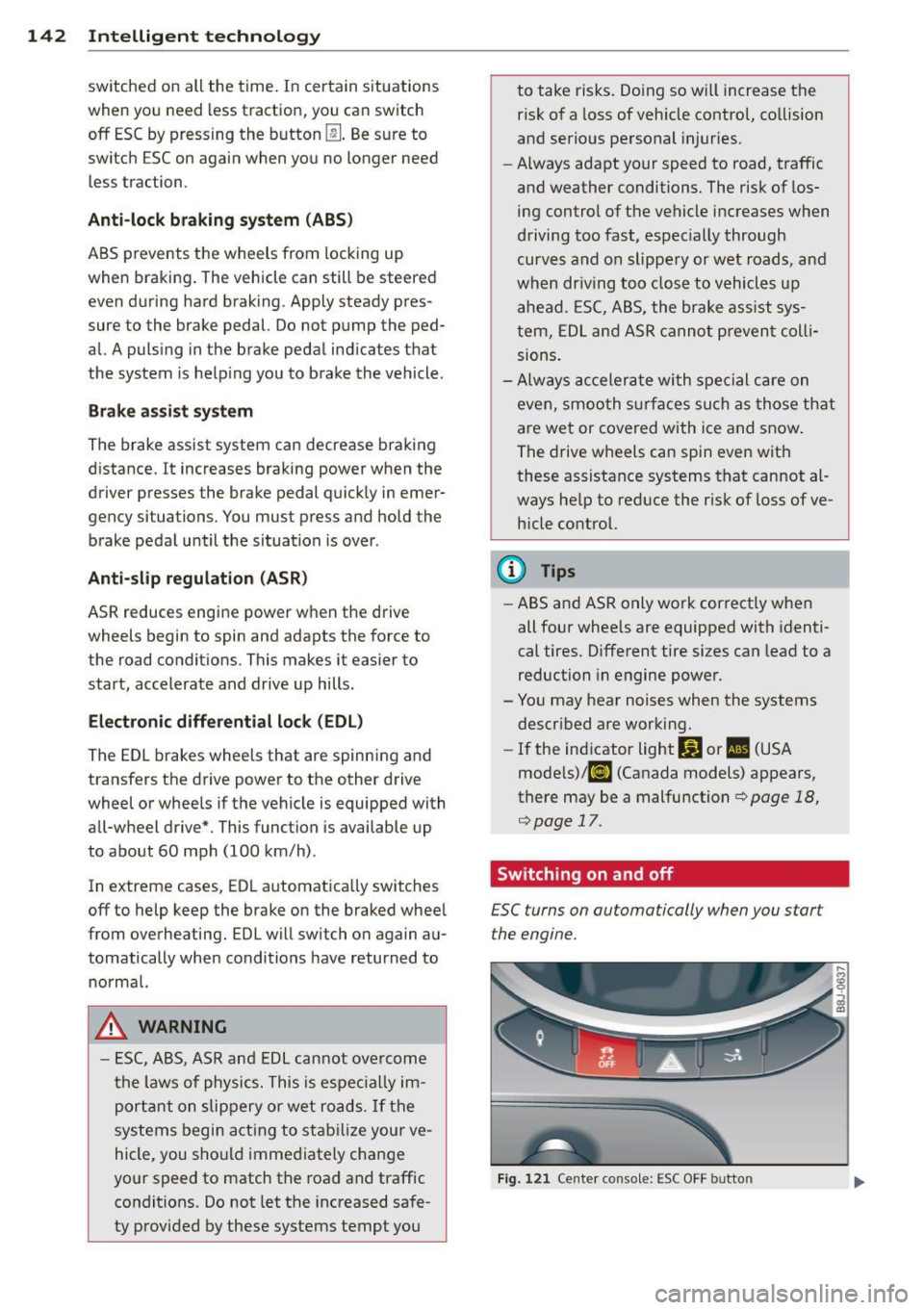
Switching on and off
£SC turns on automatically when you start
the engine.
Fig . 12 1 Ce nte r conso le: ESC OFF b utto n
Page 145 of 244
Switching ESC off (sport mod e)
I n ce rtain sit uat ions, it m ight make sense to
allow some slip. For example :
- Rocking the vehicle to free it when it is stuck
- Driving in deep snow or on loose ground
- Driving with snow cha ins
Press the[!] button . The ESC ind icator light
II turns on and Stab iliz ation p rogr am off
appears in the display. ASR deactivates com
p letely and the stabilizat ion effects from the
ESC system are lim ited .
Sw itchin g on
Press the[!] button again. The message
Sta b i
liz ation p rog ram on
appears briefly in the dis
p lay.
A WARNING
Only switch ESC sport mode on when your
driving abilities and the traffic s ituation
permit . Please note that the dr iv ing
w heels can spin and the vehicle can break
away in ESC sport mode, especia lly when
t he road is slippery.
(D Tips
If the re a re faults in the rear spo iler sys
tem or in Audi magnet ic r ide, it may not be
possible to act ivate ESC sport mode o r
normal mode may act ivate aga in a utoma t
ically.
Rear spoiler
Appl ies to vehicles: with retractable rear spoiler
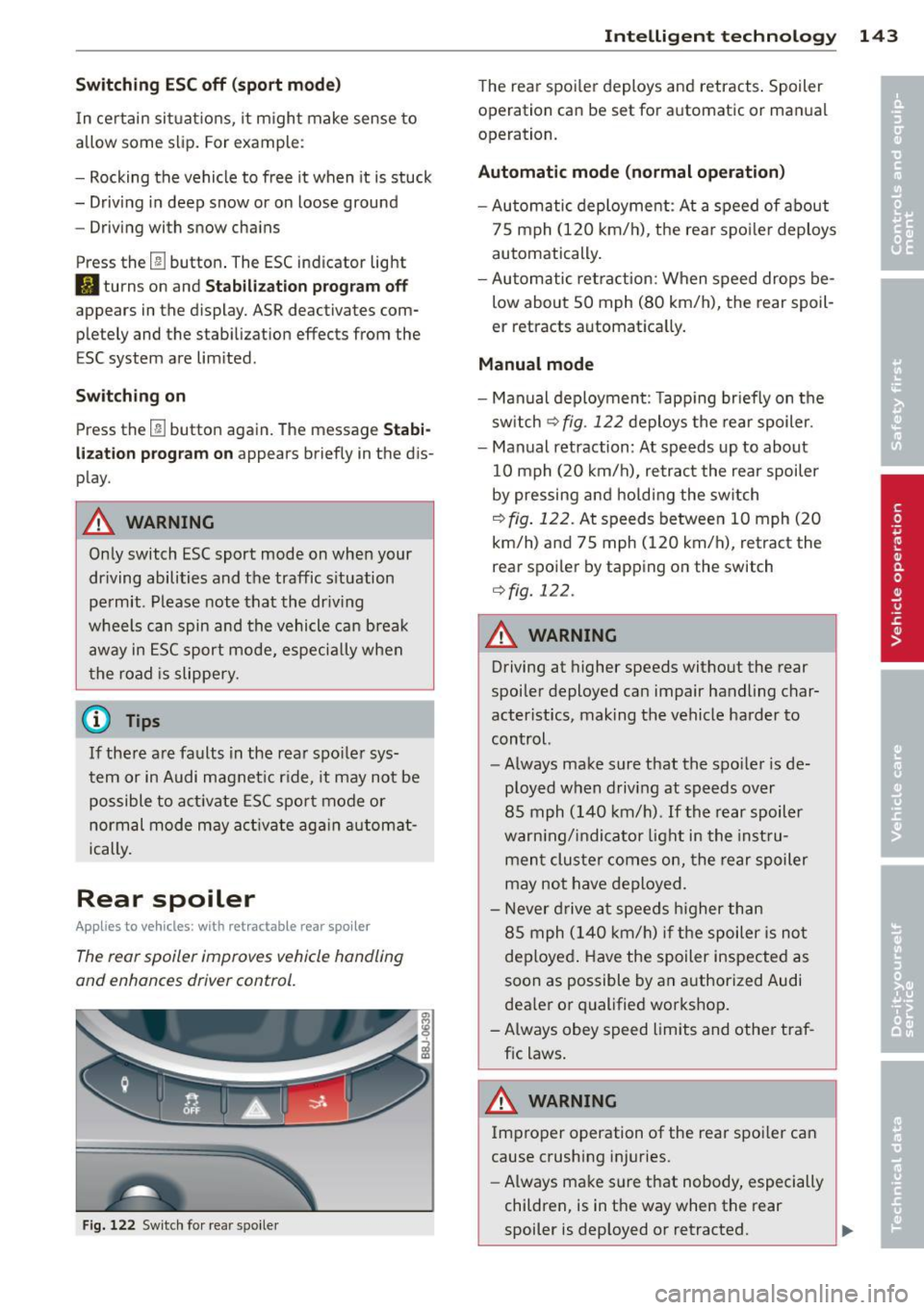
The rear spoiler improves vehicle handling
and enhances driver control.
Fig. 122 Switch for rear spo ile r
Intelligen t technolog y 143
The rear spoi ler deploys and retracts . Spoiler
operation can be set for automatic or man ual
operation.
Aut omatic mode (normal ope ration )
- Automatic deployment : At a speed of about
75 mph (120 km/h), the rea r spo ile r deploys
automatically .
- Au tomatic retraction: When speed drops be
low about SO mph (80 km/h), the rear spoil
er retracts a utomatica lly.
Manual mode
- Man ual deployment : T app ing br iefly on the
sw itch
¢ fig . 122 deploys the rear spoiler.
- Manual retraction : At speeds up to about
10 mph (20 km/h), retract the rear spoiler
by pressing and holding the sw itch
¢ fig. 122. At speeds between 10 mph (20
km/h) and 75 mph (120 km/h), retract the
rear spoi ler by tapping on the switch
¢ fig. 122 .
A WARNING
-
Driving at higher speeds without the rear
spoiler deployed can impair handling char
acter istics, making the vehicle harder to
control.
- Always make su re that the spo ile r is de
ployed when driving at speeds over
85 mph (140 km/h) . If th e rear spoil er
warn ing/ indicator light in the inst ru
men t cluster comes on, the rear spoiler
may not have deployed.
- Never d rive a t speeds higher than
85 mph (140 km/h) i f th e spoiler is not
deployed . Have the spoiler inspected as
soon as possible by an authorized Audi
dea ler or qualified workshop.
- A lways obey speed limits and other traf
fic laws .
A WARNING
Improper operation of the rear spoi ler can
cause crushing injuries .
- Always make sure that nobody, especially
children, is in the way when the rear
spoiler is dep loyed or retracted.
Page 183 of 244
-Never mount used tires on yo ur vehicle if
yo u are not sure of their "previous histo
ry." Old used tires may have been dam
aged even though the damage cannot be
seen that can lead to sudden tire failure
and loss of vehicle control.
- If you notice unusual vibration or if the
vehicle pulls to one side when d riving, al
ways stop as soon as it is safe to do so
and check the wheels and tires for dam
age .
(D Note
-Please note that summer and winter
tires are designed for the cond itions that
are typ ic al in those seasons. Aud i recom
mends using w inter t ires du ring the win-
Glossary of tire and loading terminology
Accessory weight
means the comb ined weight (in excess of
those standard items which may be replaced)
of automatic tra nsmission, power steering,
power brakes, power windows, power seats,
radio, and heater, to the extent that these
items are availab le as factory-installed equip
ment (whether installed or not) .
Aspect ratio
means the ratio of the height to the width of
the tire in percent . Numbers of 55 or lower in
d icate a low sidewall for improved steering re
sponse and better overall handling on dry
pavement .
Bead
means the pa rt of the ti re that is made of
steel wires, wrapped or reinforced by ply cords
and that is shaped to fit the rim.
Bead s eparation
means a b reakdown of the bond between
components in the bead.
Cord
means the strands forming the plies in the
tire.
Tire s an d wheel s 181
ter months . Low temperatu res signifi
cantly decrease the elastic ity of summer
t ires, which affects traction and braking
ability. If summer tires are used in very
co ld temperatures, cracks can form on
the tread bars, res ulting in permanent
ti re damage that can cause loud drivi ng
noise and unbalanced tires. Aud i is not
responsib le for this type of damage.
- Burn ished, polished or chromed rims
must not be used in winter weather. Th e
surfa ce of the rims does not have suffi
c ien t cor rosion pro te cti on for this and
c o ul d be pe rmanen tly damaged by road
salt or similar substances. This damage
is not covered by warranty.
Cold tir e inflation pressure
me ans the t ire press ure re commended by the
vehicle manufacturer fo r a tire o f a des igna ted
size that has not bee n driven for more than a
coup le of miles (k ilomete rs) at low speeds in
the three hour pe riod before the tire press ure
is measured or adjusted.
Curb weight
means the weight o f a motor vehicle with
standard equipment including the maximum
capacity of fuel, o il, and coolant, air cond i
tion ing and additional weight of optiona l
equipment.
E xtra load tire
means a tire designed to operate at higher
l oads and at higher inflation press ures than
the corresponding standard tire. Extra load
tires my be ident ified as "XL", "xl", "EXTRA
LOAD", or "RF" on the sidewall.
Gross Axle Weight Rating ("GAWR")
means the load-carrying capacity of a single
axle system, measured at the tire-ground in-
ter~ces.
~
•
•
Page 193 of 244
A WARNING
Sudden tire failure can lead to loss of con
trol, a crash and serious personal injury!
- Never drive a vehicle when the tread on
any tire is worn down to the wear indica
tors.
- Worn tires are a safety hazard, they do
not grip well on wet roads and increase
your risk of "hydroplaning" and loss of
control.
- Always keep chemicals that can cause
tire damage, such as grease, oil, gasoline
and brake fluid away from t ires.
- Tires age even if they are not be ing used
and can fail suddenly, especially at high
speeds . Tir es that are more than 6 years
old can only be used in an emergency
and then with special care and at lower
speeds.
- Never mount used tires on your vehicle if
you are not sure of their" previous histo
ry ." Old used tires may have been dam
aged even though the damage cannot be
seen that can lead to sudden tire failure
and loss of vehicle control.
Tires and wheels 191
New tires and replacing tires and wheels
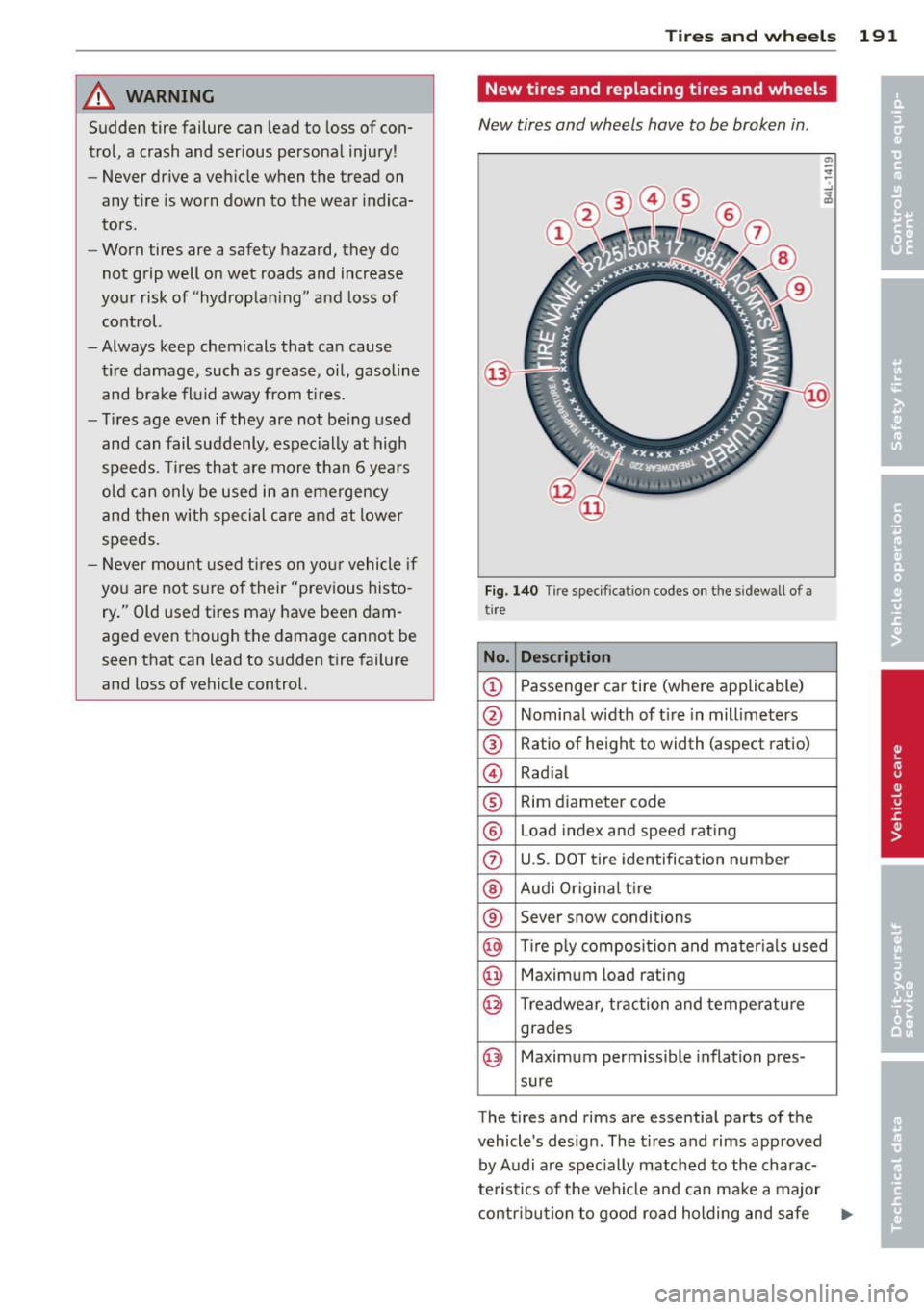
New tires and wheels have to be broken in .
Fig. 140 Tir e specificat ion codes on t he s idewall o f a
tire
No. Description
@ Passenger car tire (where applicable)
@ Nominal width of tire in millimeters
@ Ratio of height to width (aspect ratio)
© Radial
® Rim diameter code
® Load index and speed rating
0 U.S. DOT tire identification number
® Audi Original tire
® Sever snow conditions
@ Tire ply composition and mater ials used
@ Maximum load rating
@ Treadwear, traction and temperature
grades
@ Maximum permissible inflation pres-
sure
The tires and rims are essential parts of the
vehicle's design . The tires and rims approved
by Audi are spec ially matched to the charac
teristics of the vehicle and can make a major
contribution to good road holding and safe .,.
Page 196 of 244
194 Tire s and wheel s
Driving with different tires reduces vehi
cle handling and can lead to a loss of
co ntrol.
- If the spare tire is not the same as the
t ires that are mounted on the veh icle -
for example with winter tires - on ly use
the spare tire for a short period of time
and dr ive with extra ca re. Refit the nor
ma l road whee l as soon as safely possi
ble.
- Never drive faste r than the maximum
speed for which the tires o n your veh icle
are ra ted because ti res th at are driven
faster than their rated speed can fail
sudden ly .
- Over loading t ires c ause heat b uild- up,
sudden tire failure, including a blowout
and sudden deflation and loss of control.
- T emperature grades app ly to tires t hat
are properly inflated and not over o r un
derinflated.
- F or technical reasons it is not a lways
possible to use wheels from other
vehicles -in some cases not even w heels
from the same vehicle model.
- If you insta ll wheel trim discs on t he ve
hicle whee ls, make sure that the air f low
to the brakes is not blocked. Reduced air
flow to the brakes can them to overheat, increasing stopping distances and caus
ing a collision.
- Run flat t ires may on ly be used on
vehicles that were equ ipped w it h them
at the facto ry. The vehicle must have a
chassis des igned for run f lat t ires and a
fac to ry-installed t ire p ress ure moni to r
ing system that ind ic a tes a loss of tire
pressure. Incorrect use of run flat tires
can lead to vehicle damage or accidents .
Check with an a uth orized Audi dea ler or
t i re spec ialist to see i f your vehicle can be
equipped with run flat tires. If r un flat
t ires a re used, they must be installed on
all four wheels . M ixing tire types is not
permitted . (D Note
-For technical reasons, it is not generally
poss ible to use the w heel rims from oth
er ve hicles. T his can hold tr ue for wheels
of the same vehicle type.
- If the spare tire is diffe rent from the
tires that you have mounted on your ve
hicle (for example winter tires or wide
profi le tires), then use the spare tire for a
short period of time only and drive w ith
extra care. Replace the flat tire w it h the
ti re mat ching the othe rs on your vehicle
as soon as possi ble.
- N ever d rive without the valve stem cap.
T he v alves co ul d get damaged.
@ For the sake of the environment
Dis pose of o ld tires in accordance w ith the
l ocal requirements.
Uniform tire quality grading
- Tread wear
- Tra ction AA A B (
- Temperature ABC
Quality grades can be found where applicab le
o n the tire s ide wall between tread shoulder
and maximum section width
¢ page 191,
fig . 140 .
For example: Tread wear 200 , Traction AA,
Temperature A.
All passenger car ti res must conform to Feder
al Safety Req uirements in add ition to these
grades .
Tread wear
The tread wear g rade is a comparative rating
based on the wear rate of the tire when tested
u nder contro lled conditions o n a specified
government test course.
F o r example, a tire gra ded 150 wo uld wear
one and one ha lf (11/2) times as well on the
government course as a ti re graded 100.
Page 197 of 244
The relative perform a nee of ti res depends
upon the actua l conditions of their use, how
ever, and may depart sign ificantly from the
norm due to var iat ions in dr iving habits, serv
ice practices and differences in road character
istics and climate .
Trac tion
The traction grades, from highest to lowest,
are AA, A, Band
C. Those grades represent the
tire's ability to stop on wet pavement as measured under controlled cond itions on
specified government test surfaces of asphalt
and concrete . A tire marked C may have poor
traction performance ¢,&. .
Temp erature
The temperature grades are A (the h ighest),
B, and
C, representing the t ire's resistance to
the generat ion of heat and its ability to dissi
pate heat when tested under controlled condi
tions on a specified i ndoor laboratory test
wheel.
Sustained high temperature can cause the
materia l of the tire to degenerate and reduce
tire life, and excessive temperature can lead
to sudden ti re fa ilu re ¢ ,&. .
The grade
C corresponds to a level of perform
ance which all passenger car tires must meet
u nder the Federa l Moto r Veh icle Safety Stand
a rd No.
1 09. G rades Band A represent h igher
l eve ls of perfo rmance on the laboratory tes t
wheel than the m inimum required by law .
A WARNING
The traction grade assigned to this ti re is
based on stra ight-ahead b raking t raction
tests, and does not include acceleration,
cornering, hydrop lan ing or peak traction
character istics.
A WARNING
The temperature grade for this t ire is es
tablished for a t ire that is p roperly inflated
and not overloaded. Excessive speed, un
derinflation, or excessive loading, either
-
Tire s an d wheel s 195
separately or in combinat ion, can ca use
heat bui ldup and possible tire failure.
Winter tires
Winter tires can improve vehicle handling on
snow and ice. At temperatures below 45 °F (7 °C) we recommend changing to winter
tires.
In some heavy snow areas, local governments
may require true winter o r "snow" tires, those
with very deeply cut tread. These tires should
o nly be used in pairs and be installed o n all
four wheels . Make sure you purchase snow
t ires that are the same size and construction
type as the other tires on you r vehicle.
If your vehicle is equipped w ith all-whee l
drive*, th is w ill improve traction during winter
driv ing, even with the standa rd tires. Howev
er, we stro ngly recommend that you always
equip all fou r whee ls o n your veh icle w ith co r
rect ly fi tted winter tires o r all-season tires,
when w inter road condit ions are expe cted .
T his also improves the veh icle's b raking per
formance and reduces stopping distances.
Summe r tires provide less grip on i ce and
snow.
Winter tires (snow tires) must always be fitted
o n all fo ur wheels .
Ask your authorized Audi dealer or qualified
workshop for permitted
winter tire size s. Use
o nly rad ial w inter t ires.
Winter tires lose their effectiveness when the
tread is worn down to a depth of
0 .157 inch
(4 mm) .
Only drive w ith w inter t ires under w inter con
dit ions. Summer t ires handle better when
there is no snow or ice on the roads and the
temperature is above 45 °F (7 °() .
If you have a flat tire, see notes on spare
whee l
¢page 191.
Please a lways remember that winter tires may
have a lowe r speed rating than the tires o rigi -
nally installed on your vehicle at the time it .,.
•
•