2015 AUDI S7 service
[x] Cancel search: servicePage 148 of 316

146 Safety belts
,8. WARNING
Improper care, servicing and repair proce
dures can increase the risk of personal in
jury and death by preventing a safety belt
pretens ioner from act ivat ing when needed
or act ivat ing it unexpectedly:
- The belt pretensioner system can be acti
vated only once. If belt pretens ioners
have been act ivated, the system must be
replaced.
- Never repair, adjust, or change any parts
of the safety belt system.
- Safety belt systems includ ing safety be lt
pretensione rs cannot be repaired. Spe
ci al procedures are required for removal,
installation and disposal of this system.
- For any work on the safety belt system,
we strongly recommend that you see
your authorized Audi dealer or qualified
technician who has an Audi approved re
pair manual, training and specia l equip
ment necessary.
@ For the sake of the environment
Undep loyed airbag modu les and preten
sioners might be classified as Perchlorate
Material -specia l hand ling may apply, see
www.dtsc.ca.gov/haza rdou swaste/per
chlorate. When the vehicle or parts of the
restraint system including airbag modules
safety belts w ith pretens ioners are scrap
ped, all applicable laws and regulations
must be observed. Your authorized Aud i
deale r is familiar with these requ irements
and we recommend that you have your
dea ler perform this service for you.
Page 165 of 316
M N <( (.J
'SI: ,...., \!) 1.1"1 ,...., 1.1"1 ,....,
Repair, care and disposal of the airbags
Parts of the airbag system are installed at
many different places on your Audi. Installing,
removing, servicing or repairing a part in an
area of the vehicle can damage a part of an
airbag system and prevent that system from
working properly in a collision.
There are some important things you have to know to make sure that the effectiveness of
the system will not be impaired and that dis
carded components do not cause injury or pol lute the environment.
A WARNING
Improper care, servicing and repair proce
dures can increase the risk of personal in
jury and death by preventing an airbag from deploying when needed or deploying
an airbag unexpectedly:
- Never cover, obstruct, or change the
steering wheel horn pad or airbag cover
or the instrument panel or modify them
in any way.
- Never attach any objects such as cup
holders or telephone mountings to the
surfaces covering the airbag units.
- For cleaning the horn pad or instrument
panel, use only a soft, dry cloth or one
moistened with plain water. Solvents or
cleaners could damage the airbag cover
or change the stiffness or strength of the
material so that the airbag cannot de
ploy and protect properly.
- Never repair, adjust, or change any parts
of the airbag system.
- All work on the steering wheel, instru
ment panel, front seats or electrical sys
tem (including the installation of audio
equipment, cellular telephones and CB
radios, etc.) must be performed by a
qualified technician who has the training
and special equipment necessary.
- For any work on the airbag system, we
strongly recommend that you see your
authorized Audi dealer or qualified work
shop.
Airbag system 163
-Never modify the front bumper or parts
of the vehicle body.
- Always make sure that the side airbag
can inflate without interference:
- Never install seat covers or replace
ment upholstery over the front seat
backs that have not been specifically
approved by Audi.
- Never use additional seat cushions that
cover the areas where the side airbags inflate.
- Damage to the original seat covers or
to the seam in the area of the side air
bag module must always be repaired
immediately by an authorized Audi
dealer.
- The airbag system can deploy only once. After an airbag has been deployed, it must be replaced with new replacement
parts designed and approved especially
for your Audi model version. Replace
ment of complete airbag systems or air
bag components must be performed by
qualified workshops only . Make sure that
any airbag service action is entered in
your Audi Warranty
& Maintenance book
let under
AIRBAG REPLACEMENT RE
CORD.
- For safety reasons in severe accidents,
the alternator and starter are separated
from the vehicle battery with a pyrotech
nic circuit interrupter.
- Work on the pyrotechnic circuit inter
rupter must only be performed by a
qualified technicians who have the ex
perience, information and special tools
necessary to perform the work safely.
- If the vehicle or the circuit interrupter
is scrapped, all applicable safety pre
cautions must be followed.
@) For the sake of the environment
Undeployed airbag modules and preten
sioners might be classified as Perchlorate
Material - special handling may apply, see
•
•
Page 207 of 316

M N <( (.J
'SI: ,...., \!) 1.1'1 ,...., 1.1'1 ,....,
(D Note
-Be aware that just one tank fi lling with
le aded fuel will already seriously de
grade the performance of the catalytic
converter.
- Do not exceed the correct engine oil leve l
c>page229.
-Do not drive until the fuel tank becomes
complete ly empty. The engine could mis
fire. Unburned fuel could also get into
the exhaust system and this could cause
the catalyt ic converter to overheat.
- Do not switch off the ignition wh ile the
vehicle is moving .
- Do not continue to operate your vehicle
under these condit ions, as otherwise fuel
can reach the catalytic converter. This
could result in overheat ing of the con
verter, requ iring its replacement.
- To assure efficient operat ion of the Emis
s ion Control System:
- Have your vehicle maintained properly
and in accordance with the service rec
ommendations in your Warranty
&
Ma intenance booklet.
- Lack of proper maintenance as well as
improper use of the vehicle will impa ir
the funct ion of the emission control
system and could lead to damage .
@) For the sake of the environment
Even when the Emission Control System is
operating properly, the exhaust gas can
have a sulfur-like exhaust gas smell under
some operating states. This depends on
the s ulfur content of the fuel being used.
Using a d ifferent brand of fuel may help,
or filling the tank w it h lead-free super
grade gasoline .
Diesel particulate filter
Appl ies to vehicles : wit h diesel e ng in e
The diesel particulate filter fi lters nea rly a ll of
the soot part icles o ut o f the exhaus t. T he fi l
ter cleans itse lf automatically under normal
driving conditions . If the fi lter cannot clean it-
Drivin g and en vironm ent 205
self (for example, because you are on ly driving
short distances), the fi lter becomes clogged
with soot and the
II symbol for the diese l
particulate filter illuminates
c> page 21.
A WARNING
-Do not park your veh icle over flammable
mate ria ls such as grass or leaves because
the high temperature of the diesel par ticulate fi lter could start a fire.
- Do not apply an underbody protectant in
the exhaust system area or a fi re could
start.
Shutting down vehicle
If you would like your vehicle to rema in inop
erative for a longer per iod of t i me, contact an
Audi o r other spec iali zed dealer. They can ad
vise you on necessa ry precautions e.g. co rro
s ion p reven tion, maintena nce and s torage.
Pay attention to additional information con
cerning the battery . Refer to
c> page 235 .
Operate your vehicle
economically and
minimize pollution
General
Your personal style of driving will determine
the economy of your vehicle, as well as ex
haust and noise levels.
Fuel economy, environmenta l impact, and
wear on your engine, brakes and tires largely
depend on three factors:
- your personal d riving s tyle
- operati ng conditions
- technical limitat ions
If you ant ic ipate what you need to do next and
drive economically, you can easily cut your
fuel consumpt io n by 10-15 percent . T his sec
tion w ill give you some tips on how you can
help the env ironment and your poc ketbook. ..,_ •
•
Page 208 of 316

206 Driving and en vir onm ent
The consumption estimates as published
by ENVIRONMENTAL PROTECTION AGENCY
(EPA) and Transport Canada may not corre
spond to your actual consumption on the
road, which will vary depending upon vehi
cle load and speed, road and weather con
ditions, tr ip length, etc .
Drive smoothly and keep a lookout
ahead
Vehicles use the most fuel when they are ac
celerating.
• Avoid unnecessary accelerating and braking.
Vehicles use the mo st fuel when they are ac
celerating . If you anticipate what is go ing to
happen next, you will need to brake less and,
thus , accelerate less. Let the vehicle coast
wheneve r poss ible -for example when you see
that the next traffic l ight is red.
Avoid full throttle
Driving at moderate speeds saves fuel and
improves your mileage.
• Try and keep well below your car 's max imum
speed .
Accelerating gently reduces fuel consump
tion, engine wear, and does not disturb the
environment .
Fuel consumption, exhaust emissions and en
g ine no ise increase d isproportionately at high
speeds. If you dr ive at approximately three
quarters of top speed, fue l consumption will
be reduced by one half. Neve r dr ive faste r
than the posted speed limit and wea ther con
d itions permit.
Reducing unnecessary idling
Even when your car is just idling it burns up
fuel.
• Shut the engine off when you are not dr iv ing
the vehicle. •
Do not warm up the vehicle by letting the
engine run at id le .
T he id ling phase is automatically red uced for
vehicles with the Start -Stop -System . It is effi
cient to switch off the engine in vehicles with
out the Start-Stop -System when stopp ed at
railroad crossings and long red lights. Tu rning
the engine off for jus t 30-40 seconds saves
more fuel than is burned by starting the en-
. . gme again .
It takes a long time for the eng ine to warm up
fully when i t is running at idle. However, wear
and noxiou s emissions are espec ially high
when the eng ine is warm ing up . So you should
drive away as soon as you start the engine and
avo id running at high rpms while the engine is
still warming up.
W Note
Do not leave engine idling unattended af
ter start ing . If wa rning lights should come
on to indicate improper operation, they
wo uld go unheeded . Ex tended idling also
produces heat, wh ich could result in ove r
heating or other damage to the ve hicle or
other property .
Regular maintenance
A badly tuned engine unnecessarily wastes a
lot of fuel.
• Have your veh icle serviced at reg ular in ter -
vals .
By having your ve hicle regu la rly se rviced by an
Audi dealer he lps to ensu re tha t it runs p rop
erly and economically . The condition of your
vehicle not only affects its safety and ability to
ho ld its va lue, it also affects
fuel con sump
tion .
Check your oil e ach time you
fill y our tank.
The amount of o il used is re lated to engine
load and speed.
It is normal for the oil consumption of a new
engine to reach its lowest value after a certa in
mileage has bee n driven . ..,.
Page 209 of 316
You must drive your vehicle about 3,000 miles (5,000 ki lometers) before you can properly
assess o il consumption.
This also applies to fuel consumption and en
gine output.
(D Note
- Have yo ur vehicle maintained properly
and in accordance with the service rec
ommendations in your Warranty
& Main
tenance booklet. Lack of proper mainte
nance as well as improper use of the ve
hicle will impair the funct ion of the
emission control system and could lead
to damage .
- Do not alter or remove any component of
the Em ission Control System unless ap
proved by the manufacturer.
- Do not alter or remove any dev ice, such
as heat shields, switches, ignition wires,
valves, wh ich are designed to protect
your vehicle's Emission Control System
and other important veh icle compo
nents.
Fewer short trips
Fuel consumption will always be relatively
high on short trips .
.,. Try to avo id driving short distances with a
cold engine .
The engine and catalyt ic converter have to
reach their optimal
operating temperature to
reduce fuel consumption and noxious emis
sions effect ively.
Just after starting, a cold engine in a mid-size
car only achieves a fuel economy of 6 -8 miles
per gallon (30-40 l/100 km). After about a
half a mile, fuel economy climbs to 12 mpg
(20 l/100 km). Afte r abo ut
2.5 m iles (4 km),
the eng ine is at its proper operating tempera
ture and fue l economy has reached a normal
M leve l. So you can see that you should avoid N
j short trips whenever possible.
'SI: ,...., \!) 1.1'1 ,...., 1.1'1 ,....,
Driving and environment 207
The outside temperature is also critical in this
regard . Your car consumes more fue l in the
winter than in the summer.
•
•
Page 220 of 316

218 Fuel supply and filling your fuel tank
-Blend must contain not more than 15%
MTBE.
Seasonally adjusted gasoline
Many gasoline grades are blended to perform
espec ially we ll for winter or summer driv ing.
During seasonal change-over, we suggest that
you fill up at busy gas stat ions where the sea
sonal adjustment is more likely to be made in
time.
(CT) Note
- Methanol fuels which do not meet these
requirements may cause corrosion and
damage to plastic and rubber compo
nents in the fuel system .
- Do not use fuels that fai l to meet the
specified criteria in this chapter.
- If yo u are unable to determine whether
or not a particular fuel blend meets the
specifications, ask your service station or
its fuel sup plier.
- Do not use fuel for which the contents cannot be identified.
- Fuel system damage and performance
problems resulting from the use of fuels
different from those specified are not
the respons ibility of Audi and are not
covered under the New Vehicle or the Emission Control System Warranties.
- If you experience a loss of fuel economy
or driveability and performance prob l ems due to the use of one of these fuel
blends, we recommend that you switch
to unblended fuel.
Gasoline additives
A major concern among many auto manufac
turers is carbon deposit build- up caused by
the type of gasoline you use.
A lthough gasoline grades differ from one
manufacturer to another, they have certain
things in common. All gasoline g rades contain
substances that can cause deposits to co llect
on vital engine parts, such as fuel injectors
and intake valves. Although most gasoline
brands include additives to keep engine and fuel
systems clean, they a re not equally effec
tive .
A udi recommends using TOP TIER Detergent
Gasoline. For more information on TOP TIER
Detergent Gasoline, please go to the official
website (www.toptiergas.com).
After an extended period of using inadequate
f uels, carbon deposit build-ups can rob yo ur
engine of peak performance.
CD Note
Damage or malf u nct ion due to poor fuel
quality is not covered by the Aud i New Ve
hicle Limited Warranty.
Diesel fuel
Applies to veh icles: w ith diesel engine
Always use ULSD (Ultra Low Su lfu r Diesel)
No. 2. The U LSD No. 2 meets the ASTM D975.
Diesel fuel with concentrations of biodiese l
higher than 5 % s uch as Bl 1, B2O or BlOO are
strictly prohib ited.
Serv ice stat ion fuel pumps are labeled with
the correct fuel information for easy recogn i
t io n by the user. If the diesel fuel pump is not
labeled ask the station operator what fue l is
being dispensed before filling up your vehicle.
ULSD No. 2 may not be available outside the
USA and Canada. Be sure to check before trav
eling to other countries.
ULSD No. 2 can become thicker in very cold
temperatu res, and this can impair the en
gine's start ing and running. Depending on the
season, gas stat ions provide ULSD No. 2 that
flows better in cold temperatures so that you
can continue operating your vehicle as usua l.
CD Note
-Yo ur vehicle's diesel engine was de
signed soley for use with ULSD No. 2.
Therefore, never use gasoline, heating
oil, other fuels or flow improvers. These
conta in substances that will severely
damage the fuel system and the engine.
II>
Page 221 of 316

M N <( I.J "". rl I.O
"' rl
"' rl
Such damage will not be covered by your
New Vehicle Limited Warranty .
- If you p ut any amount of incorrect fue l in
t h e fue l tank, do not start the engine un
der any circumstances. Immediately con
tact the nearest author ized Audi dealer
or authorized Audi Service Facility for as
s istance. These fuels contain substances
that can severely damage the fuel sys
tem and the engin e if the engine is start
ed.
Fuel tank
Fuel filler neck
The fuel filler neck is located on the r ight rear
side panel behind the fuel f iller flap.
If the power loc king system should fail, you
can st ill open the flap manually -for detai led
instructions see ¢
page 221.
You can find the fue l tank capacity o f you r ve
hicle in
¢ page 292.
The label on the inside of the fuel filler flap
tells you the cor rec t f uel for yo ur vehicle . For
more in formation about fuel specificat ions,
see
¢ page 217 .
Your veh icle fuel tank has an on board refue l
ling vapor recove ry system . T his feature he lps
to p revent fuel vapo rs from escaping from the
tank and polluting the environment whi le you
refuel your ve hicle. In order to fill the tank
properly whi le protect ing the e nv ironment,
p lease follow t his refueling procedure careful
ly .
& WARNING
Under no rma l operating condi tions, neve r
car ry add itiona l fuel containe rs in your car.
G as can iste rs a nd other c ontaine rs used to
t ran sport fue l can be dange rous. Such con
t ainers, full or empty, may lea k and co uld
cause a fi re in a co llision . If you must
transport fue l to use for yo ur lawn mower,
snow blower, etc., be very ca refu l and al
ways observe local and state laws regard
ing the use, transportat io n and storage of
Fu el suppl y and filli ng your fuel t ank 219
such fuel containe rs . M ake certa in the con
tainer meets industry standa rds (ANSI/
ASTM F852 -86).
(D Note
Neve r drive your vehicle until the fuel tank
i s completely empty. T he irreg ular s upply
of fue l can ca use m isfir ing. Gasoline cou ld
enter t he exhaust system and damage the
catalytic converter .
Refuelling
Fig. 1 84 R ig ht rea r ve hicle s ide : Open ing t he fuel filler
flap
F ig . 185 Fu el f ille r fla p with attac hed fuel cap
When act ivat ing the centra l locking, the fuel
filler flap is a utomatically unlocked o r locked .
Ref uel the vehicle wi th t he ignition switched
off.
Taking the fuel cap off
.,. Press the left side of the fuel f iller flap to
open it ¢
fig. 184 -arrow -.
.,. Unsc rew fue l filler cap counte r-clockw ise
and ha ng it on the fue l filler flap ¢
fig. 185.
.,. Check t he label on t he ins ide of the f uel fill
er f lap t o dete rm ine if the veh icle mus t be
fue led with gasoline or diese l fuel. ..,.
Page 229 of 316
M N <( I.J "". rl I.O
"' rl
"' rl
Checking and fillin g 22 7
Engine compartment
Engine compartment overview
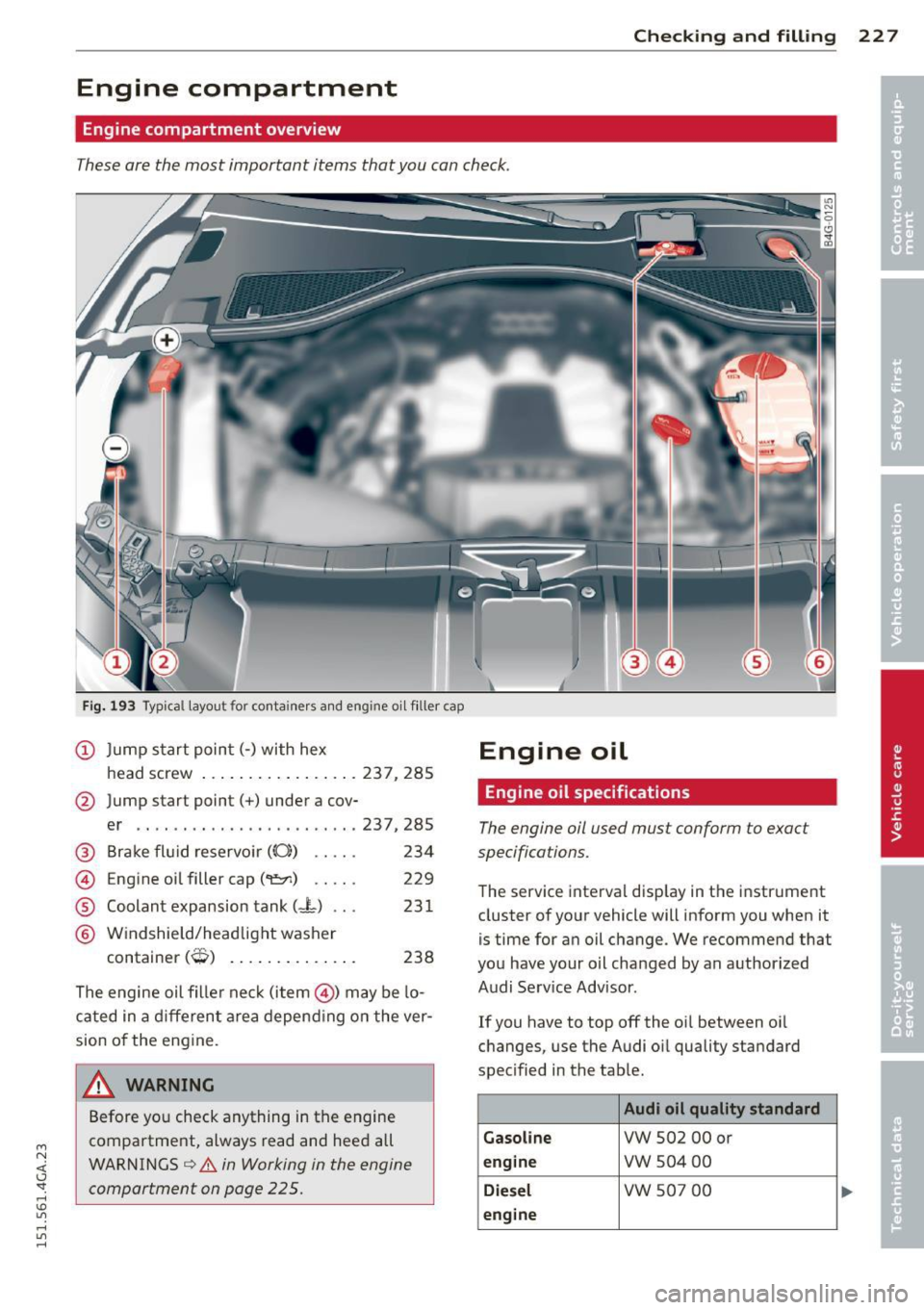
These are the most important items that you can check.
Fig. 193 Typical l ayout for conta iners and engine o il filler cap
@ Jump start poin t(-) with hex
head screw .. .. ..... ... .. .. . 237, 285
@ Jump start point(+) under a cov-
er .. .. ... ..... ...... ...... 237,285
@ Brake fl uid reservo ir ((0)) .... .
© Engine oil filler cap ("1:::r.) .... .
® Coolant expansion tank (-L) .. .
© Windshield/headlight washer
t .
(;;:;) con ainer ,..,, .. .... .. .. . .. . 234
229
23 1
238
The engine oil fille r neck (item @) may be lo
cated in a d ifferent a rea depend ing o n the
ver
sion of the eng ine.
WARNING
Before you check anything in the engine
compartment, always read and heed all
WARNINGS
c::> &. in Working in the engine
compartment on page 225.
Engine oil
Engine oil specifications
The engine oil used must conform to exact
specifications.
T he service interva l d isp lay in the instrument
cluster of yo ur vehicle will inform you when it
is time for an oil change. We recommend that
you have your oil changed by an authorized
Audi Serv ice Advisor .
If you have to top off the oi l between oi l
changes, use the Audi o il quality standard
spec ified in the table.
Audi oil quality standard
Gasoline
VW 502 00 or
engine vw 504 00
Diesel vw 507 00
eng ine