2015 AUDI S3 SEDAN turn signal
[x] Cancel search: turn signalPage 154 of 282
Airb ag syst em
-Always carefully follow the manufacturer's
instructions provided with the child seat or
carr ier.
- Always make sure that there is nothing on
the front passenger seat that will cause the
capacit ive passenger detection system in
the seat to signal to the Airbag System that
the seat is occupied by a person when it is
not, or to signa l that it is occupied by some
one who is heav ier than the person actually
sitting on the seat. The presence of addi
tional objects could cause the passenger
front a irbag to be turned on when it should
be off, or could cause the airbag to work in a
way that is different from the way it would have worked without the object on the seat.
Front airbags
Description of front airbags
The airbag system can provide supplemental
protection to properly restrained front seat occu
pants.
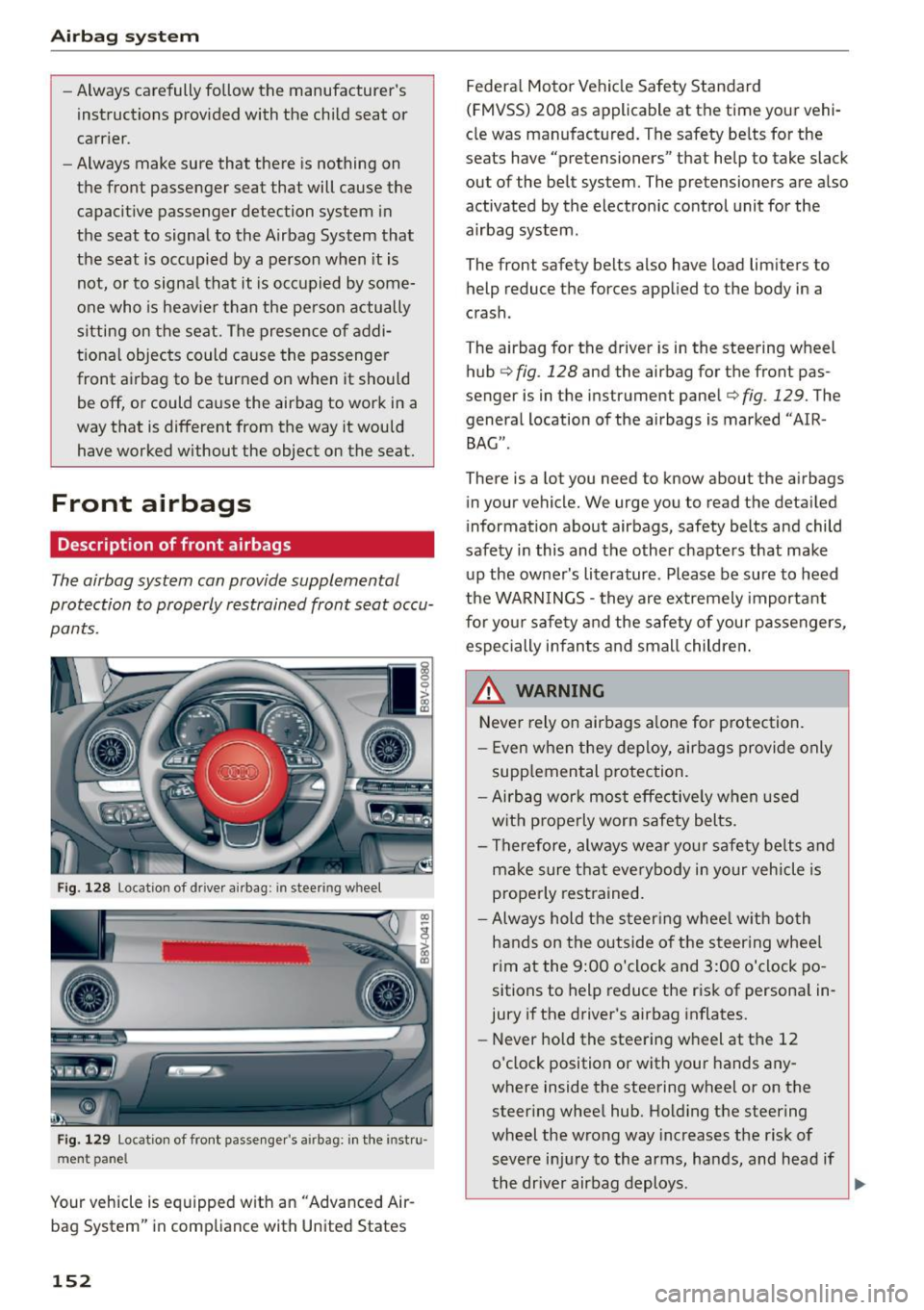
F ig. 128 Location of d river ai rbag: in steeri ng w heel
F ig. 129 Location of fro nt passenger's a irbag: in the i nstru
m ent pane l
Your vehicle is equipped w ith an "Advanced Air
bag System" in compliance with United States
152
Federa l Moto r Vehicle Safety Standard
(FMVSS) 208 as applicable at the time your vehi
cle was manufactured. The safety be lts for the
seats have "pretensioners" that help to take slack
out of the belt system. The pretensioners are also
activated by the electronic control unit for the
airbag system.
The front safety belts also have load lim iters to
help reduce the forces applied to the body in a
crash .
The airbag for the driver is in the steering wheel
hub ¢
fig. 128 and the airbag for the front pas
senger is in the instrument panel¢
fig. 129. The
genera l location of the airbags is marked ''AIR
BAG ".
There is a lot you need to know about the a irbags
in your vehicle. We urge you to read the detailed
information about airbags, safety belts and child
safety in this and the other chapte rs that make
up the owner's literature . Please be sure to heed
the WARN INGS - they are extremely important
for your safety and the safety of your passengers,
especially infants and small children .
A WARNING -
Never rely on airbags alone for protection.
- Even when they deploy, airbags provide only
supp lemental p rotection.
- Airbag wor k most effective ly when used
w it h properly worn safety belts.
- Therefore, alw ays wea r your safe ty belts and
ma ke sure that everybody in your vehicle is
properly rest rained.
- Always hold the s teer ing whee l w ith bo th
hands on the outside of the steer ing whee l
r im at the 9:00 o'clock and 3:00 o'clock po
sitions to help reduce the r isk of persona l in
jury if the driver's airbag in flates.
- Never hold the steering wheel at the 12
o'clock position or with your hands any
where inside the steering wheel or on the
steer ing whee l hub. Hold ing the steer ing
wheel the wrong way increases the risk of
severe in jury to the arms, hands , and head if
the dr iver airbag deploys .
ll>
Page 157 of 282

M N
0 > co ,...., \!) 1.1'1
1.1'1
1.1'1
,....,
A WARNING
A child in a rearward-facing child seat instal
led on the front passenger seat wi ll be seri
ously injured and can be killed if the front air
bag inflates -even with an Advanced Airbag
System.
-Although the Advanced Airbag System in
your vehicle is designed to turn off the front
airbag when a rearward-facing child re
straint has been installed on the front pas senger seat, nobody can absolutely guaran
tee that deployment is impossible in all con
c eivable s ituations that may happen dur ing
the useful life o f you r vehicle.
- The inflating a irbag w ill hit the child seat or
infant carrier w ith great force an d will
smash the ch ild seat and child agains t the
backrest, center armrest, doo r, or roo f.
- Alw ays install rearward- facing child re
straints on the rear seat .
- If you must i nst all a rearw ard facing child
sea t on the front passenger sea t beca use of
excep tional circ umstances and the
PASSEN
GER AIR BAG OFF light does not come on
and stay on, immediately install the rear
facing child seat in a rear seating position
and have the a irbag system inspected by
your Audi dealer.
A WARNING
If, in exceptional c ircumstances, you must in
stall a forward-facing ch ild restraint on the
front passenge r's seat:
-Always make sure the forward-fac ing seat
has be en designed and certified by its man
ufact urer for use on a fro nt seat wit h a pas
senger front and side airbag.
- Never put the forwa rd-facing child rest raint
up against or ve ry nea r the i nstr ument pan
el.
-Always move t he passenger seat into its
rearmost position in the seat 's fore and aft
adjus tment range, as far away from the air
bag as possib le, before installing the fo r
ward-facing c hild restraint . The backrest
must be adjusted to an up right position .
-
Airbag syste m
- Always make sure that there is nothing on
the front passenger seat that w ill cause the
capacitive passenger detection system in
the seat to signal to the Airbag System that
the seat is occup ied by a person when it is
not, or to signal that it is occupied by some
one who is heavier than the person actually
sitt ing on the se at. T he presen ce of add i
tion al ob jects could cause t he passenger
front airbag to be tu rned on when it shou ld
be off, or co uld cause the ai rbag to wo rk in a
way that is different from the way it would
have worked without the ob ject on the seat.
- Make sure that the
PASSENGER AIR BAG
OF F light comes on and stays on all the time
wheneve r the ignit ion is switched on.
Advanced Airbag System components
The front passenger seat in yo ur vehicle has a lot
of very impo rtant parts of the Advanced A irbag
System in it . T hese pa rts include the capacitive
passenge r detection system, wir ing, brackets,
and more. The con trol unit mon itors the syste m
o n the front passenge r se at when the ig nition is
swi tched on and turns the airbag indicator ligh t
on when a malfunction in the one of the system
components is detected
¢ page 160 . Because
the front passenger seat contains important
parts of the Advanced A irbag System, yo u m ust
take care to prevent it from being damaged.
Damage to the seat may prevent the Advanced
Airbag System for the front passenger seat from
doing its job in a crash.
The front Advanced Airbag System consi sts
of the following:
- Crash sensors in the front of the vehicle that
measure vehicle acceleration/deceleration to
p rov ide i nfo rmat ion to the Advanced Airbag
System abo ut the sever ity o f the cr ash.
- An elect ron ic cont ro l unit, with integrated
cr ash senso rs for front and s ide imp acts. The
cont ro l uni t "dec ides" whet her to fire the fron t
airbags based on the info rmation received from
the crash sensors . The control unit a lso "de
cides" whether the safety belt pretens ione rs
should be activated. ..,.
155
Page 161 of 282
M N
0 > co ,...., \!) 1.1'1
1.1'1
1.1'1
,....,
smash the child seat and child against the
backrest, center armrest, door or roof.
- Always install rear-facing child seats on the
rear seat.
- If you must install a rearward facing child
seat on the front passenger seat because of
exceptional circumstances and the
PASSEN
GER AIR BAG OFF
light does not come on
and stay on, immediately install the rear
facing child seat in a rear seating position
and have the airbag system inspected by
your Audi dealer.
A WARNING
Objects between you and the airbag will in
crease the risk of injury in a crash by interfer
ing with the way the airbag unfolds or by be
ing pushed into you as the airbag inflates.
- Never hold things in your hands or on your
lap when the vehicle is in use.
- Never transport items on or in the area of
the front passenger seat. Objects could
move into the area of the front airbags dur
ing braking or other sudden maneuvers and
become dangerous projectiles that can
cause serious personal injury if the airbags
inflate.
- Never place or attach accessories or other objects (such as cup holders, telephone
brackets, large, heavy or bulky objects) on
the doors, over or near the area marked "AIRBAG" on the steering wheel, instru
ment panel, seat backrests or between
those areas and yourself. These objects could cause injury in a crash, especially
when the airbags inflate.
- Never recline the front passenger's seat to
transport objects. Items can also move into
the area of the side airbag or the front air
bag during braking or in a sudden maneu
ver. Objects near the airbags can become
projectiles and cause injury, particularly
when the seat is reclined.
- Never place or transport objects on the front passenger seat. Objects on the front passenger seat could cause the capacitive
sensor in the seat to signal to airbag system
Airbag system
that the seat is occupied by a person when it
in fact is not, or that the person on the seat
is heavier than he or she actually is. The
change in electric capacitance because of
such objects can cause the passenger front
airbag to be turned on when it should be off,
or can cause the airbag to work in a way that
is different from the way it would have
worked without objects on the seat.
-Always make sure that there is nothing on
the front passenger seat that will cause the
capacitive passenger detection system in
the seat to signal to the Airbag System that
the seat is occupied by a person when it is
not, or to signal that it is occupied by some
one who is heavier than the person actually
sitting on the seat. The presence of an ob
ject could cause the passenger front airbag to be turned on when it should be off, or
could cause the airbag to work in a way that is different from the way it would have
worked without the object on the seat.
_LD. WARNING
The fine dust created when airbags deploy can
cause breathing problems for people with a
history of asthma or other breathing condi
tions.
- To reduce the risk of breathing problems,
those with asthma or other respiratory con
ditions should get fresh air right away by
getting out of the vehicle or opening win
dows or doors.
- If you are in a collision in which airbags de
ploy, wash your hands and face with mild
soap and water before eating .
- Be careful not to get the dust into your eyes,
or into any cuts or scratches.
- If the residue should get into your eyes,
flush them with water.
159
Page 176 of 282
Child safety
Advanced front airbag system and children
Your vehicle is equipped with a front "Advanced
Airbag System" in compliance with United States Federal Motor Vehicle Safety Standard (FMVSS)
208 as applicable at the time your vehicle was
manufactured.
The Advanced Airbag system in your vehicle has
been certified to meet the "low-risk" require
ments for 3- and 6-year old children on the pas
senger side and small adults on the driver side.
The low risk deployment criteria are intended to
reduce the risk of injury through interaction with
the airbag that can occur, for example, by being
too close to the steering wheel and instrument panel when the airbag inflates. In addition, the
system has been certified to comply with the
"suppression " requirements of the Safety Stand
ard, to turn off the front airbag for infants up to
12 months who are restrained on the front pas
senger seat in child restraints that are listed in
the Standard.
Even though your vehicle is equipped with an Ad
vanced Airbag system, all children, especially
those 12 years and younger, should always ride in
the back seat properly restrained for their age
and size. The airbag on the passenger side makes
the front seat a potentially dangerous place for a
child to ride. The front seat is not the safest place
for a child in a forward-facing child safety seat .
It
can be a very dangerous place for an infant or a
larger child in a rearward-facing seat .
The vehicle's Advanced Airbag System has a ca
pacitive passenger detection system in the front
passenger seat cushion that can detect the pres
ence of a baby or a child in a child restraint sys
tem on this seat.
The capacitive passenger detection system regis
ters the changes that result in an electrical field
when a child, a child restraint, and a baby blanket
are on the front passenger seat. The change in
the measured capacitance due to the presence of
a child, a child restraint, and a baby blanket on
the front passenger seat is related to the child re
straint system resting on the seat. The measured
capacitance of a child restraint system varies de-
174 pending
on the type of system and specific make
and model.
The electrical capacitance of the various types, makes, and models of child restraints specified
by the U.S.National Highway Traffic Safety Ad
ministration (NHTSA) in the relevant safety
standard are stored in the Advanced Airbag Sys
tem control unit together with the capacitances
typical of infants and a 1-year old child. When a
child restraint is used on the front passenger seat
with a typical 1 year-old infant, the Advanced Air
bag System compares the capacitance measured
by the capacitive passenger detection system
with the data stored in the electronic control
unit.
Child restraints and Advanced front airbag
system
Regardless of the child restraint that you use,
make sure that it has been certified to meet Unit
ed States Federal Motor Vehicle Safety Standards
and has been certified by its manufacturer for
use with an airbag. Always be sure that the child
restraint is properly installed at one of the rear
seating positions. If in exceptional circumstances
you must use it on the front passenger seat, care
fully read all of the information on child safety
and Advanced Airbags and heed all of the appli cable WARNINGS. Make certain that the child
and child restraint are correctly recognized by the
capacitive passenger detection system in the
front passenger seat, that the front passenger airbag is turned off, and that the airbag status is
always correctly signaled by the
PASSENGER AIR
BAG OFF
light .
Many types and models of child restraints have
been available over the years, new models are in
troduced regularly incorporating new and im
proved designs and older models are taken out of
production. Child restraints are not standardized.
Child restraints of the same type typically have
different weights and sizes and different "foot
prints", the size and shape of the bottom of the
child restraint that sits on the seat, when they
are installed on a vehicle seat . These differences
make it virtually impossible to certify compliance
with the requirements for advanced airbags with ..,.
Page 279 of 282

M N
0 > co ,...., \!) 1.1'1
1.1'1
1.1'1
,....,
Steering wheel
adjusting . . . . . . . . . . . . . . . . . . . . . . . . . . . 72
Buttons. ... .. .............. ... .. .. .. 28
Multifunction steering wheel . . . . . . . . . . . 27
Shift paddles (au tomatic transmission) . . . 87
Steps for determining correct load limit . . . 228
Stopping (engine) with button . . . . . . . . . . . . . . . . . . . . . . . . . 76
with key . . . . . . . . . . . . . . . . . . . . . . . . . . . . 74
Storage compartmen ts . . . . . . . . . . . . . . 58, 59
Storage hooks . . . . . . . . . . . . . . . . . . . . . . . . . 61
S tron ic (automatic transmission) . . . . . . . . . 82
Sun visors . . . . . . . . . . . . . . . . . . . . . . . . . . . . 49
Sw itching daytime running lights on and off 45
Switching the ign ition on/off (with key) . . . . 73
Symbols
refer to Indicator lights . . . . . . . . . . . . . . . . 13
System indicator light (MIL) . . . . . . . . . . 22, 25
T
Tachometer . . . . . . . . . . . . . . . . . . . . . . . . 10, 11
TD! clean diesel
refer to AdBlue . . . . . . . . . . . . . . . . . . . . . . 195
Technical Data . . . . . . . . . . . . . . . . . . . . . . . . 258
Technical mod ifications . . . . . . . . . . . . . . . . 264
T emperature d isp lay
Coolant . . . . . . . . . . . . . . . . . . . . . . . . . . . . . 10
Outside temperature . . . . . . . . . . . . . . . . . . 11
Tether anchors . . . . . . . . . . . . . . . . . . . . . . . 188
Tether strap . . . . . . . . . . . . . . . . . . . . . . . . . 188
The first 1,000 miles (1,500 km) and after -
wards. .. .. .. .. ........... .. .. .. .. .. .. 70
Tie-downs . . . . . . . . . . . . . . . . . . . . . . . . 61 , 137
Tips for the environment Saving fuel . . . . . . . . . . . . . . . . . . . . . . . . . . 63
tip tronic (automatic transmission) . . . . . . . . 87
Tires... ... .. .. ...................... 214
Low aspect ratio tires. . . . . . . . . . . . . . . . . 230
Replacing . . . . . . . . . . . . . . . . . . . . . . . . . . 241
Se rvice life . . . . . . . . . . . . . . . . . . . . . . . . . 222
Tire pressure . . . . . . . . . . . . . . . . . . . . . . . . 224
Tire pressure moni toring sys tem . . . 232, 233
Tire pressure table . . . . . . . . . . . . . . . . . . . 225
Treadwear ind icators . . . . . . . . . . . . . . . . . 222
Unid irect ional ............ .. .. .. .. .. . 216
Uniform tire quality grading . . . . . . . . . . . 231
Index
Tires and wheels
G lossary of tire and loading terminology .
Tires and veh icle load limits ...... ... . .
T oo l kit .. .. .. .. .. ....... ..... ... .. . .
Torn or frayed safety belts
Towing 216
227
241
142
Tow trucks . . . . . . . . . . . . . . . . . . . . . . . . . 254
T owing loop. . . . . . . . . . . . . . . . . . . . . . . . . . 255
TPMS ( tire pressure monitoring sys tem) . . . 233
T rai ler mode . . . . . . . . . . . . . . . . . . . . . . . . . . 91
Notes . . . . . . . . . . . . . . . . . . . . . . . . . . . . . . 92
T rai ler tow ing
Operating instructions . . . . . . . . . . . . . . . . . 91
T echnical requirements . . . . . . . . . . . . . 91, 92
Transmission malfunction (indicator light) . . 88
Transport Canada . . . . . . . . . . . . . . . . . . . . . 138
T ravel mode . . . . . . . . . . . . . . . . . . . . . . . . . . 46
Trunk
refer to Luggage compartment. . . . . . . . . . 59
Turning light . . . . . . . . . . . . . . . . . . . . . . . . . . 43
T urn signals. . . . . . . . . . . . . . . . . . . . . . . . . . . 45
Indicator light . . . . . . . . . . . . . . . . . . . . . . . 25
u
ULSD No. 2 (Diesel fue l) . . . . . . . . . . . . . . . . 191
Unfastening safety belts . . . . . . . . . . . . . . . 145
Uniform tire quality grading . . . . . . . . . . . . 231
Unlocking/locking by remote control . . . . . . . . . . . . . . . . . . . . 35
with the central locking switch . . . . . . . . . . 37
with the conven ience key . . . . . . . . . . . . . . . 36
with the door lock . . . . . . . . . . . . . . . . . . . . 37
V
Vanity mirror . . . . . . . . . . . . . . . . . . . . . . . . . . 49
Vehicle Care/cleaning . . . . . . . . . . . . . . . . . . . . . . . 23S
Dimensions . . . . . . . . . . . . . . . . . . . . . . . . . 259
Vehicle control modules . . . . . . . . . . . . . . . . 122
Vehicle identification label. . . . . . . . . . . . . . 258
Vehicle Identific ation Number (VIN) . . . . . . 258
Vehicle jack . . . . . . . . . . . . . . . . . . . . . . 241, 243
Vehicle key . . . . . . . . . . . . . . . . . . . . . . . . . . . 33
Vehicle tool kit . . . . . . . . . . . . . . . . . . . . . . . 24 1
277