2015 AUDI S3 SEDAN load capacity
[x] Cancel search: load capacityPage 222 of 282
Tires and wheels
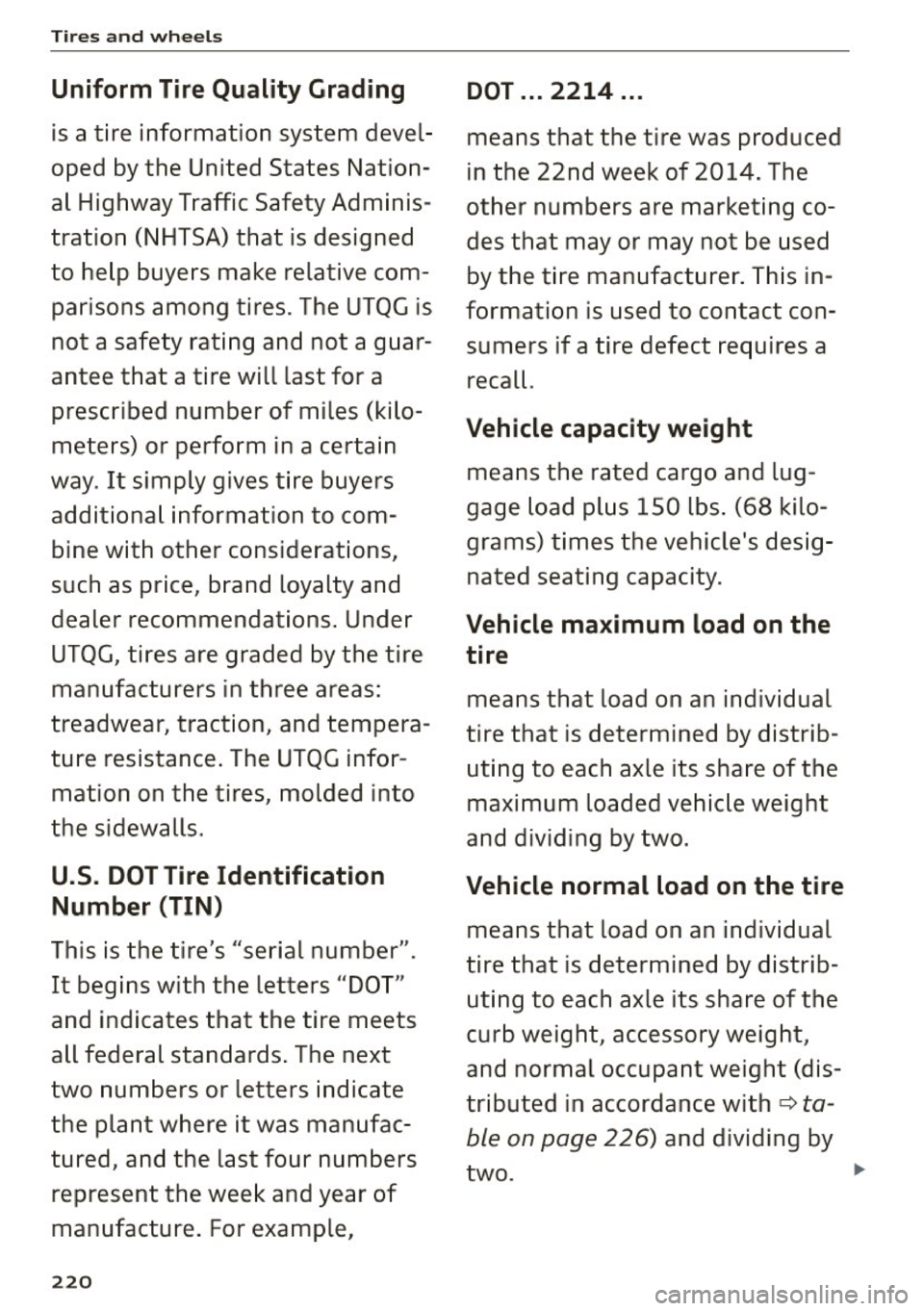
Uniform Tire Qu ality Gr ading
is a tire information system devel
oped by the United States Nation
al Highway Traffic Safety Adminis
tration (NHTSA) that is designed
to help buyers make relative com
parisons among tires. The UTQG is
not a safety rating and not a guar
antee that a tire will last for a prescribed number of miles (kilo
meters) or perform in a certain
way . It simply gives tire buyers
additional information to com
bine with other considerations,
such as price, brand loyalty and
dealer recommendations . Under
UTQG, tires are graded by the tire manufacturers in three areas:
treadwear, traction, and tempera
ture resistance . The UTQG infor
mation on the tires, molded into
the sidewalls.
U.S. DOT T ire Identification
Number (TIN )
This is the tire 's "serial number" .
It begins with the letters "DOT "
and indica tes that the tire meets
all federal standards . The next
two numbers or letters indicate
the plant where it was manufac
tured, and the last four numbers represent the week and year of
manufacture. For example,
220
DOT ... 2214 ...
means that the tire was produced
in the 22nd week of 2014. The
other numbers are marketing co
des that may or may not be used
by the tire manufacturer . This in
formation is used to contact con sumers if a tire defect requires a recall.
Vehicle capacity we ight
means the rated cargo and lug
gage load plus 150 lbs . (68 kilo
grams) times the vehicle's desig nated seating capacity .
Vehicle maximum load on the
tire
means that load on an ind ividual
t ire that is determined by distrib
uting to each axle its sha re of the
maximum loaded vehic le weight
and dividing by two.
Vehicle normal load on the tire
means that load on an individual
tire that is determined by distrib uting to each axle its share of the
curb weight, accessory weight ,
and normal occupant weight (dis
tributed in accordance with
¢ ta
ble on page 226) and dividing by
two.
...
Page 230 of 282
Tires and wheels
are listed on the safety compli
ance sticker label located on the
driver's side B-pillar
¢ page 224,
fig. 170 .
& WAR NING
-
Overloading a vehicle can cause
loss of vehicle control, a crash
or other acc ident, serious per
sonal injury, and even death.
-Carrying more weight than your vehicle was designed to carry will prevent the vehicle
from handling properly and in crease the risk of the loss of
vehicle control.
-The brakes on a vehicle that
has been overloaded may not
be able to stop the vehicle
within a safe distance .
-Tires on a vehicle that has been overloaded can fail sud
denly, including a blowout and
sudden deflation, causing loss of control and a crash.
-Always make sure that the to tal load being transported -
inc luding the weight of a trail
er hitch and the tongue
weight of a loaded trailer -
does not make the vehicle
heavier than the vehicle's
Gross Vehicle Weight Rating.
228
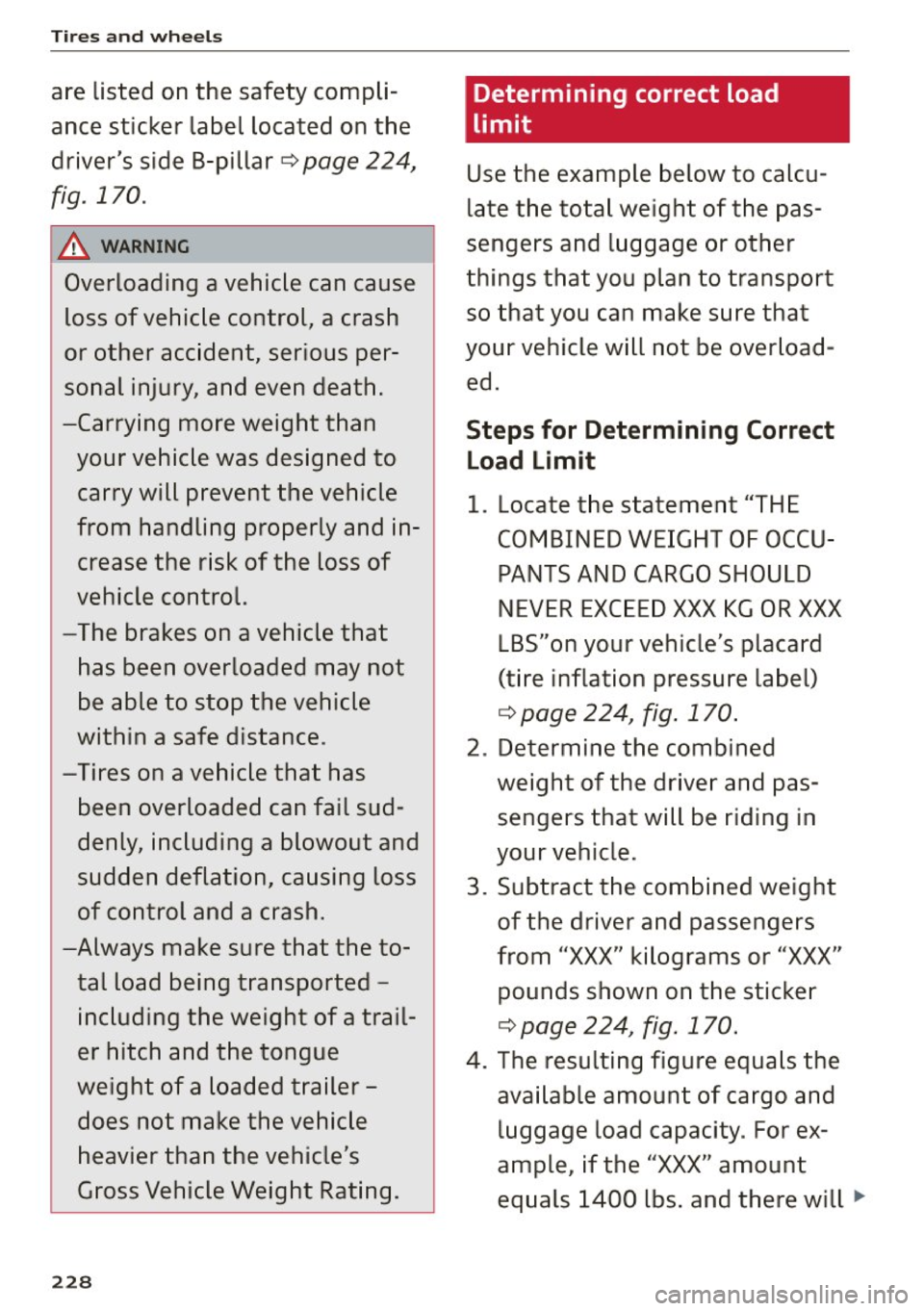
Determining correct load
limit
Use the example below to calcu
late the total weight of the pas
sengers and luggage or other
things that you plan to transport so that you can make sure that
your vehicle will not be overload
ed.
Step s for Determining Correct
Load Limit
1. Locate the statement "THE
COMBINED WE IGHT OF OCCU
PANTS AND CARGO SHOULD
NEVER EXCEED XXX KG OR XXX
L BS"on your vehicle's placard
(tire inflation pressure label)
¢ page 224, fig . 170 .
2. Determine the combined
weight of the drive r and pas
sengers that will be riding in
your vehic le.
3. Subtract the combined weight of the driver and passengers
from "XXX" kilograms or "XXX"
pounds shown on the sticker
¢ page 224, fig . 170 .
4. The resulting figure equals the
available amount of cargo and luggage load capacity . For ex
ample, if the
"XXX" amount
equals 1400 lbs . and there will ...
Page 231 of 282

M N
0 > co ,...., \!) 1.1'1
1.1'1
1.1'1
,....,
be five 150 lbs. passengers in
your vehicle, the amount of
available cargo and luggage load capacity is 650 lbs.
(1400-750 (5
X 150) = 650
lbs.)
5. Determine the combined weight of luggage and cargo
being loaded on the vehicle.
That weight may not safely
ex
ceed the available cargo and
luggage load capacity calculat
ed in Step 4.
6. If your vehicle will be towing a trailer, load from your trailer
will be transferred to your vehi
cle. Consult this manual to de
termine how this reduces the available cargo and luggage
load capacity of your vehicle.
.,.Check the tire sidewall
(c> page 214, fig. 168) to deter
mine the designated load rating
for a specific tire.
Wheel bolts and rims
Wheel bolts
Wheel bolts must be clean and loosen/tighten
easily.
Rims
Rims with a bolted rim ring* or with bolted wheel
covers* consis t of mul tiple pieces. These compo
nents were bolted together using special bolts
and a special procedure . You must not repair or
disassemble them
Q ,& .
Tires and wheels
A WARNING
Wheel bolts that are tightened or repaired in
correctly can become loose and result in loss
of vehicle control, which increases the risk of
an accident . For the correct tightening specifi
cation, refer to~
page 242, A~er changing a
wheel.
- Always keep the wheel bolts and the threads
in the wheel hub clean and free of grease.
- Only use wheel bolts that fit the rim.
-Always have damaged rims repaired by an
authorized Audi dealer or authorized Audi
Service Facility. Never repair or disassemble
rims yourself, because this increases the risk
of an accident.
Winter tires
Winter tires significantly improve the vehicle's
handling when driving in winter conditions. Be
cause of their construction (width, compound,
tread pattern), summer tires provide less traction on ice and snow.
.. Use winter tires on all four wheels.
.. Only use winter tires that are approved for your
vehicle .
.. Please note that the maximum permitted
speed may be lower with winter tires
Q _& . An
authorized Audi dealer or authorized Audi Serv
ice Facility can inform you about the maximum
permitted speed for your tires.
.. Check the tire pressure after installing wheels
Qpage 224.
The effectiveness of winter tires is reduced great
ly when the tread is worn down to a depth of
0.157 inch (4 mm). The characteristics of winter
tires also decrease greatly as the tire ages, re
gardless of the remaining tread.
A WARNING
-Never drive faster than the maximum per
mitted speed for your tires. This could cause
the tires to heat up too much. This increases
the risk of an accident because it can cause
the tire to burst.
229
Page 261 of 282
M N
0 > co ,...., \!) ..,.,
..,.,
..,., ,....,
Gross Axle We ight R atin g
The G ross Axle Weight Rating is the maximum
l oad that can be applied at each axl e of the vehi
cle ~.& .
Vehicle capacit y weight
The vehicle capac ity we ight (max. load) is listed
e ither on the dr iver's side B-pillar o r inside the
f u el filler flap .
& WARNING
-The actual Gross Axle Weight Rating at the
front and rear ax les should not exceed the
permissible weights, and their combination
must not exceed the Gross Vehicle Weight
Rating.
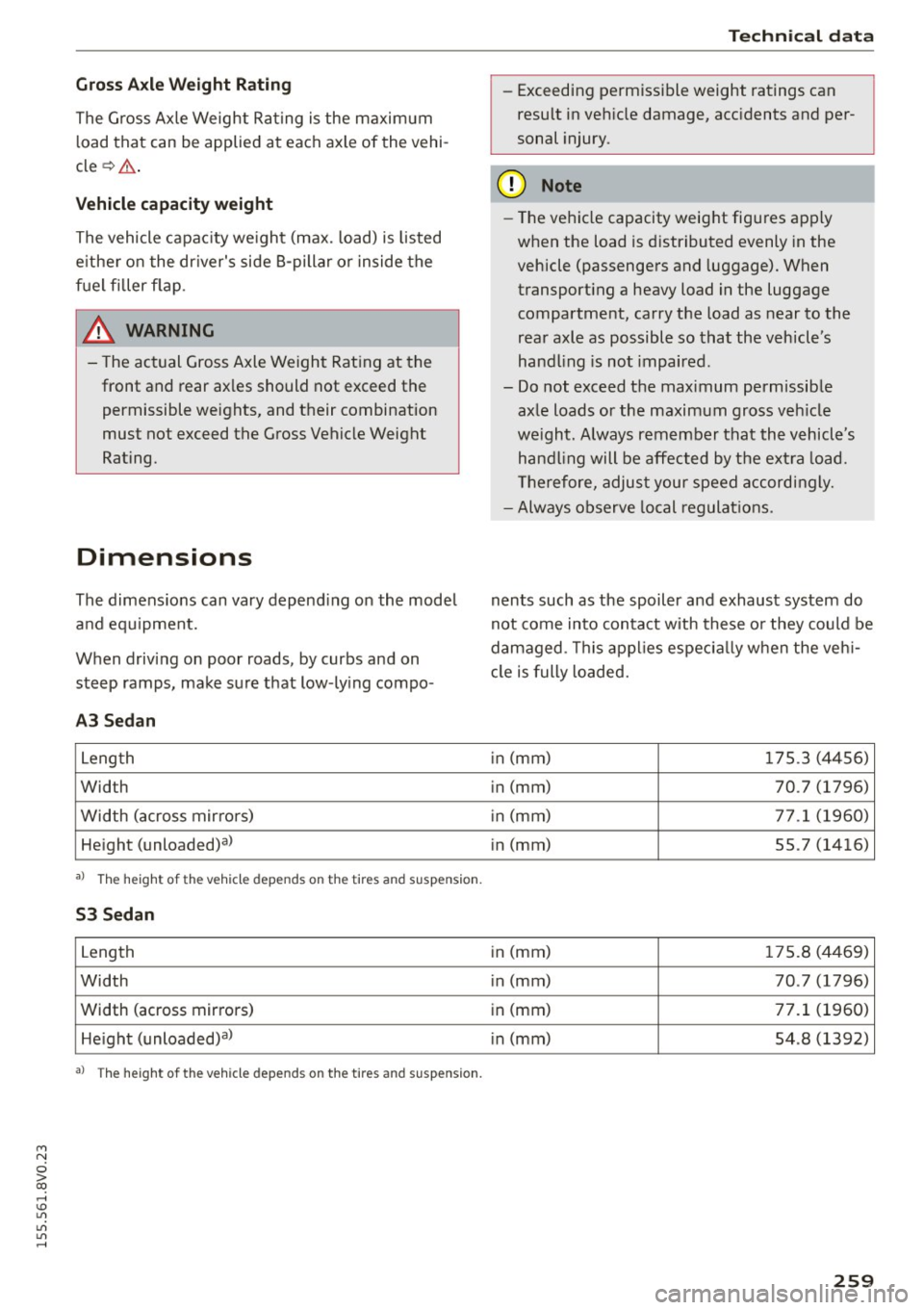
Dimensions
The dimens ions can vary depend ing on the mode l
a nd equipment.
When drivi ng on poor roads, by curbs and on
steep ramps, make sure t hat low -ly ing compo -
A3 Sedan
Length
Wid th
Width (across mir rors)
He ight (unloaded) al
al The he igh t of t he ve hicl e depe nds o n the tir es and s usp en si on .
53 Sedan
Length
Width
Width (across mirrors) He igh t (unloaded) al
al T he heig ht of t he vehi cle dep ends on t he tir es and s uspens ion .
Techni cal data
- Exceeding permiss ible weight ratings can
result in veh icle damage, acc idents and per
sonal injury.
(D Note
- The vehicle capacity weig ht figu res app ly
when the load is d istributed evenly in the
vehicle (passengers and luggage). When
transport ing a heavy load in the luggage
compartment, carry the load as near to the
rear axle as possible so that the vehicle 's
hand ling is not impaired .
- Do not exceed the maximum permissib le
ax le loads or the maximum gross veh icle
we igh t. Always remember that the vehicl e's
hand ling will be affected by the e xtra load.
T herefore, adjus t your speed accordingly.
- Always observe local regulat io ns.
nents such as the spoiler and exhaust system do
not come into contact with these o r they could be
damaged . Th is a pplies es pec ia lly w hen the veh i
cl e is fully loaded.
i n (mm)
1 75 .3 (44 56)
in (mm) 70 .7 (1796)
i n (mm) 77 .1 (1960)
in (mm) 55 .7 (1416)
in (mm) 1 75.8 (4469)
in (mm) 70 .7 (1796)
i n (mm) 77.1 (1960)
in (mm) 54 .8 (1392)
259
Page 273 of 282
M N
0 > co ,...., \!) 1.1"1
1.1"1
1.1"1
,....,
ESC Automatic post-collision braking system 123
Electronic stabilization control . . . . . . . . . 123
Spor t mode . . . . . . . . . . . . . . . . . . . . . . . . 124
also refer to Elec tronic Stabili za tion Control
( E SC) . . . . . . . . . . . . . . . . . . . . . . . . . . . . . . 123
ESP
r e fer to Electronic Stabilization
Control (ESC) . . . . . . . . . . . . . . . . . . . . . . . 123
Event Data Recorder (EDR) . . . . . . . . . . . . . . 122
Exterior lighting . . . . . . . . . . . . . . . . . . . . . . . 43
Exterior mirrors Adjusting . . . . . . . . . . . . . . . . . . . . . . . . . . . 4 7
Dimming ... .. .. ........... .. .. .. .. .. 48
f olding . . . . . . . . . . . . . . . . . . . . . . . . . . . . . 47
Heating . . . . . . . . . . . . . . . . . . . . . . . . . . . . . 47
F
Fastening
Booster seats . . . . . . . . . . . . . . . . . . . . . . . 181
Convertible ch ild safety seats . . . . . . . . . . 179
Infant seats . . . . . . . . . . . . . . . . . . . . . . . . 178
F loor mats . . . . . . . . . . . . . . . . . . . . . . . . . . . 135
F og lights/rear fog light(s) . . . . . . . . . . . . . . . 43
Folding the exterior mirrors Center locking . . . . . . . . . . . . . . . . . . . . . . . 3 7
Folding the rear seats . . . . . . . . . . . . . . . . . . . 60
Foot pedals . . . . . . . . . . . . . . . . . . . . . . . . . . 135
Footwell lighting . . . . . . . . . . . . . . . . . . . . . . 46
F or the sake of the environment
Environmentally-friendly driving . . . . . . . . 70
Fue ling . . . . . . . . . . . . . . . . . . . . . . . . . . . . 192
Leaks . . . . . . . . . . . . . . . . . . . . . . . . . . . . . . 199
Rear window defogger . . . . . . . . . . . . . . . . . 68
Freeze protection
Windshield washer system . . . . . . . . . . . . 212
Fr ont airbags
Description . . . . . . . . . . . . . . . . . . . . . . . . . 152
H ow they work . . . . . . . . . . . . . . . . . . . . . . 158
Frontal collisions and the laws of physics . . 141
Fr ont armrest . . . . . . . . . . . . . . . . . . . . . . . . . 55
Fr ont passenger's door emergency locking . . 39
Front seats Adjusting . . . . . . . . . . . . . . . . . . . . . . . . . . 132
Ch ild restra ints in the front seat . . . . . . . . 149
also refer to Seats . . . . . . . . . . . . . . . . . 53, 60
Index
Fuel
Additives. . . . . . . . . . . . . . . . . . . . . . . . . . . 190
B lended gaso line . . . . . . . . . . . . . . . . . . . . 190
Current consumption . . . . . . . . . . . . . . . . . . 28
Fuel filler neck . . . . . . . . . . . . . . . . . . . . . . 192
Fuel gauge . . . . . . . . . . . . . . . . . . . . . . . 10, 1 1
Fuel tank capacity . . . . . . . . . . . . . . . . . . . 260
Gasoline . . . . . . . . . . . . . . . . . . . . . . . . . . . 190
Gasoline addit ives . . . . . . . . . . . . . . . . . . . 191
Indicator light . . . . . . . . . . . . . . . . . . . . . . . 23
Octane rating . . . . . . . . . . . . . . . . . . . . . . . 190
Recommendation . . . . . . . . . . . . . . . . . . . . 190
Saving fuel . ..... ................ 70, 112
Fuel economy messages (efficiency program)
30
Fueling
Fuel filler door emergency release . . . . . . 194
Fuel gauge .. .. .. ..... ........... ... . 11
Fuel tank capacity . . . . . . . . . . . . . . . . . . . 260
Open ing the fuel filler door . . . . . . . . . . . . 192
Fuses Ass ignment . . . . . . . . . . . . . . . . . . . . . . . . 249
Interior . . . . . . . . . . . . . . . . . . . . . . . . . . . . 248
replacing . . . . . . . . . . . . . . . . . . . . . . . . . . . 248
G
Garment hooks . . . . . . . . . . . . . . . . . . . . . . . . 59
Gas discharge lamps . . . . . . . . . . . . . . . . . . . 250
G lossary of tire and loading terminology . . 216
Glove compartment . . . . . . . . . . . . . . . . . . . . 58
CD changer . . . . . . . . . . . . . . . . . . . . . . . . . . 58
Gross Vehicle Weight Rating (GVWR) . . . . . 258
H
Head light range control system . . . . . . . . . . 43
Indicator light . . . . . . . . . . . . . . . . . . . . . . . 24
Headlights . . . . . . . . . . . . . . . . . . . . . . . . 43, 45
Cleaning . . . . . . . . . . . . . . . . . . . . . . . . . . . 236
Headl ight range control system . . . . . . . . . 43
Left hand drive, right hand drive . . . . . . . . . 46
T rave l mode . . . . . . . . . . . . . . . . . . . . . . . . . 46
Washer system . . . . . . . . . . . . . . . . . . . . . . . 49
Head restraints . . . . . . . . . . . . . . . . . . . . . . . 134
adjusting . . . . . . . . . . . . . . . . . . . . . . . . . . . 56
Adjusting . . . . . . . . . . . . . . . . . . . . . . . . . . 134
removing and installing . . . . . . . . . . . . . . . . 56
271
Page 280 of 282
Index
w
Warning/ indicator lights
System indicator light (MIL) . . . . . . . . . . . . 22
Warn ing/Ind icator lights
A irbag system . . . . . . . . . . . . . . . . . . . . . . 160
PASSENG ER AIR BAG OFF . . . . . . . . . . . . . 160
Warn ing lights
refer to Indicator lights . . . . . . . . . . . . . . . . 1 3
Warranty coverages . . . . . . . . . . . . . . . . . . . 262
Washer fluid level (indicator l igh t) . . . . . . . . 24
Washing matte finish paint . . . . . . . . . . . . . 235
Weights . . . . . . . . . . . . . . . . . . . . . . . . . . . . . 258
What happens if you wear your safety belt too
loose? . . . . . . . . . . . . . . . . . . . . . . . . . . . . . . 144
What happens to unbelted occupants? . . . . 141
What impairs driving sa fety? . . . . . . . . . . . . 13 1
Wheel bolts . . . . . . . . . . . . . . . . . . . . . . . . . 229
Wheels . .. .. .. ................. .. ... 214
All wheel dr ive . . . . . . . . . . . . . . . . . . . . . . 127
Clea ning . . . . . . . . . . . . . . . . . . . . . . . . . . . 236
Glossa ry of t ire and load ing terminology . 216
Replacing . . . . . . . . . . . . . . . . . . . . . . . . . . 24 1
Ti res and vehicle load limits . . . . . . . . . . . 227
Wheel wrench . . . . . . . . . . . . . . . . . . . . . . . . 241
When mus t a safety belt be rep laced? . . . . 1 42
When must the airbag system be inspected? 1.60
Where are lower anchorages located? . . . . . 186
W indows
C lea ning/remov ing ice ................ 237
W indshield
cleaning . . . . . . . . . . . . . . . . . . . . . . . . . . . . 49
defrosting (automatic climate cont rol sys-
tem) . . . . . . . . . . . . . . . . . . . . . . . . . . . . . . . 67
defrosting (man ual climate contro l system) .65
also refer to Windshield . . . . . . . . . . . . . . . 4 9
W indshield washe r system .......... 49, 212
Fil ling . . . . . . . . . . . . . . . . . . . . . . . . . . . . . 212
Reservoir capacity . . . . . . . . . . . . . . . . . . . 260
W indshield wipers
Clea ning wipe r blades . . . . . . . . . . . . . . . . . 50
Folding up . . . . . . . . . . . . . . . . . . . . . . . . . . 50
I ndicato r light . . . . . . . . . . . . . . . . . . . . . . . 24
Replacing w indshield wiper blades . . . . . . . 50
Sw itching on and off . . . . . . . . . . . . . . . . . . 49
278
Win ter driving
Snow chains . . . . . . . . . . . . . . . . . . . . . . . . 230
Tires . . . . . . . . . . . . . . . . . . . . . . . . . . . . . . 229
Win ter operation
B att ery . . . . . . . . . . . . . . . . . . . . . . . . . . . . 208
Cooling system . . . . . . . . . . . . . . . . . . . . . . 205
Windshie ld washer system . . . . . . . . . . . . 212
Winter t ires . . . . . . . . . . . . . . . . . . . . . . . . . . 229
Winter use
Car washes . . . . . . . . . . . . . . . . . . . . . . . . . 235
defrost ing the windsh ield (automat ic cli -
mate control system) . . . . . . . . . . . . . . . . . . 67
Remov ing ice from windows . . . . . . . . . . . 237
Seat heating . . . . . . . . . . . . . . . . . . . . . . . . . 68
X
Xenon-L ights . . . . . . . . . . . . . . . . . . . . . . . . . 250
Xenon headlights . . . . . . . . . . . . . . . . . . . 43, 46