2015 AUDI S3 lights
[x] Cancel search: lightsPage 101 of 310

....,
N
0 > co
Switching on and off
Applies to vehicles: with Audi active lane assist
•
Fig. 86 Turn signal lever: butto n fo r act ive la n e ass ist
Fig. 87 Windsh ield: ca mera w indow for act ive lane as
s is t
.. Press the q fig. 86 button to switch the sys
tem on and off. The . or. indicator light
in the instr ument cluster turns on or off.
Indicator lights
• Ready:
The indicator light turns on when
the system is ready for use. The system can
now be operated .
• Not ready: The indicator light turns on if
the system is switched on but is inoperable.
This may be due to the following reasons:
- There is no lane boundary line.
- The relevant lane marker lines are not de-
tected (for example, markings in a construc
tion zone or because they are obstructed by
snow, dirt, water or light ing) .
- The vehicle speed is below the activation
speed of approximately 40 mph (65 km/h)
(the speed may vary depending on your
country) .
- The lane is narrower than 8
ft (2 .5 m) or
wider than 18
ft (5.5 m).
rl 1.0 -The curve is too narrow.
"' ....,
"' rl
Audi active lane assist 99
-The driver's hands are not on the steering
wheel.
a) Tips
- Make sure the camera's field of view
¢ fig. 87 is not obstructed by stickers or
anything else. For information on clean
ing, refer to
¢ page 205.
- Market-specific: In certain countries: If
the system is switched on, it wi ll remain
operab le each time the ignition is switch
ed on.
lane assist display in the instrument
cluster
Applies to vehicles: with Audi active lane assist
Fig. 88 Instrumen t cluster: monoc hrome d ispl ay
Fig. 89 Instrume nt clust er: mult icolor display
The lane assist display can be called up using
the buttons in the
multifunction steering
wheel ¢
page 28.
Monochrome display
Refer to q fig. 88
Page 111 of 310
M N
0 > co ,...., \!) 1.1"1
M 1.1"1 ,....,
Automatic
transmission S tronic-transmission
Introduction
Applies to vehicles: with S tronic transmiss ion
Your vehicle is equipped with an electronical
l y -controlled DSG transmission called S tronic.
T wo independent clutches transfer the power
between the engine and transmission. It al
lows the vehicle to accelerate without a no
ticeable interruption in traction .
T he transmission upshifts or downshifts auto
matically. The driving style continuously influ
ences the selection of the driving program .
When a
moderate driving style is used, the
transmission selects the most econom ica l
driving mode. The transmission upshifts at a
lower RPM and downshifts at a higher RPM to
improve fuel effic iency .
T he transmission switches to a sporty mode
after a kick-down or when the driver uses a
sporty driving style characterized by quick ac
celerator pedal movements, heavy accelera
tion, frequent changes in speed and traveling
at the maximum speed.
If desired, the driver can also select the gears
manually (tiptronic mode) r=> page 114,
Shifting manually (tiptronic mode) .
Selector lever positions
Applies to vehicles: with S tro nic transmission
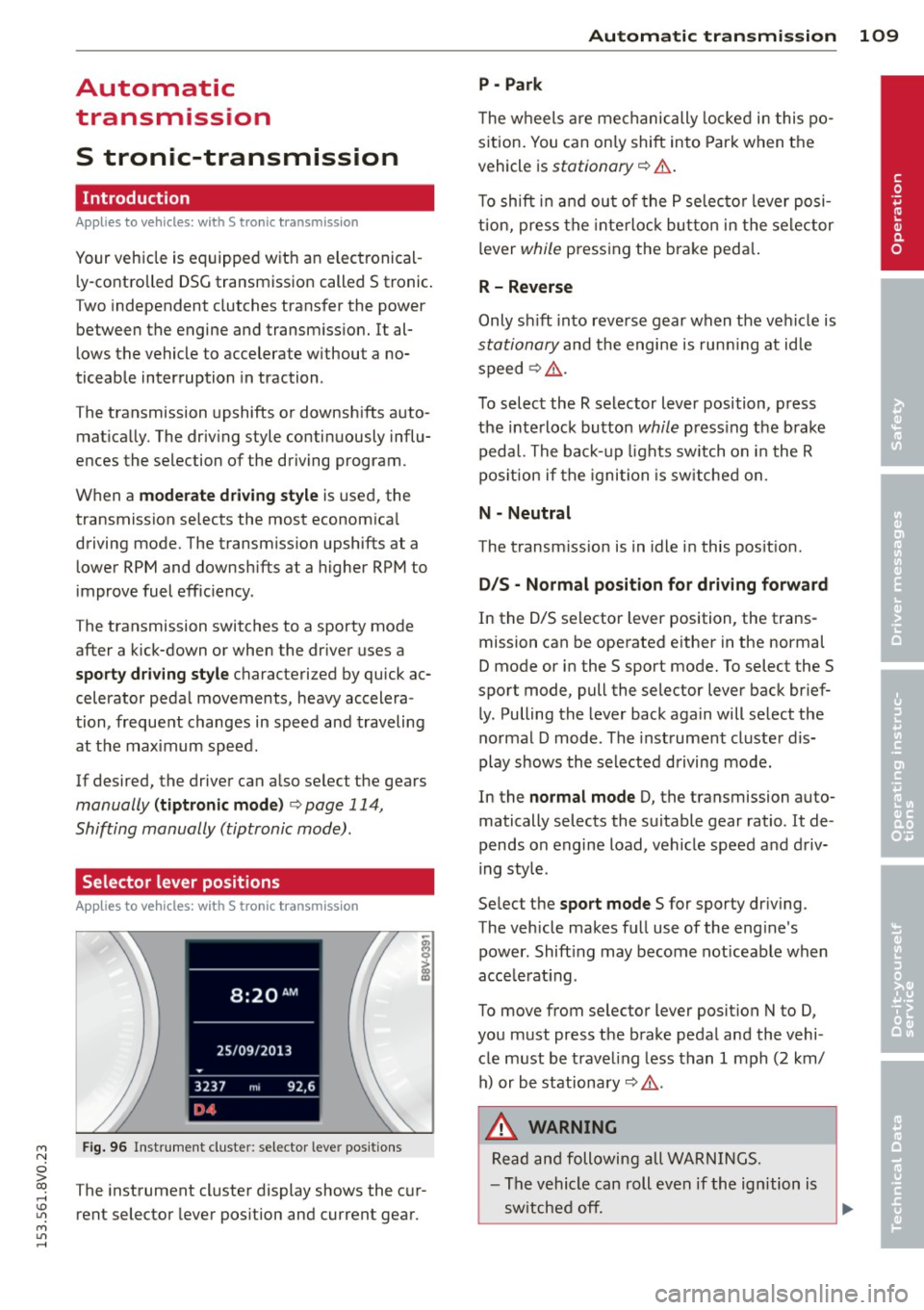
Fig. 96 Instrument cluster: selector leve r positions
The instrument cluster display shows the cur
rent selector lever position and current gear.
Automatic transmission 109
P -Park
The wheels are mechanically locked in this po
sition. You can only shift into Park when the
vehicle is
stationary r=> &..
To shift in and out of the P selector lever posi
tion, press the interlock button in the selector
lever
while pressing the brake peda l.
R- Reverse
Only shift into reverse gear when the vehicle is
stationary and the engine is running at idle
speed
r=> &. .
To select the R selector lever position, press
the interlock button
while press ing the brake
pedal. The back-up lights sw itch on in the R
pos ition if the ignition is switched on .
N -Neutral
The transm iss ion is in idle in this position .
DIS -Normal position for driving forward
In the D/S selector lever position , the trans
mission can be operated either in the normal
D mode or in the S sport mode. To select the S
spor t mode, pull the selector lever back brief
ly. Pulling the lever back again will select the
normal D mode . The instrument cluster dis
play shows the selected driving mode.
In the
normal mode D, the transmission auto
matically selects the suitable gear ratio . It de
pends on engine load, vehicle speed and driv
ing style .
Select the
sport mode S for sporty driving .
The vehicle makes full use of the eng ine's
power. Shift ing may become noticeable when
acce lerat ing.
To move from selector lever position N to D,
you must press the brake pedal and the vehi cle must be traveling less than 1 mph (2 km/
h) or be stationary~ &.-
.&_ WARNING
Read and following all WARNINGS.
- The vehicle can roll even if the ignition is
switched off.
~
•
Page 113 of 310

....,
N
ci > co
rl I.O
"' ....,
"' rl
position longer than approximately 2 seconds
when the brake pedal is not pressed.
Interlock button
The interlock button in the selector lever han
dle prevents you from moving the selector
l eve r inadvertently while in some selecto r lev
er positions. The positions that require the in
terlock button to be pressed are marked in
color in the illustration
c::;, fig. 97.
Ignition key safety interlock*
You can only remove the key from the ignition
after switching the ignition off if the se lector
lever is in the P position. The selector lever
will be locked in the P position as long as the
key is not in the ignition .
A WARNING
Read and following all WARNINGS. c::;, &. in
Selector lever positions on page 109.
{D) Tips
- If the selector lever does not engage,
there is a malfunction. The engine is dis
abled to prevent the vehicle from driving
off unintentionally . Press the brake pedal
briefly to allow the selector lever lock to
engage again.
- If the vehicle does not move forward or
i n reverse even though a drive position is
se lected, proceed as follows:
- > If the veh icle does not move in the de
sired direction, the system may not have
engaged the dr ive position correctly.
Press the brake pedal and select the
drive position again.
- >If the vehicle still does not move in the
desired direction, there is a system mal
function. See an authorized Aud i dea ler
or authorized Audi Service Facility for as
sistance to have the system checked.
Autom atic transm ission 111
Driving tips
Applies to veh icles: w it h S tronic transm iss ion
T he transmission shifts up and down auto
matically when in the driving gears.
Fig. 98 Section of the center co nsole: Selector lever
w ith interlock b utto n
The engine will only be able start when these
lector lever is in the P or N positions. At low
temperatures (below 14 °F (-10 °C)), the en
gine can only be started when the selector
lever is in the P position.
Starting from a stop
.,. Press and hold the brake pedal.
.,. Press and hold the interlock button in the
selector lever handle, select the desired se
lector lever position such as D
c::;, page 109
and re lease the lock button.
.,. Wait a moment until the transmission
shifts . Yo u will notice a slight movement
when the gear engages.
... Release the brake peda l and press the accel
erator pedal
c::;, .&_ .
Stopping temporarily
.,. Keep the vehicle stationary using the brak
ing pedal, for example at traffic lights.
.,. Do not press the accelerator peda l when do
ing this.
.,. To prevent the vehicle from ro lling when you
start driving, set the parking brake when
stopping on steep inclines
c::;, .&_ .
.,. The parking brake will release automat ically
and the vehicle will start moving once you
press the acce lerator pedal. Requ irement:
The driver's safety belt must fastened and
the driver's door must be closed.
IJll,,
Page 128 of 310

126 Driving safety
• Make sure that all lights and signals are op
erating correctly .
• Make sure that the tire pressure is correct .
• Make sure that a ll windows are clean and af
ford good visibility to the o utside.
• Secure all luggage and other items ca refully
c:::> page 64, c:::>page 62 .
• Make sure that noth ing can i nterfere with
t h e pedals.
• Adjust front seat, head rest rain t and mirro rs
correct ly for your he ight .
• Instr uct passenge rs to adjust the head re
straints according to their height.
• Make sure to use the right child restraint
correctly to protect chi ldren
c:> page 170 ,
Child Safe ty .
• Sit properly i n your seat and make sure that
you r passenge rs do the same
c:::> page 57,
Front seats .
• Fasten your safety be lt and wear it properly.
Also ins truc t your passengers to faste n their
sa fety belts proper ly
c:> pag e 13 5.
What impairs driving safety?
Safe driving i s direc tly rela ted to the condi
tion of the vehicle, the driver as well as the
driver 's ability to concentrate on the road
without being distracted .
The driver is respons ib le for the safety of the
ve hicl e and a ll of its occupants . If you r ability
to drive is impaired , safety r is k s for everybody
in the vehicle increase and you a lso become a
hazard to everyone else on the road
c:> &_ .
Therefore:
• Do not let you rself be distracted by passen
gers or by using a cellular telephone.
• NEV ER dr ive when your dr iv ing ability is im
paired (by medicat ions, alcohol, drugs, etc.).
• Observe all traffic laws , rules of the road
and speed limits and plain common sense .
• ALWAYS ad just your speed to road, t raff ic
and weathe r condit ions .
• Take frequent breaks on long t rips. Do not
dr ive for mo re th an two hours a t a str etc h .
• Do N OT drive when you are t ired, under
pressure or when you are stressed .
A WARNING
-Impaired driving safety increases the r isk
of ser ious perso nal inju ry and death when
ever a vehicle is bei ng use d.
Proper occupant
seating positions
Proper seating position for the driver
The proper driver seating position is impor
tant for safe, relaxed driving.
Fig . 11 4 Correct seat ing pos it io n
For you r own safety and to reduce t he risk of
injury in the event of an accident, we recom
me nd that you adjust t he d river's seat to the
f o llow ing pos ition:
.,. Ad just the driver's seat so that you can easi
ly p ush the pedals all the way to the floo r
while keep ing you r knee(s) slightly bent
c:>& ,
.,. Adj ust t he an gle of the seatba ck so th at it is
in an uprigh t position so that your back
comes in full contact with it when you drive.
• Adj ust the steering whee l so that t here is a
distance of at least 10 inches
(25 cm) be
tween the steering wheel and your breast bone
c:::> fig. 114 . If not possible, see your a u
thor ized Audi dealersh ip about adaptive
equ ipment .
.. Ad just t he steering whee l so that the steer
ing wheel and airbag c over poi nts at your
ches t and not a t your f ace.
• Grasp the top o f the steering whee l with
your elbow(s) slightly bent .
• For ad justab le head restra ints : Adjust the
head restra int so the uppe r edge is as even
as poss ible with the top of your head. If that..,_
Page 137 of 310

M N
0 > co ,...., \!) 1.1'1
M 1.1'1 ,....,
Safety belts
General notes
Always wear safety belts!
Wearing safety belts correctly saves lives!
T his chapter explains why safety belts are nec
essary, how they work and how to adjust and
wear them correctly .
~ Read all the information that follows and
heed all of the instructions and WARNINGS.
A WARNING
Not wearing safety belts or wearing them
improperly increases the risk of serious
personal injury and death.
- Safety belts are the single most effective
means available to reduce the risk of se
rious injury and death in automobile acci
dents. For your protection and that of
your passengers, always correctly wear
safety belts when the vehicle is moving .
- Pregnant women, injured, or physically
impaired persons must also use safety
belts. Like all vehicle occupants, they are
more likely to be seriously injured if they
do not wear safety belts. The best way to
protect a fetus is to protect the mother -
throughout the entire pregnancy.
Number of seats
Your Audi has a total of five seating positions:
two in the front and three in the rear. Each
seating position has a safety belt .
A WARNING
Not wearing safety belts or wearing them
improperly increases the risk of serious
personal injury and death.
- Never strap more than one person, in
cluding small children, into any belt. It is
especially dangerous to place a safety
belt over a child sitting on your lap.
- Never let more people ride in the vehicle
than there are safety belts available.
Safety belts 13 5
-Be sure everyone riding in the vehicle is
properly restrained with a separate safe
ty belt or child restraint.
~ Safety belt warning light
Your vehicle has a warning system for the
driver and front seat passenger (on USA mod
els only) to remind you abou t the importance
of buckling-up.
Fig. 117 Safety bel t warn ing light in the instr ume nt
cl uster -enla rged
Before driving off, always:
~ Fasten your safety belt and make sure you
are wearing it properly.
~ Make sure that your passengers also buckle
up and properly wear their safety belts.
~ Protect children with a child restraint sys-
tem appropriate for the size and age .
The warning light . in the instrument clus
ter lights up when the ignition is on as a re
minder to fasten the safety belts . In addition,
you will hear a warning tone for a certain peri
od of time .
Fasten your safety belt and make sure that
your passengers also properly put on their
safety belts.
A WARNING
- Safety belts are the single most effective
means available to reduce the risk of se
rious injury and death in automobile acci
dents. For your protection and that of
your passengers, always correctly wear
safety belts when the vehicle is moving. •
•
•
Page 195 of 310

M N
0 > co ,...., \!) 1.1'1
M 1.1'1 ,....,
the brakes. If you need to brake addit ion
ally, bra ke in intervals and not continu
ously.
(D Tips
- If the brake boos ter is not wor king, you
must p ress the brake pedal with much
more force t hen no rma l.
- If yo u retrof it your vehicle with a front
s po ile r, wheel covers or similar items,
make sure that the air f low to the front
whee ls is not interrupted. Otherwise the
brake system can become too hot.
Electromechanical
steering
The elec tromechanical steering suppor ts the
driver's s teering movements .
Powe r stee ring adapts electronically based o n
the veh icle speed.
The vehicle still has full stee ring fu nctionality
if the powe r steering fails o r whe n the eng ine
i s stopped (towi ng). To s teer, yo u must app ly
m uc h mo re fo rce than usual.
Indicator lights and messages
• Do not drive vehicle: steering defective
If th is in dicator lig ht tu rns on and stays on
and this message appears, the power steering may have fa iled.
Do
not co ntin u e dr iving . See an autho rize d
Aud i dea ler o r autho rized Aud i Service Fac ility
for assistance.
• Do not drive vehicle: steering defective
There is a malf unct io n in the electro nic steer
in g lo ck. You canno t turn the ign ition on.
Do
not tow your vehicle beca use it ca nnot be
steered. See an autho rized Aud i dea le r or au
thor ized Audi Se rv ice Facility for ass istance.
Ei:-Y Steering malfunction : you can continue
driving
I f the indicator light turns on, the steering
wheel may be more difficult to move or more
Smart Technolog y 193
sensit ive tha n usua l. The stee ring wheel may
also be at a n angle when dr iv ing stra ight .
D rive slowly to you r auth ori zed Audi de aler o r
qualifie d wo rkshop to have the ma lf u ncti on
correc ted.
II Steering lock : sy stem fault! Pl ease con
tact Service
T he re is a malfunction in the elec tronic steer
ing lock .
D rive to an author ized Audi dealer or author
ized Audi Serv ice Facility immediately to have
the malfunc tion corrected.
A WARNING
Have the sys tem ma lf u nction co rrec ted as
soon as po ssible by an aut horiz ed Aud i
d e aler or au thoriz e d Au di Service Fa cili ty,
a s this incr eases the r is k of an acciden t.
(D Tips
If th e . or l~ij indi cator ligh t only s tays
o n for a short t ime , you may con tinue dr iv
i ng.
ALL wheel drive
(quattro)
App lies to vehicles: wi th all wheel drive
In all wheel drive, all four wheels are pow
ered.
General information
In all whee l dr ive, the dr iv ing power is divi ded
between all fo ur whee ls. Thi s happens auto
matically depending on yo ur driv ing behavior
as well as the current road conditions. Refer
to
¢ page 189, Electronic stabilization con
trol (ESC) .
The all wheel drive concept is designed for
high eng ine power. Your veh icle is except ion
a lly powerfu l and has excellent driving charac
te ristics both under normal driv ing cond itions
and on snow a nd ice. Always read and follow
safety precaut ions¢ .&.. ..,.
•
•
•
Page 202 of 310

200 Driving and the environment
Vehicles use the most fuel when they are ac
celerati ng. If you anticipate what is going to
happen next, you will need to brake less and,
thus, accelerate less. let the vehicle coast
whenever poss ible -for example when you see
that the next traffic light is red.
Avoid full throttle
Driving at moderate speeds saves fuel and
improves your mileage.
.. Try and keep well be low your car's max imum
speed.
Accelerating gently reduces fuel consump
tion, engine wear, and does not disturb the
environment. F ue l consumption, exhaust emissions and en
gine noise increase disproportionately at hig h
speeds . If you drive at approximately three
quarters of top speed, fue l consumption will
be reduced by one half. Never dr ive faster
tha n the posted speed limit and weather con
d itions permit.
Reducing unnecessary idling
Even when your car is just idling it burns up
fuel.
.. Sh ut the engine off when you are not dr iving
the vehicle.
.. Do not warm up the vehicle by letting the
engine run at idle.
It is efficient to switc h off the engine when
stopped at railroad crossings and long red
lights. Turning the engine off for just 30-40
seconds saves mo re fuel than is burned by
start ing the eng in e again.
It takes a long time for the engine to warm up
fu lly when it is running at idle. However, wear
and nox ious em issions are especially high
when the engine is warming up. So you should
d rive away as soon as you sta rt the eng ine and
avoid ru nning a t high RPM wh ile the engine is
still warming up .
(D Note
Do not leave engine i dling unattended af
ter start ing. If wa rning lights sho uld come
on to indicate improper operation, they
would go unheeded. Extended idling also
produces heat , w hich could result in over
hea ting o r othe r damage to the veh icle or
othe r property.
Regular maintenance
A badly tuned engine unnecessarily wastes a
lot of fuel.
.. Have your ve hicle serviced at regu lar inter-
vals.
Having your veh icle regu larly serviced by an
authorized Aud i dealer helps to ensure that it
runs properly and econom ica lly. The cond it io n
of your veh icle not on ly affects its safety and
ability to ho ld its va lue, i t also affects
fuel
c onsumption .
Check your oil each t ime you fill your tank.
The amount of oi l used is re lated to engine
l oad and speed.
It is normal for the oil consump tion of a new
engine to reach its lowest value after a certain
mileage has been driven .
You m ust drive your ve hicle abou t 3,000 m iles
(5,000 kilometers) before you can properly
assess oil consumpt ion .
T his also ap plies to fue l consumption and en
gine o utp ut.
(D Note
- Have your veh icle ma inta in ed properly
and i n acco rdance with the service rec
ommendations in you r W arranty
& Main
t enance boo klet. l ack of proper ma inte
nance as well as im proper use of the ve
hicle will impair the function of the
em iss ion cont ro l system and cou ld lead
to damage.
Page 204 of 310

202 Trailer towing
Trailer towing Driving with a trailer
General information
Your Audi was designed primarily for passen
ger transportation .
If you plan to tow a tra iler, p lease remember
that the addit ional load will affect durab ility,
economy and performance .
T railer towing not on ly places more stress on
the vehicle, it also calls for more concentra
tion from the driver.
F or this reason, always fo llow the operating
and drivi ng i nstr uctions provided and use
common sense.
Technical requirements
Traile r hitch
Use a weight-carrying hitch conforming to the
gross trailer we ight. The hitch must be suita
b le for your veh icle and trailer and mu st be
mounted secure ly on the ve hicle's chassis at a
technically sound location . Use only a trailer
h itch with a removab le ball mount. A lways
check with the tr ailer hitch manu fac tur er to
make sure tha t you are using t he cor rect
hitch.
Do not us e a bumper hitch .
The hitch must be installed in such a way t hat
it does not interfe re with t he impact-absorb
ing bumper syst em . No mod ifications should
be made to the vehi cle exhaust and brake sys
tems . From time to time, check th at a ll hit ch
mo unt ing bo lts remain secure ly fastened.
When you are not towing a trail er, remove the
tra iler hitch ba ll mount. This prevents the
hi tch from causing d amage sho uld your ve hi
cle be str uck from be hind
¢ A .
Trailer brakes
If you r tra ile r is eq uipped w ith a braking sys
tem, check to be su re that it conforms to a ll
r egulat ions . T
he trailer hyd raulic brake system mus t not be
direct ly connected to the vehicle's hydraulic
brake system .
Safety chains
Always use s afety chains be tween your ve hicle
and t he tra ile r.
Trailer lights
Tra ile r li ghts must meet all regulations. Be
su re to c hec k w ith your Audi dea le r fo r cor rect
wiring, swi tches and relays.
Mirrors
If you are unable to see the traffic behind you
u sing the regular o utside m irrors, then you
must insta ll ext ended mirro rs . It is important
t h at you
always have clea r vis io n to the rea r.
,8. WARNING
-
Afte r removing t he trailer hit ch, d o no t
s tore it in yo ur vehicle . In case of sudden
br aking, t he h itch cou ld fly forward an d in
j ur e you or yo ur passengers .
Operating instructions
Maximum traile r weight
A trai le r fo r you r vehicle is limited to a typi cal
class 1 or class 2 trai le r.
Trailer load distribution
B e sure the load in the t ra ile r is held secure ly
i n p lace to p reven t it from shift ing forw ard,
backw ard or sideways.
Never allow a passenger to ride in a trailer
¢ A in Driving instru ctions on page 203.
Engine cooling system
Towing a trailer makes the engine work hard
er . It is impo rtant that the cooling system 's
performance is up to the additional load .
Make su re that the coo ling system has enough
fl uid .
Tire pressure
When towing a trailer, inflate the tires of your
vehicle to t he cold tire pressure listed under
ll>