2015 AUDI Q5 heated
[x] Cancel search: heatedPage 60 of 302

Lights and Vision
switched back on by moving the windshield
wiper lever to any position .
- Worn or dirty windshie ld wiper blades result
in streaking . This can affect the rain sensor
function . Check your windshield wiper
blades regularly.
- The washer fluid nozzles of the windshield
washer system are heated at low tempera
tures when the ignit ion is on.
- When stopp ing temporarily, e.g. at a traffic
light, the set speed of the windshield wipers
i s automatically reduced by one speed.
Cleaning windshield wiper blades
Clean the windshield wiper blades when they be
g in to leave streaks. Use a soft cloth and glass
cleane r to clean the windshield wiper blades .
Front wiper
.,. Place the windshield wiper arms in the service
position. Refer to
c> page 58.
.,. Lift the w iper arm away from the front w indow.
Rear wiper
.,. Lift the wiper arm away from the rear window.
A WARNING
Dirty w indshield wiper blades can impair your
view. This can lead to acc idents.
Replacing windshield wiper blades
Fig. 58 Removing the w iper blade
Wiper service position/blade replacement
posit ion
"' ij
a: CX) ID
.,. Switch the ignition off and move the windshield
wiper lever to posit ion ©
c> page 57, fig. 56.
58
The windshie ld wipers move into the service po
sition .
.,. To bring the wipers back into the origina l posi
tion, switch the ignition on and press the wind
shield w iper lever.
You can also turn the service position on or off in
the radio or MMI*:
.,. Switch the windshie ld wipers off (position @
c>page 57, fig. 56).
.,. Select: !CAR I function button> Windshield
wipers
> Service position > On /Off . Or
.,. Select:
!CAR I function button> Car systems*
cont rol butto n > Servicing
& checks > Wiper
s ervice position
> On/Off .
Removing the wiper blade
.,. Lift the windsh ield wiper arm up from the wind
shield .
.,. Press the locking knob@
c> fig. 58 on the wiper
blade. Ho ld the wiper blade firmly .
.,. Remove the wiper blade in the direction of the
arrow .
Attaching the wiper blade .,. Insert the new wiper blade into the mount on
the wipe r arm @until you hear it latch into
place .
.,. Place the wiper arm back on the winds hield.
.,. Tur n the se rvice position off.
A WARNING
F or your safety, you shou ld rep lace the wiper
b lades once or twice a year. See your author
ized Audi dealer for rep lacement blades.
(D Note
- Th e windshie ld wiper blades must only be
replaced when in the service position! Oth
erwise, you risk damaging the paint on the
hood or the w indshield wiper motor.
- Yo u should not move your vehicle or press
the windsh ield wiper lever when the wiper
arms are fo lded away from the windshield.
The windshield w ipers would move back in
to their original position and could damage
the hood and windshie ld .
Page 61 of 302

M N
co ~ co
rl I.O
"' N
"' rl
-To he lp prevent damage to the wiper sys
tem , always loosen blades which are frozen
to the windshie ld before operat ing wipers .
- To he lp prevent damage to wiper blades, do
not use gasoline, kerosene, paint thinner, or
other solvents on or near the wiper blades .
- To he lp prevent damage to the wiper arms
or other components, do not attempt to move the wipers by hand.
@ Tips
- Commercial hot waxes applied by automatic
car washes affect the how easily the glass
surface can be cleaned .
- You can also use the service position, for ex
ample, if you want to protect the windshield
from icing by using a cover.
Replacing the rear wiper blade
C
Fig . 59 Rear w ipe r: Re mov ing t he wip er blade
Removing the wiper blade
.. Fold the windshield wiper arm away from the
windshield.
.. Pull the wiper blade and holder out of the
mount.
Attaching the wiper blade
.. Press the w iper blade holder in the arrow direc
tion
~ fig. 59 into the mount.
.. Fold the windshield wiper arm back onto the
windshield .
.&_ WARNING
-
For safety reasons, the windshield wiper
blades should be replaced once or twice each
year.
Lights and Vision
Mirror
Adjusting the exterior mirrors
Fig. 60 Forwar d sectio n of drive r's arm rest : powe r mirr or
controls
Adjusting exterior mirrors
.. Rotate the knob to the© position (driver's ex
terior mirror) or to the ® position (passenger's
exterior m irror)
Q fig. 60 .
.. Rotate the knob and the mirror so that you
have a clear view to the rear.
Heated mirrors
.. Rotate the knob to position@.
Folding both exterior mirrors*
.. Turn the knob to posi tion @.
Depend ing on the outside temperature, the mir
ror surfaces are heated until the ignition is
switched off -even if the knob is no longer in po
sition @.
You are we ll-advised to fold the exterior mirrors
in when maneuvering in tight spaces or when
leaving the car parked close to other vehicles.
Memory for exterior mirrors*
On vehicles with memory for the driver's seat,
the current setting for the exterior mirrors is au
tomatically sto red a long with the seat pos ition
Q page 64.
Tilt function for the passenger's mirror*
When the reverse gear is engaged, the mirror
surface tilts downward slightly if the setting is
for the passenger's mirror (knob in position ®
Q fig. 60). This allows you to see the curb during
parallel parking. .,..
59
Page 87 of 302

M N
co
a:
co
,...., \!) 1.1"1
N 1.1"1 ,....,
~ It is possible that there wi ll be a slight de lay
when starting the engine for diesel vehicles* in
colder temperatures. Therefore, yo u must hold
the brake peda l down until the engine starts.
The ind icator lamp
1,1 illuminates when the en
gine is preheated .
Switching the ignition on /off
If you wou ld like to switch the ignition on with
out sta rt ing the engine, fo llow these steps:
~ In se rt the key into the ignition lock .
~ Press the key briefly without press the brake
peda l.
~ To switch the ignition off, press the key again .
D iese l vehicles * are prehea ted whi le the ignition
is switched on.
W hen sta rting the engine, ma jor e lectr ica l load s
a re sw itche d
off temporar ily.
You can only remove the key w ith the ignition
sw itched off. To do this, you have to p ress on the
key again.
I f the engine sho uld not start immediately, the
start ing process is a utomat ica lly stopped after a
short time. Repeat start ing procedure.
Start-Stop-System*:
Note the information on c:> page 91, Start/Stop
system .
A WARNING
-Never allow the engine to run i n confined
spaces - dange r of asphyxiation .
- Never remove the ign ition key from the ign i
t io n lock while the vehicle is moving . O ther
wise, the stee ring loc k cou ld suddenly e n
gage and you would not be able to stee r th e
vehicle .
- Always ta ke t he key with y ou wheneve r you
leave you r vehicle. Othe rwi se , the eng ine
cou ld be started or ele ctrical eq uipment
s u ch as the power windows co uld be operat
ed. This can lead to ser ious injury.
- Never le ave c hildren o r persons requi ring as
sistance unattended in the vehicle. The doo rs can be locked using the remote trans-
-
Dri ving
mitter, preventing people from escaping
from the veh icle on the ir own in the event of
an emergency. Depend ing on the time of
year, peop le inside the vehicle can be ex
posed to very high or very low tempera
tures.
(D Note
Avoid high eng ine rpm, full throttle and heavy
engine loads unti l the engine has reached op
era ting temperature - othe rwise you r isk en
g in e damage .
@ For the sake of the environment
Do not let the engine run wh ile pa rked to
warm up. Begin dr iving immediat ely . T hi s re
duces unnecessa ry em iss ions .
(D Tips
-If the key cannot be removed from the ign i
t ion lock, you have to pull the mecha nica l
key out of th e mas ter key in orde r to be able
to lo ck the vehicle
c:> page 38.
-After starting a cold engine, ther e may be a
br ief per iod of incr eased nois e because the
oil p ress ure mu st fi rst bu ild up in the hy
dr au lic valve adju ste rs. This i s norm al a nd
no t a cause fo r concern.
- If you leave the ve hicle with the ignition
s witched on, the ig nit ion w ill switch
off af
t er a ce rtain period of time . Please note that
elect rical eq uipment such as exterior lights
w ill switch off as well when that happens .
85
Page 89 of 302

M N
co ~ co
rl I.O
"' N
"' rl
CD Note
If the engine has been under heavy load for
an extended per iod, heat builds up in the en
gine c ompartment after the engine is switch
ed off -there is a risk of damag ing the eng ine .
Allow t he engine to run at idle fo r about two
m inutes befo re switch ing it off.
Convenience key
Starting the engine
Applies to vehicles: with Conven ience key
The I STAR T ENGINE S TOP I button switches the
ignition on and starts the engine.
Fi g. 1 02 Cente r co nsole : STAR T ENGIN E STOP b utto n
Starting the engine
• Hybrid dr ive *: refer to the information for start
ing the vehicle under
Q page 99 .
• Step on t he brake pedal and move the selector
lever to P o r N
Q ,& .
• Press on the 1~s= T~A_R_T_E_N--GI N_E_S_T_O_P_I button
Q fig. 102 -the engine will start.
• It is possible that there w ill be a slight de lay
when start ing the eng ine for diesel vehicles * in
colder temperatures. Therefore, yo u must hold
t h e brake pedal down until the engine starts .
The indicator lamp
II i ll uminates when the en
gine is preheated.
Switching the ignition on /off
If yo u wou ld like to switch the ignition on with
out start ing the engine, fo llow these steps:
• Press the
!S TAR T EN GINE STOPI button with
out pressing the brake ped al.
• To sw itch the ignition off, press the button
again .
Driv ing
Diesel vehicles * are preheated while the ignition
is switched on.
When sta rting the engine, major electrical loads
are swi tched off temporarily .
If the engine should not start immediately, the
sta rting process is au tomatically s topped afte r a
sho rt time. Repeat s tarting p roced ure.
Sta rt-Stop-System* :
Note the information on Q page 91, Start/Stop
system .
A WARNING
=
-Never a llow th e engine to run in confined
spaces -da nger of asphyx iat io n.
- Always take the key w ith you whenever you
leave your vehicle. Ot herwise, t he engine
could be started or e lectr ica l equipment
such as the power win dows could be ope rat
ed . This can lead to se rious i njury.
- Never le ave children or pe rsons re quiring as
sistance unattende d in the vehi cle. The
doors can be locked us ing the remote trans
mitter, preventing people from escaping
from the veh icle on the ir own in the event o f
an emergency. Depending on the time of
year, people inside the vehicle can be ex posed to very high or very low tempera
tures.
CD Note
Avoid high eng ine rpm, full throttle and heavy
engine loads u ntil the engine has reached op
erating temperature -otherwise you r isk en
gine damage.
@ For the sake of the environment
Do not let the engine run wh ile parked to
warm up. Begin dr iving immediately . Th is re
duces unnecessa ry em iss io ns.
@ Tips
- After starting a cold engine, there may be a
brief per iod of increased noise because the
oil p ressu re must f irst build up in the hy
draulic valve adjusters. Th is is norma l and
-
no t a cause fo r concern . ..,
87
Page 199 of 302

M N
co
a:
co
,...., \!) ..,.,
N ..,., ,....,
electrical energy is not being used than is being
generated and ensures an optimal state of
charge for the battery.
(D Tips
- But even energy management cannot neg
ate the limits of physics. Consider that the power and life of a battery are limited.
- If starting ability is threatened, the indica
tor light (•] appears ~
page 33.
What you should know
The highest priority is given to maintaining start
ing capability.
The battery is severely taxed in short-distance
driving, in city traffic and during the co ld time of
year. Abundant electrical energy is required, but
only a little is generated. It is also critical if the
engine is not running and electrical components
are turned on. In this instance energy is being
consumed but none is being generated.
It is in precisely these situations that you wi ll no
tice energy management actively regulating the
d istribution of energy.
Vehicl e stands fo r an e xte nded p eriod
If you do not drive your vehicle over a period of
several days or weeks , e lectrica l components are
gradually cut back or switched off . This reduces
energy consumption and maintains starting ca
pability over a longer period . Some of the con
ve nience funct ions may not operate, such as the
interior lights or the power seat adjustment. The
conven ience functions wi ll be available again
when you switch on the ignit io n and start the en
g ine.
With the engine turned off
If you listen to the radio, for example, with the
engine turned off or use other MMI* functions ,
the battery is being d ischarged .
If starting capability is jeopardized due to energy
consumption, a message appears in the radio or MMI* display . The message indicates that the
system w ill be switched off automatically in a
Smart T echno log y
moment . If you wish to continue using the func
tions, you have to start the engine.
With the engin e running
Although electrical energy is generated when the
vehicle is be ing driven, the battery can become
discharged . This happens mostly when litt le en
ergy is being generated and a great dea l con
s u med and the batte ry's state of charge is not
opt imal.
T o bring the energy ba lance back into equilibri
u m, consumers which require especially large
amounts of ene rgy are temporarily cut back or
switched off. Heating systems in particu lar re
quire a great deal of energy. If you notice, for ex
amp le, that the heated seats* or the heated rear
window are not heating, they have been tempo
rar ily cut back or switched off . These systems w il l
be available again as soon as the energy ba lance
has been restored.
You w ill also notice that engi ne idle speed has
been increased slightly . T h is is normal and not a
cause for concern. By increasing eng ine idle
speed the additional energy requi red is generated
and the battery is ch arged .
197
Page 290 of 302

Index
(upholders . . . . . . . . . . . . . . . . . . . . . . . . 7 4, 76
Heated and cooled . . . . . . . . . . . . . . . . . . . . 75
D
Data recorder
Date display 190
12
Daytime running lights . . . . . . . . . . . . . . . . . . 53
Declaration of compliance
Adapt ive cruise control . . . . . . . . . . . . . . . 284
Audi side assist . . . . . . . . . . . . . . . . . . . . . 284
Cell phone package . . . . . . . . . . . . . . . . . . 284
Convenience key . . . . . . . . . . . . . . . . . . . . . 284
Electronic immobilizer . . . . . . . . . . . . . . . . 284
Homelink universal remote control . . . . . 284
Remote control key . . . . . . . . . . . . . . . . . . 284
Defective light bulb warning . . . . . . . . . . . . . 32
Defrosting (windows) . . . . . . . . . . . . . . . . . . . 82
Determining correct load limit . . . . . . . . . . 249
Diesel fuel ..... .. ............. .... .. . 215
Diesel part iculate filter . . . . . . . . . . . . . 34, 199
Digita l clock . . . . . . . . . . . . . . . . . . . . . . . . . . 12
Digital compass . . . . . . . . . . . . . . . . . . . . . . . 61
Digital speedometer................ .. .. 21
Dimensions . . . . . . . . . . . . . . . . . . . . . . . . . . 278
Dimming the rearview mirror . . . . . . . . . . . . 60
Doors Child safety locks . . . . . . . . . . . . . . . . . . . . . 45
Emergency locking . . . . . . . . . . . . . . . . . . . . 42
Driver information system . . . . . . . . . . . . . . . 20
Defective light bulb warning . . . . . . . . . . . . 32
Digital speedometer . . . . . . . . . . . . . . . . . . 21
Driver information messages . . . . . . . . . . . 27
Indicator lights . . . . . . . . . . . . . . . . . . . . . 100
Messages . . . . . . . . . . . . . . . . . . . . . . . . . . 100
Open door or rear lid warning . . . . . . . . . . . 21
Outside temperature display.... .. .. .. .. 21
Sound system display . . . . . . . . . . . . . . . . . 20
Driver seat
refer to Seat ing pos ition . . . . . . . . . . . . . . 136
Driver's seat memory
Activating remote control key . . . . . . . . . . . 65
D . l nve se ect . . . . . . . . . . . . . . . . . . . . . . . . . . 120
Adaptive dampers . . . . . . . . . . . . . . . . . . . 120
Dynamic steering . . . . . . . . . . . . . . . . . . . . 120
Setting the driving mode........ ... .. . 121
Driving economically 199
288
Driving lights .
. . . . . . . . . . . . . . . . . . . . . . . . 52
Driving messages 27
Driving offroad Driving through water . . . . . . . . . . . . . . . . 203
Driving tips . . . . . . . . . . . . . . . . . . . . . . . . . 202
Rules of behavior . . . . . . . . . . . . . . . . . . . . 202
Sand and mud 203
Snow-covered ground . . . . . . . . . . . . . . . . 203
Unpaved roads ... .. .. ........... .. .. 203
Driving safely . . . . . . . . . . . . . . . . . . . . . . . . 135
Driving through water 203
Driving time . . . . . . . . . . . . . . . . . . . . . . . . . . 22
Duplicate key . . . . . . . . . . . . . . . . . . . . . . . . . 36
Dust filter
refer to Pollutant filter (climate control) . . 80
D . t . ynam1c s eenng .. ... ......... ... 120, 191
Ind icator light . . . . . . . . . . . . . . . . . . . . . . 195
E
E85 (Fuel) . . . . . . . . . . . . . . . . . . . . . . . . . . . 214
Efficiency program . . . . . . . . . . . . . . . . . . . . . 25
Fuel economy messages . . . . . . . . . . . . . . . 25
Memory level s . . . . . . . . . . . . . . . . . . . . . . . 23
Other equipment . . . . . . . . . . . . . . . . . . . . . 25
E lectrical accessories
refer to Socket . . . . . . . . . . . . . . . . . . . . . . . 77
Electrical seat adjustment
refer to Seat adjustment . . . . . . . . . . . . . . . 64
Electromechanical parking brake Emergency braking . . . . . . . . . . . . . . . . . . . 91
Malfunction . . . . . . . . . . . . . . . . . . . . . . . . . 91
Operation . . . . . . . . . . . . . . . . . . . . . . . . . . . 89
Parking . . . . . . . . . . . . . . . . . . . . . . . . . . . . . 90
Re leasing and closing . . . . . . . . . . . . . . . . . 89
Starting assist . . . . . . . . . . . . . . . . . . . . . . . 90
Starting from rest . . . . . . . . . . . . . . . . . . . . 90
Starting off with a trailer . . . . . . . . . . . . . . . 91
Warning/indicator lights . . . . . . . . . . . . . . . 18
Electromechanical power assist....... ... 195
Indicator light . . . . . . . . . . . . . . . . . . . . . . 195
Electronic Differential Lock . . . . . . . . . . . . . 191
Electronic differential lock (EDL)
Warning/indicator lights . . . . . . . . . . . . 15, 17
E lectronic immobilizer . . . . . . . . . . . . . . . . . . 38
Electronic power control (EPC) warning/indicator light . . . . . . . . . . . 15
Page 292 of 302
Index
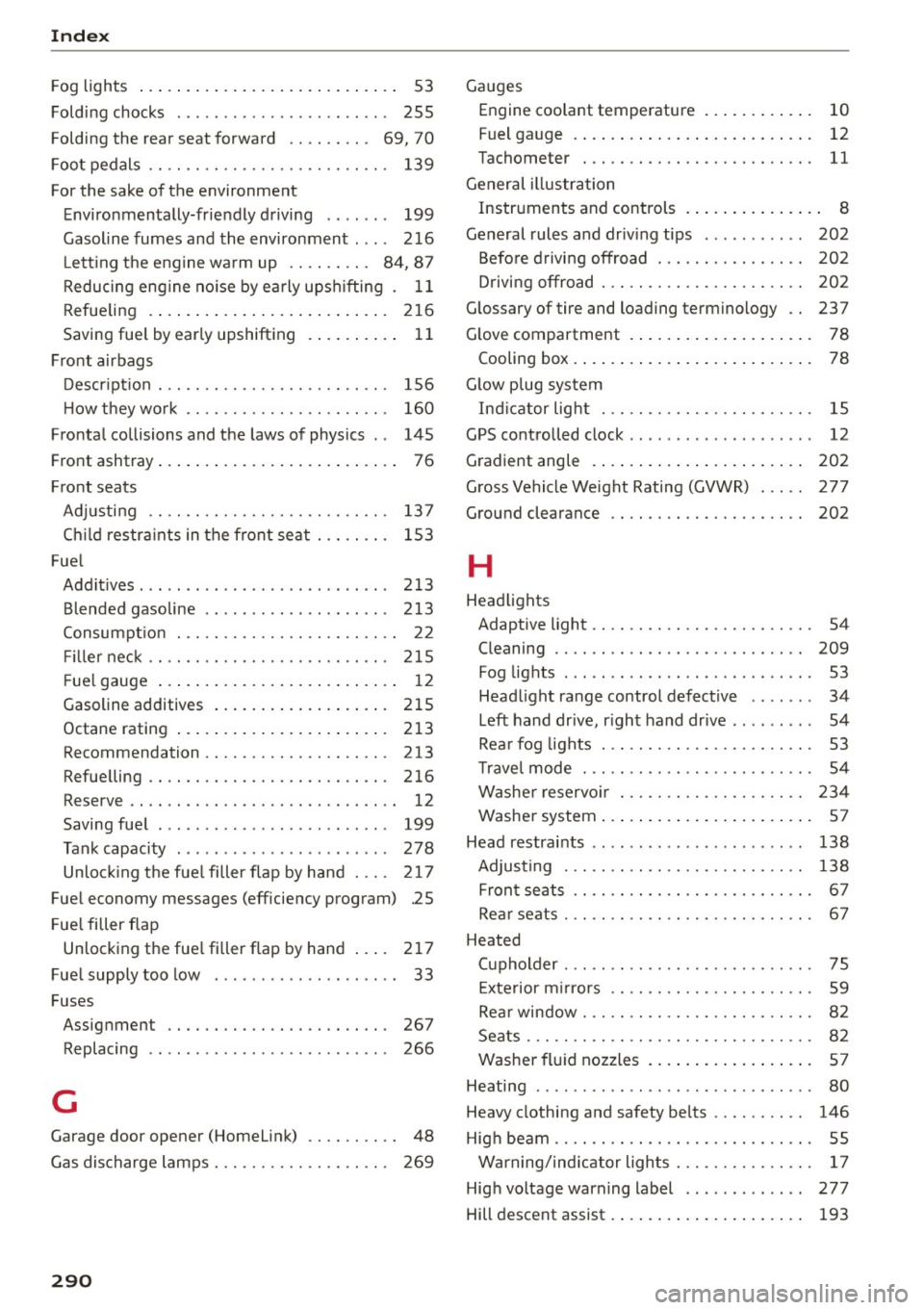
Fog lights . . . . . . . . . . . . . . . . . . . . . . . . . . . . 53
Folding chocks . . . . . . . . . . . . . . . . . . . . . . . 255
Folding the rear seat forward . . . . . . . . . 69, 70
F oot pedals . . . . . . . . . . . . . . . . . . . . . . . . . . 139
For the sake of the environment
Environmentally-friendly driving . . . . . . . 199
Gasoline fumes and the environment . . . . 216
L ett ing the engine warm up . . . . . . . . . 84, 87
Reducing engine noise by early upsh ifting . 11
Refueling . . . . . . . . . . . . . . . . . . . . . . . . . . 216
Saving fue l by early upshifting . . . . . . . . . . 11
Front airbags Description . . . . . . . . . . . . . . . . . . . . . . . . . 156
H ow they work . . . . . . . . . . . . . . . . . . . . . . 160
Frontal collisions and the laws of physics . . 145
Fr ont ashtray . . . . . . . . . . . . . . . . . . . . . . . . . . 76
Front seats
Adjusting . . . . . . . . . . . . . . . . . . . . . . . . . . 137
Ch ild restra ints in the front seat . . . . . . . . 153
Fuel Addit ives ....... .......... ...... ... . 213
Blended gasoline . . . . . . . . . . . . . . . . . . . . 213
Consumpt ion . . . . . . . . . . . . . . . . . . . . . . . . 22
Fill er neck . . . . . . . . . . . . . . . . . . . . . . . . . . 215
F ue l gauge . . . . . . . . . . . . . . . . . . . . . . . . . . 12
Gasoline additives . . . . . . . . . . . . . . . . . . . 215
Octane rating . . . . . . . . . . . . . . . . . . . . . . . 213
Recommendation............... .. ... 213
Refuelling .. .. .... ........... .. .. ... 216
Reserve . . . . . . . . . . . . . . . . . . . . . . . . . . . . . 12
Saving fuel . . . . . . . . . . . . . . . . . . . . . . . . . 199
Tank capacity . . . . . . . . . . . . . . . . . . . . . . . 278
Unloc king the fue l filler flap by hand . . . . 217
Fue l economy messages (efficiency program) .25
F ue l filler flap
Unlocking the fuel filler flap by hand . . . . 217
Fue l supply too low . . . . . . . . . . . . . . . . . . . . 33
Fuses Assignment . . . . . . . . . . . . . . . . . . . . . . . . 267
Replacing . . . . . . . . . . . . . . . . . . . . . . . . . . 266
G
Garage door opener (Homelink) . . . . . . . . . . 48
Gas discharge lamps . . . . . . . . . . . . . . . . . . . 269
290
Gauges
Engine coolant temperature . . . . . . . . . . . . 10
Fuel gauge . . . . . . . . . . . . . . . . . . . . . . . . . . 12
Tachometer . . . . . . . . . . . . . . . . . . . . . . . . . 11
General illu stration
Instruments and controls . . . . . . . . . . . . . . . 8
General rules and driv ing tips . . . . . . . . . . . 202
Before driving offroad . . . . . . . . . . . . . . . . 202
Driving offroad . . . . . . . . . . . . . . . . . . . . . . 202
Glossary of tire and loading terminology .. 237
Glove compartment . . . . . . . . . . . . . . . . . . . . 78
Cooling box . . . . . . . . . . . . . . . . . . . . . . . . . . 78
Glow plug system
Indicator light . . . . . . . . . . . . . . . . . . . . . . . 15
GPS controlled clock .................. . .
Gradient angle ...... .. ........... .. . .
Gross Vehicle Weight Rating (GVWR) ... . .
Ground clearance
H
Head lights 12
202
277
202
Adaptive light . . . . . . . . . . . . . . . . . . . . . . . . 54
Cleaning . . . . . . . . . . . . . . . . . . . . . . . . . . . 209
Fog lights . . . . . . . . . . . . . . . . . . . . . . . . . . . 53
Headlight range control defective . . . . . . . 34
Left hand drive, r ight hand drive . . . . . . . . . 54
Rear fog lights . . . . . . . . . . . . . . . . . . . . . . . 53
T rave l mode . . . . . . . . . . . . . . . . . . . . . . . . . 54
Washer reservo ir . . . . . . . . . . . . . . . . . . . . 234
Washer system . . . . . . . . . . . . . . . . . . . . . . . 57
H d . ea restra ints . . . . . . . . . . . . . . . . . . . . . . . 138
Ad .
t· JUS mg . . . . . . . . . . . . . . . . . . . . . . . . . . 138
Front seats . . . . . . . . . . . . . . . . . . . . . . . . . . 67
Rear seats . . . . . . . . . . . . . . . . . . . . . . . . . . . 67
Heated (upholder . . . . . . . . . . . . . . . . . . . . . . . . . . . 75
Ex terior mirrors . . . . . . . . . . . . . . . . . . . . . . 59
Rear window . . . . . . . . . . . . . . . . . . . . . . . . . 82
Seats . . . . . . . . . . . . . . . . . . . . . . . . . . . . . . . 82
Washer fluid nozzles . . . . . . . . . . . . . . . . . . 57
Heating . . . . . . . . . . . . . . . . . . . . . . . . . . . . . . 80
Heavy clothing and safety belts . . . . . . . . . . 146
High beam . . . . . . . . . . . . . . . . . . . . . . . . . . . . 5S
Warning/indicator lights . . . . . . . . . . . . . . . 17
High voltage warn ing label . . . . . . . . . . . . . 277
Hill descent assist . . . . . . . . . . . . . . . . . . . . . 193