2015 AUDI Q5 airbag
[x] Cancel search: airbagPage 184 of 302
Child safety
A WARNING
Improperly installed child safety seats in
crease the risk of serious personal injury and
death in a collision.
- Always make sure that the safety belt re
tractor is locked when installing a child safe
ty seat . An unlocked safety belt retractor
cannot hold the child safety seat in place
during normal driving or in a crash.
- Always buckle the child safety seat firmly in
place even if a child is not sitting in it. A
loose child safety seat can fly around during
a sudden stop or in a collision.
- Always make sure that the rear seat back
rest to which the center rear safety belt is
attached is securely latched whenever the
rear center safety belt is being used to se
cure a child restraint.
- If the backrest is not securely latched, the
child and the child restraint will be thrown
forward together with the backrest and will
strike parts of the vehicle interior. The child
can be seriously injured or killed.
- Never install rear-facing child safety seats or
infant carriers on the front passenger seat.
A child will be seriously injured and can be
killed when the passenger airbag inflates .
- The inflating airbag will hit the child safety
seat or infant carrier with great force and
will smash the child safety seat and child
against the backrest, center armrest, door
or roof.
-Always install rear-facing child safety seats
or infant carriers on the rear seat.
- Forward-facing child safety seats or infant
carriers installed on the front passenger's
seat may interfere with the deployment of
the airbag and cause serious injury to the
child.
- It is safer to install a forward-facing child
safety seat on the rear seat.
- Always read and heed all WARNINGS when
ever using a child restrained in a vehicle is
being used
~page 172. Special precautions
apply when installing a child safety seat on
the front passenger seat~
page 153, Child
182
restraints on the front seat -some impor
tant things to know.
A WARNING
Always take special precautions if you must
install a forward or rearward-facing child re
straint on the front passenger's seat in excep
tional situations:
- Whenever a forward or rearward-facing
child restraint is installed on the front pas
senger seat, the
PASSENGER AIR BAG OFF
light must come on and stay on whenever
the ignition is switched on.
- If the PASSENGER AIR BAG OFF light does
not come on and stay on, perform the
checks described
~ page 162, Monitoring
the Advanced Airbag System.
-Take the child restraint off the front passen
ger seat and install it properly at one of the
rear seat positions if the
PASSENGER AIR
BAG OFF
light does not stay on whenever
the ignition is switched on.
- Improper installation of child restraints can
reduce their effectiveness or even prevent
them from providing any protection.
- An improperly installed child restraint can
interfere with the airbag as it deploys and
seriously injure or even kill the child .
- Always carefully follow the manufacturer's
instructions provided with the child safety
seat or carrier.
- Never place additional items on the seat
that can increase the total weight registered
by the weight-sensing mat and can cause in
jury in a crash.
A WARNING
Forward-facing child restraints:
-Always make sure the forward-facing seat
has been designed and certified by its man
ufacturer for use on a front seat with a pas
senger front and side airbag.
- Never put the forward-facing child restraint
up, against or very near the instrument pan
el.
-
.__ ________________ __J ...
Page 185 of 302
M N
co
a:
co
,...., \!) 1.1'1
N 1.1'1 ,....,
-Always move the passenger seat into its
rearmost position in the seat's fore and aft
adjustment range, as far away from the air
bag as possible before installing the for
ward-facing child restraint. The backrest must be adjusted to an upright position.
- Make sure that the
PASSENGER AIR BAG
OFF
light comes on and stays on all the time
whenever the ignition is switched on.
A WARNING
Rearward-facing child restraints:
-A child in a rearward-facing child safety seat
installed on the front passenger seat will be
seriously injured and can be killed if the
front airbag inflates - even with an Ad
vanced Airbag System.
- The inflating airbag will hit the child safety
seat or infant carrier with great force and
will smash the child safety seat and child
against the backrest, center armrest, door
or roof.
- Always be especially careful if you must in
stall a rearward facing child safety seat on
the front passenger seat in exceptional cir cumstances.
- A tight tether strap on a rearward-facing
child restraint attached to the front passen
ger seat can put too much pressure on the
weight-mat in the seat and register a heavi er weight in the Advanced Airbag System.
The heavier weight registered can make the
system work as though an adult were on the
seat and deploy the Advanced Airbag when
it must be suppressed causing serious or
even fatal injury to the child.
- Make sure that the
PASSENGER AIR BAG
OFF
light comes on and stays on all the time
whenever the ignition is switched on.
- If the
PASSENGER AIR BAG OFF light does
not come on and stay on, immediately in
stall the rear-facing child safety seat in a
rear seating position and have the airbag
system inspected by your Audi dealer.
Child safety
Activating the convertible locking retractor
Use the convertible locking retractor to secure a
child restraint .
Always heed the child safety seat manufacturer's
instructions when installing a child restraint in
your vehicle . To activate the convertible locking
retractor:
.. Place the child restraint on a sea t, preferably on
the rear seat.
.. Slowly pull the belt all the way out.
.. Route it around or through the child restraint
belt path
~ . & .
.. Push the child safety seat down with your full
weight to get the safety belt really tight.
.. Insert the belt tongue into the buckle for that
seating position.
.. Guide the safety belt back into the retractor un
til the belt lies flat and snug on the child safety
seat .
.. You should hear a "clicking" noise as the belt
winds back into the inertia reel. Test the con
vertible locking retractor by pulling on the belt .
You should no longer be able to pull the belt
out of the retractor. The convertible locking re
tractor is now activated .
.. Make sure that the red release button is facing
away from the child restraint so that it can be
unbuckled quickly.
.. Pull on the belt to make sure the safety belt is
properly tight and fastened so that the seat
cannot move forward or sideways more than
one inch (2 .5 cm) .
A WARNING
Using the wrong child restraint or an improp
erly installed child restraint can cause serious
personal injury or death in a crash .
- Always make sure that the safety belt re
tractor is locked when installing a child safe
ty seat. An unlocked safety belt retractor
cannot hold the child safety seat in place
during normal driving or in a crash.
- Always buckle the child safety seat firmly in place even if a child is not sitting in it. A
loose child safety seat can fly around during
a sudden stop or in a crash. ..,.
183
Page 189 of 302
M N
co ~ co
rl I.O
"' N
"' rl
Tether anchors and tether straps
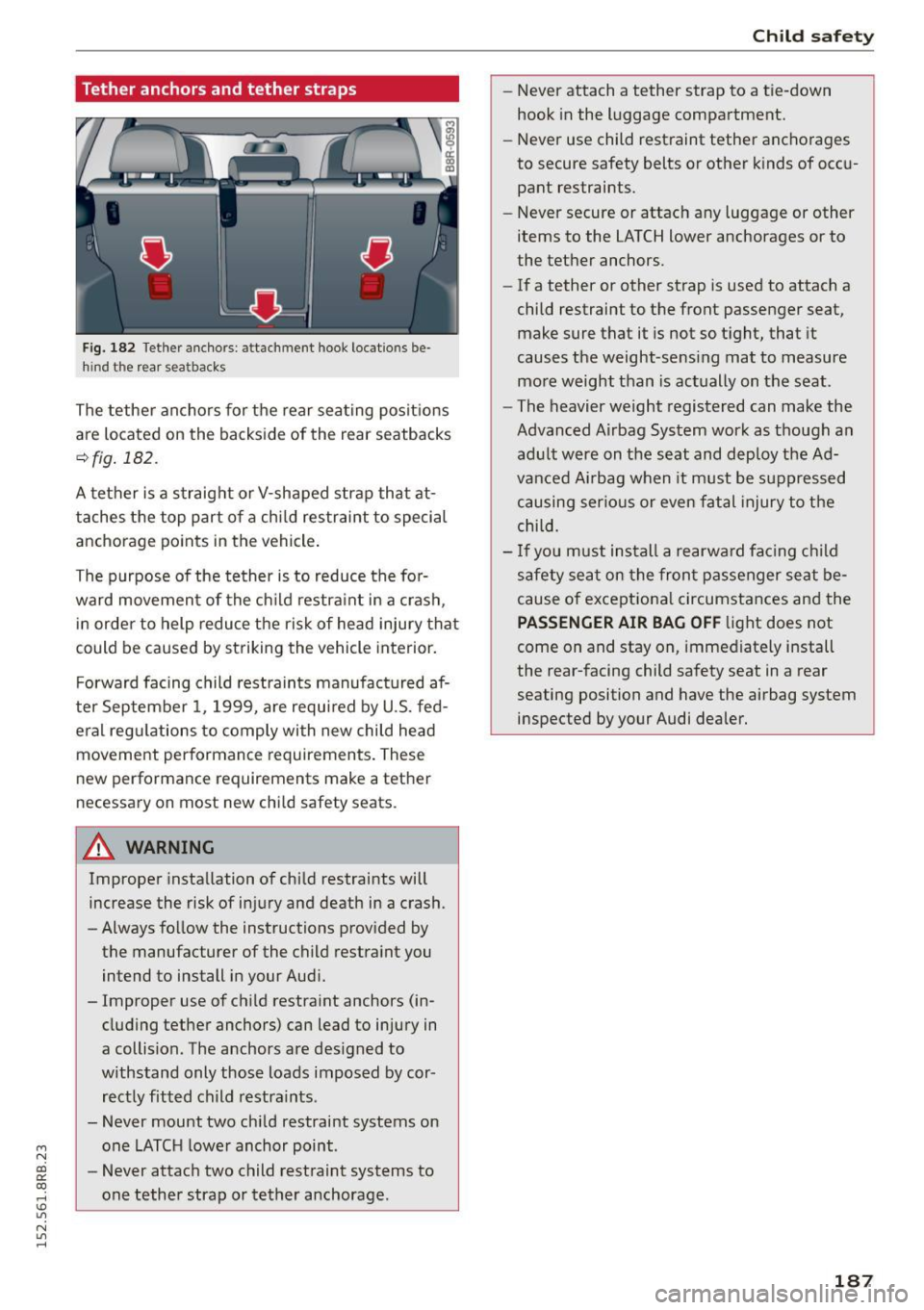
Fig. 182 Tether ancho rs: attach ment hook locatio ns be·
h ind t he rear sea tbacks
The tethe r anchors for the rear seating posit ions
are located on the backside of the rear seatbacks
¢ fig . 182 .
A tether is a s traig ht or V-shaped strap that at
taches the top part o f a ch ild restraint to special
anchorage points in the vehicle .
The purpose of the tether is to reduce the fo r
ward movemen t of the ch ild restra int in a crash ,
i n orde r to help reduce the ris k of head injury that
could be caused by striking the vehicle interior.
F orward facing child restra ints manufact ured af
ter September 1, 1999, are requ ired by U.S. fed
eral reg ulations to comply with new child head
movement performance requirements . These
new performance requirements make a tether
necessary on most new chi ld safety seats.
A WARNING
Improper installation of chi ld restraints will
increase the risk of i nju ry and death in a crash.
- Always fo llow the instructions prov ided by
the manufacturer of the child restra int you
intend to install in your Aud i.
- Improper use of ch ild restraint anchors (in
cluding tether anchors) can lead to injury in
a collision . The anchors are des igned to
withstand only those loads imposed by cor
rectly fitted child restra ints .
- Never mount two chi ld restraint systems on
one LATC H lower anchor point .
- Never attach two child restraint systems to
one tether strap or tether anchorage .
Child sa fe ty
- Never attach a tether strap to a tie-down
hook in the luggage compa rtment.
- Never use child restraint tether ancho rages
to secure safety belts or other k inds of occ u
pant restraints.
- Never secure or attach any luggage or other
items to the LATCH lower anchorages or to
the tether anchors.
- If a tether or other strap is used to attach a
child restraint to the front passenger seat,
make sure that it is not so t ight, that it
causes the weight -sens ing mat to measure
mo re weight than is actually on the seat .
- The heavier weight registered can make the
Advanced A irbag System work as though an
adult were on the seat and dep loy the Ad
vanced Ai rbag when it must be suppressed
causing ser ious or even fatal injury to the
child.
- If you m ust ins tall a rearwa rd fa cing c hild
safety sea t on the fron t passenger se at be
cause of except iona l circumstances and the
PASSENGER AIR BAG OFF light does not
come on and stay on , immediately install
the rear-facing child safety seat in a rear
seating position and have the airbag system
inspected by your Audi dealer.
187
Page 190 of 302
Child safety
Installing the upper tether strap on the
anchorage
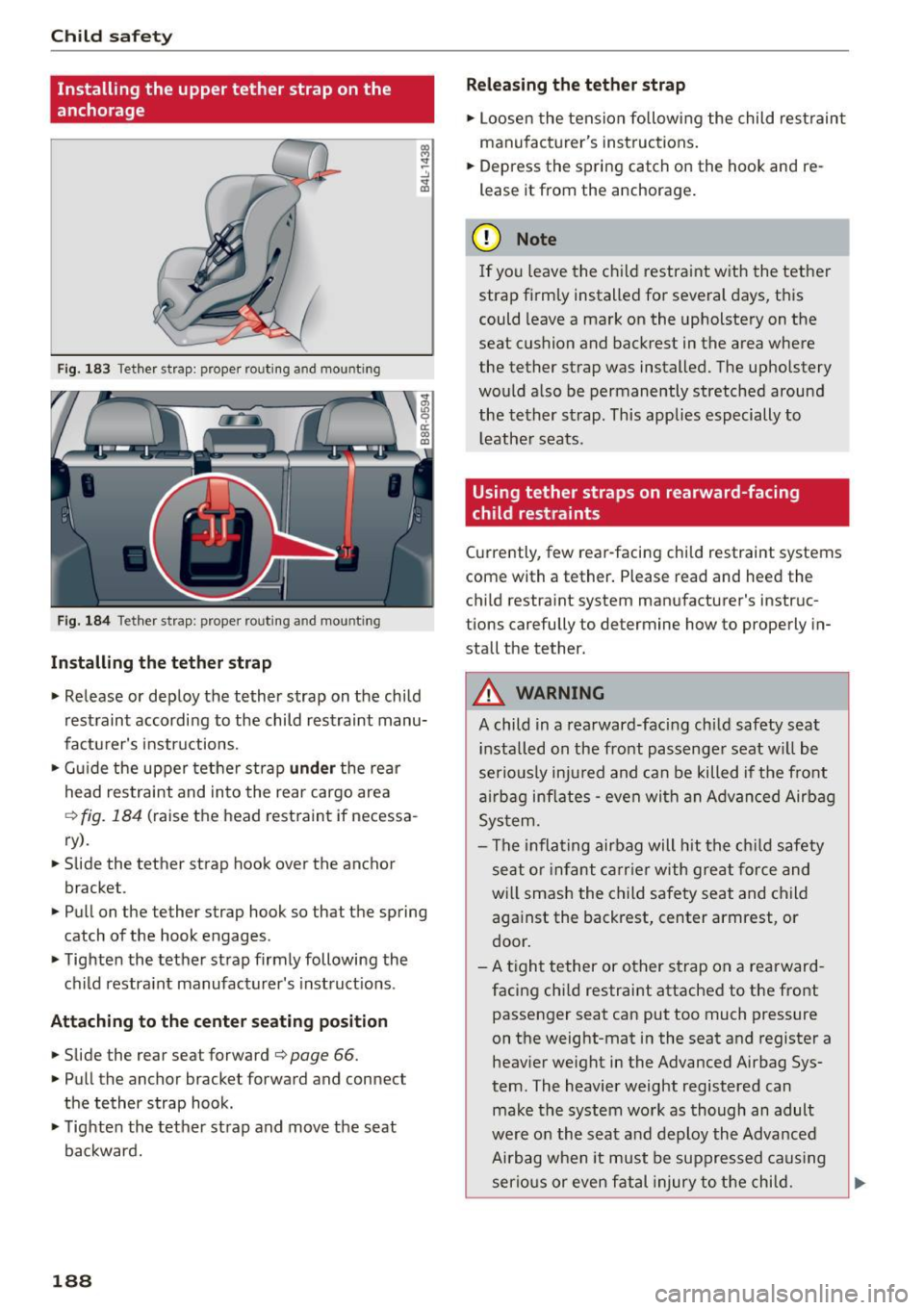
F ig . 183 Tether strap: proper routing and mounting
F ig . 18 4 Tether st rap: proper routing and mounting
Installing the tether strap
• Release or dep loy the tether strap on the child
restraint according to the child restraint manu
factu rer's instr uctions.
• Gui de the upper te ther strap
under the rear
head restraint and into the rear cargo area
¢ fig. 184 (raise the head restraint if necessa
ry).
• Slide the tether strap hook over the anchor
bracket.
• Pull on the tether strap hook so that the spring
catch of the hook engages .
• Tighte n the tether st rap firmly following the
c h ild restra int manufac turer's inst ruct ions .
Attaching to the center seating position
• Slide the rear seat forward ¢ page 66.
• Pull the anchor bracket forward and connect
the tether strap hook .
• Tig hte n the tet her strap and move the seat
backward.
188
Releasing the tether strap
• Loosen the tension fo llow ing the child rest raint
manu fact urer's inst ructions.
• Depress the spring catch on the hook and re
lease it from the anchorage .
(D Note
If you leave the ch ild restraint with the tet her
strap fi rm ly installed fo r several days, t his
could leave a mark on the upholstery on the
seat cushion and backrest in the area where
the tether strap was installed. The upholstery
would a lso be permanently stretched around
the tether s trap . This applies especially to
l ea ther seats.
Using tether straps on rearward-facing
child restraints
Curre ntly, few rear -facing chi ld restraint systems
come with a tether. Please read and heed the
ch ild restra int system manufacturer's instr uc
tions carefully to determine how to properly in
stall the tether.
A WARNING
A child in a rearward-facing ch ild safety sea t
i nstalled on the fro nt pass enge r seat w ill be
seriously inju red and can be killed if the front
air bag in flates - even with an A dvan ced Air bag
Sys tem.
- The infla ting airbag will h it the c hild safety
seat o r infant carrier with great force and
w ill smash the child safety seat and child
aga inst the backrest, center armrest, or
door.
- A t igh t tether or other s trap on a rearward
facing chi ld restraint attached to the front
passenger seat can put too much pressure
on t he weight-mat in the seat and register a
heav ier weight in the Advanced Airbag Sys
tem. The heavier weight registered can
ma ke the system wo rk as though an adult
were o n the seat and deploy the Advanced
Airbag when it must be suppressed ca us ing
ser io us or even fat al injury to t he child.
~
Page 191 of 302
M N
co
a:
co
,...., \!) 1.1'1
N 1.1'1 ,....,
-If you must install a rearward facing child
safety seat on the front passenger seat be
cause of exceptional circumstances and the
PASSENGER AIR BAG OFF light does not
come on and stay on, immediately install
the rear-fac ing ch ild safety seat in a rea r
seating pos it ion and have the airbag system
inspec ted by your A udi dealer.
Additional information
Sources of information about child
restraints and their use
There are a numbe r of sources of additional infor
mat ion about ch ild restra int select ion, installa
tion and use:
NHTSA advises that the best child safety seat is
the one t hat fits your ch ild and f its in your vehi
cle, and that you will use co rrectly and consis
tently.
T ry before you buy!
U.S National Highway T raffic Safety Administra
tion
Te l.: 1-888-327-4236 (TTY: 1-800-424-9153)
http :/ /www .nhtsa .gov
National SAFE KIDS Campaign
Te l.: (202) 662-0600
h ttp://www.safekids.org
Safety BeltS afe U .S .A
T e l. : (800) 745-SAFE (English)
Te l.: (800) 747-SANO (Spanish)
h ttp://www.carseat.org
T ran spo rt Canada Info rm ation Cent re
T e l. : 1-800-333-0371 or call 1-613-998-8616 i f
you are in t he Ottawa area
h ttp://www.tc.gc.ca/eng/roadsafety/menu. htm
Audi Customer Relations
Te l. : (800) 822 -2834
Child sa fety
189
Page 192 of 302

Smart Technology
Smart Technology Notice about data
recorded by the Event
Data Recorder and
vehicle control modules
Event Data Recorder
This vehicle is equipped with an Event Data Re
corder (EDR) . The main purpose of an EDR is to
record, in certain crash or near crash-like situa
tions, such as an airbag deployment or hitting a
road obstacle, data that will assist in understand
ing how a vehicle 's systems performed . The EDR
is designed to record data related to vehicle dy
namics and safety systems for a short period of
time, typically 30 seconds or less . The EDR in this
veh icle is designed to record such data as:
- How various systems in your vehicle were oper
at ing;
- Whe ther or not the driver and passenger safety
belts were buckled/fastened;
- How far (if at all) the driver was depressing the
accelerator and/or brake pedal; and,
- How fast the vehicle was traveling.
These data can help provide a better understand
ing of the circumstances in which crashes and in
juries occur. NOT E: EDR data are recorded by your
vehicle only if a non-trivial crash situation occurs;
no data are recorded by the EDR under normal
driving conditions and no personal data (e.g .,
name, gender , age, and crash location) are re
corded. However, other part ies, such as law en
forcement, could combine the EDR data with the
type of personally identify ing data routinely ac
qui red during a crash investigation.
To read data recorded by an EDR, special equip
ment is requ ired, and access to the vehicle or the
E DR is needed. In addition to the vehicle manu
facturer, other parties, such as law enforcement,
that have the specia l equipment , can read the in
formation if they have access to the vehicle or the E DR.
Some state laws restrict the retrieval or down
loading of data stored by EDRs installed in a vehi
cle for the express purpose of retrieving data af-
190
ter an accident or crash event without the own
er's consent.
Audi will not access the EDR and/or similar data
o r g ive it to others -
- unless the veh icle owner (or lessee if the veh i
cle has been leased) agrees; or
- upon the official request by the police; or
- upon the order of a court of law or a govern-
ment agency; or
- for the defense of a lawsuit through the judicial
discovery process .
- Audi may also use the data for research about
veh icle operation and safety performance or
provide the data to a third party for research
purposes without identifying the spec ific vehi
cle or information about the ident ity of its own
er or lessee and only after the recorded vehicle
data has been accessed.
Vehicle control modules
Your vehicle is also equipped with a number of
electronic control modules for var ious vehicle
systems, such as engine management, emission
control, airbags, and safety belts .
These electronic control modules record data dur ing norma l vehicle operation that may be
needed by trained technicians for diagnostic and
repair purposes. The recording capabil ity of these
modules is lim ited to data (no sound is recorded).
Only a small amount of data is actua lly recorded
over a very limited period of time, or stored when
a system fau lt is detected by a contro l modu le.
Some of the data stored may relate to vehicle
speed, direction, or braking, as well as restraint
system use and performance in the event of a crash. Stored data can also only be read and
down loaded w ith specia l equipment that is di
rectly connected to the vehicle.
(D Tips
Your vehicle may be equipped with Audi con
nect . Your use of certain Audi connect fea
tures requires wireless serv ices that are p ro
v ided by a third party wireless telecommuni
cations provider . For details regarding how in
formation obtained through Audi connect is
collected, processed, transmitted, used, and ..,..
Page 232 of 302

Checking and F ill in g
The brake fluid reservoir is located at the rear
partition of the engine compartment on t he left
side ¢
page 223.
The fl uid level may drop slightly after some time
due to the automatic adjustment of the brake
pads. This is not cause for alarm.
If the b ra ke fluid level fal ls considerably below
the "MIN" mark, the brake warn ing/indicator
light (U.S. models:
1111 , Canadian models: . )
will come on¢
page 18 and ¢ page 28 . Do not
continue to operate the vehicle . The complete
brake system shou ld be thoroughly checked by an
author ized Audi dealer or qualif ied workshop and
the cause corrected. If the brake fluid level is too low, the brake warning/indicator light will illum i
nate. Contact an authorized Aud i dealer
immedi
a tel y.
Changing brake fluid
Have the brake fluid changed by an experienced technician.
Brake flu id abso rbs moisture from the a ir . If the
water content in the brake fluid is too high, cor rosion in the b rake system may result after a pe ri
od of time. The boiling point of the bra ke fluid
will also decrease conside rably and decrease
b ra ki ng per fo rmance .
Therefore, th e brake flu id must be changed
ev ery
tw o years .
Always use new b rake fluid w hich con
forms to Fede ra l Motor Vehicle Standa rd " FMVSS
1 16 DOT 4".
The brake fluid rese rvoir can be difficult to reach,
therefo re, we recommend that yo u have the
b rake fluid changed by your authori zed
Audi
dealer .
Your dealer has the cor rect too ls, the
right brake f luid and the know -how to do t his for
you.
A WARNING
- Brake fluid is po isonous. It must be stored
only in the closed orig inal container out of
the reach of children!
- Brake fai lure can result from old or inappro
pr iate brake fluid . Observe these precau
t ions:
230
- Use only brake fluid that meets SAE spec i
ficat io n
J 1703 and conforms to Federal
Motor Vehicle Sta ndard 116 . Always check
with your aut horized Aud i dea ler to make
su re you are using the correct brake fl uid .
The co rrect type of brake f lu id is also ind i
cated on t he b rake fluid reservoir.
- The brake fl uid must be new. Heavy use of
the b rakes can cause a vapor lock if the
brake fluid is left in t he system too long.
This can se riou sly affec t the efficiency of
the b rakes as well as yo ur sa fety. This
could result in an acc ident .
(D Note
Bra ke fluid will damage the pai nt of you r vehi
cle.
@ For the sake of the environment
B ecause of the prob lem of prope r disposal of
b rake fluid as well as the spe cial tools re
q ui red and the necessary ex pert ise, we rec
ommend that you have the brake f lu id
cha nged by yo ur autho rize d Aud i dea le r.
Battery
General information
U nder normal operat ing conditions , the battery
i n you r Aud i does not need any maintenance.
With
high outside tem pera tures or long d aily
drives we recommend that you have the e lectro
l yte level checked by an a utho rized Audi dea le r or
qualified workshop. The electrolyte leve l should
a lso be checked each time the battery is charged
¢ page 232.
Have the battery checked when yo u take your ve
hicle in for service. You a re well advised to re
place a battery that is older than 5 years.
With cer tain types of airbag deployment, t he bat
tery is disconnected from the vehicle elect rical
system for safety reasons
Q &. in Repair, care
and disposal of the airbags on page 165.
Hybrid drive *: yo u can find important information
abo ut the high voltage battery under ¢
page 98 . ..,.
Page 269 of 302

M N
co ~ co
rl I.O
"' N
"' rl
Left cockpit fuse assignment
Fig. 224 Left side of the cockpit: fuse panel with plastic
clip
Fuse panel @ (black )
No. Equipment
1 Dynamic steering
2 ESC control module
A/C system pressure sensor, electrome-
3 chanical park
ing brake, Homelink, auto-
matic dimming interior rearview mirror, air
quality/outside air sensor, ESC button
5 Sound
actuator/exhaust sound tuning
6 Headlight range contro l/cornering light
7 Headlight (cornering light)
Control modu les (e lectromechanical park-
8 ing brake, shock absorber, quattro Sport,
trailer hitch), DCDC converter
9
Adaptive cruise control or high voltage
battery (hybrid drive)
11 Side assist
12 Headlight range control, parking system
13 Airbag
14 Rear w iper
15 Auxi
liary fuse (instrument panel)
1 6 Auxiliary fuse terminal 15 (engine area) Fuses
and bulbs
Fuse panel @ (brown)
No . Equipment
1 Electric exhaust door
2 Brake light sensor or brake pedal
move-
ment sensor (hybr id drive)
3 Fuel pump
4 AdBlue pumps
or brake booster power
supply (hybrid dr ive)
5 Left seat heating with/without seat venti-
lation
6 ESC
7 Horn
8 Left
front door (window regulator, central
locking, mirror, switch, lighting)
9 Wiper motor
10 ESC
11 Left
rear door (window regu lator, switch,
lighting)
12 Rain and light sensor
Fu
se panel © (re d)
No . Equipment
3 Lumbar support
4 Dynamic steering
5 Climatized cupholder
6 Windshie
ld washer system, headlamp
washer system
7 Vehicle electr ical system control module 1
8 Vehicle e
lectrica l system control module 1
9 Panorama sunroof
10 Vehicle e lectrica l system control module 1
11 Sun shade (pano rama sunroof)
12 Anti-theft a
larm system
267