2015 AUDI Q5 oil
[x] Cancel search: oilPage 228 of 302

Checking and F ill in g
- The oi l fi ller cap mus t be pr operly secured to
p re vent oil from being sprayed on the hot
engine and exhaust system when the engine
is running - fire hazard!
- If your skin has come in contact with the en
gine oil, you must subsequently clea nse it
tho roughly .
CD Note
-Check the o il level using the radio or the
MMI*. If the message
Please reduce oil lev
el
appears, contact your authorized Audi
dealer or other qualified wo rkshop to have
excess oil ext racted if necessa ry .
- Audi does not recommend the use of oil
additive s. They may damage the engine
and adversely affect your New Vehicle War
ranty .
@ For the sake of the environment
- Under no circ umstances ca n the o il come in
contact w ith the sewage network o r the soil.
- Observe and fo llow lega l regu lations whe n
dispos ing of empty oil co ntaine rs .
Changing the engine oil
We recommend that have your oil changed by an
authorized Audi dealer or a qualified service sta
tion .
Before you check any thing in the engine compart
ment,
always read and heed all WARNINGS c> .&.
in Working in the engine compartment on
page 221 .
The engine oil must be changed according to the i n terva ls specified in your Warranty
& Mainte
nance booklet . This is ve ry impo rtant because the
lubricat ing propert ies of o il diminish gradua lly
du ring normal ve hicl e use.
Unde r some circumstances the eng ine o il should
be changed more frequent ly. Change oil more of
ten if yo u drive most ly short distances, operate
t he vehicle in d usty areas or unde r predom inan tly
s top-and-go traff ic co ndit io ns, o r have you r vehi
cle where tem peratures rema in be low freezing
for extended periods .
226
Detergent additives in the oil will make fresh oil
l ook dark after the engine has been running fo r a
short time. Th is is norma l and is not a reason to
c h ange the oi l more often than recommended.
Beca use o f the p rob lem of p roper disposal, along
with t he specia l too ls and necessary expertise re
quired, we strongly recommend that yo u have
your oi l changed by an authori zed
Audi dealer or
a q ua lified service station.
If you choose to change your oil yourself , please
note the fo llow ing important info rmat ion:
_& WARNING
To reduce the risk of personal inj ur y if you
must change the eng ine oil in your vehicle
yourself:
- Wear eye protect ion.
- To reduce t he risk of burns from hot eng ine
oil, let the engine coo l d own to the to uch.
-
- W hen removing the o il dra in p lug with your
fingers, stay as far away as possible. Always
keep you r forearm parallel t o the ground to
he lp prevent hot o il from running down your
arm .
- Dra in the oil i nto a container designed for
this purpose , one large enough to hold at
l e ast the tota l amount o f oil in you r engine.
- Engine oil is poisonous. Keep it we ll out of
the reach of ch ildren .
- Continuous contact w it h used eng ine oi l is
ha rmf ul to your skin . Always protect your
skin by washi ng oil off tho roughly wi th soap
a nd wate r.
CD Note
N eve r mix oil additives with you r engine oil.
These add itives can damage your engine and
adverse ly affec t your Aud i Lim ited New Vehi
cle Warranty.
@ For the sake of the environment
-Before changi ng your oil , first make sure
you know wh ere you ca n prope rly dispose of
t h e us ed oil.
- Always disp ose of used eng ine oil properly.
Do not dump it o n garden soi l, wooded
Page 229 of 302

M N
co
a:
co
,...., \!) 1.1'1
N 1.1'1 ,....,
areas, into open streams or down sewage
drains.
- Recycle used engine oil by taking it to a used
engine oil collection facility in your area, or
contact a service station.
Cooling system
Coolant
T he engine coolant performs two functions: it
keeps the engine from overheating and it pro
tects the engine from freezing in the winter .
The cooling system is sealed and generally re
qu ires little attention .
T he cooling system has been filled at the factory
with a permanent coolant which doe s not need to
be changed . T he cool ant consists of a mixture of
specia lly condit io ned water and the ma nufactur
e r's g lycol-basedcoo lant additive G 13 antifreeze
w ith a nticorros ion add itives (50% for USA mod
e ls; 60% for Canadian models) . Thi s m ixt ure bot h
a ssures the ne cessary frost protection and pro
tec ts meta l components in the engine 's cooling
system from corrosion and sca ling. It a lso raises
the boiling point of the coolant.
D o not red uce the conce ntra tion o f th e coo lant i n
the summer by add ing p la in wa ter.
The propor
tion of coolant additive must be at least 50% but not more than 60 %
to maintain antifreeze
protection and cooling efficiency . If the coolant
frost protection is too low, the coolan t could
freeze and damage t he vehicle heat ing and en
g ine cooling system .
For yea r-round driving, antifree ze is added at the
factory for tempe ratu res down to:
- -31°F ( -35°C) USA
- - 4 0°F ( - 40°C) C anada .
I f yo u mu st add coo lant, use a m ixt ure of wate r
a nd coolant add it ive. Mixing the coolant additive
with d istilled water is recommende d.
_& WARNING
Be fore yo u check any thing i n the engine com
par tment, always read and hee d all WAR N-
Checking and Fillin g
IN GS ¢ .& in Working in the engine compart
ment on page 221.
@ Note
- Be fore winte r sets in , have the coo lant
checke d to see if the coolant additive in you r
vehicle is sufficient to meet the climate con diti ons. This is espec ia lly important if you
live in a region where the winter is extreme
ly cold . If necessary, increase the p ropo rtion
o f coolan t addi tive to 60%.
- Whe n adding coolant additive to your cool
ing system, remember :
- We recommend using o nly coo lan t add i
tive G12++ o r G13 fo r yo ur vehicle . This
coolant ad dit ive is available at author ized
A ud i dealers . Othe r types of antifreeze ca n
significantly reduce cor rosion protect ion .
The resulting cor rosion can ca use a loss of
coolant a nd serious e ngine damage .
- Do not add any type of rad iator leak sealant
to your vehicle's engine coolant. Adding ra diat or repa ir flu id may adverse ly affect the
function and perfo rmance of your cooling
system and cou ld result i n damage not cov
ere d by your New Vehicle Lim ited W arra nty .
Checking the engine coolant level
Th e engine coolant level can be checked with a
quick glance.
Fi g. 200 Engin e compar tmen t: cov er on th e coo lant ex pan
s io n ta nk
Befo re you ch eck a nyth ing in the eng in e compart
me nt,
always read and heed all WARNINGS
¢ ,& in Working in the engine compartmen t on
page 221.
~
227
Page 230 of 302

Checking and Filling
"'Park your vehicle on a level surface.
"'Turn off the ignition.
"'Read the engine coolant level from the coolant
expansion tank
c:> fig . 200, <=> page 223,
fig. 197. With a cold engine, the coolant level
should be between the "MIN" and "MAX" mark
ings . When the engine is warm, the level may
be slightly above the "MAX" marking .
The location of the coolant expansion tank can be
seen in the engine compartment illustration
<=> page 223 .
To obtain an accurate reading, the engine must
be switched off.
The expansion tank in your vehicle is equipped
with an electric coolant level sensor.
When the coolant level is too low, the warning
light in the Auto-Check System
c::> page 29 will
blink until you add coolant and the level has been
restored to normal. Even though there is an elec
tric coolant level sensor, we still recommend you
check the coolant level from time to time .
Coolant loss
Coolant loss may indicate a leak in the cooling
system. In the event of coolant loss, the cooling
system should be inspected immediately by your
authorized Audi dealer. It is not enough merely
to add coolant .
In a
sealed system, losses can occur only if the
boiling point of the coolant is exceeded as a re
sult of overheating.
0 Note
Do not add any type of radiator leak sealant
to your vehicle's engine coolant . Adding radia
tor repair fluid may adversely affect the func
tion and performance of your cooling system
and could result in damage not covered by
your New Vehicle Limited Warranty .
Adding coolant
Be very careful when adding engine coolant.
Before you check anything in the engine compart
ment,
always read and heed all WARNINGS
228
c::> A in Working in the engine compartment on
page
221.
Requirement: There must be a residual amount
of coolant in the expansion tank
<=>(i) .
"'Turn off the engine.
"' Let the engine cool down.
"' Place a thick rag over the coolant expansion
tank
c::> page 22 7, fig. 200 and carefully turn
the cap counter-clockwise
c::> .&, .
"'Add coolant mixed in the correct ratio
c::> page 22 7, Coolant up to the MAX marking.
"'Make sure that the fluid level remains stable.
Add more coolant if necessary .
"'Twist the cap on again
tightly.
Replacement engine coolant must conform to ex
act specifications
c::> page 22 7, Coolant.
We recommend using only coolant additive Gl2+
+, Gl3
or in an emergency Gl2+. Do not use a
different additive. In an emergency use plain wa
ter until you can get the correct additive and can
restore the correct ratio. This should be done as
soon as possible.
If you have lost a considerable amount of cool
ant, then you should add cold antifree ze and cold
water only when the engine is cold.
Always use
new engine coolant when refilling.
Do not fill coolant above the "MAX" mark. Excess
coolant will be forced out through the pressure
relief valve in the cap when the engine becomes
hot.
A WARNING
- The cooling system is under pressure and
can get very hot. Reduce the risk of scalding
from hot coolant by following these steps.
- Turn off the engine and allow it to cool
down.
- Protect your face, hands and arms from
escaping fluid and steam by covering the
cap with a large, thick rag.
- Turn the cap slowly and very carefully in a
counter-clockwise direction while applying
light, downward pressure on the top of
the cap.
ll-
Page 232 of 302

Checking and F ill in g
The brake fluid reservoir is located at the rear
partition of the engine compartment on t he left
side ¢
page 223.
The fl uid level may drop slightly after some time
due to the automatic adjustment of the brake
pads. This is not cause for alarm.
If the b ra ke fluid level fal ls considerably below
the "MIN" mark, the brake warn ing/indicator
light (U.S. models:
1111 , Canadian models: . )
will come on¢
page 18 and ¢ page 28 . Do not
continue to operate the vehicle . The complete
brake system shou ld be thoroughly checked by an
author ized Audi dealer or qualif ied workshop and
the cause corrected. If the brake fluid level is too low, the brake warning/indicator light will illum i
nate. Contact an authorized Aud i dealer
immedi
a tel y.
Changing brake fluid
Have the brake fluid changed by an experienced technician.
Brake flu id abso rbs moisture from the a ir . If the
water content in the brake fluid is too high, cor rosion in the b rake system may result after a pe ri
od of time. The boiling point of the bra ke fluid
will also decrease conside rably and decrease
b ra ki ng per fo rmance .
Therefore, th e brake flu id must be changed
ev ery
tw o years .
Always use new b rake fluid w hich con
forms to Fede ra l Motor Vehicle Standa rd " FMVSS
1 16 DOT 4".
The brake fluid rese rvoir can be difficult to reach,
therefo re, we recommend that yo u have the
b rake fluid changed by your authori zed
Audi
dealer .
Your dealer has the cor rect too ls, the
right brake f luid and the know -how to do t his for
you.
A WARNING
- Brake fluid is po isonous. It must be stored
only in the closed orig inal container out of
the reach of children!
- Brake fai lure can result from old or inappro
pr iate brake fluid . Observe these precau
t ions:
230
- Use only brake fluid that meets SAE spec i
ficat io n
J 1703 and conforms to Federal
Motor Vehicle Sta ndard 116 . Always check
with your aut horized Aud i dea ler to make
su re you are using the correct brake fl uid .
The co rrect type of brake f lu id is also ind i
cated on t he b rake fluid reservoir.
- The brake fl uid must be new. Heavy use of
the b rakes can cause a vapor lock if the
brake fluid is left in t he system too long.
This can se riou sly affec t the efficiency of
the b rakes as well as yo ur sa fety. This
could result in an acc ident .
(D Note
Bra ke fluid will damage the pai nt of you r vehi
cle.
@ For the sake of the environment
B ecause of the prob lem of prope r disposal of
b rake fluid as well as the spe cial tools re
q ui red and the necessary ex pert ise, we rec
ommend that you have the brake f lu id
cha nged by yo ur autho rize d Aud i dea le r.
Battery
General information
U nder normal operat ing conditions , the battery
i n you r Aud i does not need any maintenance.
With
high outside tem pera tures or long d aily
drives we recommend that you have the e lectro
l yte level checked by an a utho rized Audi dea le r or
qualified workshop. The electrolyte leve l should
a lso be checked each time the battery is charged
¢ page 232.
Have the battery checked when yo u take your ve
hicle in for service. You a re well advised to re
place a battery that is older than 5 years.
With cer tain types of airbag deployment, t he bat
tery is disconnected from the vehicle elect rical
system for safety reasons
Q &. in Repair, care
and disposal of the airbags on page 165.
Hybrid drive *: yo u can find important information
abo ut the high voltage battery under ¢
page 98 . ..,.
Page 237 of 302

M N ai
"' ~
-"' "' N
"' ...,
Wheels
Wheels and Tires
General information
.,.Che ck your tires regularly for
damage (punctures, cuts, cracks
and bulges). Remove foreign ob
jects from the tire tread.
.,. If driving over curbs or similar
obstacles, drive slowly and ap
proach the curb at an angle.
.,.Have faulty tires or rims re
placed immediately.
"'Protec t your tires from oil,
grease and fuel.
.,.Ma rk tires before removing
them so that the same running direction can be maintained if
they are reinstalled .
.,.Lay tires flat when storing and
store them in a cool, dry location
with as little exposure to light as
possible.
(D Note
-Please note that summer and
winter tires are designed for
the conditions that are typical
in those seasons. Audi recom
mends using winter tires dur
ing the winter months . Low
temperatures significantly de crease the elasticity of summ
er tires, which affects traction
Wheels
and braking ability. If summer
tires are used in very cold tem
peratures, cracks can form on
the tread bars, resulting in
permanent tire damage that
can cause loud driving noise
and unbalanced tires.
-Burnished, polished or
chromed rims must not be
used in winter driving condi
tions. The surface of the rims
does not have sufficient corro
sion protection for this and
could be permanently dam
aged by road salt or similar
substances.
Tire designations
Fig. 204 T ir e designations on the sid e-
wall ,..
235
Page 249 of 302

M N
co
a:
co
,...., \!) 1.1'1
N 1.1'1 ,....,
Wheels
Model/ Tire designation Tire pressure
engine Normal load Maximum load
(up to 3 people)a)
front rear front rear
PSI
235/60 Rl8 103H
29 Q5: All Season
2.0L 235/55 Rl9 101H
4 cylinders All Season
30
and
Q5: 235/55 Rl9 101W 2
9 High Performance
3.0L
6 cylinders 255/45 R20 101W
29 High Performance
255/45 R20 101W
3
9 SQ5:
High Performance
3.0L
6 cylinders 255/40 R21 102Y XL
41
High Performance
a) 2 p
eopl e in th e fron t, 1 p ers on i n th e re arr
A WARNING
Please note the important safe
ty precautions regarding tire pressure
¢ page 245 and load
limits
¢ page 247 .
Tires and vehicle load limits
There are limits to the amount of
load or weight that any vehicle
and any tire can carry. A vehicle
that is overloaded will not handle
well and is more difficult to stop.
Overloading can not only lead to
lo ss of vehicle control , but can al
so damage important parts of the
vehicle and can lead to sudden
tire failure, including a blowout
kPA PSI kPA PSI kPA PSI
20 0 29 2 00 32 220 32
2 10 30 210 33 230 33
200 2 9 200
33 2
30 33
2 00 29 2 00 33 230 33
270 39 270 41 280 41
280 36 2
50 41 2 80 42
and sudden deflation that can
cause the vehicle to crash.
kPA
220
230
2 30
230
280
2 90
Your safety and that of your pas
sengers also depends on making
sure that load limits are not ex
c eeded. Vehicle load includes ev
erybody and everything in and on
the vehicle. These load limits are te chnically referred to as the vehi
cle 's
Gross Vehicle Weight Rating
("GVWR") .
The "GVWR " includes the weight
of the basic vehicle, all factory in
stalled accessories, a full tank of
fuel, oil, coolant and other fluids
plus maximum load. The maxi
mum load includes the number of""
247
Page 260 of 302
Emergency assistance
Tire repair set
General information and safety precautions
Applies to veh icles: w ith tire repair kit
The tire repair is only meant for temporary use.
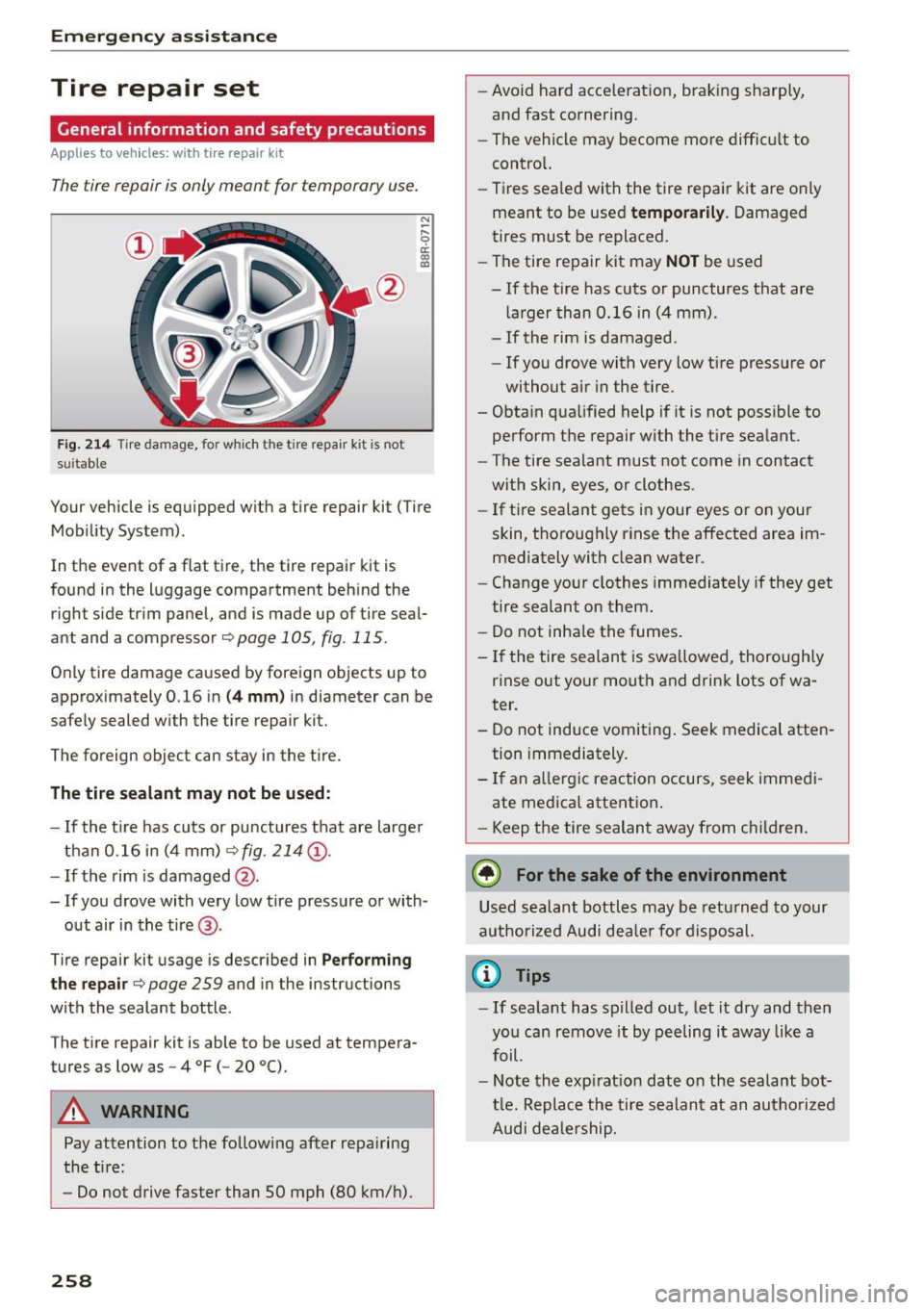
Fig. 214 T ire damage, for which the tire repa ir kit is not
s ui ta bl e
N ~ .... 0 cc co m
Your vehicle is eq uipped w ith a tire repair kit (Tire
Mob ility System).
In the event of a flat tire, the tire repai r kit is
found in the l uggage compartment beh ind the
right side tr im panel, and is made up of tire seal
ant and a compressor
<=:>page 105, fig . 115 .
Only tire damage caused by foreign objects up to
approximately 0.16 in
( 4 mm ) in diameter can be
safe ly sealed with the tire repair kit.
The fo reign object can stay in the tire .
The tire sealant may not be used:
-If the t ire has cuts or pu nctures that are large r
than 0.16 in (4 mm)
r::::> fig. 214 @.
-If the rim is damaged @.
- If you drove with very low t ire pressure or with -
out air in the tire @.
Tire repair kit usage is descr ibed in
Performing
the repair r::::> page 259 and in the instructions
with the sealant bottle .
The tire repair kit is able to be used at tempera
tures as low as -4 °F (- 20 °C).
A WARNING
Pay attention to the following after repa iring
the t ire:
- Do not drive faster than SO mph (80 km/ h).
258
- Avoid hard acce lerat ion, bra king sharply,
and fast cornering .
- Th e vehicle may become more diffic ult to
contro l.
- Tires sea led with the tire repair kit are o nly
meant to be use d
temporarily. Damaged
tires must be replaced .
- The tire repair kit may
NOT be used
- If the ti re has cuts or punctures that are
lar ger than 0.16 in (4 mm).
- If the rim is damaged.
- If you drove with very low t ire pressure or
without air in the tire .
- Obta in qua lified help i f it is not poss ible to
perform t he repair with the tire sealant.
- The tire sealant must not come in contact
w it h skin, eyes, or clothes .
- If tire sealant gets in your eyes or on your
skin, thoroughly rinse the affected area im
mediately with clean wate r.
- Change your clothes immediately if they get
tire sealant on them.
- Do not inha le the fumes.
- If the tire sealan t is swa llowed, thoroughly
rinse out yo ur mouth and drink lots of wa
ter.
- Do not induce vomiting . Seek medical atten
tion immediately .
- If an a llergic reaction occurs, seek immedi
ate med ica l attention .
- Keep t he tire sealan t away from c hild ren.
@ For the sake of the environment
Used s ealant bottl es may be retu rned to your
a uthori zed Audi dea le r fo r d isposal.
(j) Tips
- If sea lant has spilled out, let it dry and then
yo u can remove it by pe eling it away like a
foil.
- Note the expi rat ion date on the sealant bot
t le . Replace the tire sealant at an au tho riz ed
Audi dealership .
Page 261 of 302
M N
co ~ co
rl I.O
"' N
"' rl
Performing the repair
Applies to vehicles: with tire repair kit
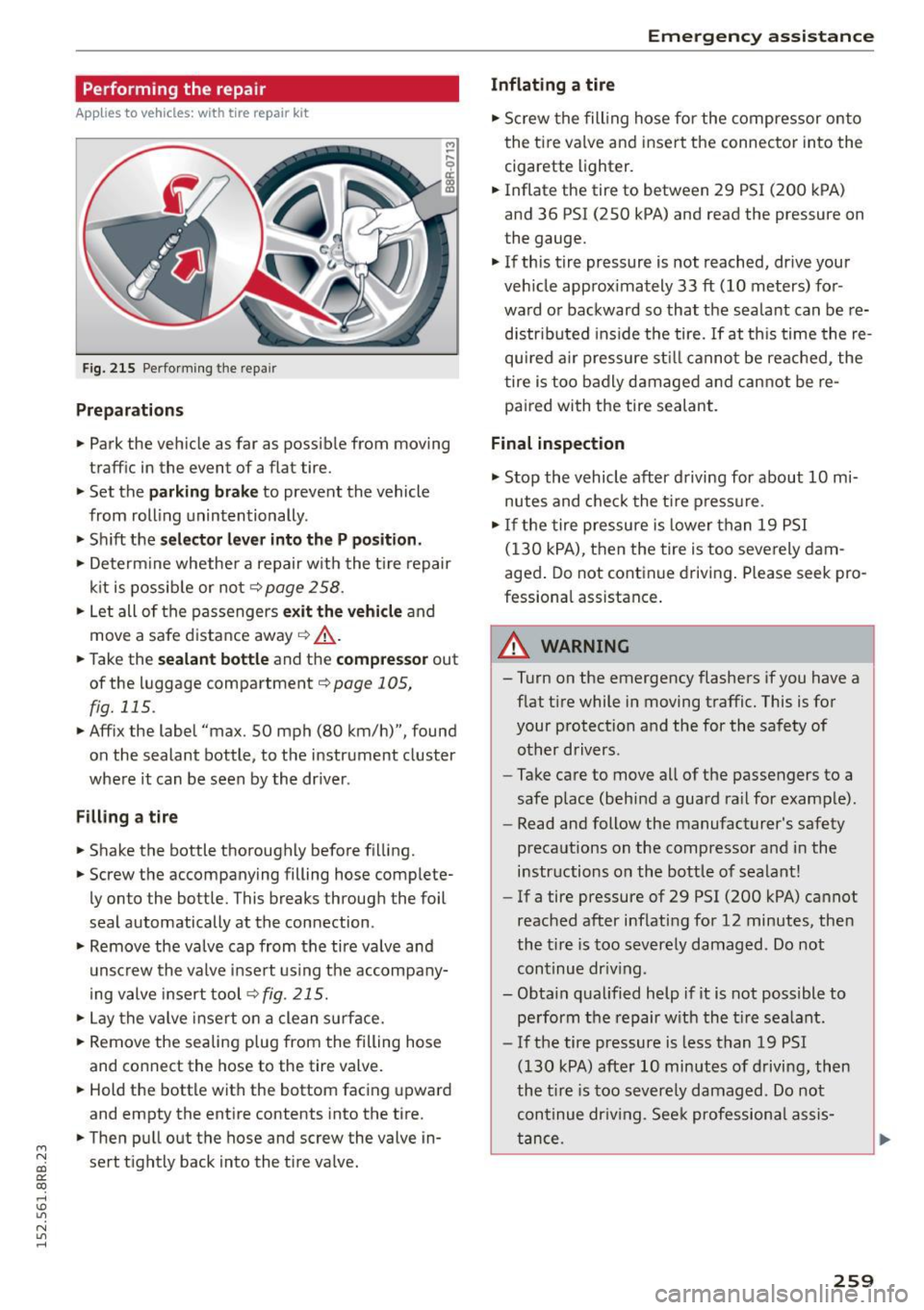
Fig. 215 Perfo rm ing the repa ir
Prep arati ons
"' Park the vehicle as far as possib le from moving
traff ic in the event of a flat tire.
"' Set the
parki ng brak e to prevent the vehicle
from roll ing unintentionally.
"' Shift the
sele ctor lever into th e P po sition .
"'Determ ine whethe r a repair w ith the t ire repair
k it is possib le or not
c::> page 258.
"' Let all of the passengers ex it the vehicle and
move a safe d istance away
c::> .&_ .
• Take the se alant bottle and the compre ssor out
of the luggage compartment
i:::> page 105,
fig. 115 .
"'Affix the label "max. 50 mph (80 km/h)", found
on the sealant bottle, to the instrument cluster
where it can be seen by the dr iver.
F illing a tire
"'Shake the bottle thoroughly before fi lling.
"' Screw the accompanying filling hose complete-
ly onto the bottle. This breaks throug h the foil
seal automatically at the connection .
"' Remove the valve cap from the tire va lve and
unscrew the valve insert us ing the accompany
ing valve insert tool~
fig. 215.
"'Lay the valve inse rt o n a clean s urface.
"' Remove the sealing plug from the filling hose
and connect the hose to the tire valve.
"' Hold the bottle with the bottom facing upward
and empty the ent ire contents into the tire.
"' Then pull out the hose and screw the valve in
sert tightly back into the t ire va lve.
Em erg en cy ass is tan ce
Inflating a tire
"'Screw the fill ing hose for the compressor onto
the t ire va lve and insert the connector into the
cigarette lighter.
• Inflate the tire to between 29 PSI (200 kPA)
and 36 PSI (250 kPA) and read the pressure on
the gauge.
"' If this tire pressure is not reached, dr ive your
veh icle app rox imately 33 ft (10 meters) for
ward or backward so that the sealant can be re distr ibuted ins ide the tire . If at th is time the re
qui red a ir pressure st ill canno t be reached, the
t ire is too badly damaged and cannot be re
pa ired with the tire sealant.
Final inspection
"' Stop the vehicle after driving for about 10 mi
nutes and che ck the t ire p ress ure .
"'I f the tire pressure is lower than 19 PSI
( 1 30 kPA), then the tire is too seve rely dam
aged. Do not continue driving . Please seek pro
fessiona l assistance .
A WARNING
-
- Turn on the emergency flashers if you have a
flat tire while in moving traffic. This is for
your protection and the for the safety of
other drivers .
- Take care to move all of the passengers to a
safe place (behind a guard rail for examp le).
- Read and follow the manufacturer's safety
precautions on the compressor and in the instructions on the bottle of sealant!
- If a tire pressure of 29 PSI (200 kPA) cannot
reached after inflating for 12 minutes, then
the t ire is too severely damaged . Do not
continue dr iv ing .
- Obta in qualified help if it is not possible to
perform t he repair w ith the t ire sea lant.
- If the tire pressure is less than 19 PSI
(130 kPA) after 10 minutes of drivi ng, then
the t ire is too severe ly damaged . Do not
continue dr iv ing. See k professiona l assis
tance .
259