2015 AUDI Q3 ESP
[x] Cancel search: ESPPage 215 of 258

M N
M N
0 ::i co ,...., \!) 1.1'1 ,...., 1.1'1 ,....,
In o rder to minimize the occurrence o f imp act
damage to the tires of y our vehicle, we recom
mend that you observe the following precau
tions :
- Always maintain recommended inflation
pressures. Check your tire pressure every
2,000 miles (3,000 km) and add a ir if neces
sary.
- Drive carefu lly on roads with potholes, deep
gullies or ridges. The impact from driving
through or over such obstacles can damage
your tires. Impact with a curb may also cause damage to your tires .
- After any impact, immediately inspect your
tires or have them inspected by the nearest
authorized Aud i deale r. Replace a damaged
t ire as soon as poss ible .
- In spect your t ires every 2,000 miles (3,000
km) for damage and wear . Damage is not al
ways easy to see. Damage can lead to loss of
air and unde rinflation, wh ic h could eventu
ally cause ti re fa il ur e.
If yo u be lieve that a
t ir e may have been damaged , replace the
tire as soon as possible.
- These tires may wea r more q uick ly than oth
ers.
- Please a lso remembe r that, whi le these t ires
deliver respons ive handling, they may ride
l ess comfortably and make more noise than
other c hoices.
Reduced p erformance in winter /cold
s ea son condit ion s
All ti res are designed for certain purposes .
The low aspect ratio, ultra hig h pe rformance
tires orig inally installed on your veh icle are in
tended for max imum dry and wet road per
formance and handling . They are not suitable
for cold, snowy or icy weather cond it ions . If
you dr ive under those circumstances, you
should equip your vehicle with all-season or
winter tires, whi ch offe r better trac tion under
t hose cond itions . We suggest yo u use the rec
ommended snow or all -season tires specified
for your ve hicle, or their equiva lent .
Refe r to
~ page 210 for mo re deta iled info r
mat io n regarding w in ter t ires.
Tire s an d wheel s 213
Tire pressure
monitoring system
ill General notes
App lies to vehicles : wi th tire p ress ure mo nito rin g system
Each tire, incl uding the spa re (if provided),
sho uld be checked monthly when co ld and in
flated to the inflation pressure recommended
by the veh icle manufacturer on the veh icle
placard or tire inflation pressure label. (If your
vehicle has tires of a d ifferent size than the
s iz e indicated on the vehicle placa rd o r tire in
flat io n pressu re labe l, you s hou ld dete rm ine
the p roper t ire inflation p ress ure fo r those
ti r es).
As an added safety featu re, your veh icle has
been equipped with a tire p ressure monitoring
system ( TPMS) tha t illum inates a low ti re
pressure te lltale whe n one or more o f you r
ti res is significant ly under -inflated . Acco rding
ly, when the low tire pressure te lltale i llumi
nates, yo u shou ld stop and check you r tires as
soon as possib le, and inf late them to the
proper pressure. Driving on a sign ificantly un
der- inflated t ire causes the tire to overheat
and can lead to tire fa ilure . Under-inflation al
so reduces fuel eff ic iency and tire tread life,
and may affe ct the vehicle 's hand ling and
stopp ing abil ity.
Please note that the TPMS is not a subst itute
fo r proper tire ma intenanc e, and it is the d riv
er's respo nsibility to maintain co rrect tire
pressure, even if under -inflation has not
reached the leve l to tr igger illum inat ion o f the
T PMS low ti re p ressu re tellta le .
You r vehicle has also been equipped with a
T PMS ma lf u nction indicator to ind icate w hen
t he sys tem is not oper ating prope rly . T he
T PMS ma lfunction indicator is combined w ith
the low tire pressure te lltale. When the sys
tem detects a malfunction, the telltale wi ll
flash for approximate ly one min ute and then
rema in con tinuously i llum inated . T hi s se
quence will continue upon subsequent vehicle
start-ups as long as the malfunct ion exists . ..,.
•
•
Page 217 of 258

M N
M N
0 ::i co ,...., \!) 1.1'1 ,...., 1.1'1 ,....,
-The driver is responsible for maintaining
the correct tire pressures. You must
check the tire pressures regularly.
- Under certain conditions (such as a spor
ty driving style, winter conditions or un
paved roads), the pressure monitor indi
cator may be delayed.
- Ask your authorized dealer if run-flat
tires may be used on your vehicle. Your
vehicle registration becomes invalid if
you use these tires when not permitted .
Damage to your vehicle or accidents
could also result.
- The tire pressure monitoring system may
stop working when there is an ESC mal
function.
- Using snow chains may result in a system
malfunction.
- The tire pressure monitoring system on
your Audi was developed using tires with
the "AO" or "RO" identification on the
tire sidewall
¢page 206. We recom
mend using these tires.
Reset tire pressure monitoring system
Applies to vehicles: with tire pressure monit oring sys te m
If the tire pressure is adjusted, wheels are ro
tated or changed, the TPMS must be reset.
"'Before storing the new tire pressures, check
that the current pressures on all four tires correspond to the specified values and
adapt the pressures to the current load
¢ page 199.
"'Sw itch on the ignition.
"' Select: the
I CAR I function button > Car* sys
tems
contro l button > Servicing & checks >
Tire pressure monitoring > Store tire pres
sures > Yes, store now .
(D Tips
Do not store the tire pressure if there are
snow chains on the tire. Otherwise, a sys
tem malfunction may occur.
Tires and wheels 215
•
•
Page 218 of 258
216 What do I do now?
What do I do now?
General information
.. Park the vehicle as far as possible from mov
ing traffic in the event of a flat tire. In the
event of a flat tire, park the vehicle on a lev
el surface . It you are on a steep incline, be
especially careful.
.. Set the parking brake .
.. Switch the emergency flashers on .
.. Put on a reflective vest, if ava ilable .
.. Set up the warning triang le, if available .
.. Have the passengers exit the vehicle. They
should move to a safe place, for example
behind a guard rai l.
A WARNING
Pay attention to the steps above. They are
for your protection and the for the safety
of other drivers.
A WARNING
Improper use of the vehicle jack can cause
serious personal injuries.
- Never use the screw driver hex head to
tighten wheel bolts, since the bolts can
not attain the necessary tightening tor
que if you use the hex head, potentially
causing an accident.
- The factory-suppl ied jack is intended on
ly for your vehicle model. Under no cir
cumstances should it be used to lift
heavy vehicles or other loads; you risk in
jur ing yourself.
- Never start the engine when the vehicle
is raised, which could cause an accident.
- Support the vehicle securely with appro
priate stands if work is to be performed
underneath the vehicle; otherwise, there
is a potential risk for injury.
- Never use the jack supplied with your
Audi on another vehicle, particularly on a
heavier one . The jack is only suitable for
use on the vehicle it came with .
Vehicle tool kit with
lifting jack
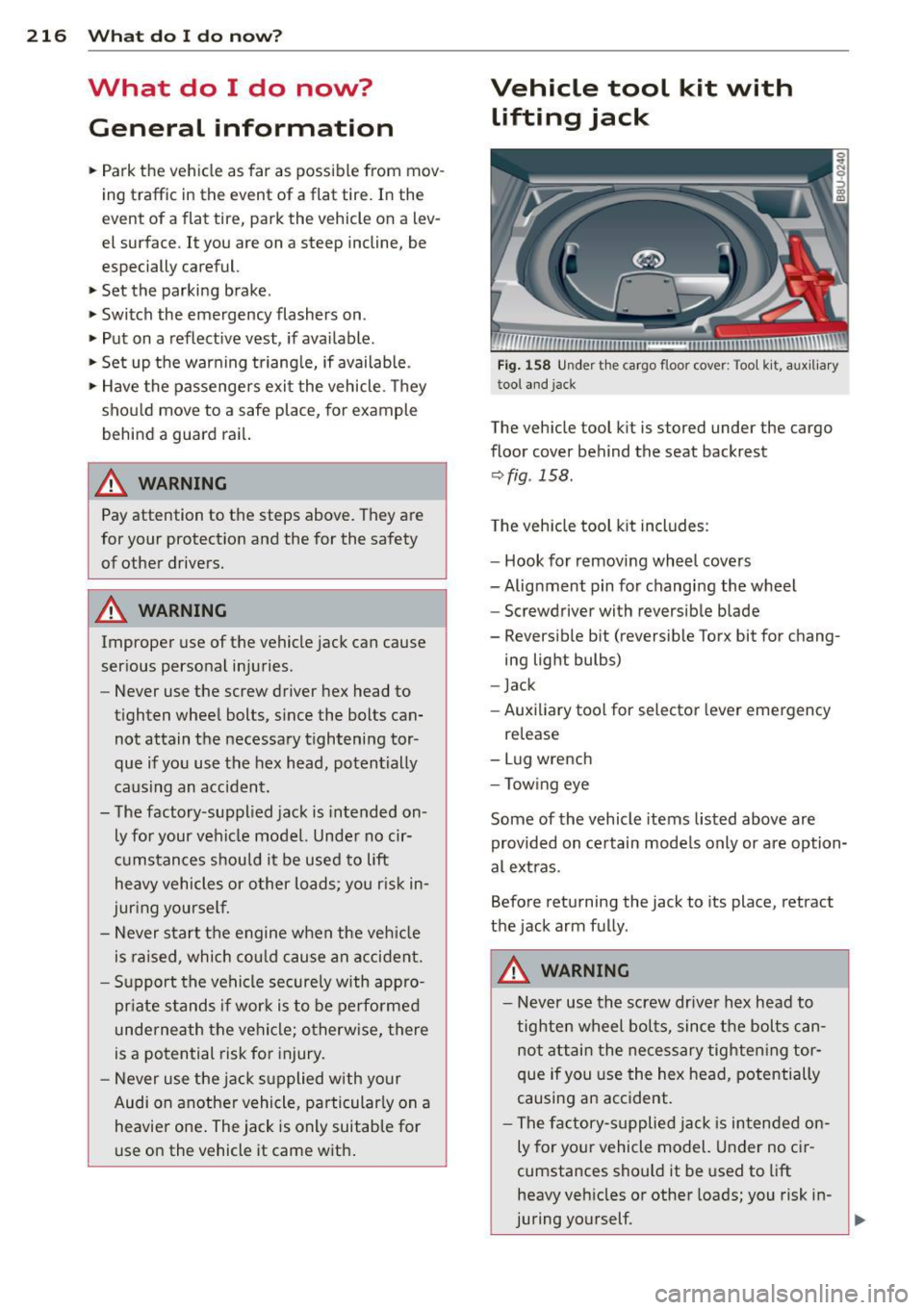
Fig. 158 Under the cargo floo r cover : Too l kit , auxiliary
too l and jack
The veh icle tool kit is stored under the cargo
floor cover behind the seat backrest
Q fig . 158 .
The vehicle tool kit includes :
- Hook for removing wheel covers
- Alig nment pin for changing the wheel
- Screwdriver with reversible blade
- Reversible bit (reversible Torx bit for chang-
ing light bulbs)
- Jack
- Auxil iary tool for selector lever emergency
release
- Lug wrench
-Towing eye
Some of the vehicle items listed above are
provided on certain models only or are option
al extras.
Before returning the jack to its place , retract
the jack arm fully .
A WARNING
-Never use the screw driver hex head to
tighten wheel bolts, since the bolts can
not attain the necessary tighten ing tor
que if you use the hex head, potentially
causing an accident.
- The factory-supplied jack is intended on
ly for your vehicle model. Under no cir
cumstances should it be used to lift
heavy veh icles or other loads; you risk in-
-
juring yourself. ~
Page 226 of 258

224 Fuses and bulbs
Fuses and bulbs
Fuses
Replacing a fuse
Fuses that have blown will have metal strips
that have burned through .
Fig . 169 Stee ring co lu m n area: Fold ing down cover
Fig . 170 Left side o f the engi ne compa rt me nt: Re leas·
i n g cove r
The fuses a re located behind the cover in the
driver's footwell and in the engine compart ment.
Preparations
• Switch off t he ignition and the fai le d elec tri
ca l equ ipme nt.
• Refer to the fo llowing tab les to ident ify the
fuse for t he failed component.
Fuses in the interior
• Open the storage compartmen t.
• Press the retainers on both s ides inwar ds
and fold the sto rage compartment a ll the
way down
q fig. 169.
Fuses in engine compartment
• Open the engine hood q page 179.
• Re lease the fuse cove r by sliding the two
tabs (left and right) fo rwards
Q fig. 170 .
• Take off the fuse cover .
Replacing a fuse
There is a clip underneath th e fuses behind
the sto rage compa rtme nt on the driver's side.
• Fold the storage compartment all the way
down and take the clip o ut of its mounting .
• Use the clip to pull out the fuse and rep lace
t he blown fu se wi th a f use of the same ra t
ing .
_& WARNING ~ -
Do not repair fuses and never re place a
b lown f use with one that has a hig her am p
rat ing . This can ca use damage to the elec
tr ica l system and a fire .
(D Note
If a new fuse burns ou t again after short ly
have you have insta lled it, have the e lectri
ca l system chec ked by yo ur autho rize d
A udi dealer .
(@ Tips
-The followi ng table does not list fuse lo
cat ions that are not used.
- Some of the equipment items listed are
optio nal or only available on certain
mode l configurations.
Interior fuse assignment
The fuse number is given on the plastic be
neath o r above the co rrespond ing fuse .
No. Consumer Amps
3 Interior lights s
7 Stee ring lock 7
,S
8
"Keyless go" and "keyless en-
7,5
t ry" control un it
9
Airbag control unit, A IRBAG
5
OFF ind icator lamp
1 0 quatt ro cont ro l unit 10
1 2
Automat ic transmiss ion s
Page 227 of 258

M N
M N
0 ::i co ,...., \!) 1.1'1 ,...., 1.1'1 ,....,
No.
13
14
15
16
17
18
19
20
23
26
27
28
Consumer
A ir quality/outside air sen-
sor, heated washer jets,
Electronic Stabilization Con-
trol (button), reversing
light, electromechanical
parking brake, o il level sen-
sor, climate control, seat oc-
cup ied recognit ion system,
seat heating, contro ls in
center console, automatic
dimming mirrors
Eng ine control u nit, auto-
matic transmiss ion, bra ke
l ights, electro-mechanical
power steer ing, gateway
control un it, towing bracket
control unit, ESC contro l
unit, light switch, damping
control un it
H eadlight leveling, park ing
brake contro l unit, inst ru-
men t lighting, headlights,
diagnostic connector, adap-
tive light control unit, heat-
er for crankcase, air mass
meter, relay for electr ical
sockets, DC/DC converter
Parking aid
Reversing camera for park-
i ng a id
TV tuner
Eng ine starter cont ro l unit,
DC/DC converter
ESC control unit, air condi-
tioner controls, interface for
spec ial functions
e lectromechanical parking
b rake switch, switches for
interior lighting (front), di-
agnostic connector, light
switch, rain and light sensor,
humidity sensor
Rear window wiper
Starter control un it
Radio/MM I
Amps
5
7,5 10 5
5
5 5
s
10
15
40
15/7,5
Fu ses and bulb s 225
No. Consumer Amps
29
Supply for reversing camera
15 for park ing aid and TV tuner
30 Infot ainment 5
31
Infotainment 5
32
Instr ument cluster 5
33
Automatic dimming rear-
view m irror
10
E lectrica l socket in front
36 cabin, electrical socket in 20
luggage compartment
37 Electr ica l soc ket i n rear cab-
20 in, ciga rette lighter
38 Automatic transmission 15
44
Rear window hea ting 30
45
Parking brake control unit 20
48
Power-operated rear lid 30
so B lower 40
51
Parking brake control unit 20
52
On board supply control unit 20
53
Seat heating, front 30
54
Panoram ic sun roof 20
55
Sun b lind for panorama sun 20
roof
56
Contro l unit fo r suspension
20 cont rol
Engine compartment fuse assignment
The fuse number is given on the plastic be
neath or above the correspond ing fuse.
No. Electrical equipment
amps
1 Power supply for automatic 5 transmission
2
E lectronic Stabilizat ion Con-
30 t ro l (E SC)
3 Horn 15
4
DC/DC converter 40
5
Onboard supply control unit 5
6
BCM (righ t-side) 30
7
Washer pump 20
8
BCM ( left -side) 30
•
•
Page 228 of 258

226 Fuses and bulbs
No. Electrical equipment amps
9 Lumbar support seat adjust-
ment
10
10 Lambda probe 10
Steering column lever, mul-
11 ti-function steering wheel
s
controls
12 Mobile phone adapter
s
13 Engine control unit 10
14 Engine control
unit
25
15 Gateway 5
16 Lambda
probe, fuel pump,
10
engine components
17 Eng ine components 20
18 Fuel pump control unit
2S
19 Sound
amplifier, DC/DC con-
verter 30
20 Brake light sensor
s
22 Windshield
wipers
30
Water recirculation pump,
23
supplementary heater, rad i-
10 a tor fans, relay coils for fuel
pump , engine components
24 Ignition coils 20
2S Central locking
, e lectr ic win-
30
dow (driver's side)
26 Central locking, e
lectr ic win-
30
dow (front passenger's side)
27 Power supply, terminal 15
so
29 Electric seat adjustment 30
30 Electronic Stabilization Con-
40
trol (ESC)
Bulbs
Replacing bulbs
For your safety, we recommend that you have
your authorized Audi dealer replace any bulbs for you.
It is becoming increas ingly more and more
difficult to replace vehicle lig ht bulbs s ince in
many cases, other parts of the car must first
be removed before you are able to get to the bulb.
This applies especially to the light bulbs
in the front of your car which you can only
reach through the engine compartment.
Sheet meta l and bulb holders can have sharp
edges that can cause serious cuts, parts must
be correct ly taken apart and then properly put
back together to he lp prevent breakage of
parts and long term damage from water that
can enter housings that have not been proper
ly resealed.
For your safety, we recommend that you have
your authori zed Audi dea ler replace any bulbs
for you, since your dealer has the proper tools,
the correct bulbs and the expertise.
Gas discharge lamps (Xenon lights ):
Due to the high e lectr ica l voltage, have the
bulbs replaced by a qualified technician.
Headlights with Xenon light are identified by
the high voltage st icker.
A WARNING "--
Changing Xenon lamps without the neces-
sary equipment can cause serious persona l
injury.
- Bulbs are pressurized and can explode
when being changed. Potential risk of in
jury!
- On veh icles equipped with gas discharge
bulbs (Xenon light) life-threatening inju
ries can result from improper handling of
the high-voltage portions of such lamps!
- Only your authorized Audi dealer or qualified workshop should change the
bu lbs in gas discharge lamps. There are
pa rts with sharp edges on the openings
and on the bulb holders that can cause
serious cuts. If you are uncertain about
what to do, have the work performed by
an authorized Audi dealer or qualified
workshop. Serious personal injury may
result from improperly performed work.
@ Tips
-If you still prefer to replace the light
bulbs yourself, be aware that the engine ..,.
Page 235 of 258

M N
M N
0 ::i co ,...., \!) 1.1'1 ,...., 1.1'1 ,....,
jack mounting point ¢ fig. 178. Do not lift
the vehicle at the vertical sill reinforcement.
Rear lifting point
T h e lift ing poin t is lo cate d on th e vertical rein
fo rc ement o f the lower s ill for th e on boar d
jack
r::!vfig. 1 79 .
Lifting with vehicle jack
Refe r to ¢ page 221 .
A WARNING
- To reduce the r is k o f se rious injury a nd
vehicle damag e.
- Always lift the ve hicle on ly at the spe
cial w ork shop h oist and flo or jack lift
points illustrated
¢ fig. 178 and
¢fig. 179 .
-Fai lure to lift the vehicle at these
poi nts cou ld cause the ve hicle to tilt or
fa ll from a lift if the re is a chang e in ve
h icl e w eigh t distr ibu tion and balance.
This might happen, for e xam ple, w hen
heavy co mpo ne nts su ch as the engi ne
b lo ck or tra nsmi ssion ar e removed .
- W hen removing heavy comp onents like
th ese, a nch or ve hicle to hoist or add cor
resp ond ing weig hts to maintai n the cen
ter o f gravity . Othe rwise, the vehicle
mig ht tilt or s lip off the hoist, causi ng
serious persona l injury .
(D Note
- Be aw ar e of t he fo llow ing poin ts be fore
lift ing t he vehicle:
- The vehicle should never be lifted or
jacked up from underneath the engine oil pan, the transmission housing, the
front or rear axle or the body side members. This could lead to serious
damage.
- To avoid damage to the underbody or
chassis frame, a rubber pad must be
inserted between the floor jack and
the lift points .
- Before driving over a workshop hoist,
check that the vehicle weight does not
-
Emergency situations 233
exceed the permissible lifting capacity
of the hoist .
- Before driving over a workshop hoist ,
ensure that there is sufficient clear
ance between the hoist and low parts
of the vehicle.
•
•
Page 239 of 258

M N
M N
0 ::i co ,...., \!) 1.1"1 ,...., 1.1"1 ,....,
Consumer Information
Warranty coverages
Your Audi is covered by the following war
ranties :
- New Vehicle Limited Warranty
- Limited Warranty Against Corrosion Perfo-
ration
- Emissions Control System Warranty
- Emissions Performance Warranty
- California Emissions Con trol Warranty (USA
vehicles only)
- California Emissions Performance Warranty
(USA vehicles only)
Detailed information regarding your warran
ties can be found in your
Warranty & Mainte
nance booklet .
Operating your vehicle
outside the U.S.A. or
Canada
Government regulations in the United States
and Canada require that automobiles meet
specific emission regulations and safety
standards. Therefore, veh icles built for the
U.S.A. and Canada differ from vehicles sold in
other countries .
If you p lan to take your vehicle outside the
continental limits of the United States or Can
ada, there is the possibility that:
- unleaded fuels for vehicles with cata lytic
converter may not be available;
- fuel may have a considerably lower octane
rating . Improper fuel may cause engine
damage ;
- service may be inadequate due to lack of
proper service facilities, tools or testing
equipment;
- replacement parts may not be readily availa
ble.
- Navigation systems for vehicles built for the
U.S.A. and Canada will not necessari ly work
in Europe, and may not work in other coun
tries outside of North America.
Consumer Information 237
@ Note
Audi cannot be responsible for mechanical
damage that could result from inadequate
fuel, service or parts availab ility.
Audi Service Repair
Manuals and Literature
Audi Offic ial Factory Service Manuals and Lit
erature are published as soon as possible after
model introduction. Service Manuals and liter
atu re are availabl e to order from the Audi
T echnical Literature Ordering Center at:
www.audi.techliterature.com
Maintenance
' General
Your vehicle has been designed to help keep
maintenance requirements to a minimum.
However, a certain amount of regular mainte
nance is still necessary to assure your vehicle's
safety, economy and reliability . For detailed
vehicle maintenance consult your Warranty
&
Maintenance booklet.
Under difficult operating conditions , for ex
ample at extremely low outside temperatures ,
in very dusty regions, when towing a tra iler
very frequently, etc., some serv ice work
shou ld be pe rformed between the intervals
specified. This applies particularly to:
- oil changes, and
- cleaning or replacing the air filter .
® For the sake of the environment
By regularly maintaining your vehicle, you
help make sure that emission standards
are maintained, thus min imizi ng adverse
effects on the environment .
Important considerations for you and
your vehicle
The increasing use of electronics , sophisticat
ed fuel injection and emission contro l sys-
tems, and the genera lly increasing technica l ..,_
•
•