2015 AUDI A3 lock
[x] Cancel search: lockPage 202 of 288

200 Trailer towing
who is not properly wearing the restraints
provided by Aud i.
Trailer towing tips
Important to know
Your vehicle hand les different ly when tow ing
a trailer because of the additional weight and
different weight distribution. Safety, perform
ance and economy wi ll greatly depend on how
carefully you load your trailer and operate
your rig.
Before you actually tow your trailer, practice
turning, stopp ing and backing up in an area
away from traffic. Keep practicing until you have become completely familiar with the way
your vehicle-trailer combination behaves and responds.
Backing up is difficult and requires practice.
Backing up with a trai ler genera lly requires
steering action opposite to that when backing up your vehicle without a trailer.
Maintain a greater distance between your ve
hicle and the one in front of you. You will need
more room to stop. To compensate for the
trailer, you will need a larger than normal
turn ing radius .
When passing, remember that you cannot ac
celerate as fast as you normally would be
cause of the added load. Make sure you have
enough room to pass . After passing, allow
plenty of room for your tra iler before chang
ing lanes aga in.
Avoid jerky starts, sharp turns or rapid lane
changes .
(D Tips
-Do not tow a tra iler during the break-in
period of your vehicle.
- If you tow a trailer, your Audi may re
quire more frequent maintenance due to
the extra load
q page 268.
Parking on a slope
Do not park on a slope with a trailer . If it can
not be avoided, do so only after doing the fol lowing:
When parking:
.. App ly the foot brake.
.. Have someone place chocks under both the
vehicle and the trailer wheels .
.,. With chocks in place, slowly release the
brakes until the wheel chocks absorb the
load.
.. Turn the whee ls towards the curb.
.. App ly the parking brake.
.. Select the P selector lever position.
When restarting after parking:
.. Apply the foot brake .
.. Start the engine .
.. Select the D/S selector lever position.
.. Release the parking brake and s lowly pull
out and away from the wheel chocks .
.. Stop and have someone retrieve the wheel
chocks .
(D Tips
If you move the selector lever of the auto
matic transmission to P before applying
the parking brake and before blocking the
whee ls, you may have to use more force
later to move the lever out of the P posi
tion.
Page 209 of 288

Many gasoline grades are blended to perform
especially well for winter or summer driving. During seasonal change-over , we suggest that
you fill up at busy gas stations where the sea sonal adjustment is more likely to be made in
time.
Q;) Note
- Methanol fuels which do not meet these requirements may cause corrosion and
damage to plastic and rubber compo
nents in the fuel system .
- Do not use fuels that fail to meet the
specified criteria in this chapter .
- If you are unable to determine whether
or not a particular fuel blend meets the
specificat ions, ask your service station or
i ts fuel supp lier .
- Do not use fuel for which the contents cannot be identified .
- Fuel system damage and performance
problems resulting from the use of fuels
different from those specified are not
the responsibility of Audi and are not
covered under the New Vehicle or the
Emission Control System Warranties.
- If you experience a loss of fuel economy
or driveability and performance prob
lems due to the use of one of these fuel
blends, we recommend that you switch
to unblended fuel.
Gasoline additives
A major concern among many auto manufac
turers is carbon deposit build-up caused by
the type of gasoline you use .
Although gasoline grades differ from one manufacturer to another, they have cer tain
things in common. All gasoline grades contain substances that can cause deposits to collect
on vital engine parts, such as fuel injectors
and intake valves. Although most gasoline
brands include additives to keep engine and
fuel systems clean, they are not equally effec
tive.
Checking and Filling 207
Audi recommends using TOP TIER Detergent
Gasoline . For more information on TOP TIER
Detergent Gasoline, please go to the official
website (www .toptiergas .com) .
After an extended period of using inadequate
fuels, carbon deposit build-ups can rob your engine of peak performance.
CJ) Note
Damage or malfunction due to poor fuel
quality is not covered by the Audi New Ve
hicle Limited Warranty.
Refueling
Fuel filler neck
The fuel filler neck is located on the right rear
side panel behind the fuel filler flap.
If the power locking system should fail, you
can still open the flap manually -for detailed
instructions see
c::> page 209.
You can find the fuel tank capacity of your ve
hicle in
c::> page 266.
The label on the inside of the fuel filler flap
tells you the correct fuel for your vehicle. For
more information about fuel specifications,
see
c::> page 206 .
Your vehicle fuel tank has an on board refuel
ling vapor recovery system. This feature helps
to prevent fuel vapors from escaping from the
tank and polluting the environment while you refuel your vehicle. In order to fill the tank
properly while protecting the environment,
please follow this refueling procedure careful
ly .
A WARNING ~
Under normal operating conditions, never
carry additional fuel containers in your car.
Gas canisters and other containers used to
transport fuel can be dangerous. Such con
tainers, full or empty, may leak and could
cause a fire in a collision . If you must
transport fuel to use for your lawn mower, ..,.
•
•
•
Page 210 of 288

208 Checking and Filling
snow blower, etc., be very careful and al
ways observe local and state laws regard
ing the use, transportation and storage of
such fuel containers . Make certain the con
tainer meets industry standards (ANSI/
ASTM F852 -86) .
(D Note
Never drive your vehicle until the fuel tank
is completely empty . The irregular supply
of fuel can cause misfiring. Gasoline could
enter the exhaust system and damage the
catalytic converter.
Fueling procedure
Fig. 144 Rig ht rear side of the vehicle: opening the
fue l filler door
Fig. 145 Fu el filler door w ith atta ched fuel cap
The fuel filler door is unlocked or locked by
the central locking system.
Opening the fuel filler door
.,. Press the left side of the fuel filler door to
open it -arrow-
c::> fig . 144 .
• Unscrew the tank cap counterclockwise.
• Place the cap from above on the open fuel
filler door
c::> fig . 145. Closing the fuel cap
.,.
Turn the fuel cap clockwise until you hear it
lock.
.,. Close fuel filler door until it latches.
Once the pump nozzle switches off , the fuel
tank is "full". Do not fill the tank more. Other
wise the expansion space in the tank will be
filled.
The correct fuel type for your vehicle can be
found on a label located on the inside of the
fuel filler door. Additional information on fuel
c::>page206.
The fuel tank capacity of your vehicle is in the
Technical Data c::> page 266.
To avoid fuel spilling or evaporating from the
fuel tank always close fuel filler cap properly
and completely. An improperly closed fuel fill
er cap may also cause the MIL lamp
c::> page 29
to come on.
A WARNING
Improper refueling or handling of fuel can
cause fire, explosion and severe burns.
- Fuel is highly flammable and can cause
severe burns and other injuries.
- Failure to shut the engine off while refu
eling and/or to insert the pump nozzle
fully into the fuel filler neck could cause
fuel to spray out of filler neck or to
over
flow. Fuel spray and overflowing fuel can
cause a fire .
- Never use a cellular telephone while re
fueling. The electromagnetic radiation can cause sparks that can ignite fuel va
pors and cause a fire .
- Never get back into your vehicle while re
fueling . If in exceptional circumstances
you must get back in your vehicle while
refueling, make certain that you close
the door and touch metal to discharge
static electricity before touching the fill
er nozzle again. Static electricity can
cause sparks that can ignite fuel vapors released during refueling .
Page 211 of 288

-Never smoke or have an open flame any
where in or near your vehicle when refu
eling or filling a portable fuel container.
- For your safety, we strongly recommend
that you do not travel with a portable
fuel container in your vehicle. The con
tainer, full or empty may leak and could
cause a fire, especially in a crash.
- If, under exceptional circumstances, you
must transport a portable fuel container,
please observe the following:
- Never fill a portable fuel container while it is anywhere in or on the vehicle
(for example, in the luggage compart
ment, or on the trunk). Static electrici
ty can build up while filling and can ig
nite fuel vapors causing a fire .
- Always place a portable fuel container
on the ground before filling .
- Always keep the filler nozzle complete
ly inside the portable container before
and during filling.
- If filling a portable container made of
metal, the filler nozzle must always be
in contact with the container . This will
help prevent static electricity from dis
charging and cause a fire.
- Never spill fuel inside the vehicle or
luggage compartment. Fuel vapors are
highly flammable.
- Always observe local and state/provin
cial laws regarding the use, storage
and transportation of fuel containers.
- Make certain the fuel container meets
industry standards (ANSI/ ASTM
F852-86).
(D Note
If any fuel has spilled onto the car, it
should be removed immediately to prevent
damage to the paint.
@ For the sake of the environment
As soon as the correctly operated nozzle
switches off automatically for the first
time, the tank is full. Do not try to add
more fuel because fuel may spill out. In
Checking and Filling 209
addition, the expansion space in the fuel
tank will be filled -causing the fuel to
overflow when it becomes warm and pol
lute the environment.
@ Tips
-Running your engine while refuelling
may cause vapors to escape or even
cause fuel to spill out of the tank. This
would then shut off the fuel nozzle be
fore the tank is full.
- Do not refuel your vehicle with the igni
tion switched on. The fuel gauge may
otherwise not indicate the correct fuel
level after refuelling .
- The fuel filler flap of your vehicle is not
locked when you lock the vehicle from
the inside.
Fuel filler door emergency release
If the central locking system is faulty, the
fuel filler door can be unlocked manually .
Fig. 146 Rig ht rea r lu g g ag e compar tme nt: emergency
release
The emergency release mechanism is located
behind the right side trim panel in the lug
gage compartment .
.,. Remove the cover in the side panel.
.,. Loosen the loop from the retainer and then
pull on the loop carefully -arrow -
c:>(D . The
fuel filler door is released .
.,. To open the fuel filler door, press on the left
side
c:> page 208, fig. 144 . i,..
Page 213 of 288

,&_ WARNING
California Proposition 65 Warning:
- Engine exhaust, some of its constituents,
and certain vehicle components contain
or emit chemicals known to the State of
California to cause cancer and birth de
fects and reproductive harm. In addition, certain fluids contained in vehicles and
certain products of component wear con
tain or emit chemicals known to the
State of California to cause cancer and birth defects or other reproductive harm .
- Battery posts, terminals and related ac
cessories contain lead and lead com
pounds, chemicals known to the State of
California to cause cancer and reproduc
tive harms. Wash hands after handling.
(D Note
When filling fluids, be sure not to mix the
fluids up. Otherwise severe malfunctions and engine damage will occur.
@) For the sake of the environment
You should regularly check the ground un der your vehicle in order to detect leaks
quickly .
If there are visible spots from oil
or other fluids, bring your vehicle to an au
thorized Audi dealer or qualified repair fa
cility to be checked.
Opening the hood
The hood is released from the interior.
Fig. 147 Sect ion of the driver's footwell: release lever
Checking and Filling 211
Fig. 148 Rocke r switch un der t he hood
Make sure the wiper arms are not raised up
from the windshield. Otherwise the paint
could be damaged .
The hood can only be released with the driv
er's door open .
.,. Pull the lever under the instrument panel in
the direction of the arrow¢
fig. 147 .
.,. Raise the hood slightly¢,&. .
.,. Press the rocker switch under the hood up
ward
c:> fig. 148. This releases the catch.
.,. Open the hood .
.&, WARNING
Never open the hood when you see that
steam or coolant drips from the engine
compartment- there is a danger of burns!
Wait until no steam or coolant flows out.
- To reduce the risk of being burned, never open the hood if you see or hear steam
or coolant escaping from the engine
compartment. Wait until no steam or
coolant can be seen or heard before care
fully opening the hood .
Closing the hood
.,. Push the hood down until the force of the
strut is overcome . -
.,. Then lower the hood and let it fall into the
engine hood latch -you do
not have to press
on the hood after it is locked. ¢ ,&. .
.&, WARNING -
A hood that is not completely latched
could fly up and block your view while driv ing.
Page 219 of 288

The cooling system has been filled at the fac
tory with a permanent coolant which does not need to be changed. The coolant consists of a
mixture of spec ia lly conditioned water and the
manufacturer's glycol-based coolant addi-
tive Gl3 antifreeze with anticorros ion addi
tives (50% fo r USA models; 60% for Canadian
models) . This mixture both assures th e neces
sary frost protect ion a nd p rotects me tal com
ponents in the engine 's coo ling system from
corrosion and scaling.
It al so raises the boil
ing po int o f the coo lant .
D o no t reduce the concentration of t he coo l
an t in the summer by ad ding plain w ate r.
The
proportion of coolant additive must be at
lea st 50 % but not more than 60%
to main
tain ant ifreeze protection and cooling efficien
cy. If the coolant frost protect ion is too low ,
the coolant cou ld free ze and damage the veh i
cle heating and eng ine cooling system.
F or yea r-round driv ing, antifreeze is added at
the facto ry for temperatures down to:
- -3 1 °F ( -3 5°C) USA
- -4 0°F ( -4 0°C) Canada.
If you must add coolant, use a m ixture of wa
ter and coolant addit ive. M ixing the coolant
addi tive wi th dist illed wate r is recom mend ed.
_& WARNING
Bef ore yo u check any thing in the e ngine
comp artme nt, alw ays re ad and hee d all
WARN INGS
¢page 210.
(D Note
- B efo re winter sets in, have the coolant
c hec ked to see if the c oolan t ad dit ive i n
you r vehi cle is su fficient t o mee t the cl i
mate cond itions. This is especially impor
tant if yo u live in a region whe re the win
ter is extremely cold. If necessary, in
crease the proport ion of coolant additive
to 60%.
- W hen addi ng coolant additive to your
cooling system, remember:
- We recommend using only coolant ad
ditive Gl2 ++ o r Gl3 ( check t he label)
-
Che cking and Fillin g 21 7
for you r vehi cle. This coolan t additive is
avai lab le at authorize d Audi dea le rs .
Ot her types of antifreeze ca n sig nifi
cantly reduce corros io n protection. The
res ulting corrosion can cause a loss of
coolant and serio us e ngine da mage .
- Do not add any type of rad iator leak seal
ant to you r vehicle's engine coolant .
Add ing radiator repair flu id may adverse
ly affect t he function and performanc e of
yo ur cooling sys tem and co uld resu lt i n
damage not covered by yo ur New Ve hicle
L imi ted W arranty.
Adding coolant
Fi g. 152 En gine co mpa rtment: markin gs on t he coo l
an t e xpan sio n t ank
Befo re you check a nyt hing in the eng ine com
partment ,
alway s read and heed all WARN
INGS ¢ page 210.
Checking the engine coolant level
.,. Park yo ur vehicle o n a level su rf a ce .
.,. Switch t he ignition off.
.,. Read t he coolant leve l on the coo lant expan
sion tank ¢
fig. 152. The coolant leve l must
be between the markings when the engine
in cold. When the engine is warm it can be
slightly above the upper mark ing .
Adding coolant
Req uirement : There m ust be a res idual
amount of coo lant in the expansion tank
c::> Q) .
.,. Le t the engine cool down.
.,. Place a clot h over the coo lant expans ion
tank cap a nd u nscrew the cap co unterclock-
wise
c::> _& . ..,.
Page 220 of 288

218 Check ing and F illin g
• Add coolant mixed in the correct ratio
¢page 216 up to the upper marking.
• Make sure that the fluid level rema ins sta-
ble. Add more coolant if necessary.
• Clove the cap securely.
A coo lant loss suggests a leak. Immediately
drive your vehicle to an authorized repair fa
cility and have the coolant system inspected.
If the coolant system is not leaking, a loss can
come from the coolant cooking through over
heat ing and being pushed out of the coolant
system.
.8, WARNING
The cool ing system is under pressure and
can get very hot. Reduce the risk of scald
ing from hot coolant by following these
steps .
- Do not open the coo lant expansion tank
cap with the engine hot . There is a risk of
burns.
- T urn off the engine and allow it to cool
down .
- Protect your face, hands and arms from
escaping fluid and steam by covering the
cap with a large, thick rag.
- T urn the cap slowly and ve ry carefu lly in
a counter-clockwise direction wh ile ap
plying light, downward pressure on the
top of the cap.
- To avoid being b urned, do not spill anti
freeze or coo lant on the exhaust system
or hot eng ine parts. Under certain condi
t ions, the ethylene g lycol in engine cool
ant can catch fire.
- The coo lant add itive and the coolant can
be dange rous to your hea lth. For th is
reason, keep the coolant in the or ig inal
conta iner away from children. There is a
risk of poisoning.
- Whe n work ing in the engine compart
ment, remembe r that the radiator fan
can swit ch on even if the ignition is
switched off, wh ic h increases the risk of
persona l inju ry .
(D Note
Do not add coo lant if the expansion tank is
empty. Air cou ld enter the cooling system
and damage the engine. If this is the case,
do not continue dr iving. See your author
i zed Audi dealer or qualified repair fac ility .
Radiator fan
The radiator fan switches on automatically by
itself
An a uxiliary electric radiator fan switches on
and off depending on coolant temperature
and other vehicle operat ing condit ions.
After you switch the engine off, the auxi liary
fan can continue running for up to 10 m inutes
- even w ith the ignition off.
It can even switch
on again later by itself¢.&. , if
- the temperature of the engine coo lant rises
due to the heat build- up from the engine in
the engine compartment, or
- the engine compartment heats up because
the vehicle is parked in intense sunlight.
.8, WARNING ,-
- To reduce the risk of personal injury nev-
er touch the radiator fan.
- The a uxiliary electric fan is temperat ure
controlled and can sw itch on suddenly
even when the engine is not ru nning.
- The auxiliary radiator fan sw itches on a u
tomatically when the engine coo lant
reaches a certain temperature and will
continue to run until the coolant temper
ature drops.
Page 221 of 288
Brake fluid
Checking brake fluid level
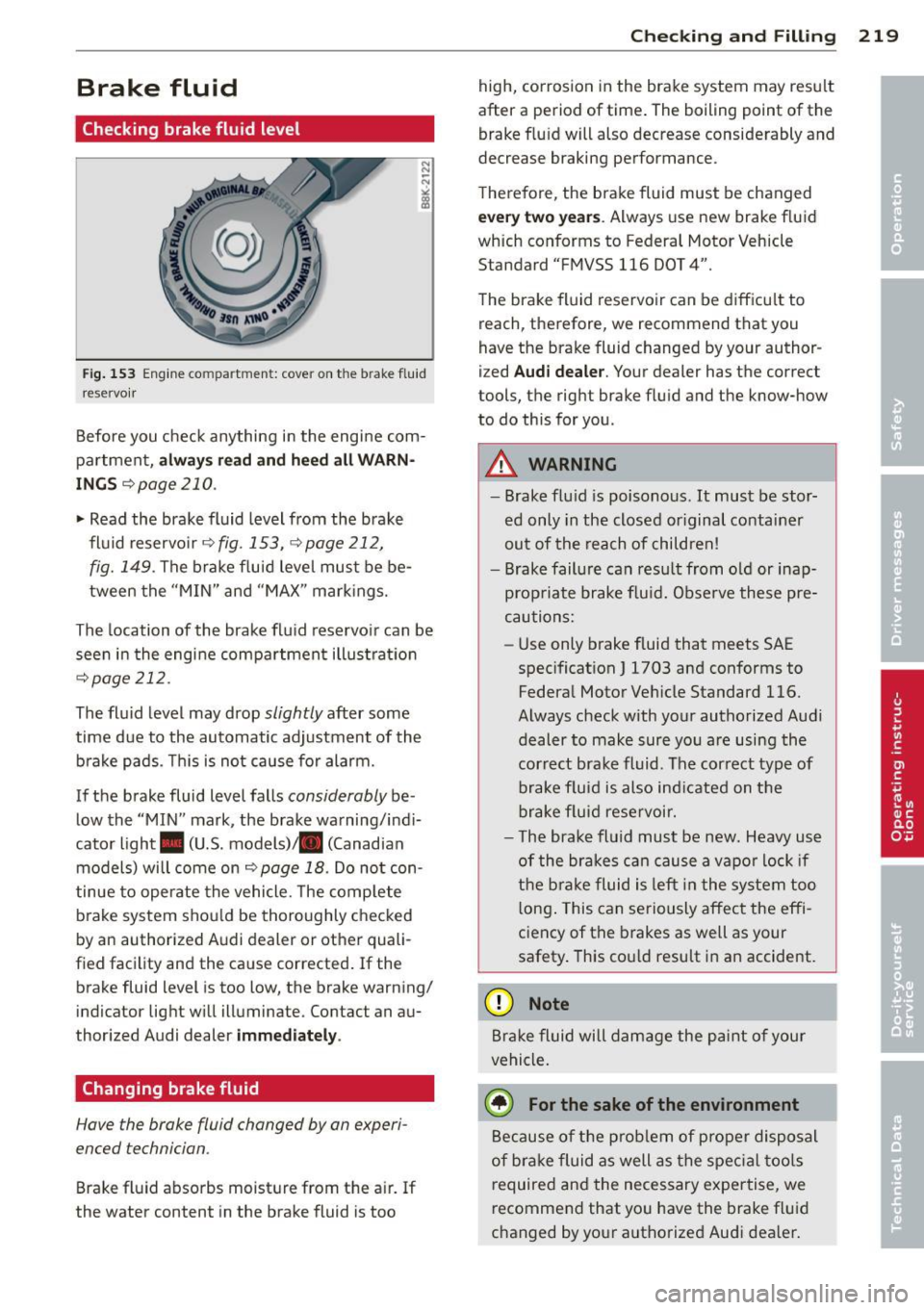
Fig . 153 Engine co mpa rtment: cove r on the b rake f lu id
reservo ir
B efore you check anything in the engi ne com
partment,
alwa ys read and heed all WARN ·
INGS r:=:,page 210 .
~ Read the brak e fluid level from the brake
fluid reservo ir
r:=;, fig . 153, r:=:, page 212,
fig. 149 .
The brake f luid leve l mus t be be
tween the "MIN" and "MAX " ma rkings.
The location of the brake flu id reservo ir can be
seen in the engi ne compa rtment illust ra ti on
¢ page 212 .
The fluid level may drop slightly after some
time due to the automatic adjustment of the b rake pads . Thi s is not cause for alarm.
If the brake fluid level falls
considerably be
low the "MIN" mark, the b rake wa rning/ind i
cato r light . (U .S . models)/ . (Canadian
models) will come on
r:=;, page 18 . Do not con
tinue to operate the vehicle. The comp lete
brake system should be thoroughly checked
by an authorized A udi dealer or other quali
f ied fac ility and the ca use corrected . If the
br ake fluid level is too low, the brake warning/
indica tor light w ill illuminate. Contact an au·
thor ized Audi dealer
immediately .
Changing brake fluid
Have the brake fluid changed by an experi
enced technician .
Brake fluid abso rbs moist ure from the air. If
the water content in the brake fluid is too
Che cking and Fillin g 219
high, co rrosion in the brake system may resu lt
after a period of time . The boiling point of the
brake f lu id will also decrease conside rably and
decrease braking performance.
T herefore, the brake fluid must be changed
eve ry two year s. Always use new brake f luid
which conforms to Federal Motor Veh icle
Standard "FMVSS 116 DOT 4".
The brake fluid reservoi r can be difficu lt to
reach, therefore, we recomm end that you
have the brake fluid changed by your author
i z ed
Audi dealer . Your dealer has the correct
tools, the right brake flu id and the know-how
to do this for you .
A WARNING
-
-Brake flu id is poisonous. It must be stor-
ed only in the closed or iginal containe r
out of the rea ch of children!
- Brake failure can resu lt from o ld or inap
p rop riate brake f lu id. Observe these pre
cautions:
- Use only brake f luid that meets SAE
spec ificat ion
J 1703 and conforms to
Federa l Motor Ve hicle Standard 116.
Always check with your authorized Audi
dealer to make sure yo u are using the
cor rect bra ke fluid. The cor rect type of
brake f luid is also i nd icated on t he
brake f lui d rese rvoir.
- The bra ke flu id must be new. Heavy us e
of the brake s can cause a vapo r lock if
the b ra ke fluid is left i n the system too
l ong . This can se riously affect the effi
ciency of the brakes as we ll as your
safety . This co uld resu lt i n an accident .
(D Note
Brak e fluid will dam age the pa int of your
vehicle .
@ For the sake of the environment
Because of the p rob lem of proper disposal
o f bra ke fluid as well as the spec ial too ls
r equired and the necessary exper tise, we
recommend that yo u have the brake flu id
changed by yo ur authorized Audi dea ler.