2015 AUDI A3 CABRIOLET brake
[x] Cancel search: brakePage 255 of 302

Tires and wheels 253
sure of their "previous histo-and sudden deflation and
ry." Old used tires may have loss of control.
been damaged even though -Temperature grades apply
the damage cannot be seen to tires that are properly in-
that can lead to sudden tire flated and not over or un-
' •
•
failure and loss of vehicle derinflated.
control. -For technical reasons it is
-All four wheels must be fit- not always possible to use
ted with radial tires of the wheels from other vehicles -
same type , size (rolling cir-
in some cases not even
cumference) and the same wheels from the same vehi-
tread pattern. Driving with cle model.
different tires reduces vehi- -If you install wheel trim
cle handling and can lead to discs on the vehicle wheels,
a loss of control. make sure that the air flow
-If the spare tire is not the to the brakes is not blocked.
same as the tires that are Reduced airflow to the
mounted on the vehicle - for brakes can them to over-
example with winter tires - heat, increasing stopping
only use the spare tire for a distances and causing a col-
short period of time and lision.
drive with extra ca re. Refit -Run flat tires may only be
the normal road wheel as used on vehicles that were
soon as safely possible. equipped with them at the
-Never drive faster than the factory. The vehicle must
maximum speed for which have a chassis designed for
the tires on your vehicle are run flat tires. Incorrect use
rated because tires that are of run flat tires can lead to
driven faster than their rat- vehicle damage or acci-
ed speed can fail suddenly. dents. Check with an au-
-Overloading tires cause heat thorized Audi dealer or tire
' M • N
" build-up, sudden tire fail- specialist to see if your vehi-> co ......
ure, including a blowout cle can be equipped with ... \!) 1.1'1
...... 1.1'1 ......
Page 258 of 302

256 Tires and wheels
loss of control, crashes and serious per
sona l injuries . Have worn or damaged tires
replaced immediate ly.
- Winter tires have maximum speed rating
that may be lower than your vehicle's
maximum speed .
- Never drive faster than the speed for
which the winter or other tires installed
on your vehicle are rated.
A WARNING
Always adjust your driving to the road and
traffic conditions. Never let the good ac
celeration of the winter tires and all-wheel
drive tempt you into taking extra risks. Al
ways remember:
- When braking, an all-wheel drive vehicle
handles in the same way as a front drive
vehicle .
- Drive carefully and reduce your speed on
icy and slippery roads, even winter tires
cannot help under black ice conditions.
@) For the sake of the environment
Use summer tires when weather condi
tions permit. They are quieter, do not wear
as quickly and reduce fuel consumption.
Snow chains
Snow chains may be fitted only to the front
wheels, and only to certain tire sizes. Ask your
authorized Audi dealer on which tire sizes
snow chains can be used.
If you are going to use snow chains, then you
must install them on the front wheels at
l east.
The snow chains must have low-profile links
and must not be thicker than 0.53 inch
(13.5 mm), including the lock.
Remove wheel center covers and trim discs
before putting snow chains on your vehicle
q 0 . For safety reasons cover caps must then
be fitted over the wheel bolts. These are avail
able from authorized Audi dealers.
A WARNING
Using the wrong snow chains for your vehi
cle or installing them incorrectly can in
crease the risk of loss of control leading to
serious personal injury.
- Snow chains are available in different
sizes . Always make sure to follow the in
structions provided by the snow chain
manufacturer.
- When driving with snow chains never
drive faster than the speed permitted for
your specific snow chains.
- Always observe local regulations.
@ Note
-Remove snow chains before driving on
roads not covered with snow to avoid
damaging tires and wearing the snow
chains down unnecessarily .
- Snow chains, which come into direct con
tact with the wheel rim, can scratch or
damage it. Therefore, make sure that the
snow chains are suitably covered. Check
the position of the snow chains after
driving a few yards and correct if neces
sary. Follow the instructions from the
snow chain manufacturer when doing so.
@ Tips
Where snow chains are mandatory on cer
tain roads, this normally also applies to
vehicles with all-wheel drive .
Wheel bolts
Wheel bolts must always be tightened to the
correct torque.
The design of wheel bolts is matched to the
factory installed rims. If different rims are fit
ted, the correct wheel bolts with the right
length and correct ly shaped bolt heads must
be used. This ensures that wheels are fitted
securely and that the brake system functions
correctly . .,..
Page 263 of 302

....,
N
r--. > co
rl I.O
"' rl
"' rl
What do I do now? Luggage compartment
lid emergency release
In case of an emergency, the rear lid can be
opened from the inside using the trunk es
cape handle .
Fig. 178 Rear lid: emergency release lock cylinder
.,. Insert the key into the lock cylinder near the
hand le .
.,. Turn the key counterclockwise .
General information
.,. Park the vehicle as far as possib le from mov
ing traff ic in the event of a flat tire. In the
event of a flat tire, park the vehicle on a lev
el surface. It you are on a steep incline, be
especially careful.
.,. Set the parking brake .
.,. Switch the emergency flashers on .
.,. Put on a reflective vest, if avai lable .
.,. Set up the warn ing t riang le, if available .
.,. Have the passengers exit the vehicle. They
shou ld move to a safe place, for example
behind a guard rail.
.&_ WARNING
Pay attention to the steps above . They are
for your protection and the for the safety
of other drivers.
.&_ WARNING
Improper use of the vehicle jack can cause
ser ious personal inju ries .
- Never use the screw driver hex head to
tighten wheel bolts, since the bolts can-
What do I d o now ? 261
not attain the necessary tightening tor
que if you use the hex head, potentially
causing an accident.
- The factory-supplied jack is intended on
ly for your vehicle model. Under no c ir
cumstances should it be used to lift
heavy veh icles o r other loads; you risk i n
juring yourself .
- Never start the engine when the vehicle
is raised, wh ich could cause an acc ident.
- Support the vehicle securely with appro
priate stands if work is to be performed
underneath the vehicle; otherwise , there
is a pote ntia l risk for injury .
- Never use the jack supplied with your Aud i on another vehicle , part icularly on a
heav ier one. The jack is only su itable for
use on the veh icle it came with .
a) Tips
- Some of the onboard items listed above
are provided on certai n models only or
are opt ional ext ras.
- Before stor ing the jack*, ma ke sure it is
wound back down as far as it w ill go.
Equipment
Vehicle tool kit
Applies to vehicles: with vehicle tool kit
Fig. 179 Luggag e compar tment: cargo floor cover
folde d upward
The vehicle tool kit is located in the luggage
compartment under the cargo floor cover
¢fig . 179 .
Hook the plast ic hook CD into the luggage
compartment seal.
Page 265 of 302

the tire chain before mounting the wheel
and tire is recommended.
- Loose items in the passenger compart
ment can cause serious personal injury
during hard braking or in an accident.
Never store the inf latab le spare tire or
jack and tools in the passenger compart
ment.
- Normal summer or winter tires must not
be mounted on the compact spare wheel
rim.
Removing the subwoofer
A pp lies to vehicles: with s ubwoofer
The subwoofer must be removed before the
spare wheel* can be removed.
Fig. 182 Spare wheel well: subwoofer
Removing the subwoofer
• Lift the cargo floor c:, page 262, fig. 180.
• Pull the latch (D c:> fig. 182 toward the ca
ble.
• Press the locking tab @down .
• Remove the connector @ and set the re-
moved cable aside.
• Remove the bolt@.
• Carefully remove the subwoofer.
Installing the subwoofer
• Carefully place the subwoofer n the rim
well. The word "FRONT" on the subwoofer
must face forward .
• Insert the connector that was removed .
• Secure the subwoofer with the bolt.
~ • Fold the cargo floor cover back into place.
r--. > co
rl I.O
"' rl
"' rl
What do I do now? 263
Changing a wheel
Before changing a wheel
Observe the following precautions for your
own and your passenger's safety when chang
ing a wheel.
• After you experience a tire failure, pull the
car well away from moving traffic and try to
reach
level ground before you stop c:> _&..
• All passengers should leave the car and
move to a safe location (for instance, behind
the guardrail)
c:> _&..
• Engage the parking brake to prevent your
vehicle from rolling unintentionally
c:> _&. .
• Move selector lever to position P c:> ,&..
• If you are towing a trailer, unhitch the trailer
from your vehicle.
• Take the
jack c:, page 261 and the spare tire
r:> page 262 out of the luggage compart
ment .
A WARNING
You or your passengers could be injured
while changing a wheel if you do not fol
low these safety precautions:
-If you have a flat tire, move a safe dis
tance off the road. Turn off the engine,
turn the eme rgency flashers on and use
other warning devices to alert other mo
torists.
- Make sure that passengers wait in a safe
place away from the vehicle and well
away from the road and traffic.
- To help prevent the vehicle from moving
suddenly and possibly slipping off the
jack, always fully set the parking brake
and block the wheel diagonally opposite
the wheel being changed. When one
front wheel is lifted off the ground, plac ing the Automatic Transmission in P
(Park) will
not prevent the vehicle from
mov ing .
- Before you change a wheel, be sure the
ground is level and firm. If necessary,
use a sturdy board under the jack.
-
Page 272 of 302

2 70 Fuses and bulbs
Interior fuse assignment
No. Equipment Ampere
Fl 3 Adaptive dampers contro
l
20
module
Fl4 Climate
control system
30
blower
Fl S E
lectronic steering column
10
lock
Fl6 MM I area 7.5
Fl7 Instrument cluster 5
Fl8 Rearview camera
7.5
F l9 Convince key
system control
7.5
module, tank system
F20 Tank system
7.5
F23 E
xterior lighti ng, heated
40
washe r fl ui d nozzles
Panorama sunroof/ power
F24 top control module, power 20/30
Fig. 192 Vehicle inter ior : fuse assignment top latch (Cabriolet)
No. Equipment Ampere
F25 Door/dr
iver's side doors (for
30
example power windows)
Fl Engine components 30 F26 Seat heat
ing 30
F2 Seat adjustment 10 F27
Sound-amplif
ier
30
F3 Hydraulic pump
cover (Cab-
40
riolet) F28
Power top control module,
5
elect ro ni cs (Cabr io let)
F4 M
M co ntrols, M MI-compo-
7.5
nents F29
Inte
rior lights
7.5
F3 1 E xterior lighting
40
F5 Gateway
5
F32 Driver ass istance systems 7.5
F 6 Anti-theft a
larm system
s F33 Airbag 5
Climate/heating control, se-
Button illumination, coils
lector lever (automatic
for upper cab in heating relay
F7 transmission), park ing heat- 10
er, rear window heater re lay F34 (Cabriolet) and socket relay,
7.5
in ter ior sound, back-up light
coil switch, temperature sensor,
Diagnosis, electrical parking oil level sensor
F 8 brake
switch, light switch,
10
rain/ light sensor, interior
light ing Diagnosis, headlight range
F35 co
ntrol system, a ir quality
10
sensor, a utomat ic dimming
F9 Steering column
switch
1
module
Fl0 D isp lay 5 rearview mir
ror
F36 Right
corner ing light/ right
15
LED-headlight
Fll Reversible driver's
side safe-
25
ty belt tensioners F37
Left corner
ing light/ left
15
L E D- headlight
Fl 2 M MI area 15/20
Page 273 of 302

....,
N
" > co
rl I.O
"' rl
"' rl
No. Equipment Ampere
Door/front passenger's side
F39 doors (for examp le, power
30
windows)
F40 Sockets 20
F41 Reversible front
passenger's
25
side safety belt tensioners
F42 Central locking components,
40
windshield washer system
F43 Headlights, light ing 30
F44 all wheel drive
15
F49 Starte
r, clutch sensor, head-
5
light re lay coil
FS3 Rear window defogger 30
The power seats* are protected v ia
ci rc uit
b reaker s
that automatically sw itch on after a
few seconds after the overload has been re
duced.
(D Tips
Note that the following table was accurate
at the time of print ing and is subject to
change.
Left engine compartment fuse
assignment
F ig. 193 Engine compartme nt: fuse assignment
No.
Fl
F2
F3
F4
F5
F6
F7
F8
F9
FlO
F ll
F12
Fl3
FlS
F l 6
F l 7
Fl8
F19
F20
F22
F23
F24
F3 1
F32
Fu se s and bulb s 2 71
Equipment Ampere
E5C contro l modu le 40
ESC contro l modu le 40
Engine control module (gas-
15/30
oli ne/d iesel)
Engine cooling, eng ine com-
ponents, auxiliary heater 5/10
coi l relay (1+2), secondary
air injection pump relay
Engine components, tank 7.5/10/
system 15
Brake light sensor 5
Engine components, wa ter 7.5/10/
pumps 15
Oxygen sensor
10/15
Engine compone nts, ex-
haust door, glow time con- 5/10/20
tro l module, SU LEV valve
Fuel injectors, fuel control
15/20
module
Auxiliary heater heating ele- 40
ment 2
Auxilia ry heater heat ing ele-
40
ment 3
Automat ic transmiss ion con-
15/30
t ro l module
Horn 15
Ignit ion coil 5/20
ESC contro l module, engine
7.5
control module
T ermina l 30 (reference volt-
5
age)
Windsh ie ld wipers
30
Horn 10
Termina l 50 diagnosis
5
Starter 30
Auxilia ry heater heat ing ele-
40
ment 1
Vacuum pump 15
L E D head lights 5
Page 276 of 302
2 7 4 Emergency situations
@ Tips
The discharged battery must be properly
connected to the vehicle's electrical sys
tem. When jump starting or charging the
battery, never connect the negative
ground cable to the battery negative post
because the batte ry manager system must
be able to detect the battery 's state of
charge. Always connect the negative
ground cab le to the negative ground post
of the battery manager control unit.
Using jump start cables
Connect the jump start cables in the exact or
der described below.
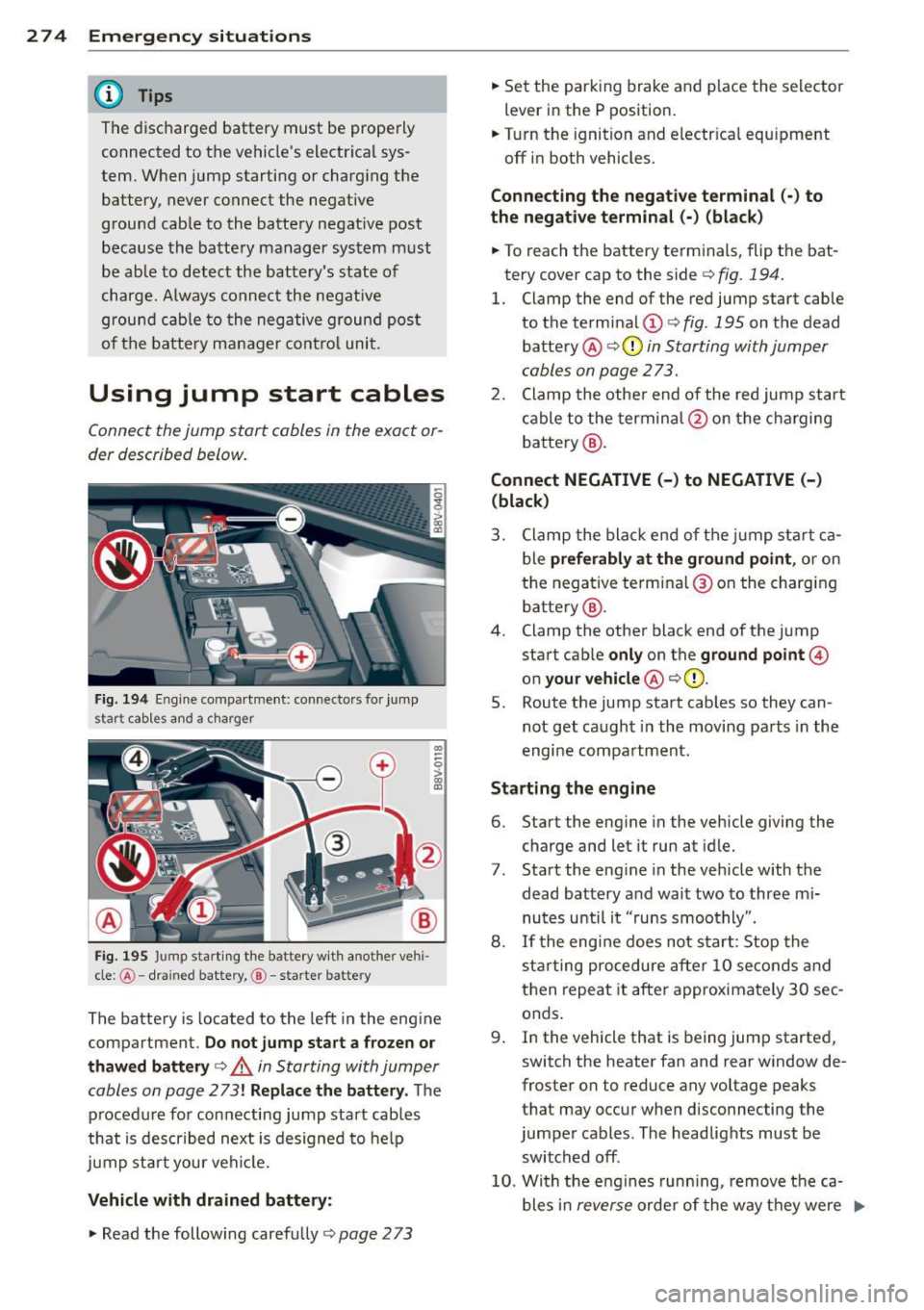
Fig. 194 Engine compartment: connecto rs fo r jump
start cab les and a charger
Fig. 195 Jump sta rting the battery with another ve hi
cle :@ -drained battery, @-starte r battery
CD
--0 > ~
The battery is located to the left in the engine
compartment.
Do not jump start a frozen or
thawed battery¢
,A in Starting with Jumper
cables on page
273! Replace the battery. The
procedure for connecting jump start cables
that is described next is designed to help
jump start your vehicle.
Vehicle with drained battery:
.. Read the following carefully ¢ page 2 73
.. Set the parking brake and place the selector
lever in the P position.
.. Turn the ignition and electr ical equipment
off in both vehicles.
Connecting the negative terminal(·) to
the negative terminal (-) (black)
.. To reach the battery terminals, flip the bat
tery cover cap to the side¢
fig. 194.
l. Clamp the end of the red jump start cable
to the terminal (!)¢
fig. 195 on the dead
battery @¢0
in Starting with Jumper
cables on page 273.
2. Clamp the other end of the red jump start
cable to the terminal @on the charging
battery @.
Connect NEGATIVE (-) to NEGATIVE (-)
(black)
3. Clamp the black end of the jump start ca
ble
preferably at the ground point, or on
the negative terminal@on the charging
battery @.
4. Clamp the other black end of the jump
start cab le
only on the ground point@
on your vehicle @¢(D.
5. Route the jump start cables so they can
not get caught in the moving parts in the
engine compartment .
Starting the engine
6. Start the engine in the vehicle giving the
charge and let it run at idle.
7 . Start the engine in the vehicle with the
dead battery and wait two to three mi nutes until it "runs smoothly" .
8.
If the engine does not start: Stop the
starting procedure after
10 seconds and
then repeat it after approximately
30 sec
onds .
9 . In the vehicle that is being jump started,
switch the heater fan and rear window de
froster on to reduce any voltage peaks
that may occur when disconnecting the
jumper cables. The headlights must be
switched off .
10. With the engines running, remove the ca
bles in
reverse order of the way they were ..,.
Page 277 of 302

M N ,....
> co ,...., \!) 1.1'1 ,...., 1.1'1 ,....,
installed. Make sure the cables do not get
caught in moving engine components .
11. Sw itch the heater fan and rear window de-
froster off.
12. Close the battery cover.
The battery is vented to the outside so that not gases enter the passenger compartment.
Make sure that the connected positive termi
nal clamps on the jump start cable have suff i
cient contact with metal.
A WARNING
Follow the warn ings and instructions from
the jump start cable manufacturer to re duce the risk of serious injuries and vehicle
damage .
If you are uns ure abo ut anything,
call roadside assistance.
- T he jump start cables must be long
enough so that the vehicles do not
touch.
- Route the jump sta rt cab les so they can
not get ca ught in the moving parts in the
engine compartment .
- Always read and follow the warnings be
fore checking anything in the engine
compartment <=>
page 214.
(D Note
Correctly jump start cables incorre ctly can
destroy the a lternator .
- Always connect the positive term inal(+)
to the positive terminal( +) and the neg
ative termina l (-) to the negative termi
nal(-) on the body ground point, but not
the negative termina l on the battery.
- Make sure the screw plugs on the batte ry
ce lls are insta lled securely. If not, tight
en the plugs before connecting the
clamps to the negat ive termina l on the
battery.
- P lease note that the connecting process
described be low for the jump start ca
bles is intended for when your vehicle is
being jump started. If you are jump
starting another vehicle, do not connect
the negat ive cab le to the negative termi
nal(·) on the drained battery, but rathe r
Emerg en cy si tuation s 275
connect it to a large metal component
that is bolted securely to the engine
bloc k, or to the engine block itsel f. If the
battery in the vehicle being jump started
is not vented to the outside, there is a
r isk of explosion due to hydrogen gas.
- Make sure that the connected positive
terminal clamps have sufficient contact
with metal.
- Do not use the battery negat ive terminal
for jump start ing or a malfunct ion could
occur in the vehicle electrical system.
Emergency towing
with commercial tow
truck
General hints
Your Audi requires special handling for tow
ing .
The following information is to be used by
commerc ial tow truck operators who know
how to operat e th eir equipment safely.
- Never to w you r Aud i. Towing will cause
damage to the engine and tran smission.
- Nev er wra p the s afety ch ains or wi nch ca
bles a round the brake li nes.
- To p revent unnece ssary dam age , your Aud i
must be t ranspo rted with a flat bed truck.
- To load the vehicle on to the fl at bed , us e
the towing loop fo und in the vehicle tool s
and attach to the front o r rear anchorage
<=> page 2 76 and <=> page 2 76.
A WARNING
A vehicle being towed is not safe for pas
sengers. Neve r allow anyone to ride in a
vehicle be ing towed, fo r any reason.
-
•
•
•