2014 YAMAHA XT1200Z check oil
[x] Cancel search: check oilPage 70 of 116

PERIODIC MAINTENANCE AND ADJUSTMENT
6-7
6
EAU36773
TIPAir filter
• This model’s air filter is equipped with a disposable oil-coated paper element, which must not be cleaned with com- pressed air to avoid damaging it.
• The air filter element needs to be replaced more frequently when riding in unusually wet or dusty areas.
Hydraulic brake and clutch service
• Regularly check and, if necessary, correct the brake fluid and clutch fluid levels.
• Every two years replace the internal components of the brake master cylinders and calipers as well as clutch master and release cylinders, and change the brake and clutch fluids.
• Replace the brake and clutch hoses every four years and if cracked or damaged.
U2BSE0E0.book Page 7 Tuesday, September 17, 2013 8:55 AM
Page 74 of 116

PERIODIC MAINTENANCE AND ADJUSTMENT
6-11
6
TIPIf a torque wrench is not available
when installing a spark plug, a good
estimate of the correct torque is 1/4–
1/2 turn past finger tight. However, the
spark plug should be tightened to the
specified torque as soon as possible.NOTICE
ECA10841
Do not use any tools to remove or in-
stall the spark plug cap, otherwise
the i gnition coil coupler may get
d amag ed . The spark plu g cap may
b e difficult to remove because the
ru bber seal on the en d of the cap fits
ti g htly. To remove the spark plu g
cap, simply twist it b ack and forth
while pullin g it out; to install it, twist
it back an d forth while pushin g it in.
EAU58600
En gine oil an d oil filter car-
tri dgeThe engine oil level should be checked
before each ride. In addition, the oil
must be changed and the oil filter car-
tridge replaced at the intervals speci-
fied in the periodic maintenance and
lubrication chart.
To check the en gine oil level
1. Place the vehicle on a level sur- face and hold it in an upright posi-
tion. A slight tilt to the side can
result in a false reading.
2. Start the engine and warm it up for ten minutes until the engine oil has
reached a normal temperature of
60 °C (140 °F), and then turn the
engine off.
3. Wait a few minutes until the oil set- tles, and then check the oil level
through the engine oil level check
window located at the bottom-
right side of the crankcase.TIPThe engine oil should be between the
minimum and maximum level marks.
4. If the engine oil is below the mini-mum level mark, add sufficient oil
of the recommended type to raise
it to the correct level.
To chan ge the en gine oil (with or
without oil filter cartri dge replace-
ment) 1. Place the vehicle on a level sur- face.
2. Start the engine, warm it up for several minutes, and then turn it
off.
3. Place an oil pan under the oil tank to collect the used oil.1. Engine oil level check window
2. Maximum level mark
3. Minimum level mark
4. Engine oil filler cap
42
3
1
U2BSE0E0.book Page 11 Tuesday, September 17, 2013 8:55 AM
Page 77 of 116

PERIODIC MAINTENANCE AND ADJUSTMENT
6-14
6
a
ddition, do not use oils lab eled
“ENERGY CONSERVING II” or
hi gher.
Make sure that no forei gn mate-
rial enters the crankcase.
14. Start the engine, and then let it idle for several minutes while checking
it for oil leakage. If oil is leaking,
immediately turn the engine off
and check for the cause.TIPAfter the engine is started, the engine
oil level warning light should go off if
the oil level is sufficient.NOTICE
ECA10402
If the oil level warnin g li ght flickers
or remains on even if the oil level is
correct, imme diately turn the en gine
off an d have a Yamaha d ealer check
the vehicle.15. Turn the engine off, wait a few minutes until the oil settles, and
then check the oil level and cor-
rect it if necessary.
EAU20028
Final gear oilThe final gear case must be checked
for oil leakage before each ride. If any
leakage is found, have a Yamaha deal-
er check and repair the vehicle. In ad-
dition, the final gear oil level must be
checked and the oil changed as fol-
lows at the intervals specified in the
periodic maintenance and lubrication
chart.
WARNING
EWA10371
Make sure that no forei gn mate-
rial enters the final gear case.
Make sure that no oil gets on
the tire or wheel.To check the final g ear oil level
1. Place the vehicle on a level sur- face and hold it in an upright posi-
tion.TIPMake sure that the vehicle is posi-
tioned straight up when checking the
oil level. A slight tilt to the side can re-
sult in a false reading.
2. Remove the final gear oil filler boltand its gasket, and then check the
oil level in the final gear case.TIPThe oil level should be at the brim of
the filler hole.3. If the oil is below the brim of thefiller hole, add sufficient oil of the
recommended type to raise it to
the correct level.
4. Check the gasket for damage, and replace it if necessary.
5. Install the final gear oil filler bolt and its gasket, and then tighten
the bolt to the specified torque.1. Final gear oil filler bolt
2. Gasket
3. Correct oil level
1
2
3
U2BSE0E0.book Page 14 Tuesday, September 17, 2013 8:55 AM
Page 78 of 116
PERIODIC MAINTENANCE AND ADJUSTMENT
6-15
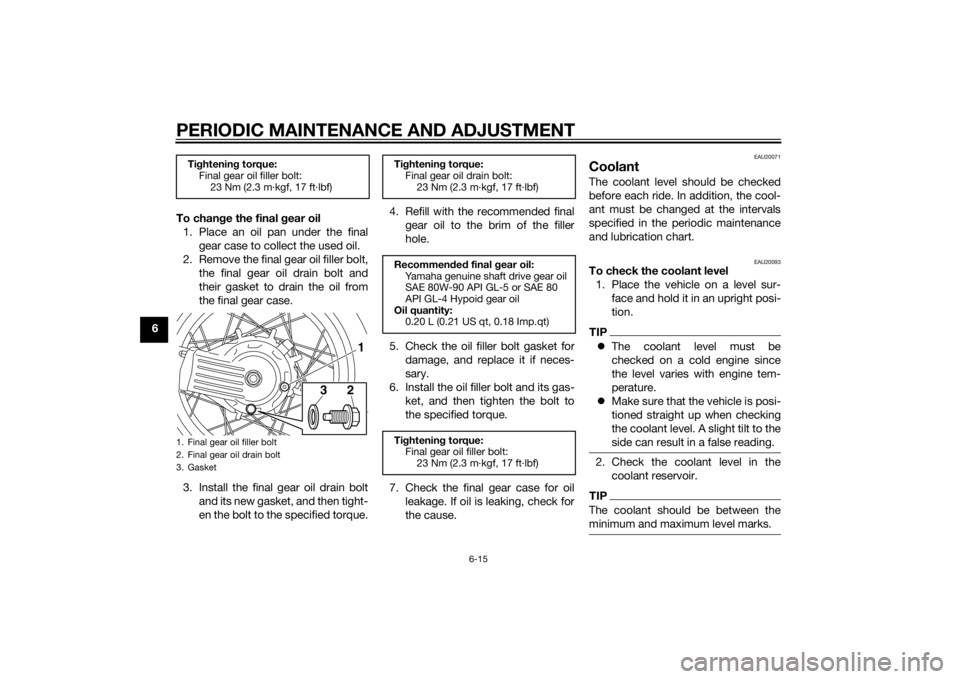
6To chan
ge the final gear oil
1. Place an oil pan under the final gear case to collect the used oil.
2. Remove the final gear oil filler bolt, the final gear oil drain bolt and
their gasket to drain the oil from
the final gear case.
3. Install the final gear oil drain bolt and its new gasket, and then tight-
en the bolt to the specified torque. 4. Refill with the recommended final
gear oil to the brim of the filler
hole.
5. Check the oil filler bolt gasket for damage, and replace it if neces-
sary.
6. Install the oil filler bolt and its gas- ket, and then tighten the bolt to
the specified torque.
7. Check the final gear case for oil leakage. If oil is leaking, check for
the cause.
EAU20071
CoolantThe coolant level should be checked
before each ride. In addition, the cool-
ant must be changed at the intervals
specified in the periodic maintenance
and lubrication chart.
EAU20093
To check the coolant level1. Place the vehicle on a level sur- face and hold it in an upright posi-
tion.TIPThe coolant level must be
checked on a cold engine since
the level varies with engine tem-
perature.
Make sure that the vehicle is posi-
tioned straight up when checking
the coolant level. A slight tilt to the
side can result in a false reading.2. Check the coolant level in the
coolant reservoir.TIPThe coolant should be between the
minimum and maximum level marks.
Tightenin g torque:
Final gear oil filler bolt:
23 Nm (2.3 m·kgf, 17 ft·lbf)1. Final gear oil filler bolt
2. Final gear oil drain bolt
3. Gasket
2
3
1
Tightenin g torque:
Final gear oil drain bolt:
23 Nm (2.3 m·kgf, 17 ft·lbf)
Recommen ded final gear oil:
Yamaha genuine shaft drive gear oil
SAE 80W-90 API GL-5 or SAE 80
API GL-4 Hypoid gear oil
Oil quantity: 0.20 L (0.21 US qt, 0.18 Imp.qt)
Ti ghtenin g torque:
Final gear oil filler bolt:
23 Nm (2.3 m·kgf, 17 ft·lbf)
U2BSE0E0.book Page 15 Tuesday, September 17, 2013 8:55 AM
Page 87 of 116

PERIODIC MAINTENANCE AND ADJUSTMENT
6-24
6
Use only the specifie d b rake flu-
i d ; otherwise, the ru bber seals
may deteriorate, causin g leak-
a g e.
Refill with the same type of
brake flui d. A ddin g a brake flui d
other than DOT 4 may result in a
harmful chemical reaction.
Be careful that water or dust
d oes not enter the brake flui d
reservoir when refillin g. Water
will si gnificantly lower the boil-
in g point of the flui d an d may re-
sult in vapor lock, an d d irt may
clo g the ABS hy draulic unit
valves.
NOTICE
ECA17641
Brake flui d may d amage painte d
surfaces or plastic parts. Always
clean up spille d flui d imme diately.As the brake pads wear, it is normal for
the brake fluid level to gradually go
down. A low brake fluid level may indi-
cate worn brake pads and/or brake
system leakage; therefore, be sure to
check the brake pads for wear and the
brake system for leakage. If the brake fluid level goes down suddenly, have a
Yamaha dealer check the cause before
further riding.
EAU22754
Chan
gin g the brake an d
clutch flui dsHave a Yamaha dealer change the
brake and clutch fluids at the intervals
specified in the periodic maintenance
and lubrication chart. In addition, have
the oil seals of the brake and clutch
master cylinders and calipers as well
as the brake and clutch hoses replaced
at the intervals listed below or whenev-
er they are damaged or leaking.
Oil seals: Replace every two
years.
Brake and clutch hoses: Replace
every four years.
U2BSE0E0.book Page 24 Tuesday, September 17, 2013 8:55 AM
Page 90 of 116

PERIODIC MAINTENANCE AND ADJUSTMENT
6-27
6
EAUM1653
Lubricatin g the swin garm piv-
otsThe swingarm pivots must be lubricat-
ed by a Yamaha dealer at the intervals
specified in the periodic maintenance
and lubrication chart.
EAU23273
Checkin g the front forkThe condition and operation of the
front fork must be checked as follows
at the intervals specified in the periodic
maintenance and lubrication chart.
To check the con dition
Check the inner tubes for scratches,
damage and excessive oil leakage.
To check the operation 1. Place the vehicle on a level sur- face and hold it in an upright posi-
tion. WARNING! To avoi d injury,
securely support the vehicle so
there is no dan ger of it fallin g
over.
[EWA10752]
2. While applying the front brake, push down hard on the handle-
bars several times to check if the
front fork compresses and re-
bounds smoothly.
NOTICE
ECA10591
If any d amage is foun d or the front
fork does not operate smoothly,
have a Yamaha dealer check or re-
pair it.
Recommen ded lu bricant:
Lithium-soap-based grease
U2BSE0E0.book Page 27 Tuesday, September 17, 2013 8:55 AM
Page 106 of 116

MOTORCYCLE CARE AND STORAGE
7-4
7
EAU49592
StorageShort-term
Always store your motorcycle in a cool,
dry place and, if necessary, protect it
against dust with a porous cover. Be
sure the engine and the exhaust sys-
tem are cool before covering the mo-
torcycle.NOTICE
ECA10811
Storin g the motorcycle in a
poorly ventilate d room or cover-
in g it with a tarp, while it is still
wet, will allow water an d humi d-
ity to seep in an d cause rust.
To prevent corrosion, avoi d
d amp cellars, sta bles ( because
of the presence of ammonia)
an d areas where stron g chemi-
cals are stored .Long-term
Before storing your motorcycle for sev-
eral months: 1. Follow all the instructions in the “Care” section of this chapter. 2. Fill up the fuel tank and add fuel
stabilizer (if available) to prevent
the fuel tank from rusting and the
fuel from deteriorating.
3. Perform the following steps to protect the cylinders, piston rings,
etc. from corrosion.a. Remove the spark plug caps and spark plugs.
b. Pour a teaspoonful of engine oil into each spark plug bore.
c. Install the spark plug caps onto the spark plugs, and then
place the spark plugs on the
cylinder head so that the elec-
trodes are grounded. (This will
limit sparking during the next
step.)
d. Turn the engine over several times with the starter. (This will
coat the cylinder walls with oil.)
WARNING! To prevent d am-
a g e or injury from sparkin g,
make sure to groun d the
spark plu g electro des while
turnin g the en gine over.
[EWA10952]
e. Remove the spark plug caps
from the spark plugs, and then
install the spark plugs and the
spark plug caps.
4. Lubricate all control cables and the pivoting points of all levers and
pedals as well as of the side-
stand/centerstand.
5. Check and, if necessary, correct the tire air pressure, and then lift
the motorcycle so that both of its
wheels are off the ground. Alterna-
tively, turn the wheels a little every
month in order to prevent the tires
from becoming degraded in one
spot.
6. Cover the muffler outlet with a plastic bag to prevent moisture
from entering it.
7. Remove the battery and fully charge it. Store it in a cool, dry
place and charge it once a month.
Do not store the battery in an ex-
cessively cold or warm place [less
than 0 °C (30 °F) or more than 30
°C (90 °F)]. For more information
on storing the battery, see page
6-29.
U2BSE0E0.book Page 4 Tuesday, September 17, 2013 8:55 AM
Page 112 of 116

10-1
10
INDEXAABS ....................................................... 3-26
ABS warning light ................................... 3-5
Air filter element .................................... 6-17
Auxiliary DC jack ................................... 3-42
Auxiliary light bulb, replacing ................ 6-34BBattery .................................................. 6-29
Brake and clutch fluids, changing ........ 6-24
Brake and clutch levers, checking and lubricating ........................................... 6-26
Brake and shift pedals, checking and
lubricating ........................................... 6-25
Brake fluid level, checking .................... 6-23
Brake lever ............................................ 3-25
Brake lever free play, checking............. 6-21
Brake light switches.............................. 6-22
Brake pedal........................................... 3-26CCare ........................................................ 7-1
Carriers ................................................. 3-39
Catalytic converter ................................ 3-31
Clutch lever ................................. 3-24, 6-21
Coolant ................................................. 6-15
Cowlings, removing and installing .......... 6-8
Cruise control indicator lights ................. 3-4
Cruise control switches ........................ 3-23
Cruise control system ............................. 3-6DDimmer/Pass switch ............................. 3-23
D-mode (drive mode) ............................ 3-22EEngine break-in....................................... 5-3
Engine idling speed, checking .............. 6-17 Engine oil and oil filter
cartridge ........... 6-11
Engine trouble warning light ................... 3-5
FFinal gear oil ......................................... 6-14
Front and rear brake pads, checking ... 6-22
Front fork, adjusting ............................. 3-35
Front fork, checking ............................. 6-27
Fuel ....................................................... 3-30
Fuel consumption, tips for reducing ...... 5-3
Fuel tank breather hose and overflow
hose ................................................... 3-31
Fuel tank cap ........................................ 3-29
Fuses, replacing ................................... 6-30HHandlebar switches .............................. 3-22
Hazard switch....................................... 3-23
Headlight bulb, replacing ..................... 6-32
High beam indicator light ....................... 3-4
Horn switch .......................................... 3-23IIdentification numbers ............................ 9-1
Ignition circuit cut-off system ............... 3-40
Immobilizer system ................................ 3-1
Immobilizer system indicator light .......... 3-6
Indicator lights and warning lights ......... 3-4LLicense plate light bulb, replacing........ 6-33
Luggage strap holders ......................... 3-39MMain switch/steering lock....................... 3-2
Maintenance and lubrication, periodic ... 6-4
Maintenance, emission control system.................................................. 6-3
Matte color, caution ............................... 7-1 Menu switch..........................................3-23
Model label .............................................9-1
Multi-function meter unit .......................3-10
NNeutral indicator light ..............................3-4OOil level warning light ..............................3-4PParking ....................................................5-4
Part locations ..........................................2-1RRider seat ..............................................3-32
Rider seat height, adjusting ..................3-33SSafety information ...................................1-1
Select switch.........................................3-24
Shifting ....................................................5-2
Shift pedal .............................................3-25
Shock absorber assembly, adjusting ....3-37
Sidestand ..............................................3-40
Sidestand, checking and lubricating.....6-26
Spark plugs, checking ..........................6-10
Specifications .........................................8-1
Start/Engine stop switch .......................3-23
Starting the engine ..................................5-1
Steering, checking ................................6-28
Storage ...................................................7-4
Supporting the motorcycle ...................6-36
Swingarm pivots, lubricating ................6-27TThrottle grip and cable, checking and
lubricating ...........................................6-25
Throttle grip free play, checking ...........6-17
Tires ......................................................6-18
U2BSE0E0.book Page 1 Tuesday, September 17, 2013 8:55 AM