2014 YAMAHA TRICITY warning
[x] Cancel search: warningPage 36 of 84

OPERATION AND IMPORTANT RIDING POINTS
5-1
5
EAU15952
Read the Owner’s Manual carefully to
become familiar with all controls. If
there is a control or function you do not
understand, ask your Yamaha dealer.
WARNING
EWA10272
Failure to familiarize yourself with
the controls can lead to loss of con-
trol, which coul d cause an acci dent
or injury.
EAU45311
TIPThis model is equipped with a lean an-
gle sensor to stop the engine in case of
a turnover. To start the engine after a
turnover, be sure to turn the main
switch to “OFF” and then to “ON”. Fail-
ing to do so will prevent the engine
from starting even though the engine
will crank when pushing the start
switch.
EAU60631
Startin g the en gineNOTICE
ECA10251
See pag e 5-3 for en gine break-in in-
structions prior to operatin g the ve-
hicle for the first time.In order for the ignition circuit cut-off
system to enable starting, the side-
stand must be up. See page 3-15 for more information. 1. Turn the key to “ON”. The following warning lights
should come on for a few sec-
onds, then go off. Engine trouble warning light
Coolant temperature warning
lightNOTICE
ECA15485
If a warnin g li ght does not come on
initially when the key is turned to
“ON”, or if a warnin g li ght remains
on, see pa ge 3-2 for the correspon d-
in g warnin g li ght circuit check.2. Close the throttle completely.
U2CME0E0.book Page 1 Friday, May 2, 2014 2:55 PM
Page 38 of 84
OPERATION AND IMPORTANT RIDING POINTS
5-3
5
EAU60650
Braking
WARNING
EWA17790
Avoi d b rakin g har d or su ddenly
(especially when leanin g over to
one si de), otherwise the vehicle
may skid or overturn.
Railroa d crossin gs, streetcar
rails, iron plates on roa d con-
struction sites, an d manhole
covers become extremely slip-
pery when wet. Therefore, slow
d own when approachin g such
areas an d cross them with cau-
tion.
Keep in min d that b raking on a
wet roa d is much more difficult.
Ride slowly d own a hill, as brak-
in g d ownhill can b e very diffi-
cult.1. Close the throttle completely.
2. Apply both front and rear brakes simultaneously while gradually in-
creasing the pressure.
EAU16821
Tips for re ducin g fuel con-
sumptionFuel consumption depends largely on
your riding style. Consider the follow-
ing tips to reduce fuel consumption:
Avoid high engine speeds during
acceleration.
Avoid high engine speeds with no
load on the engine.
Turn the engine off instead of let-
ting it idle for an extended length
of time (e.g., in traffic jams, at traf-
fic lights or at railroad crossings).
EAU16831
Engine break-inThere is never a more important period
in the life of your engine than the period
between 0 and 1000 km (600 mi). For
this reason, you should read the fol-
lowing material carefully.
Since the engine is brand new, do not
put an excessive load on it for the first
1000 km (600 mi). The various parts in
the engine wear and polish themselves
to the correct operating clearances.
During this period, prolonged full-throt-
tle operation or any condition that
might result in engine overheating
must be avoided.
EAU61040
0–150 km (0–90 mi)
Avoid prolonged operation above 1/3
throttle.
After every hour of operation, stop the
engine, and then let it cool for five to
ten minutes.
Vary the engine speed from time to
time. Do not operate the engine at one
set throttle position.
U2CME0E0.book Page 3 Friday, May 2, 2014 2:55 PM
Page 39 of 84
OPERATION AND IMPORTANT RIDING POINTS
5-4
5
150–500 km (90–300 mi)
Avoid prolonged operation above 1/2
throttle.
Rev the engine freely through the
gears, but do not use full throttle at any
time.
500–1000 km (300–600 mi)
Avoid prolonged operation above 3/4
throttle.
1000 km (600 mi) an
d b eyon d
Avoid prolonged full-throttle operation.
Vary the engine speed occasionally.
NOTICE: After 1000 km (600 mi) of
operation, be sure to chan ge the en-
g ine oil an d final transmission oil,
an d to clean the oil strainer.
[ECA16502]
NOTICE
ECA10271
If any en gine trou ble shoul d occur
d urin g the en gine break-in perio d,
imme diately have a Yamaha dealer
check the vehicle.
EAU17214
Parkin gWhen parking, stop the engine, and
then remove the key from the main
switch.
WARNING
EWA10312
Since the en gine an d exhaust
system can b ecome very hot,
park in a place where ped estri-
ans or chil dren are not likely to
touch them an d b e burne d.
Do not park on a slope or on soft
groun d, otherwise the vehicle
may overturn, increasin g the
risk of a fuel leak an d fire.
Do not park near grass or other
flamma ble materials which
mi ght catch fire.
U2CME0E0.book Page 4 Friday, May 2, 2014 2:55 PM
Page 40 of 84

PERIODIC MAINTENANCE AND ADJUSTMENT
6-1
6
EAU17245
Periodic inspection, adjustment, and
lubrication will keep your vehicle in the
safest and most efficient condition
possible. Safety is an obligation of the
vehicle owner/operator. The most im-
portant points of vehicle inspection,
adjustment, and lubrication are ex-
plained on the following pages.
The intervals given in the periodic
maintenance charts should be simply
considered as a general guide under
normal riding conditions. However, de-
pending on the weather, terrain, geo-
graphical location, and individual use,
the maintenance intervals may need to
be shortened.
WARNING
EWA10322
Failure to properly maintain the vehi-
cle or performing maintenance ac-
tivities incorrectly may increase
your risk of injury or death durin g
service or while usin g the vehicle. If
you are not familiar with vehicle ser-
vice, have a Yamaha d ealer perform
service.
WARNING
EWA15123
Turn off the en gine when performin g
maintenance unless otherwise
specified .
A runnin g en gine has movin g
parts that can catch on body
parts or clothin g an d electrical
parts that can cause shocks or
fires.
Runnin g the en gine while ser-
vicin g can lead to eye injury,
b urns, fire, or car bon monoxi de
poisonin g – possi bly lea din g to
d eath. See pag e 1-2 for more in-
formation a bout car bon monox-
i d e.
WARNING
EWA15461
Brake discs, calipers, drums, and
linin gs can b ecome very hot d uring
use. To avoi d possi ble burns, let
b rake components cool before
touchin g them.
EAU17303
Emission controls not only function to
ensure cleaner air, but are also vital to
proper engine operation and maximum
performance. In the following periodic
maintenance charts, the services relat-
ed to emissions control are grouped
separately. These services require
specialized data, knowledge, and
equipment. Maintenance, replace-
ment, or repair of the emission control
devices and systems may be per-
formed by any repair establishment or
individual that is certified (if applicable).
Yamaha dealers are trained and equipped to perform these particular
services.
U2CME0E0.book Page 1 Friday, May 2, 2014 2:55 PM
Page 49 of 84

PERIODIC MAINTENANCE AND ADJUSTMENT
6-10
6
EAU61000
Engine oil an d oil strainerThe engine oil level should be checked
before each ride. In addition, the oil
must be changed and the oil strainer
cleaned at the intervals specified in the
periodic maintenance and lubrication
chart.
To check the en gine oil level
1. Place the vehicle on the center- stand. A slight tilt to the side can
result in a false reading.
2. Start the engine, warm it up for several minutes, and then turn it
off.
3. Wait a few minutes until the oil set- tles, remove the engine oil filler
cap, wipe the engine oil dipstick
clean, insert it back into the oil fill-
er hole (without screwing it in), and
then remove it again to check the
oil level. WARNING! The muffler
an d muffler protector become
very hot d uring use. To avoi d
possi ble burns, let the muffler
an d protector cool b efore re-
movin g the oil filler cap.
[EWA17810]
TIPThe engine oil should be between the
tip of the dipstick and the maximum
level mark.4. If the engine oil is not between the
tip of the dipstick and the maxi-
mum level mark, add sufficient oil
of the recommended type to raise
it to the correct level.
5. Insert the dipstick into the oil filler hole, and then tighten the oil filler
cap. To chan
ge the en gine oil an d clean
the oil strainer 1. Start the engine, warm it up for several minutes, and then turn it
off.
2. Place an oil pan under the engine to collect the used oil.
3. Remove the engine oil filler cap and engine oil drain bolts A and B
to drain the oil from the crankcase.
NOTICE: When removin g the
en gine oil drain bolt B, the O-
rin g, compression spring , and
oil strainer will fall out. Take
care not to lose these parts.
[ECAT1022]
1. Engine oil filler cap
2. Engine oil dipstick
3. Maximum level mark
4. Tip of the engine oil dipstick
1
234
U2CME0E0.book Page 10 Friday, May 2, 2014 2:55 PM
Page 51 of 84
PERIODIC MAINTENANCE AND ADJUSTMENT
6-12
6
EAU60660
Final transmission oilThe final transmission case must be
checked for oil leakage before each
ride. If any leakage is found, have a
Yamaha dealer check and repair the vehicle. In addition, the final transmis-
sion oil must be changed as follows at
the intervals specified in the periodic
maintenance and lubrication chart. 1. Start the engine, warm up the final transmission oil by riding the vehi-
cle for several minutes, and then
stop the engine.
2. Place the vehicle on the center- stand.
3. Place an oil pan under the final transmission case to collect the
used oil.
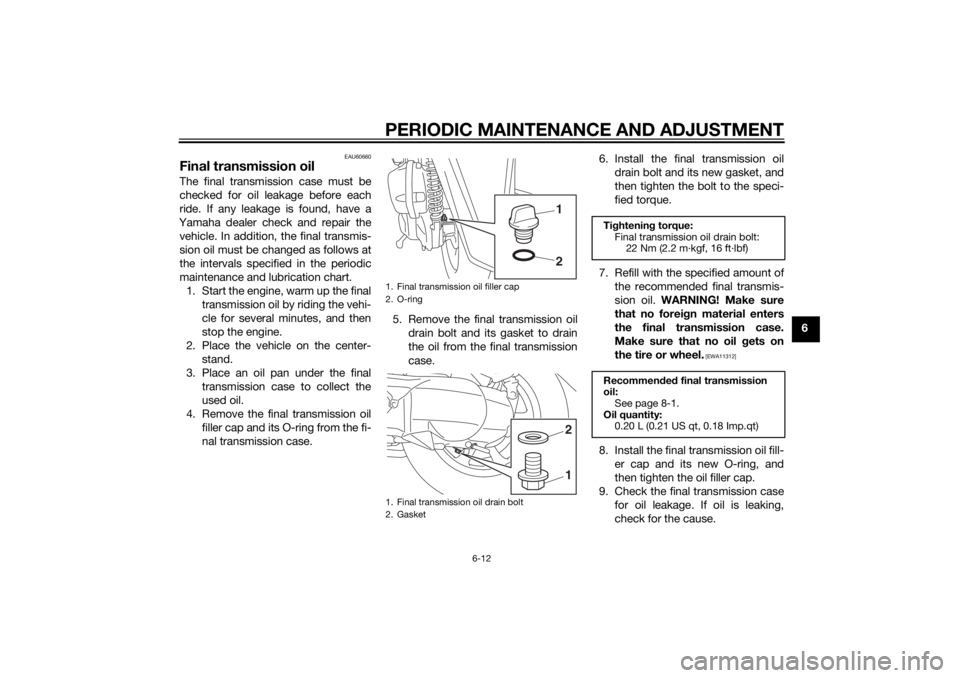
4. Remove the final transmission oil filler cap and its O-ring from the fi-
nal transmission case. 5. Remove the final transmission oil
drain bolt and its gasket to drain
the oil from the final transmission
case. 6. Install the final transmission oil
drain bolt and its new gasket, and
then tighten the bolt to the speci-
fied torque.
7. Refill with the specified amount of the recommended final transmis-
sion oil. WARNING! Make sure
that no forei gn material enters
the final transmission case.
Make sure that no oil gets on
the tire or wheel.
[EWA11312]
8. Install the final transmission oil fill- er cap and its new O-ring, and
then tighten the oil filler cap.
9. Check the final transmission case for oil leakage. If oil is leaking,
check for the cause.
1. Final transmission oil filler cap
2. O-ring
1. Final transmission oil drain bolt
2. Gasket
1
212
Tightenin g torque:
Final transmission oil drain bolt: 22 Nm (2.2 m·kgf, 16 ft·lbf)
Recommen ded final transmission
oil: See page 8-1.
Oil quantity: 0.20 L (0.21 US qt, 0.18 Imp.qt)
U2CME0E0.book Page 12 Friday, May 2, 2014 2:55 PM
Page 52 of 84

PERIODIC MAINTENANCE AND ADJUSTMENT
6-13
6
EAU20071
CoolantThe coolant level should be checked
before each ride. In addition, the cool-
ant must be changed at the intervals
specified in the periodic maintenance
and lubrication chart.
EAU40155
To check the coolant level1. Place the vehicle on the center- stand.TIPThe coolant level must be
checked on a cold engine since
the level varies with engine tem-
perature.
Make sure that the vehicle is posi-
tioned straight up when checking
the coolant level. A slight tilt to the
side can result in a false reading.2. Check the coolant level in the
coolant reservoir.TIPThe coolant should be between the
minimum and maximum level marks.
3. If the coolant is at or below theminimum level mark, remove the
coolant reservoir cap.
4. Add coolant or distilled water to raise the coolant to the maximum
level mark, install the coolant res-
ervoir cap. WARNING! Remove
only the coolant reservoir cap.
Never attempt to remove the ra-
d iator cap when the en gine is
hot.
[EWA15162]
NOTICE: If coolant is
not availab le, use distille d water
or soft tap water instea d. Do not
use har d water or salt water
since it is harmful to the en gine. If water has
been used instead
of coolant, replace it with cool-
ant as soon as possi ble, other-
wise the coolin g system will not
b e protecte d a gainst frost an d
corrosion. If water has been
a dde d to the coolant, have a
Yamaha dealer check the anti-
freeze content of the coolant as
soon as possi ble, otherwise the
effectiveness of the coolant will
b e re duce d.
[ECA10473]
EAU33032
Changin g the coolant
The coolant must be changed at the in-
tervals specified in the periodic main-
tenance and lubrication chart. Have a
Yamaha dealer change the coolant.
WARNING! Never attempt to remove the ra diator cap when the en gine is
hot.
[EWA10382]
1. Coolant reservoir cap
2. Coolant reservoir
3. Maximum level mark
4. Minimum level mark
12
34
Coolant reservoir capacity (up to
the maximum level mark): 0.33 L (0.35 US qt, 0.29 Imp.qt)
U2CME0E0.book Page 13 Friday, May 2, 2014 2:55 PM
Page 54 of 84
PERIODIC MAINTENANCE AND ADJUSTMENT
6-15
6Cleanin
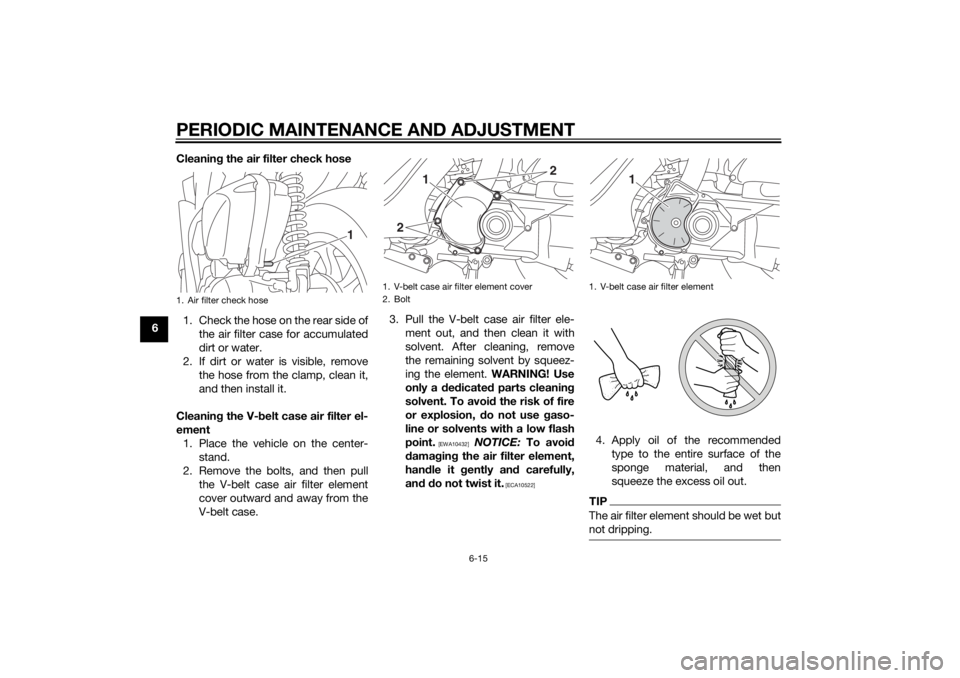
g the air filter check hose
1. Check the hose on the rear side of the air filter case for accumulated
dirt or water.
2. If dirt or water is visible, remove the hose from the clamp, clean it,
and then install it.
Cleanin g the V- belt case air filter el-
ement 1. Place the vehicle on the center- stand.
2. Remove the bolts, and then pull the V-belt case air filter element
cover outward and away from the
V-belt case. 3. Pull the V-belt case air filter ele-
ment out, and then clean it with
solvent. After cleaning, remove
the remaining solvent by squeez-
ing the element. WARNING! Use
only a ded icated parts cleanin g
solvent. To avoi d the risk of fire
or explosion, do not use gaso-
line or solvents with a low flash
point.
[EWA10432]
NOTICE: To avoi d
d amag ing the air filter element,
han dle it gently an d carefully,
an d d o not twist it.
[ECA10522]
4. Apply oil of the recommended
type to the entire surface of the
sponge material, and then
squeeze the excess oil out.TIPThe air filter element should be wet but
not dripping.
1. Air filter check hose
1
1. V-belt case air filter element cover
2. Bolt
1
2
2
1. V-belt case air filter element
1
U2CME0E0.book Page 15 Friday, May 2, 2014 2:55 PM