2014 YAMAHA SLIDER 50 battery
[x] Cancel search: batteryPage 6 of 68

TABLE OF CONTENTSSAFETY INFORMATION.................. 1-1
Further safe-riding points ............... 1-5
DESCRIPTION.................................. 2-1
Left view ......................................... 2-1
Right view ....................................... 2-2
Controls and instruments ............... 2-3
INSTRUMENT AND CONTROL
FUNCTIONS...................................... 3-1
Main switch/steering lock............... 3-1
Indicator lights and warning
lights............................................ 3-2
Speedometer unit ........................... 3-3
Handlebar switches ........................ 3-3
Front brake lever ............................ 3-4
Rear brake lever ............................. 3-4
Fuel and 2-stroke engine oil tank
caps ............................................ 3-5
Fuel ................................................. 3-5
Catalytic converter ......................... 3-6
2-stroke engine oil .......................... 3-7
Starter (choke) lever ...................... 3-7
Kickstarter ...................................... 3-8
Seat ................................................ 3-8
Anti-theft device housing ............... 3-8
Luggage hook................................. 3-9FOR YOUR SAFETY –
PRE-OPERATION CHECKS............. 4-1
OPERATION AND IMPORTANT
RIDING POINTS................................ 5-1
Starting a cold engine ..................... 5-1
Starting a warm engine ................... 5-2
Starting off ...................................... 5-2
Acceleration and deceleration ........ 5-3
Braking ............................................ 5-3
Tips for reducing fuel
consumption ................................ 5-4
Engine break-in ............................... 5-4
Parking ............................................ 5-5
PERIODIC MAINTENANCE AND
ADJUSTMENT................................... 6-1
Periodic maintenance chart for the
emission control system .............. 6-2
General maintenance and
lubrication chart ........................... 6-3
Removing and installing the
cowling and panel........................ 6-6
Checking the spark plug ................. 6-7
Final transmission oil....................... 6-8
Cleaning the air filter element ......... 6-9
Adjusting the carburetor ............... 6-10
Checking the throttle grip free
play ............................................ 6-10
Tires .............................................. 6-10
Cast wheels................................... 6-12Checking the front brake lever
free play..................................... 6-13
Adjusting the rear brake lever
free play..................................... 6-13
Checking the front brake pads
and rear brake shoes ............... 6-14
Checking the brake fluid level ...... 6-14
Changing the brake fluid .............. 6-15
Checking and lubricating the
cables ........................................ 6-16
Checking and lubricating the
throttle grip and cable ............... 6-16
Lubricating the front and rear
brake levers ............................... 6-16
Checking and lubricating the
centerstand ............................... 6-17
Checking the front fork ................. 6-18
Checking the steering................... 6-18
Checking the wheel bearings ....... 6-19
Battery .......................................... 6-19
Replacing the fuse ........................ 6-21
Replacing the headlight bulb ........ 6-21
Replacing the tail/brake light
bulb ........................................... 6-22
Replacing a turn signal light
bulb ........................................... 6-22
Troubleshooting............................ 6-23
Troubleshooting chart .................. 6-24
SCOOTER CARE AND STORAGE... 7-1
Matte color caution......................... 7-1U1S0E2E0.book Page 1 Thursday, July 25, 2013 6:53 PM
Page 15 of 68

DESCRIPTION
2-2
2
EAU10421
Right view
123
4 5 6
1. 2-stroke engine oil tank cap (page 3-5/3-7)
2. Anti-theft device housing (page 3-8)
3. Fuel tank cap (page 3-5)
4. Luggage hook (page 3-9)
5. Battery/fuse (page 6-19/6-21)
6. Centerstand (page 6-17)
U1S0E2E0.book Page 2 Thursday, July 25, 2013 6:53 PM
Page 27 of 68

FOR YOUR SAFETY – PRE-OPERATION CHECKS
4-2
4
Throttle grip• Make sure that operation is smooth.
• Check throttle grip free play.
• If necessary, have Yamaha dealer adjust throttle grip free play and lubricate ca-
ble and grip housing.6-10, 6-16
Wheels and tires• Check for damage.
• Check tire condition and tread depth.
• Check air pressure.
• Correct if necessary.6-10, 6-12
Brake levers• Make sure that operation is smooth.
• Lubricate lever pivoting points if necessary.6-16
Centerstand• Make sure that operation is smooth.
• Lubricate pivot if necessary.6-17
Chassis fasteners• Make sure that all nuts, bolts and screws are properly tightened.
• Tighten if necessary.—
Instruments, lights, signals
and switches• Check operation.
• Correct if necessary.—
Battery• Check fluid level.
• Fill with distilled water if necessary.6-19 ITEM CHECKS PAGE
U1S0E2E0.book Page 2 Thursday, July 25, 2013 6:53 PM
Page 28 of 68
OPERATION AND IMPORTANT RIDING POINTS
5-1
5
EAU15952
Read the Owner’s Manual carefully to
become familiar with all controls. If
there is a control or function you do not
understand, ask your Yamaha dealer.
WARNING
EWA10272
Failure to familiarize yourself with
the controls can lead to loss of con-
trol, which could cause an accident
or injury.
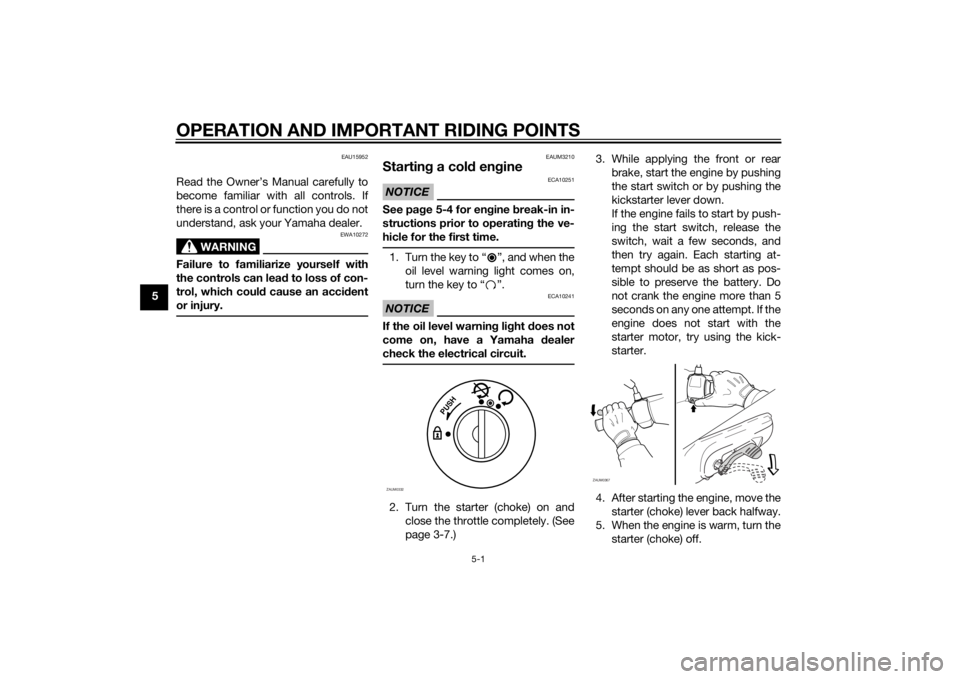
EAUM3210
Starting a cold engineNOTICE
ECA10251
See page 5-4 for engine break-in in-
structions prior to operating the ve-
hicle for the first time.1. Turn the key to “ ”, and when the
oil level warning light comes on,
turn the key to “ ”.NOTICE
ECA10241
If the oil level warning light does not
come on, have a Yamaha dealer
check the electrical circuit.2. Turn the starter (choke) on and
close the throttle completely. (See
page 3-7.)3. While applying the front or rear
brake, start the engine by pushing
the start switch or by pushing the
kickstarter lever down.
If the engine fails to start by push-
ing the start switch, release the
switch, wait a few seconds, and
then try again. Each starting at-
tempt should be as short as pos-
sible to preserve the battery. Do
not crank the engine more than 5
seconds on any one attempt. If the
engine does not start with the
starter motor, try using the kick-
starter.
4. After starting the engine, move the
starter (choke) lever back halfway.
5. When the engine is warm, turn the
starter (choke) off.
P
U
S
H
ZAUM0332
ZAUM0367
U1S0E2E0.book Page 1 Thursday, July 25, 2013 6:53 PM
Page 35 of 68

PERIODIC MAINTENANCE AND ADJUSTMENT
6-3
6
EAU1771A
General maintenance and lubrication chartNO. ITEM CHECK OR MAINTENANCE JOBODOMETER READING
ANNUAL
CHECK 1000 km
(600 mi)6000 km
(3500 mi)12000 km
(7000 mi)18000 km
(10500 mi)24000 km
(14000 mi)
1 Air filter element• Clean.√√
•Replace.√√
2*Battery• Check electrolyte level and spe-
cific gravity.
• Make sure that the breather hose
is properly routed.√√√√√
3*Front brake• Check operation, fluid level and
vehicle for fluid leakage.√√√√√√
• Replace brake pads. Whenever worn to the limit
4*Rear brake• Check operation and adjust brake
lever free play.√√√√√√
• Replace brake shoes. Whenever worn to the limit
5*Brake hose• Check for cracks or damage.
• Check for correct routing and
clamping.√√√√√
• Replace. Every 4 years
6*Brake fluid• Replace. Every 2 years
7*Wheels• Check runout and for damage.√√√√
8*Tires• Check tread depth and for dam-
age.
• Replace if necessary.
• Check air pressure.
• Correct if necessary.√√√√√
U1S0E2E0.book Page 3 Thursday, July 25, 2013 6:53 PM
Page 51 of 68

PERIODIC MAINTENANCE AND ADJUSTMENT
6-19
6
EAU23292
Checking the wheel bearingsThe front and rear wheel bearings must
be checked at the intervals specified in
the periodic maintenance and lubrica-
tion chart. If there is play in the wheel
hub or if the wheel does not turn
smoothly, have a Yamaha dealer
check the wheel bearings.
EAUM3190
BatteryA poorly maintained battery will cor-
rode and discharge quickly. The elec-
trolyte level, battery lead connections
and breather hose routing should be
checked before each ride and at the in-
tervals specified in the periodic main-
tenance and lubrication chart.
To check the electrolyte level
1. Place the scooter on a level surfa-
ce and hold it in an upright posi-
tion.
TIPMake sure that the scooter is posi-
tioned straight up when checking the
electrolyte level.2. Remove panel A. (See page 6-6.)
3. Check the electrolyte level in the
battery.TIPThe electrolyte should be between the
minimum and maximum level marks.4. If the electrolyte is at or below the
minimum level mark, add distilled
water to raise it to the maximum
level mark. NOTICE: Use only
1. Panel A
2. Fuse
3. Battery
32 1
ZAUM0162
1. Maximum level mark
2. Minimum level mark1
2
+
UPPER
LOWER
ZAUM0106
U1S0E2E0.book Page 19 Thursday, July 25, 2013 6:53 PM
Page 52 of 68
![YAMAHA SLIDER 50 2014 Owners Manual PERIODIC MAINTENANCE AND ADJUSTMENT
6-20
6distilled water, as tap water
contains minerals that are
harmful to the battery.
[ECA10612]
WARNING
EWA10761
Electrolyte is poisonous and
dangerous since](/manual-img/51/51201/w960_51201-51.png "YAMAHA SLIDER 50 2014 Owners Manual PERIODIC MAINTENANCE AND ADJUSTMENT
6-20
6distilled water, as tap water
contains minerals that are
harmful to the battery.
[ECA10612]
WARNING
EWA10761
Electrolyte is poisonous and
dangerous since")
PERIODIC MAINTENANCE AND ADJUSTMENT
6-20
6distilled water, as tap water
contains minerals that are
harmful to the battery.
[ECA10612]
WARNING
EWA10761
Electrolyte is poisonous and
dangerous since it contains sul-
furic acid, which causes severe
burns. Avoid any contact with
skin, eyes or clothing and al-
ways shield your eyes when
working near batteries. In case
of contact, administer the fol-
lowing FIRST AID.
EXTERNAL: Flush with plenty
of water.
INTERNAL: Drink large quan-
tities of water or milk and im-
mediately call a physician.
EYES: Flush with water for 15
minutes and seek prompt
medical attention.
Batteries produce explosive hy-
drogen gas. Therefore, keep
sparks, flames, cigarettes, etc.,
away from the battery and pro-
vide sufficient ventilation when
charging it in an enclosed
space.KEEP THIS AND ALL BATTER-
IES OUT OF THE REACH OF
CHILDREN.
5. Check and, if necessary, tighten
the battery lead connections and
correct the breather hose routing.
To store the battery
1. If the scooter will not be used for
more than one month, remove the
battery, fully charge it, and then
place it in a cool, dry place.
NOTICE: When removing the
battery, be sure the key is
turned to “ ”, then disconnect
the negative lead before discon-
necting the positive lead.
[ECA17711]
2. If the battery will be stored for
more than two months, check the
specific gravity of the electrolyte
at least once a month and fully
charge the battery whenever nec-
essary.
3. Fully charge the battery before
installation. NOTICE: When in-
stalling the battery, be sure the
key is turned to “ ”, then con-nect the positive lead before
connecting the negative lead.
[ECA17721]
4. After installation, make sure that
the battery leads are properly con-
nected to the battery terminals
and that the breather hose is
properly routed, in good condi-
tion, and not obstructed. NOTICE:
If the breather hose is posi-
tioned in such a way that the
frame is exposed to electrolyte
or gas expelled from the bat-
tery, the frame could suffer
structural and external damag-
es.
[ECA10602]
U1S0E2E0.book Page 20 Thursday, July 25, 2013 6:53 PM
Page 53 of 68

PERIODIC MAINTENANCE AND ADJUSTMENT
6-21
6
EAUM3200
Replacing the fuseThe fuse holder is located behind panel
A. (See page 6-6.)
If the fuse is blown, replace it as fol-
lows.
1. Turn the key to “ ” and turn off all
electrical circuits.
2. Remove the blown fuse, and then
install a new fuse of the specified
amperage. WARNING! Do not
use a fuse of a higher amperage
rating than recommended to
avoid causing extensive dam-
age to the electrical system and
possibly a fire.
[EWA15132]
3. Turn the key to “ ” and turn on
the electrical circuits to check if
the devices operate.
4. If the fuse immediately blows
again, have a Yamaha dealer
check the electrical system.
EAUM2112
Replacing the headlight bulbIf the headlight bulb burns out, replace
it as follows.NOTICE
ECA10671
It is advisable to have a Yamaha
dealer perform this job.1. Remove cowling A. (See page
6-6.)
2. Disconnect the headlight coupler.
3. Remove the headlight bulb holder
by turning it counterclockwise,
and then remove the burnt out
bulb.
4. Place a new headlight bulb into
position, and then secure it with
the bulb holder.
1. Panel A
2. Fuse
3. Battery
32 1
ZAUM0162
Specified fuse:
7.5 A
1. Headlight bulb holder
1
ZAUM0603
U1S0E2E0.book Page 21 Thursday, July 25, 2013 6:53 PM