2014 VOLVO V60 remote control
[x] Cancel search: remote controlPage 268 of 442
08 Starting and driving
08
266* Option/accessory, for more information, see Introduction.
Remote start (ERS)*
Remote start (ERS – Engine Remote Start) means that the car's engine can be startedremotely using the remote control key or thePCC key. This is so that the passenger com-partment can be warmed up/cooled downbefore departure. The climate control system and audio system start with the same settings that were in usewhen the car was parked. An ERS-started engine is activated for a maximum of 15 minutes, then it is switchedoff. After two ERS-activations the enginemust be started in the normal way beforeERS can be re-used. The optional ERS function is available on most cars with automatic gearbox.
NOTE
The service life of the remote control key's battery is affected by the ERS function. Inthe event of frequent use of ERS the bat-tery should therefore be changed once peryear, see Remote control key/PCC -replacing the battery (p. 158).
NOTE
Follow local/national rules/regulations on idling.
WARNING
To remote-start the engine, the following criteria must be met:
• The car must be supervised.
• There must be no people or animals inside the car.
• The car must not be parked in aclosed, unventilated area - the exhaustgases may seriously injure humansand animals.
Related information
•
Remote start (ERS) - operation (p. 266)
• Remote start (ERS) - symbols and mes- sages (p. 268)
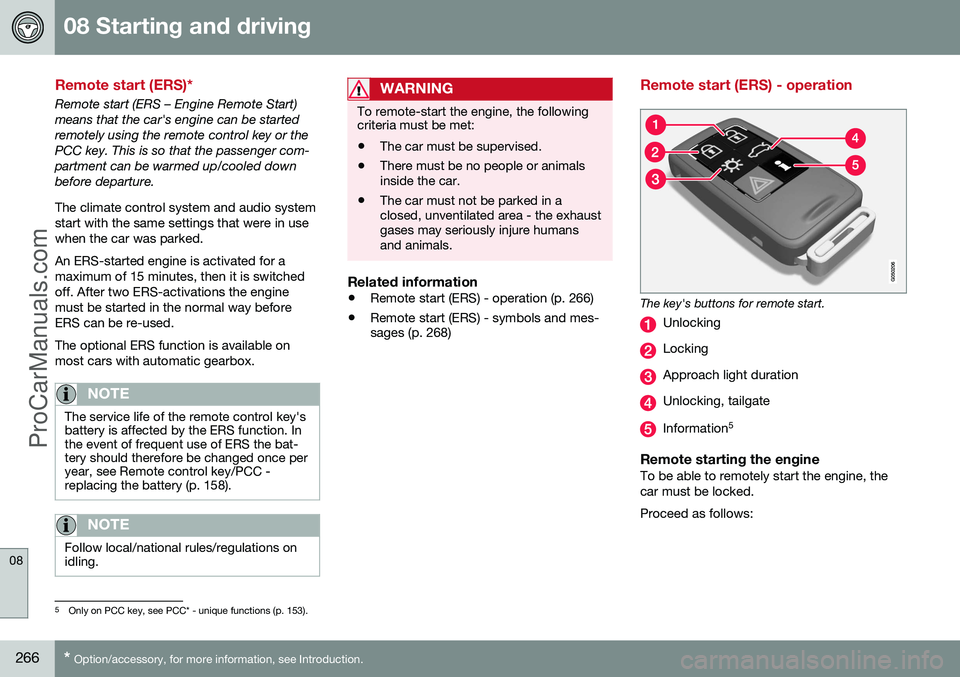
Remote start (ERS) - operation
The key's buttons for remote start.
Unlocking
Locking
Approach light duration
Unlocking, tailgate
Information 5
Remote starting the engineTo be able to remotely start the engine, the car must be locked. Proceed as follows:
5
Only on PCC key, see PCC* - unique functions (p. 153).
ProCarManuals.co’
Page 269 of 442

08 Starting and driving
08
* Option/accessory, for more information, see Introduction.267
1. Briefly press on the key's button (2).
2. Follow this immediately afterwards with a
long press - at least 2 seconds - on button (3).
If the conditions for ERS are fulfilled then the following takes place:
1. The direction indicators flash quickly sev- eral times.
2. The engine starts.
3. The direction indicators illuminate with a constant glow for 3 seconds to verify that the engine has started.
NOTE
After remote starting, the car continues to be locked but with deactivated movementdetector*.
With PCC 6
keyThe light indication for Approach lighting 7
flashes several times when
the button is pressed and then goes to constant glow if all criteria for
ERS have been fulfilled. However, this doesnot mean that ERS has started the engine. To check whether ERS has started the engine, the user can press the button (5) - ifthe engine has started, there is a light indica-tion by the buttons (2) and (3).
Active functionsThe following functions are activated with a remote started engine: • Ventilation system
• Audio/video system
• Approach light duration.
Deactivated functionsThe following functions are deactivated with a remote started engine: • Headlamps
• Position lamps
• Number plate lighting
• Windscreen wiper.
ERS is interruptedThe following steps switch off an ERS-started engine: • The remote control key's button (1), (2) or (4) is depressed
• The car is unlocked
• A door is opened
• Accelerator pedal or brake pedal isdepressed
• The gear selector is moved out of
P posi-
tion
• There is approx.10 litres left in the fueltank •
Active ERS time exceeds 15 minutes.
When an ERS-started engine is switched off, the direction indicators illuminate with a con-stant glow for 3 seconds.
Related information
• Remote start (ERS)* (p. 266)
• Remote start (ERS) - symbols and mes- sages (p. 268)
6
For more information on the PCC key, see PCC* - unique functions (p. 153).7
For more information on Approach lighting, see Remote control key - functions (p. 151) and Approach light duration (p. 89).
ProCarManuals.co’
Page 272 of 442

||
08 Starting and driving
08
270
IMPORTANT
After the fuel mixture in the tank has been changed an adaptation should be made bydriving at an even speed for about 15minutes.
If the battery has been discharged or discon- nected then a slightly longer period of drivingis required for the adaptation as the memoryfor the electronics has been cleared.
Related information
•Jump starting with battery (p. 270)
• Starting the engine (p. 264)
Jump starting with battery
If the starter battery (p. 361) is discharged then the car can be started with current fromanother battery.
When jump starting the car, the following steps are recommended to avoid short cir-cuits or other damage:
1. Insert the remote control key in key posi-
tion 0 (p. 70).
2. Check that the donor battery has a volt- age of 12 V.
3. If the donor battery is installed in another car - switch off the donor car's engine and make sure that the two cars do nottouch each other. 4. Connect one of the red jump lead's
clamps to the donor battery's positiveterminal (1).
IMPORTANT
Connect the start cable carefully to avoid short circuits with other components in theengine compartment.
5. Open the clips on the front cover of thebattery in your car and remove the cover, see Starter battery - replacement (p.363).
6. Connect the red jump lead's other clamp onto the car's positive terminal (2).
7. Connect one of the black jump lead's clamps to the donor battery's negativeterminal (3).
8. Connect the other clamp to a grounding point, e.g. right-hand engine mounting atthe top, the outer screw head (4).
9. Check that the jump lead clamps are affixed securely so that there are nosparks during the starting procedure.
10. Start the engine of the "donor car" and allow it to run a few minutes at a speedslightly higher than idleapprox. 1500 rpm.
ProCarManuals.co’
Page 280 of 442

08 Starting and driving
08
278
Gear selector inhibitor
There are two different types of gear selector inhibitor - mechanical and automatic.
Mechanical gear selector inhibitor
G021351
The gear selector can be moved forward and back freely between N and D. Other positions
are locked with a latch that is released withthe inhibitor button on the gear selector. With the inhibitor button depressed the lever can be moved forwards or backwardsbetween P, R , N and D.
Automatic gear selector inhibitorThe automatic gearbox has special safetysystems: Parking position (P) Stationary car with engine running: •
Keep your foot on the brake pedal when moving the gear selector to another posi-tion.
Electric gear inhibitor – Shiftlock
Parking position (P)
To be able to move the gear selector from P
to other gear positions, the brake pedal must be depressed and the remote control keymust be in key position II (p. 70).
Shiftlock – Neutral (N)If the gear selector is in N position and the
car has been stationary for at least 3 seconds(irrespective of whether the engine is running)then the gear selector is locked. To be able to move the gear selector from N
to other gear positions, the brake pedal must be depressed and the remote control keymust be in key position II.
Deactivate automatic gear selector inhibitor
If the car cannot be driven, e.g. due to a flat battery, the gear selector must be movedfrom the P position so that the car can be
moved.
Lift the rubber mat in the compartment behind the centre console and locate a hole 11
for the key blade (p. 155) in the
bottom of the compartment.
Search for a spring-loaded button down in the hole with the key blade; depressthe button with the blade and hold.
Move the gear selector from the P posi-
tion and pull up the key blade.
4. Set the rubber mat back in place.
11 There may be 2 holes - one for the key blade and one that fixes the rubber mat.
ProCarManuals.co’
Page 296 of 442

||
08 Starting and driving
08
294
Disengaging the parking brake
Parking brake control - release.
Cars with manual gearbox
Releasing manually
1. Insert the remote control key in the igni- tion switch. 13
2. Press the foot brake pedal down firmly.
3. Pull the control PUSH LOCK/PULL
RELEASE .
>
The parking brake releases and
the combined instrument panel's sym- bol extinguishes.
NOTE
The parking brake can also be released manually by depressing the clutch pedalinstead of the brake pedal. Volvo recom-mends that the brake pedal is used.
Releasing automatically1. Start the engine.
2. Engage 1st gear or reverse gear.
3. Ease up the clutch and depress the accelerator. >
The parking brake releases and
the combined instrument panel's sym- bol extinguishes.
Cars with automatic gearbox Releasing manually
1. Insert the remote control key in the igni-
tion switch 13
.
2. Press the foot brake pedal down firmly.
3. Pull the control. >
The parking brake releases and
the combined instrument panel's sym- bol extinguishes.
Releasing automatically1. Put the seatbelt on. 2. Start the engine.
3. Press the foot brake pedal down firmly.
4. Move the gear selector to position
D or R
and depress the accelerator. >
The parking brake releases and
the combined instrument panel's sym- bol extinguishes.
NOTE
For safety reasons, the parking brake is only released automatically if the engine isrunning and the driver is wearing a seat-belt. The parking brake is released imme-diately on cars with automatic gearboxwhen the accelerator pedal is depressedand the gear selector is in position D or R.
Heavy load uphillA heavy load, such as a trailer, can cause the car to roll backward when the parking brakeis released automatically on a steep incline.Avoid this by depressing the control whiledriving off. Release the control when theengine achieves traction.
Replacing the brake liningsThe rear brake linings must be replaced at aworkshop due to the design of the electricparking brake - an authorised Volvo work-shop is recommended.
13
For a car with the Keyless system: Press START/STOP ENGINE.
ProCarManuals.co’
Page 304 of 442

08 Starting and driving
08
302
Fuel - petrol
Petrol is used as fuel. Petrol must fulfil the EN 228 standard. Most engines can be run with octane ratings of 95and 98 RON. Only in exceptional casesshould 91 RON be used.
• 95 RON can be used for normal driving.
• 98 RON is recommended for optimum performance and minimum fuel consump-tion.
When driving in temperatures above +38 °C, fuel with the highest possible octane rating isrecommended for optimum performance andfuel economy.
IMPORTANT
• Always refuel with unleaded petrol so as not to damage the catalytic con-verter.
• Do not use additives not recom-mended by Volvo.
Related information
•
Fuel - handling (p. 301)
• Economical driving (p. 305)
• Fuel consumption and CO2 emissions (p. 403)
• Fuel tank - volume (p. 402)
Fuel - diesel
Diesel is used as fuel. Only use diesel fuel from well-known produc- ers. Never use diesel of dubious quality. Die-sel should fulfil the EN 590 or JIS K2204standards. Diesel engines are sensitive tocontaminants in the fuel, such as excessivelyhigh volumes of sulphur particles for exam-ple. At low temperatures (-6 °C to -40 °C), a par- affin precipitate may form in the diesel fuel,which may lead to ignition problems. Specialdiesel fuel designed for low temperaturesaround freezing point is available from themajor oil companies. This fuel is less viscousat low temperatures and reduces the risk ofparaffin precipitate. The risk of condensation in the fuel tank is reduced if the tank is kept well filled. Whenrefuelling, check that the area around the fuelfiller pipe is clean. Avoid spilling fuel onto thepaintwork. Wash off any spillage with deter-gent and water.
IMPORTANT
Only ever use fuel that fulfils the European diesel standard. The sulphur content must be a maximum of 50 ppm.
IMPORTANT
Diesel type fuels that must not be used:
• Special additives
• Marine diesel fuel
• Heating oil
• FAME 15
(Fatty Acid Methyl Ester) and
vegetable oil.
These fuels do not fulfil the requirements in accordance with Volvo recommendationsand generate increased wear and enginedamage that is not covered by the Volvowarranty.
Empty tankThe design of the fuel system in a diesel engine means that if the vehicle runs out offuel, the tank may need to be vented in theworkshop in order to restart the engine afterfuelling. Once the engine has stopped due to fuel starvation, the fuel system needs a fewmoments to carry out a check. Do this beforestarting the engine, once the fuel tank hasbeen filled with diesel:
1. Insert the remote control key in the igni- tion switch and push it in to the end posi-
15Diesel fuel may contain a certain amount of FAME, but further amounts must not be added.
ProCarManuals.co’
Page 315 of 442

08 Starting and driving
08
313
end up in the wrong lane or leave the car- riageway. The trailer stability assist continually monitors the car's movements, particularly lateralmovements. If snaking is detected, the frontwheels are individually braked. This serves tostabilise the car/trailer combination. This isoften enough to help the driver regain controlof the car. If snaking is not eliminated the first time the trailer stability assist comes into action, thecar/trailer combination is braked with allwheels and engine power is reduced. Oncesnaking has been gradually suppressed andthe car/trailer combination is stable onceagain, the system stops regulating and thedriver once again has full control of the car.For more information, see Stability and trac-tion control system (DSTC) - operation (p.176)
MiscellaneousThe trailer stability assist can engage withinthe speed interval 60-160 km/h.
NOTE
TSA function is switched off if the driver selects Sport mode, see Stability and
traction control system (DSTC) (p. 175).
The trailer stability assist may fail to engage if the driver uses sudden steering wheel move-ments to try to rectify the snaking because in such a situation the system cannot determinewhether it is the trailer or the driver that iscausing the snaking.
When the trailer stability assist isworking, the combined instrument
panel's DSTC symbol flashes.
Related information
•Stability and traction control system (DSTC) - symbols and messages (p. 178)
Towing
During towing, one vehicle is towed by another vehicle using a tow rope.
IMPORTANT
Note that the car must always be towed with the wheels rolling forward. Do not tow the vehicle at speeds higher than 80 km/h or for distances in excess of80 km.
Find out the statutory maximum speed limit for towing before towing begins.
1. Unlock the steering lock by inserting the
remote control key in the ignition switch and giving a long press on the START/
STOP ENGINE button - key position II is
activated, see Key positions (p. 70) formore information about key positions.
2. The remote control key must remain in the ignition switch while the car is beingtowed.
3. Keep the towline taut when the towing vehicle reduces speed by holding yourfoot gently pressed on the brake pedal -thereby avoiding unnecessary jerking.
4. Be prepared to brake to stop.
ProCarManuals.co’
Page 316 of 442

||
08 Starting and driving
08
314
WARNING
•Check that the steering lock is unlocked before towing.
• The remote control key must be in keyposition
II - in position I all airbags are
deactivated.
• Never remove the remote control keyfrom the ignition switch when the caris being towed.
WARNING
The brake servo and power steering do not work when the engine is switched off - thebrake pedal needs to be depressedabout 5 times more heavily and the steer-ing is considerably heavier than normal.
Manual gearboxPrior to towing:
–Move gear lever into neutral and release the parking brake.
Automatic gearbox GeartronicPrior to towing:
–Move the gear selector to position
N and
release the parking brake.
Automatic gearbox PowershiftThe model with Powershift transmission should not be towed as it is dependent on theengine running in order to receive sufficient lubrication. If towing still has to take place,the route must be as short as possible andthen with very low speed. In the event of uncertainty as to whether or not the car is equipped with Powershift trans-mission, this can be verified by checking thedesignation on the gearbox label under thebonnet, see Type designations (p. 386). Thedesignation ”MPS6” means that it isPowershift transmission - otherwise it isGeartronic automatic transmission.
IMPORTANT
Avoid towing.
• However, the car can be towed for a short distance at low speed to move itfrom a dangerous position - not furtherthan 10 km and not faster than10 km/h. Note that the car mustalways be towed with the wheels roll-ing forward.
• In the event of moving a longer dis-tance than 10 km, the car must betransported with the drive wheelsraised from the road - professionalrecovery is recommended.
Prior to towing:
–Move the gear selector to position
N and
release the parking brake.
Jump startingDo not tow the car to bump start the engine. Use a donor battery if the battery is dis-charged and the engine does not start, seeJump starting with battery (p. 270).
IMPORTANT
The catalytic converter may be damaged during attempts to tow-start the engine.
Related information
• Towing eye (p. 315)
ProCarManuals.co’